GitHub Copilot code review will bill repository owners by default on December 30
GitHub will move licensed members’ manual and automatic Copilot reviews to organization billing on eligible accounts with no saved choice. Admins can select Member before December 30 to keep using individual entitlements.
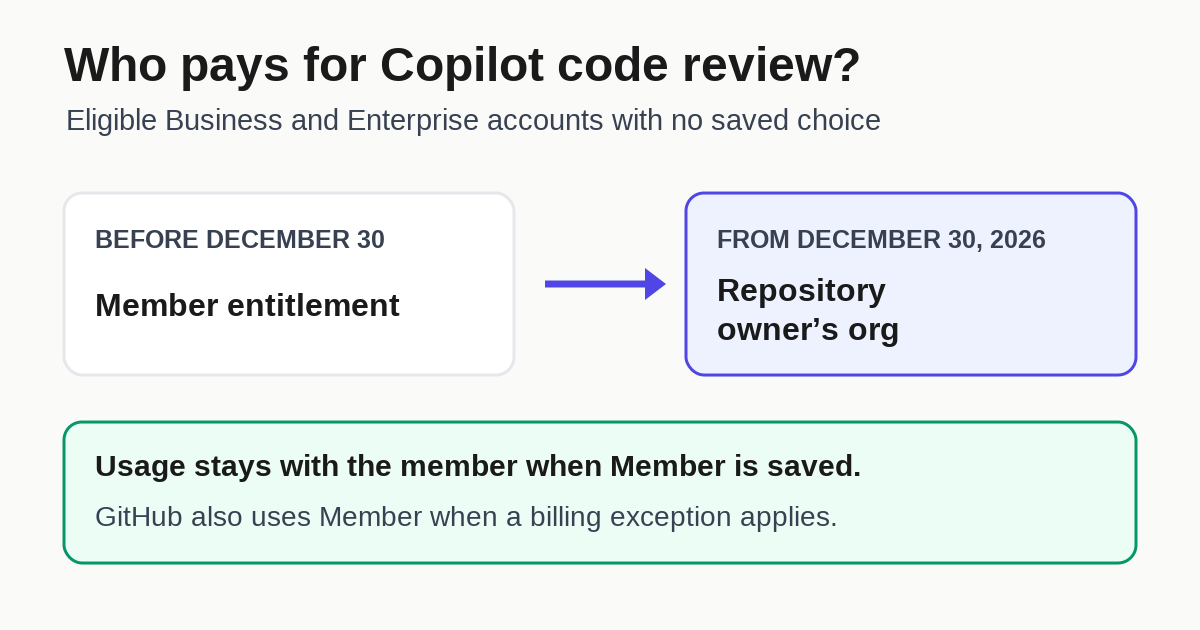
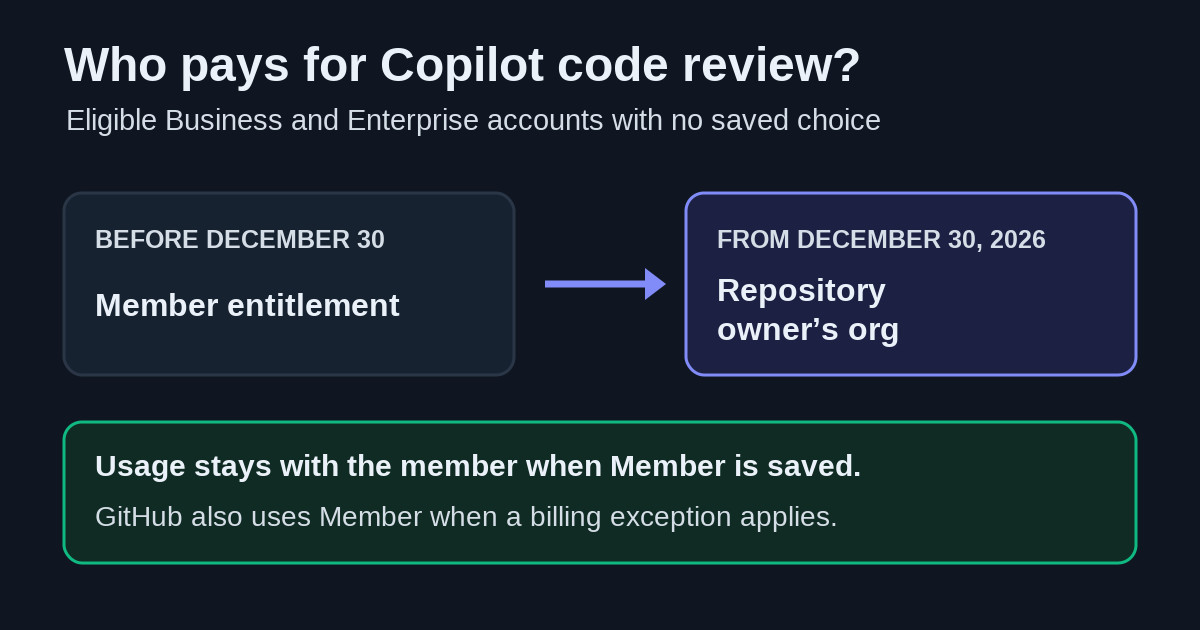
Starting December 30, 2026, GitHub will bill the organization that owns a repository for Copilot code reviews associated with members who have a paid Copilot license, if the organization or enterprise is on Copilot Business or Enterprise, has left the billing choice unset, and meets GitHub’s billing requirements. Today, the unset option uses the member’s Copilot entitlement. GitHub says administrators who want to keep that behavior should select Member before the switch. GitHub Changelog
An existing branch ruleset can keep requesting the same reviews after December 30 while the organization starts picking up their AI credit usage. The change covers both manual requests and automatic reviews. For platform teams, that makes this a budgeting decision about a workflow that may already be running across many repositories. For developers, keeping Member preserves a different constraint. GitHub’s configuration guide says a review fails if the member’s quota is exhausted. GitHub Docs on code review configuration
Which accounts will switch?
GitHub says the setting appears as Default (Member) before the transition if nobody has saved a choice. The changelog supplies the effective date and the exceptions. Use it to interpret the configuration guide’s description of Default as organization billing. GitHub Changelog · GitHub Docs on code review configuration
| Billing setting for licensed members | What GitHub says will happen on December 30 |
|---|---|
| Unset and eligible for organization billing | Reviews are billed to the organization that owns the repository. |
| Unset with AI Credits paid usage disabled, a billing lock, or no billable customer | GitHub sets the choice to Member. |
| Member or Organization already saved | The saved choice stays in effect. |
Access to code review remains governed by its own policy. GitHub also leaves the separate setting for members without a Copilot license in place. If an organization already funds reviews for unlicensed authors, its admins still need to check the licensed-member billing setting separately. GitHub Changelog · GitHub Docs for organization owners
Find the owner of the billing decision
Organization owners can look under Settings → Code, planning, and automation → Copilot → Policies for Choose how members with a Copilot license are billed. If the enterprise enforces a choice, the enterprise owner controls it. The enterprise path runs through AI controls → Copilot → Features & clients → Configure features & clients. The enterprise can also select Let organizations decide, in which case organization owners make the choice. Record who controls the setting and whether Member or Organization is already saved. GitHub’s configuration guide lists billing among the settings unavailable through the code review APIs, so the policy screen is the place to check. GitHub Docs on code review configuration · GitHub Docs for enterprise owners
Estimate exposure from reviews, including repeat runs
Start with the repositories your organization owns and the rulesets that request reviews on them. Count manual requests alongside automatic runs, and check whether rulesets cover draft pull requests or request reviews again on new pushes. A pull request can qualify through multiple automatic triggers and still get a single review when those triggers overlap. Conversely, a ruleset that reviews new pushes can produce multiple reviews over the life of one pull request. Pull request counts alone can therefore misstate expected usage in either direction. Review effort matters too. GitHub’s docs say Balanced and Max use more AI credits. GitHub Docs on code review configuration · Earlier coverage of Copilot’s Adaptive review effort
If the organization will pay, check the scope and exhaustion behavior of its AI credit budget alongside the expected review volume. GitHub documents a Stop usage when budget limit is reached option. With that option enabled, reviews that need paid usage stop when the budget is exhausted and can resume in the next billing cycle or when the budget is raised. For an enterprise-owned organization, GitHub directs owners to enterprise billing settings to scope a budget to that organization. Review also uses GitHub Actions minutes, so keep those visible as a separate cost when assessing the workflow. GitHub Docs for organization owners
For teams keeping member entitlements, the deadline is for saving Member. For teams accepting organization billing, the handoff is to the budget owner for the repositories where those reviews run. Let maintainers know which limit could interrupt their reviews so they know where to look if an expected review stops appearing. GitHub Changelog · GitHub Docs for organization owners