
OpenAI Desktop Fix Advances: Updated App Out for Linux and macOS After ChatGPT Work Thread Failures, Windows Rollout Pending
OpenAI's 09:28 UTC update on October 7, 2026 released an updated ChatGPT desktop app for Linux and macOS after build 26.1002.51308 blocked new ChatGPT Work threads. The Windows fix was still rolling out, with Codex in ChatGPT Desktop in partial outage.
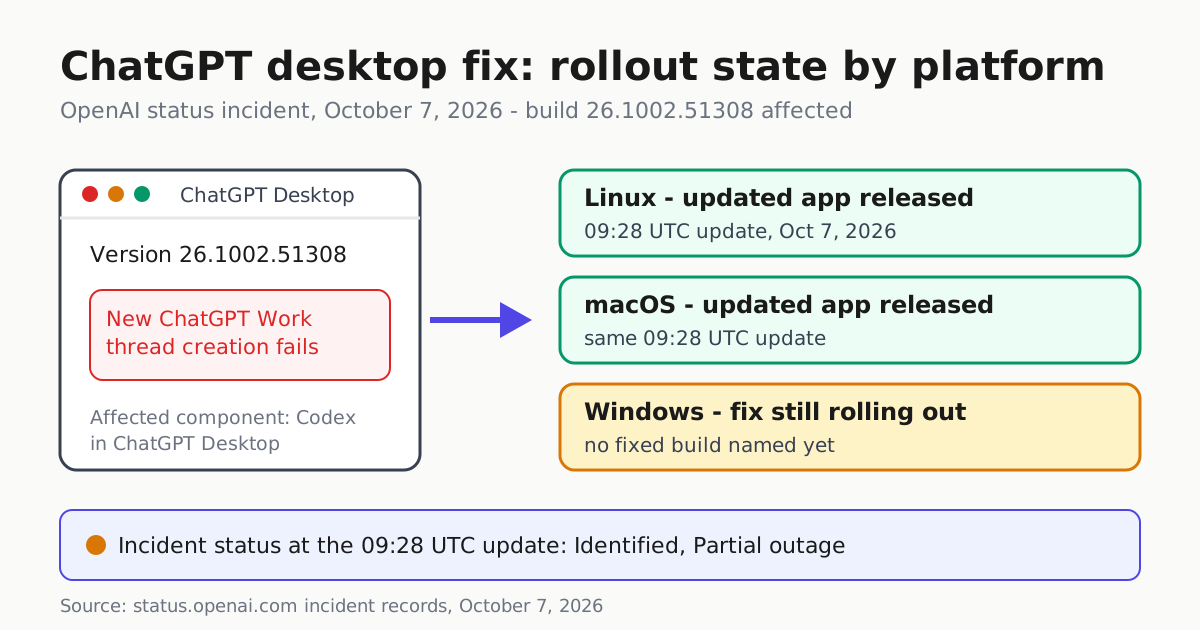
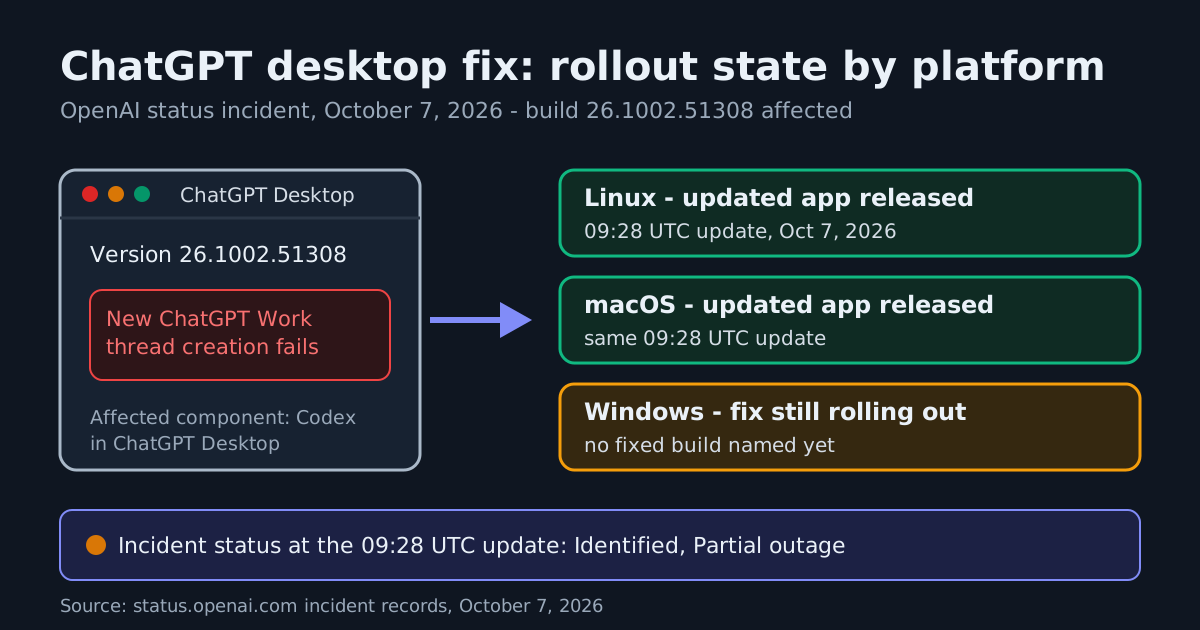
OpenAI moved from rollback to a shipped desktop fix on October 7, 2026. Its 09:28 UTC update on the incident record says the issue is identified, an updated app version has been released for Linux and macOS, and the Windows fix is actively rolling out. The incident, “Unable to create new ChatGPT Work threads in latest version of desktop app,” remained Identified, Partial outage at that update, with Codex in ChatGPT Desktop as its one affected component.
Three publisher updates trace the response. An investigating note displayed at 02:00 UTC named the affected build, version 26.1002.51308. At 05:54 UTC OpenAI said it had identified the issue and was “working on rolling back to the previous version.” The 09:28 UTC update replaced rollback with a released fix on two platforms. OpenAI named no replacement build, published no root cause and gave no timetable for Windows. Displayed update times mark publisher messages, not necessarily when impact began; the page’s component bar runs from 05:31 UTC to “Now.”
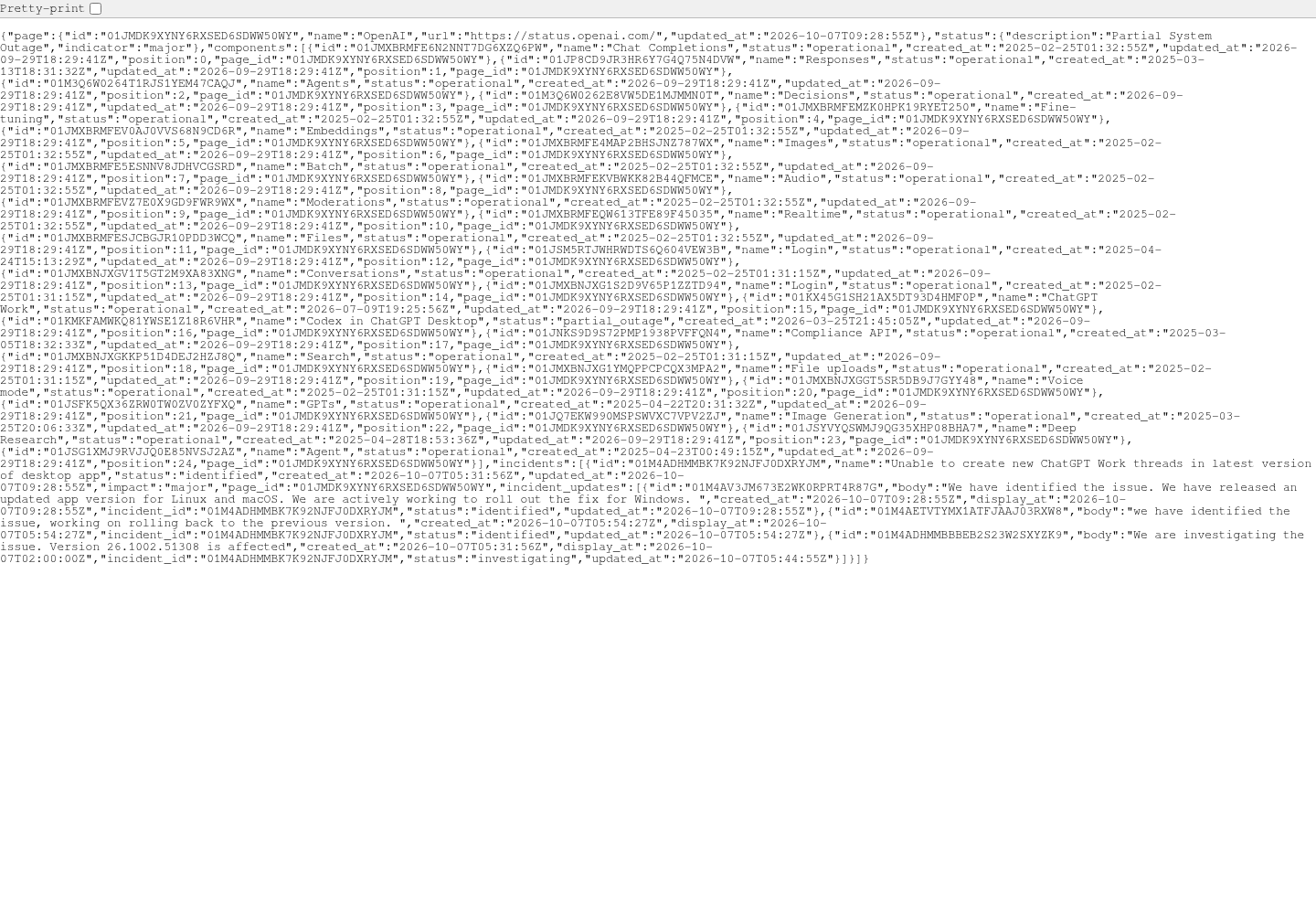
OpenAI’s status summary feed, last updated at 2026-10-07T09:28:55Z, described a Partial System Outage with indicator major, listing Codex in ChatGPT Desktop in partial_outage and every other listed component operational. The feed also carries the incident’s three updates verbatim. The status site’s incident pages render their content with client-side JavaScript, so this article’s figures rely on that machine-readable feed and the linked incident record.
What to do on each platform
- Linux and macOS: take the updated app through your normal client update path, then confirm new ChatGPT Work thread creation on one machine before widening the rollout. OpenAI named the broken build but no fixed build number, so verify by behavior, not version string.
- Windows: the 09:28 UTC update still had the fix rolling out. Check the live record and your installed build before reinstalling or escalating; a machine on 26.1002.51308 may just be waiting for the update.
- Fleets: keep this client defect separate from the four resolved service incidents below. They list different affected components, and nothing published this week ties them to one cause.
Five incident windows in three days
| Incident | Affected components as listed | Publisher updates (UTC) | State at last update |
|---|---|---|---|
| Elevated Work Mode errors | ChatGPT Work, Codex in ChatGPT Desktop | Oct 5 07:03 to Oct 6 02:10 | Resolved |
| Errors processing large PDFs in the Responses API | Responses | Oct 6 15:23 to 17:50 | Resolved |
| Computer Use Is Experiencing Issues | Agents | Oct 6 17:15 to 20:00 | Resolved |
| Workspace Agents Degraded and Responses Impacted | Agent | Oct 6 22:52 to Oct 7 03:00 | Resolved |
| New ChatGPT Work threads blocked in the desktop app | Codex in ChatGPT Desktop | Oct 7 02:00 to 09:28 | Identified, partial outage |
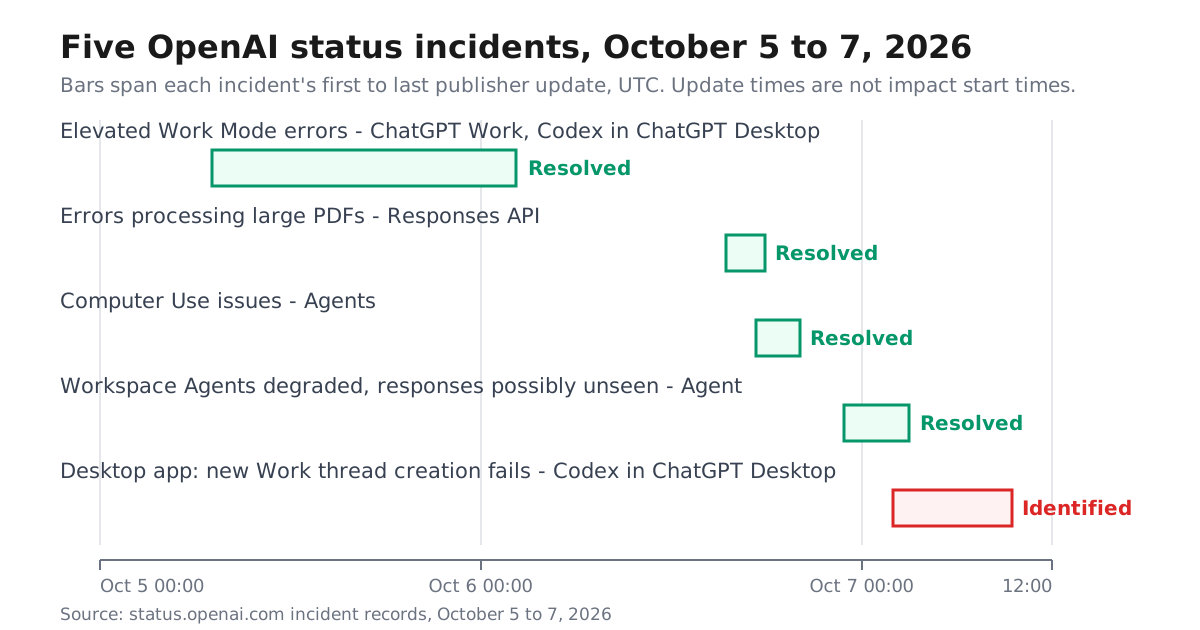
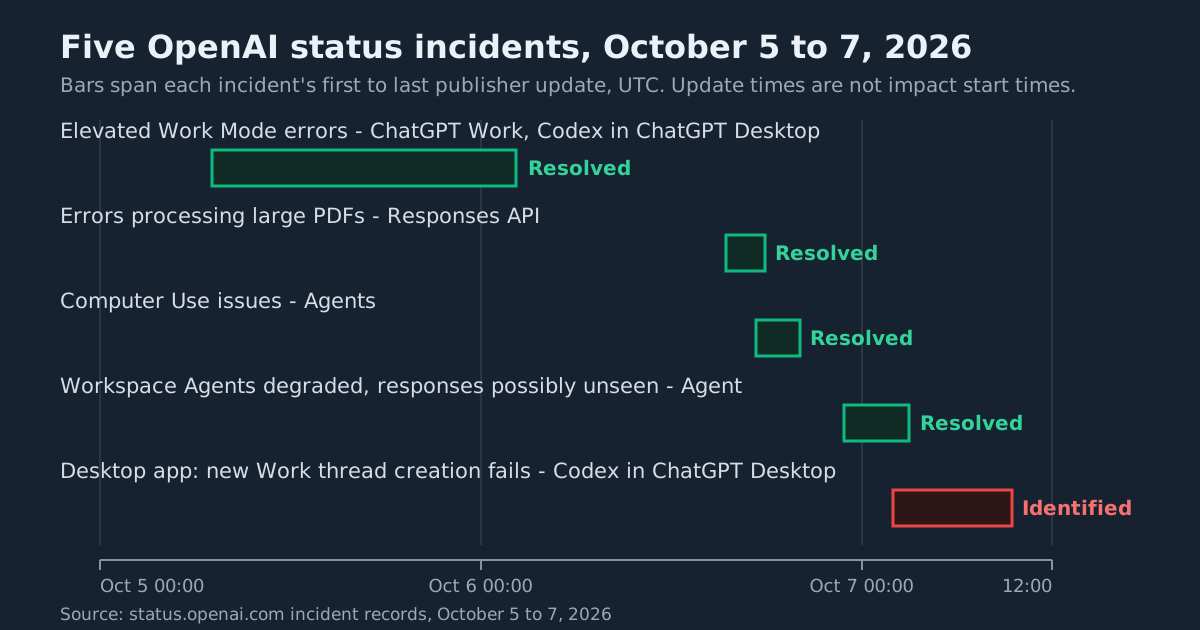
Every timestamp above is a publisher update time, not a measured impact window, and the pages show the gap: the PDF component bar starts at 05:00 UTC on October 6, ten hours before its first investigating note, and the Work Mode component bar ends at 08:29 UTC on October 6, hours after its 02:10 UTC resolved marker. OpenAI also cautions that availability metrics aggregate tiers, models and error types, so your own error rates can diverge from the headline.
Where outputs deserve a second look
The Workspace Agents incident is the one that can hide finished work. Its first note, at 22:52 UTC on October 6, warned that “users may not see the responses during the issue time”; the 01:52 UTC update said the mitigation was being implemented, the 02:45 UTC update reported it applied with recovery being monitored, and full recovery was posted at 03:00 UTC on October 7. If an agent reply is missing from that window, confirm what actually completed in your system of record before rerunning. A blind rerun of work that already finished duplicates execution and cost.
The three remaining windows each name their affected components on the page, and no page publishes measurements that would rank their impact. The Computer Use incident said OpenAI was “investigating issues for agents api and computer use” in a note posted at 17:15 UTC, with recovery posted at 20:00 UTC on October 6; it names no failure mode and no start time, so the check is which computer-use and Agents API calls errored in your own logs. The Responses API PDF incident posted investigating at 15:23 UTC and full recovery at 17:50 UTC on October 6 without saying when errors began or ended, so replay document jobs that recorded failures rather than re-uploading blind. The Work Mode incident flagged that “Scheduled tasks may also be impacted,” putting unattended runs in scope, not just interactive sessions.
September’s wider outage is context, not this event
The September 29 incident listed 12 API components, 14 ChatGPT components and all four Codex components, including the Agents API, CLI and VS Code extension. Its published write-up blames a feature rollout that made routine settings requests trigger repeated background checks, exhausting shared network connection capacity; most customer-facing impact was mitigated in about 30 minutes. Nothing in the October records ties this week’s incidents to that cause.
A short operator playbook
- Stage desktop client updates like CLI upgrades: our canary upgrade guide catches behavior drift on unpinned lanes, and the Codex deep dive maps where the desktop client sits among Codex surfaces.
- Treat invisible responses and impacted scheduled tasks as delivery risk: verify completion in the system of record before rerunning anything from the October 5 to 7 windows.
- Keep a rehearsed fallback per lane, not per vendor: the provider cutoff drill and Agents API continuity guide cover the pattern, and the GitHub Actions October 5 outage shows the same check upstream.
The current record supports one named broken build, a released fix for Linux and macOS, a Windows rollout in progress, four resolved windows on distinct surfaces and no published October root cause. Any of those states can change with the next update; read the live record before acting on it.
Sources
- Unable to create new ChatGPT Work threads in latest version of desktop app - OpenAI Status
- Workspace Agents Degraded and Responses Impacted - OpenAI Status
- Computer Use Is Experiencing Issues - OpenAI Status
- Errors processing large PDFs in the Responses API - OpenAI Status
- Elevated errors across ChatGPT, Codex, and the API including the Agents API - OpenAI Status
- Elevated Work Mode errors - OpenAI Status
- OpenAI Desktop Fix Advances: Updated App Out for Linux and macOS After ChatGPT Work Thread Failures, Windows Rollout Pending
- Elevated errors across ChatGPT, Codex, and the API including the Agents API - OpenAI Status