
NVIDIA Brings Frontier AI Agents to Omniverse for Autonomous Robotics Simulation
NVIDIA integrates GPT-6 Astra and other frontier AI agents with its Omniverse and Isaac Sim platforms, allowing engineers to automate physical AI and robotics simulations. Coupled with the Halos safety architecture, the toolchain accelerates real-world deployment.
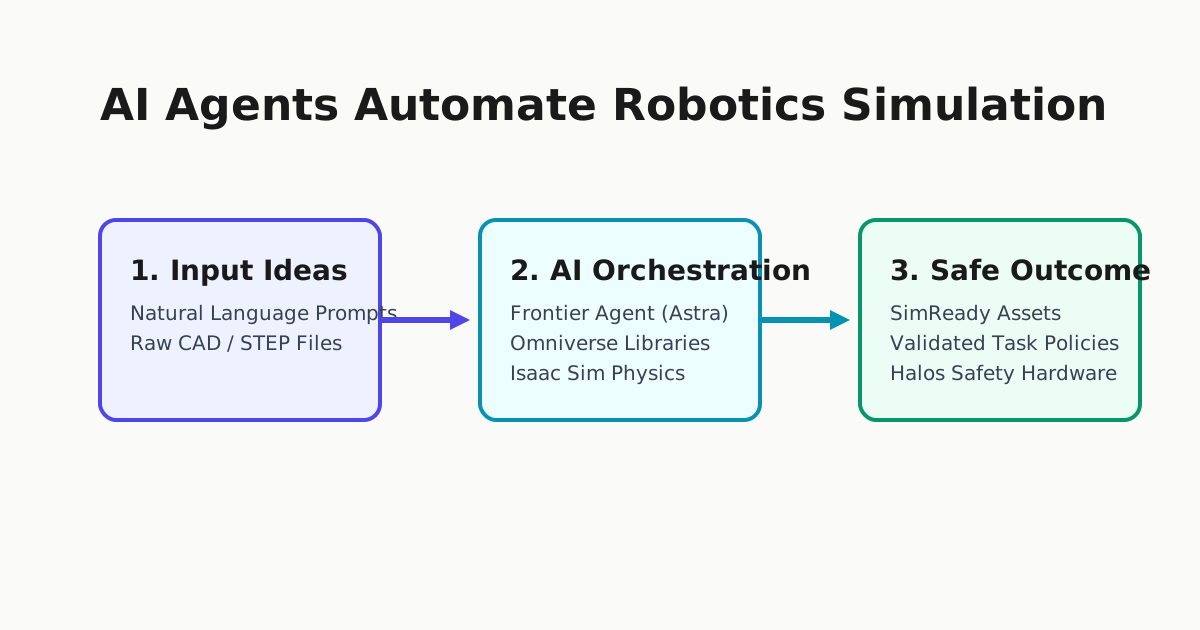
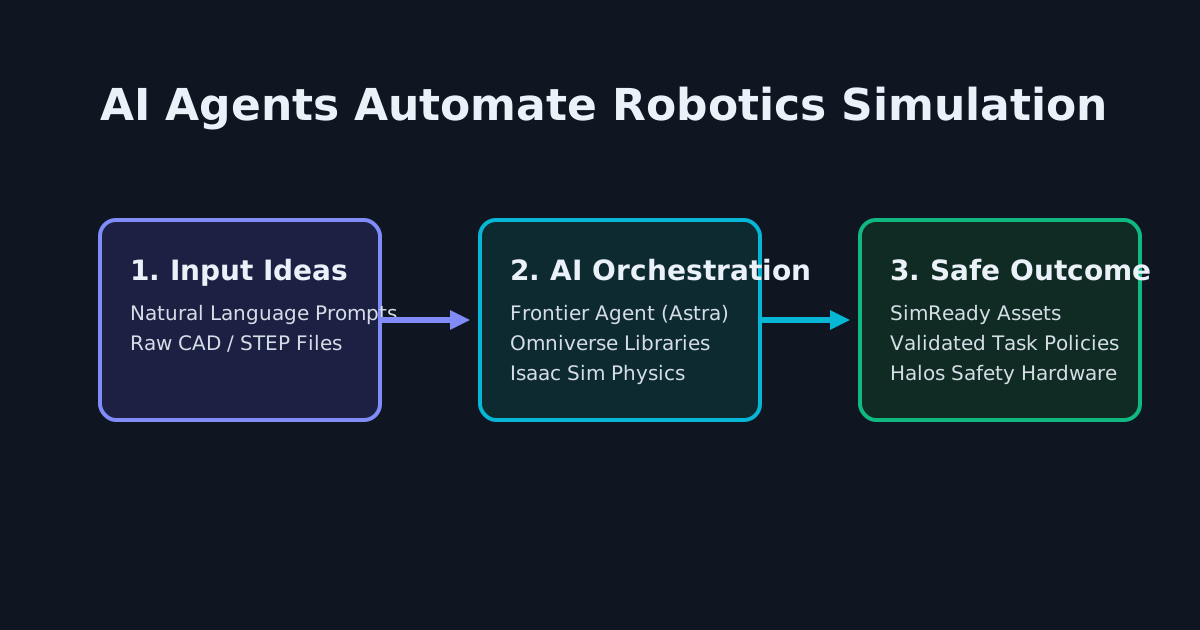
The development of physical AI and robotics has long been constrained by the manual effort required to translate computer-aided design (CAD) geometry into rigorous, physics-based simulation environments. Engineers must painstakingly configure joints, collision boundaries, and material properties before a robot can even attempt its first virtual task. But that workflow is undergoing a massive shift. NVIDIA is integrating frontier AI agents, powered by models like GPT-6 Astra, directly into its Omniverse ecosystem. This allows developers to use natural language to direct AI agents to assemble, configure, and validate complete simulation environments.
By combining generative agentic workflows with GPU-accelerated Omniverse libraries and its new Halos safety architecture, NVIDIA is accelerating the path from digital twins to real-world deployment for autonomous vehicles, mobile warehouse robots, and general-purpose humanoids. This approach fundamentally changes how engineers approach agentic workflows, turning natural language prompts into executable simulation applications.
Agent-Driven Simulation Development
According to recent updates from NVIDIA, developers are successfully turning raw ideas into working simulations by collaborating with AI agents. Rather than writing thousands of lines of boilerplate code to initialize scenes and configure sensors, engineers can now instruct agents to orchestrate NVIDIA Omniverse libraries on their behalf.
For example, Frank DeLise, an Omniverse product manager, used GPT-6 Astra to build an interactive warehouse simulator for a humanoid robot. By directing the AI to connect Omniverse physics (ovphysx), rendering (ovrtx), and scene updates (ovstage), Astra was able to generate the necessary application code and bring a SimReady warehouse environment to life.
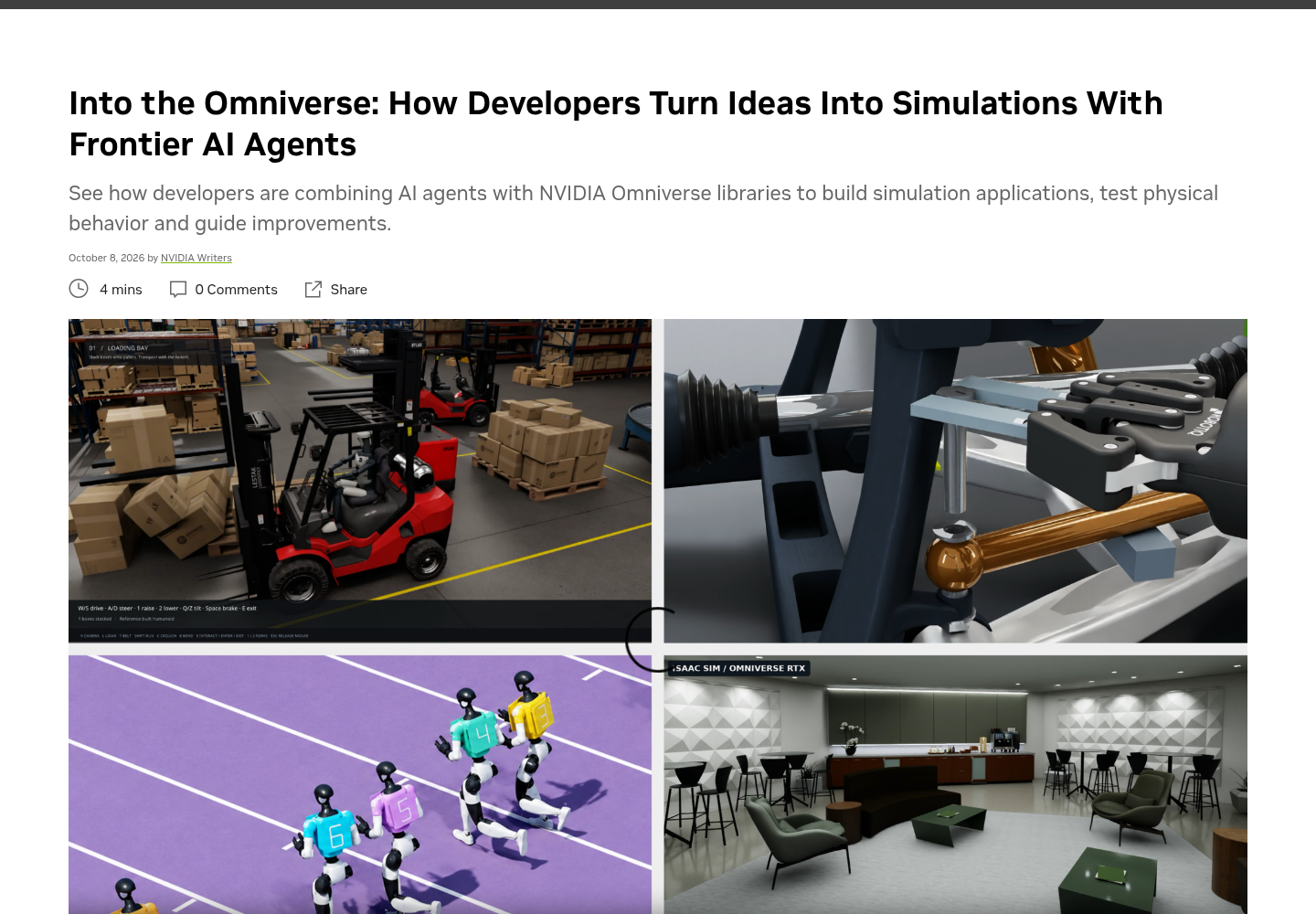
Another project, led by Doyub Kim, demonstrated how Astra could build “Zero to Alpamayo,” a reusable autonomous driving test environment based on San Francisco’s Market Street. The AI agent mapped out the workflow, handled asset creation, and connected Omniverse RTX sensor simulations with driving models. A separate Cosmos3-Nano experiment then varied weather and lighting in recorded simulation videos, allowing Kim to compare the driving model’s responses to the same scenario under different conditions. As detailed in the NVIDIA Blog, these capabilities offer a new way for teams to measure discrepancies between simulated camera outputs and raw recorded data.
Automating the 5-Step SimReady Pipeline
One of the most complex challenges in physical AI is ensuring that 3D assets are not just visually accurate, but physically sound. An imported robotic gripper might look flawless, but without properly defined collision geometry or friction coefficients, simulated objects will simply fall through its fingers.
To address this, NVIDIA formalized a five-step workflow for preparing SimReady assets using frontier AI models. As documented in a technical deep dive by the NVIDIA Technical Blog, the process leverages Omniverse AI Agent skills (such as the CAD-to-SimReady skill) and Isaac Sim to automate asset preparation:
- Geometry Import: The agent starts by taking raw STEP files (such as an ABB YuMi robot) and converting them into the OpenUSD format.
- Visual Matching: Using reference images and videos, the AI adjusts materials, metallic responses, and roughness to align the simulated model’s appearance with reality.
- Physics Configuration: This is where the agentic approach truly shines. The AI agent can pull manufacturer datasheets or public URDF files to determine joint axes, motion limits, and zero configurations. It estimates mass distribution based on geometry and sets contact properties (e.g., static friction of 0.8 and dynamic friction of 0.6).
- SimReady Validation: The asset undergoes a rigorous automated check against the SimReady Foundation schema, verifying rigid bodies, drives, articulation, and runtime behavior to ensure it won’t break the simulation engine.
- Task Validation: Finally, the asset is tested in NVIDIA Isaac Sim. In the ABB YuMi demonstration, the agent successfully programmed the robot to execute a pick-and-place task, gripping and moving colored cubes and an image-derived Sharpie marker without relying on artificial kinematic attachments.
By offloading the heavy lifting of physics rigging to frontier models like GPT-6 Astra, engineers can focus on tuning the actual robot policies rather than debugging mesh collisions. For organizations exploring how to scale this kind of automation, it represents a profound leap in agentic coding applied to mechanical engineering.
Bridging the Gap: Safety in the Physical World
Simulating a robot’s behavior is only half the battle. When humanoid robots or autonomous mobile robots (AMRs) step out of the virtual world and into a physical warehouse or factory floor, safety becomes the primary bottleneck. As AI models become more capable, they require equally robust safety architectures to prevent harm to humans operating nearby.
This is where NVIDIA’s Halos system comes in. Originally launched for autonomous vehicles in 2025, the company has expanded the platform to encompass general robotics. As reported by Ars Technica, NVIDIA’s head of robotics ecosystem Amit Goel noted that Halos for Robotics is designed to provide full-stack functional safety.
The Halos system runs on specialized hardware, like the NVIDIA IGX Thor compute module, which features an independent processor dedicated exclusively to safety-critical workloads. By separating the primary functional AI systems from the safety monitoring systems on the same silicon, robots can swiftly detect hardware failures or corrupted sensor data.
Agility Robotics recently became the first partner to integrate Halos into its Digit 5 humanoid robot. By bringing safety systems onboard, the robot is no longer tethered to external sensors placed around a fixed work cell. It can navigate dynamically across factory floors. Boston Dynamics is also participating in the Halos accreditation program for its Spot, Stretch, and Atlas robots.
A Unified Vision for Generalist Machines
The combination of agent-driven Omniverse simulation and edge-deployed safety architectures highlights NVIDIA’s massive bet on physical AI—a sector CEO Jensen Huang estimates is already driving billions in annual revenue. By standardizing the pipeline from CAD import to simulated validation to safe physical deployment, NVIDIA is laying the groundwork for generalist robots capable of mastering multiple tasks in unstructured environments.
For developers, the message is clear: the days of manually tweaking collision meshes and joint parameters are numbered. Frontier AI agents are ready to take over the virtual factory, freeing engineers to build the physical future.