NVIDIA's DGX Spark HPC Developer Kit Puts a Four-Node Supercomputing Lab on a Research Desk
NVIDIA's SC26 DGX Spark HPC Developer Kit packages four GB10 Grace Blackwell nodes in a direct ring, with an HPC SDK playbook coming soon, aiming to move multi-node scientific debugging and agent-assisted workflows from shared-cluster queues to the desk.
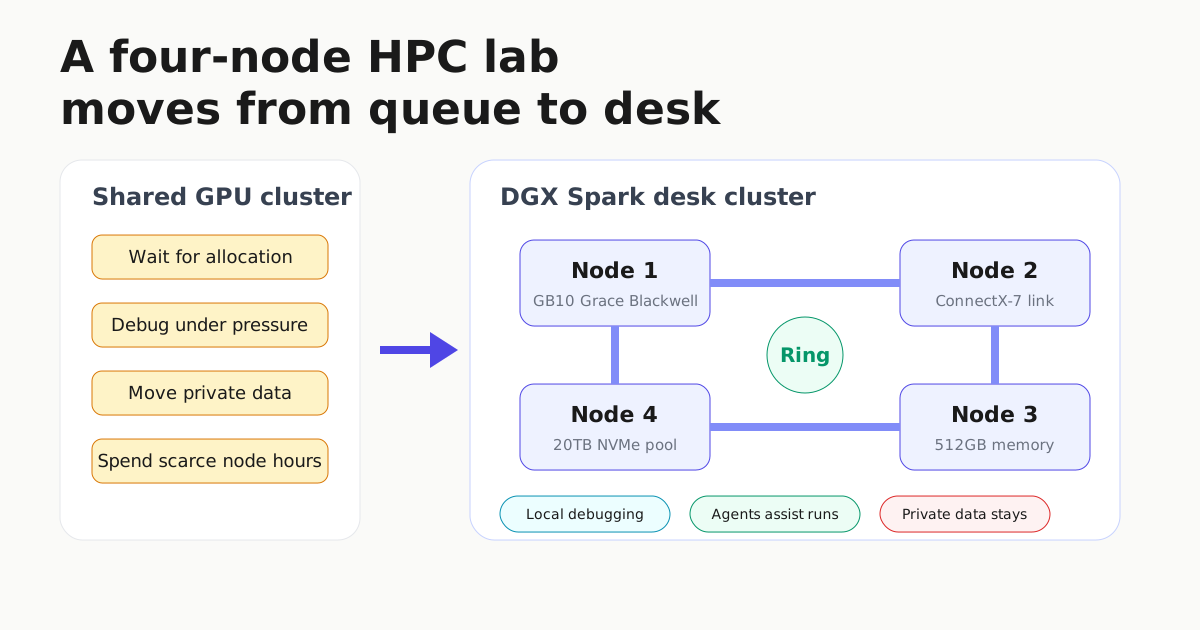
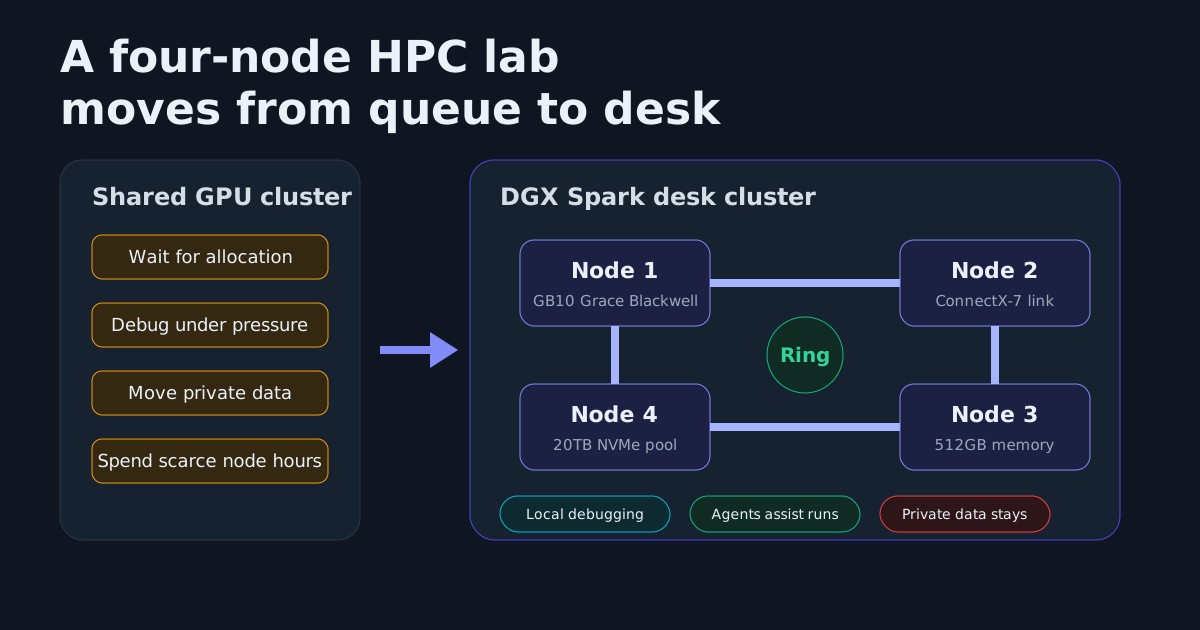
NVIDIA used SC26 in Chicago to introduce a DGX Spark HPC Developer Kit that turns four DGX Spark systems into a desk-side cluster for researchers, academics and developers. The important shift is not another box with a GPU; it is a packaging decision that puts a multi-node development and debugging environment within reach of labs that normally ration scarce shared-GPU time.
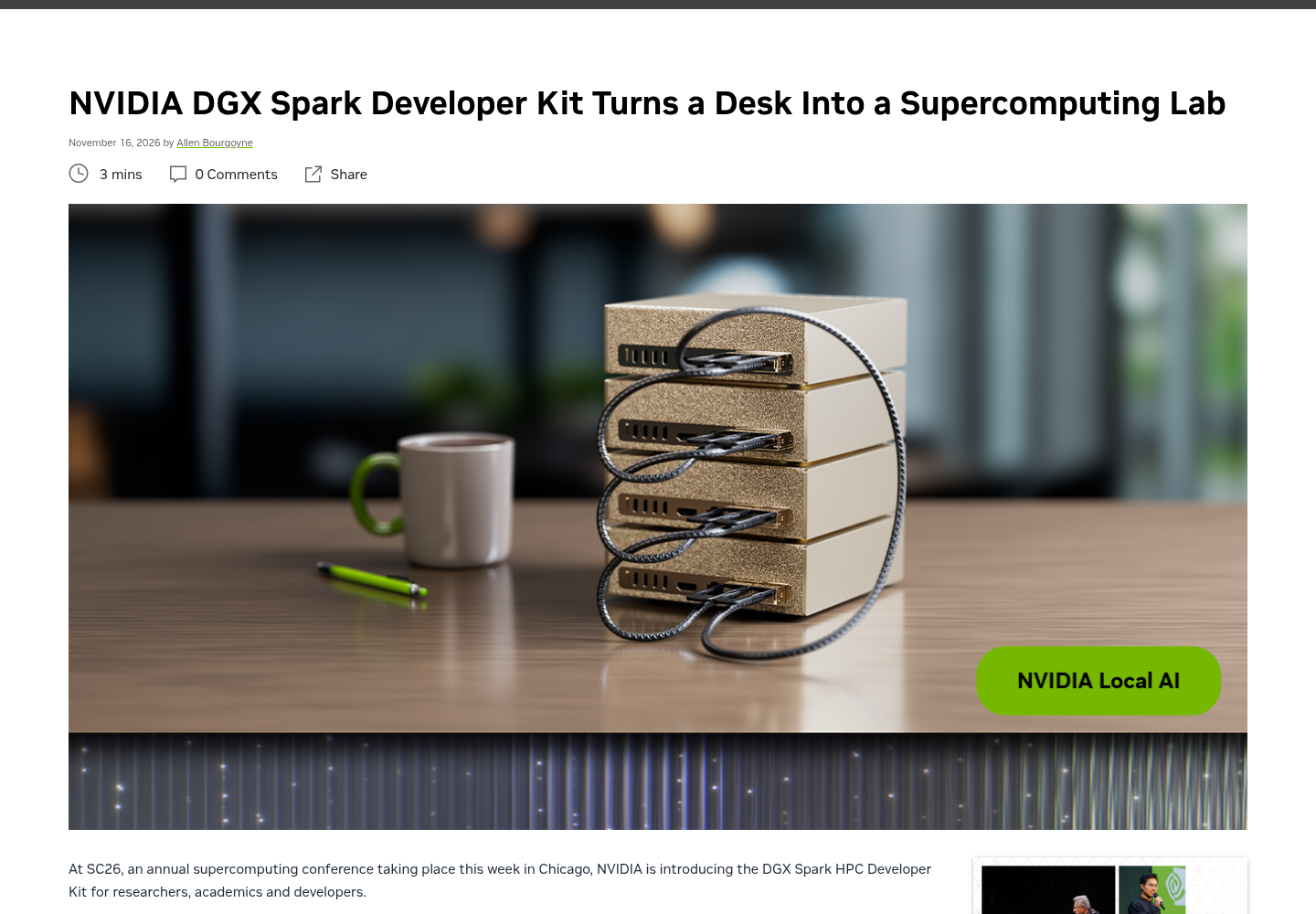
NVIDIA’s own SC26 announcement describes the four-node DGX Spark cluster, desk-side scientific workloads and the coming HPC SDK playbook.
The configuration is deliberately simple: one to four DGX Spark nodes, each linked directly to its neighbors over ConnectX-7 networking, with no separate switch to buy or configure. At four nodes, NVIDIA says the ring provides 512GB of combined memory and 20TB of NVMe storage. With NVFP4, the company says researchers can deploy models up to 700B parameters locally across the four-node cluster, naming DeepSeek V4.1 as an example. NVIDIA also says the kit is on display at SC26 and available for sale through OEM partners and NVIDIA Marketplace, while the companion NVIDIA HPC SDK installation playbook is only coming soon. That distinction matters: the hardware path is presented as available now, but the standardized multi-node HPC SDK setup NVIDIA is promising is not yet the thing researchers can simply follow end to end.
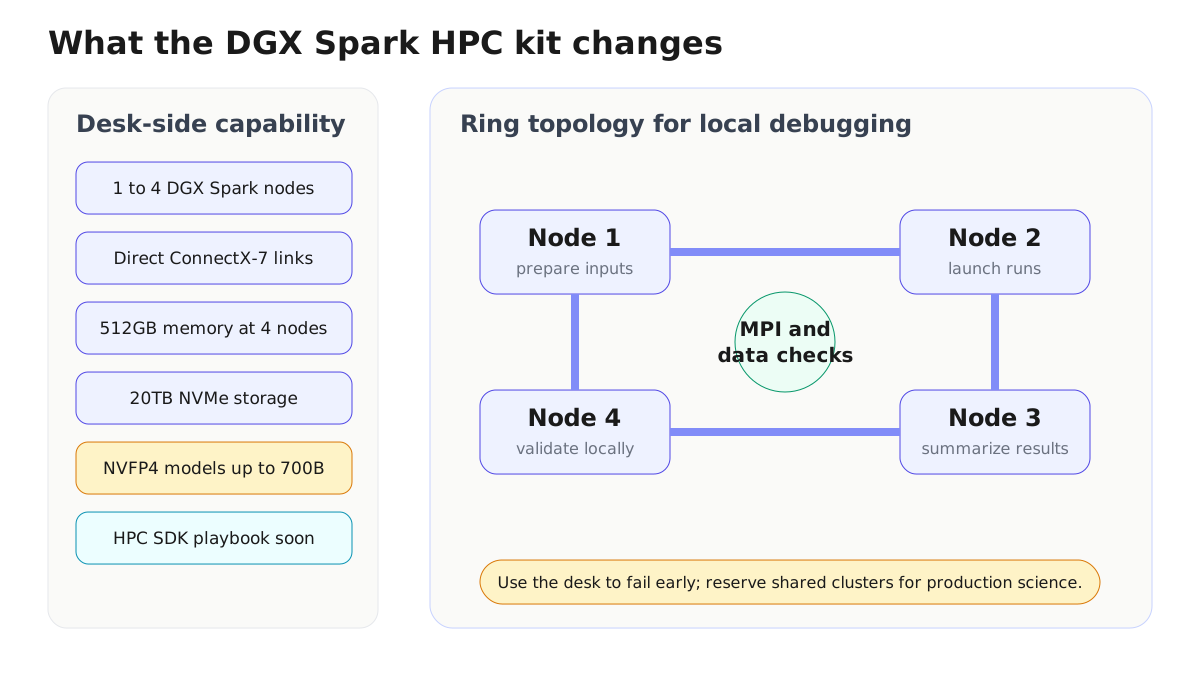
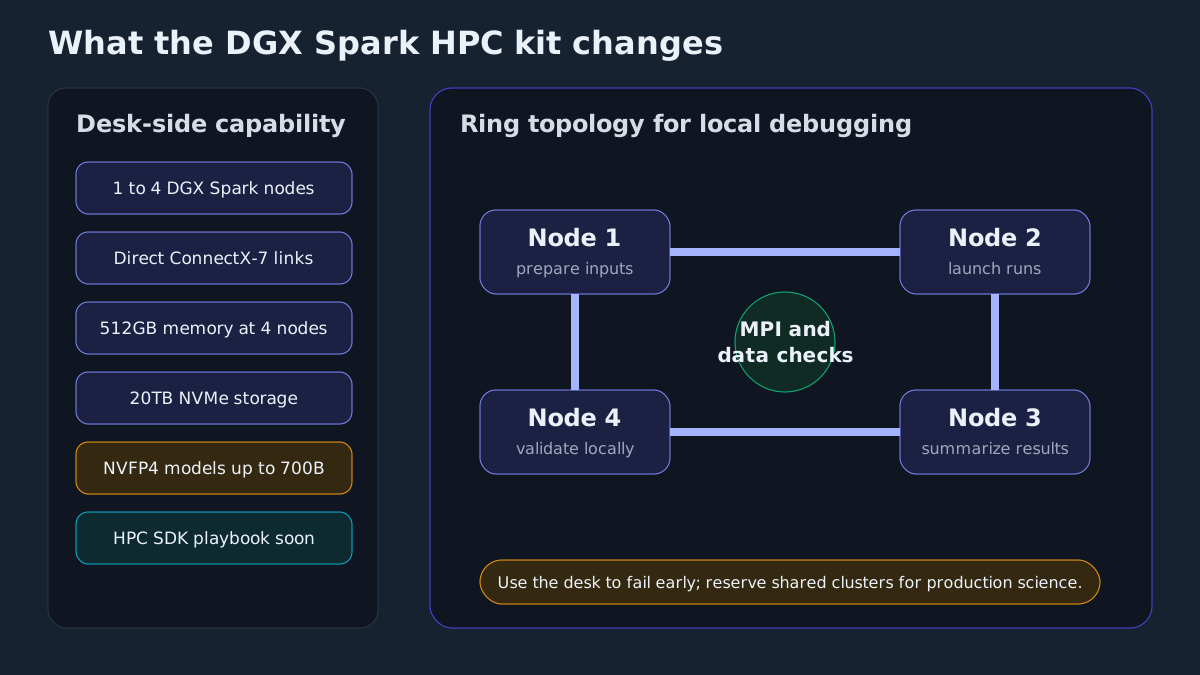
A four-node DGX Spark ring links neighbors directly over ConnectX-7; the practical change is local debugging before scarce production HPC time is spent.
The research consequence is queue bypass with guardrails. A lab with a fixed compute allocation can iterate on its own desk, keep unpublished results and proprietary datasets on premises, and reserve shared cluster hours for larger production runs. NVIDIA positions the kit as a place to check how computation and data are distributed, debug communication issues, and test FP32 or mixed-precision algorithms before scaling to data-center systems. That is the same workflow pattern operators know from canary lanes and local coding agents: move the failure earlier, where it is cheaper.
The software evidence is broader than one kit. In the same SC26 wave, NVIDIA says expanded CUDA-X libraries give agents and researchers tools for black-hole correlation, fusion steering, molecular interaction, materials calculations and spatial biology. The post reports vendor-side speedups that should be treated as claims to reproduce, not neutral benchmarks: Event Horizon Telescope correlation dropping from over a month to eight minutes with cuPhoton.xBeam, cuPotential accelerating existing simulation software by up to 3x, cuSpa claiming a 900x CPU comparison for cell-polygon spatial graphs, and GPU-accelerated HMMER benchmark searches up to 84x faster at Basecamp Research. The throughline is that agents are being given scientific instruments: prepare inputs, launch runs, extract insights while simulations run, summarize results, and leave validation to the scientist.
NVIDIA’s named workloads make the desk-cluster story concrete. The kit announcement cites demonstrated four-system runs including LAMMPS with Kokkos for materials simulation and NAMD for molecular dynamics, plus broader community validation for GROMACS, OpenFOAM, weather modeling with WRF, and NIM microservices such as OpenFold3 and Boltz2. It also lists early users: Kvantify reporting 70-qubit, 975-gate tensor-network quantum-chemistry simulations on a single DGX Spark; CYRAN AI using PixelFlux for JPEG 2000 satellite-image decoding; OpenFold fine-tuning OpenFold3; Berkeley’s Rubin Lab reporting results 15x sooner by avoiding an 11-hour cluster queue; and the Hartwig Group fitting a 120B-class Nemotron 3 Super model with NVFP4 for back-to-back local training fits.
| SC26 item | Status in the primary evidence | Practical consequence |
|---|---|---|
| Four-node DGX Spark ring | Described as on display and available for sale | Gives a lab a local multi-node target for development and debugging |
| ConnectX-7 direct-neighbor links, no switch | Hardware architecture claim | Lowers cluster setup friction, but still requires real MPI and data-distribution testing |
| HPC SDK playbook | Explicitly coming soon | The standardized path for GPU-accelerated C, C++ and Fortran tools is promised, not yet complete |
| CUDA-X scientific libraries | Expanded with agent-facing examples | Gives researchers agent workflows and GPU libraries, while reported speedups need independent validation |
There is also an industry backdrop. NVIDIA’s supply-chain Q&A describes long manufacturing relationships with TSMC, Foxconn, Wistron, Coherent, Lumentum, Amphenol and others, weekly allocation of critical components, chip-to-invoice traceability, and the operational muscle needed to move from chip supply to full systems. That does not prove the DGX Spark kit will be easy to buy at every lab’s preferred price, but it explains why NVIDIA can treat a desk supercomputing cluster as a product category rather than a one-off conference demo.
For researchers, the tradeoff is clear. A four-node desk ring is not a replacement for petascale HPC; NVIDIA’s own examples still point users toward larger systems for production science. But it changes who gets to practice the multi-node part early. Teams can test decomposition, communication bottlenecks, agent-assisted run preparation and local post-training before burning shared allocations. For operators and builders, the bigger signal is convergence: local AI workstations, agent workflows and HPC software stacks are colliding. Related coverage includes NVIDIA’s Agent Substrate for multiplexing idle agent sessions onto Kubernetes worker pools, Sentry and OpenShell for moving agent enforcement outside the agent’s reach, and the Agent Knowledge Foundation open toolkit for grounding agents in company data.
The near-term watchpoints are availability discipline and reproducibility. If the HPC SDK playbook arrives with the promised MPI tools, compilers and libraries, the kit becomes a credible on-ramp rather than a hardware teaser. If CUDA-X agent examples publish runnable recipes, researchers can verify those dramatic vendor-reported speedups on their own datasets. Until then, the consequential claim is narrower but still real: NVIDIA is trying to make multi-node scientific debugging local, private and routine.