NVIDIA Debuts Rubin HPC and a CUDA-X Scientific Stack at SC26, Betting on AI Agents for Research
At SC26, NVIDIA debuted Rubin HPC (shipping 2028), CUDA-X libraries that cut black-hole and cell-analysis runtimes, and Nemotron post-training recipes for scientific agents.
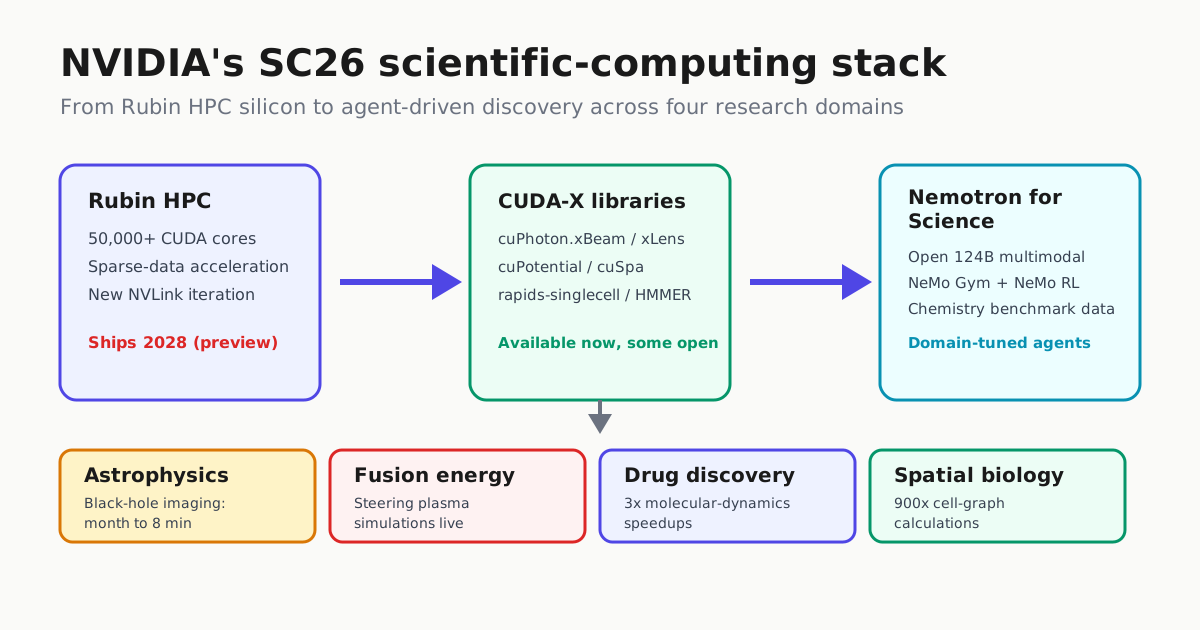
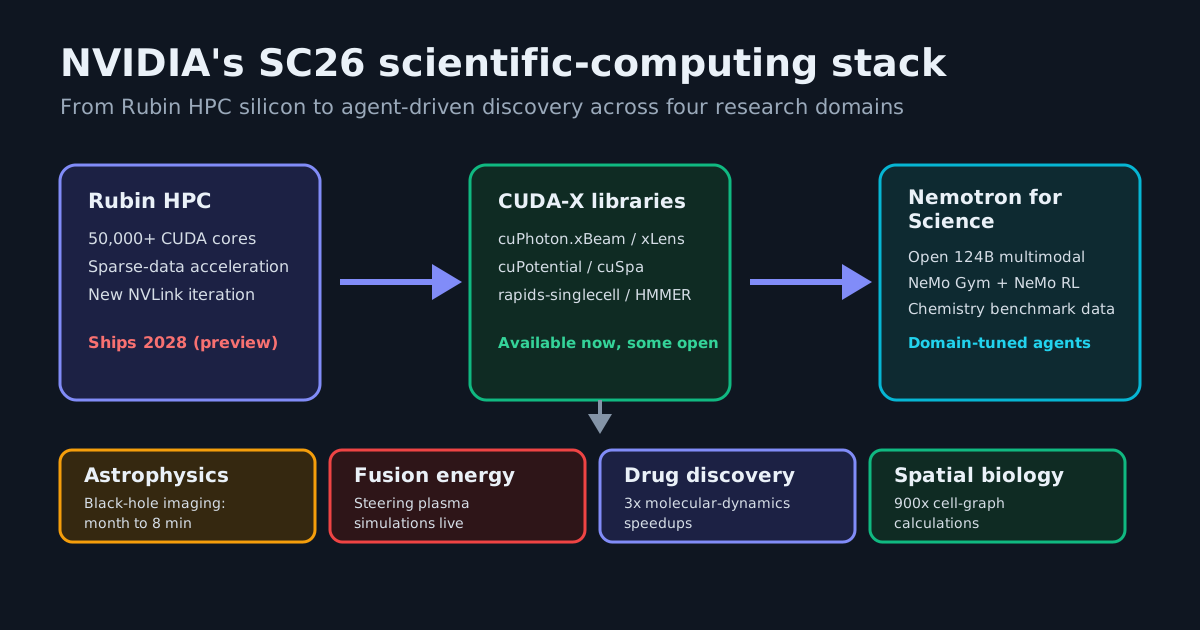
NVIDIA used the SC26 supercomputing conference in Chicago to extend its Rubin architecture beyond AI training and inference into scientific computing. The company previewed a new Rubin HPC graphics processor, expanded its CUDA-X library family with tools for astrophysics, fusion, materials science and biology, and bundled a Nemotron for Science offering that gives researchers an open model plus post-training recipes for building domain-specific agents.
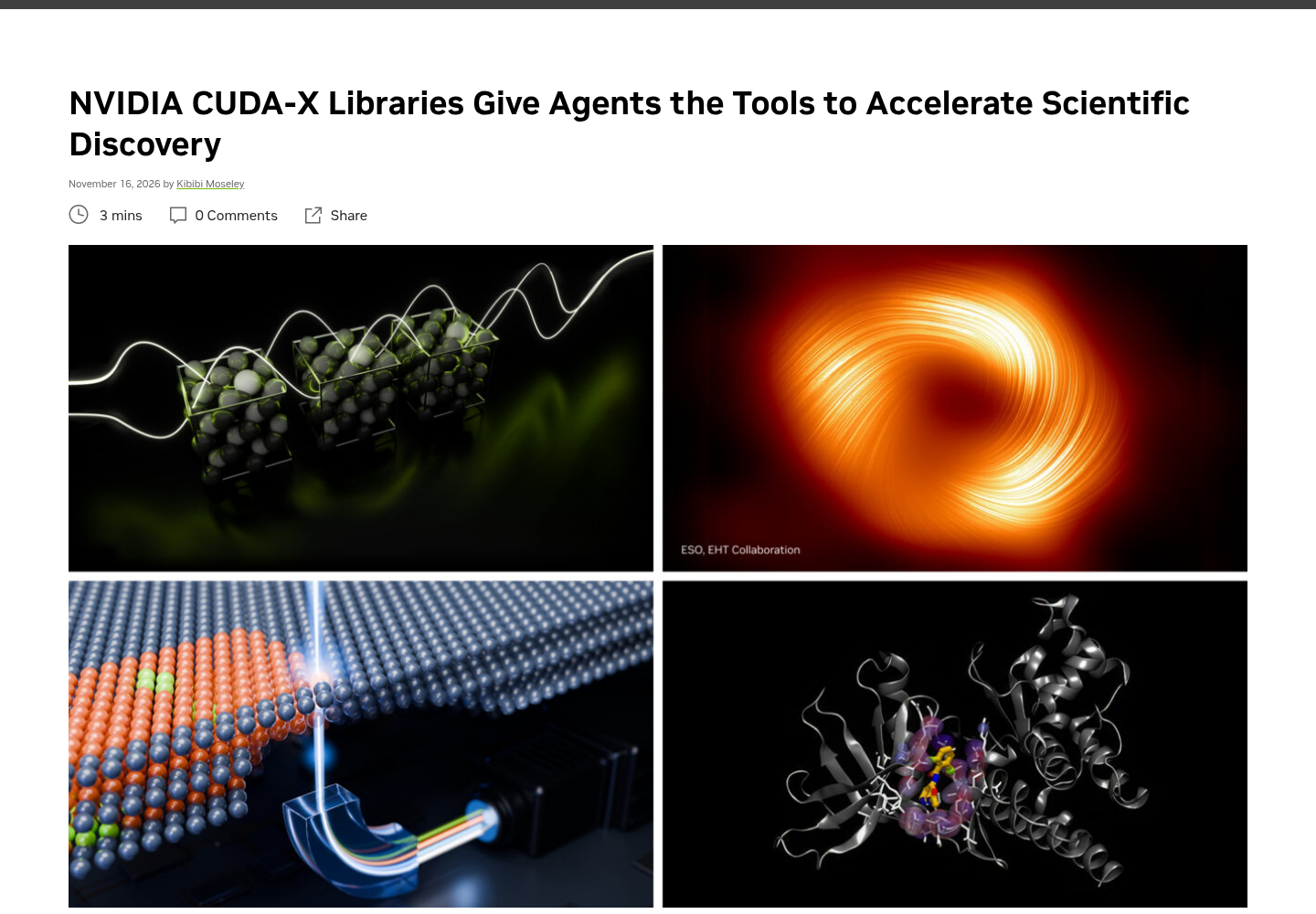
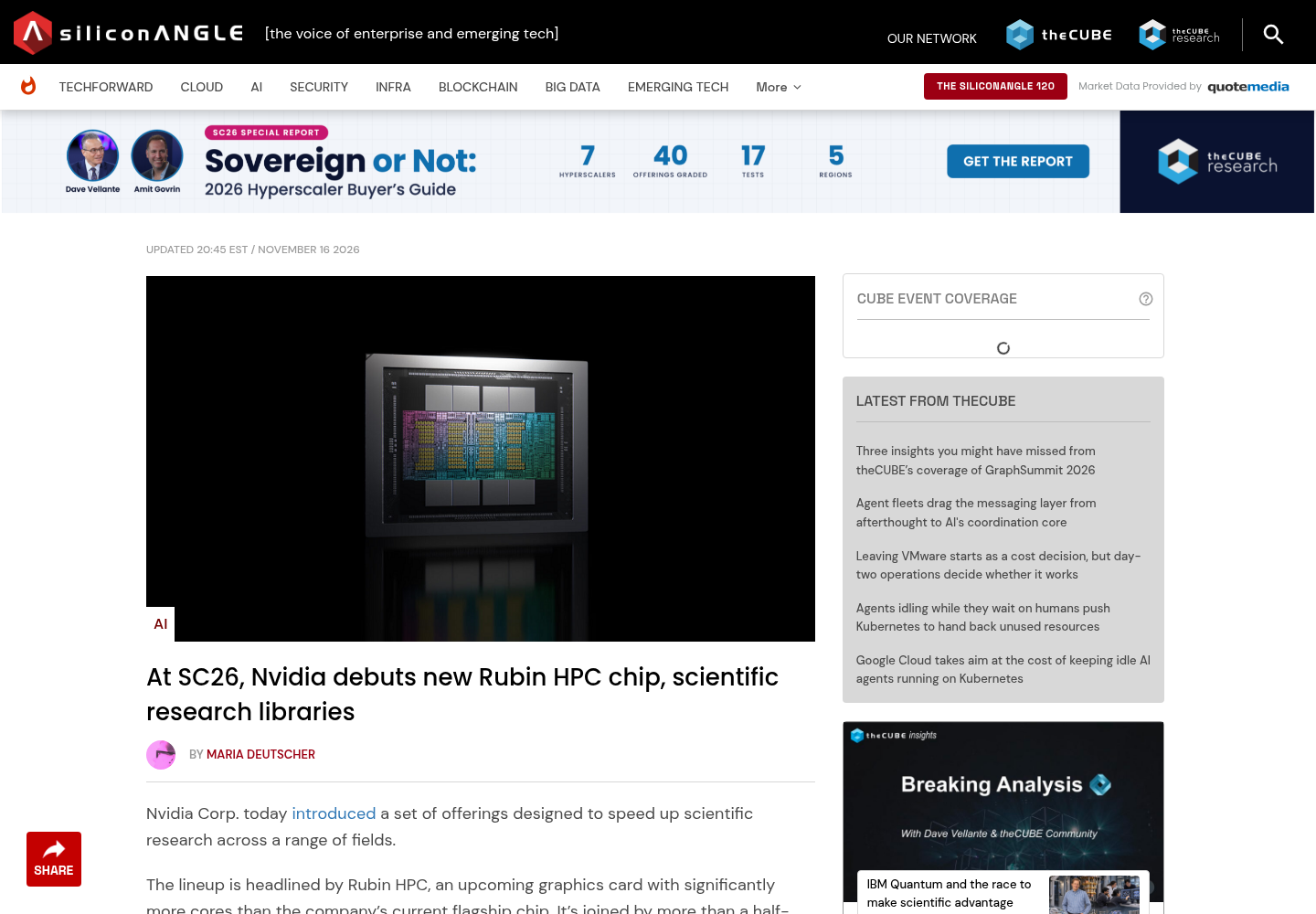
The announcements — detailed in NVIDIA’s own post, “NVIDIA CUDA-X Libraries Give Agents the Tools to Accelerate Scientific Discovery”, and reported by SiliconANGLE — are dated November 16, 2026, and they mark a deliberate repositioning: NVIDIA wants the same agentic-AI stack running coding and inference workloads to also run telescopes, fusion reactors and cancer-research pipelines.
Rubin HPC: an announcement, not a product you can buy
The hardware headline needs a caveat up front. Rubin HPC ships in 2028; it is a preview, not a launch. What NVIDIA showed is a scientific-computing variant of the flagship Rubin GPU: where the current Rubin chip carries 898 Tensor cores and just over 28,000 CUDA cores, Rubin HPC will pack more than 50,000 CUDA cores, a new iteration of the NVLink interconnect (the current version moves 3.6 terabits per second per GPU), and a “sparse data acceleration” feature targeting datasets dense with zeros — common in biology and astrophysics, where a telescope may represent empty sky as zero values.
“For agents tackling science and engineering, faster simulation means faster discovery,” Ian Buck, NVIDIA’s vice president of hyperscale and HPC, said in the announcement, as SiliconANGLE reported. The pitch is that agents running simulations to test hypotheses are the workload, not a side effect.
The CUDA-X additions are available now
While the silicon is years out, the software debuted alongside it is the near-term story. NVIDIA’s own figures, from its SC26 CUDA-X announcement:
| Library | Domain | Claimed result |
|---|---|---|
| cuPhoton.xBeam | Event Horizon Telescope black-hole imaging | Correlation work cut from over a month to 8 minutes; already correlated jet observations J1924 and 3C279 |
| cuPhoton.xLens | Fusion plasma simulation (Pacific Fusion) | In-situ insight extraction while simulations run, coupled to a local Nemotron agent for interactive steering |
| cuPotential | Molecular dynamics / drug design | Up to 3x acceleration of existing simulation software; work with Schrödinger and the AMBER, NAMD, GROMACS, LAMMPS and Open Molecular Software Foundation communities |
| Daviator on ALCHEMI | Quantum-mechanical materials calculations (VASP) | Up to 22x faster at up to 75% lower cost |
| DAQIRI | Electron microscopy at Lawrence Berkeley National Laboratory | Moves analysis into the live experiment, deciding what to measure next mid-acquisition |
| cuSpa (open source) | Spatial cell graphs at Memorial Sloan Kettering | 900x speedup over CPUs |
| rapids-singlecell (containerized) | Single-cell analysis | Therna Biosciences processed data 200x faster; integrated into 10x Genomics’ Sentira platform |
| HMMER (open source) | Protein-sequence annotation | Up to 84x faster at Basecamp Research |
Several of these are open-source or shipping in containerized, “agent-ready” form now — which is the real change for research teams planning their next porting cycle, since the hardware Rubin HPC implies will not arrive until 2028.
Nemotron for Science: the model is only half the offer
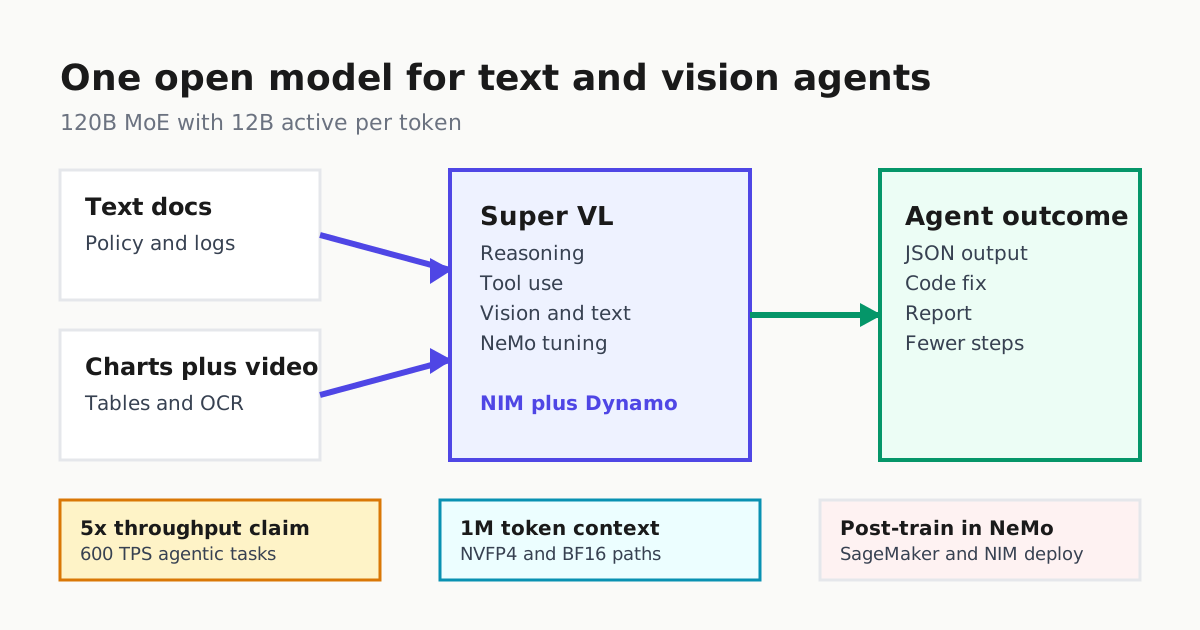
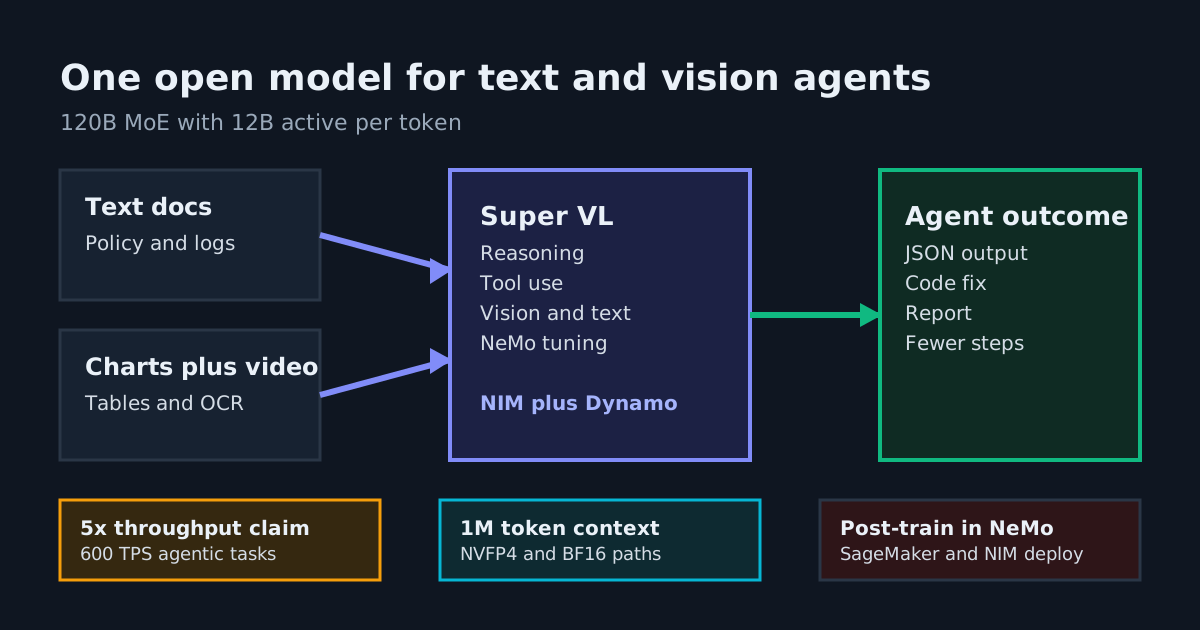
The third piece is Nemotron for Science, built on Nemotron 3.5 Super VL — the 124-billion-parameter open model NVIDIA introduced last month, which activates roughly a tenth of its parameters at a time and is partly based on the Mamba-2 architecture. The bundle adds the open Litmus-Bench V2.0 chemistry dataset and nearly 50,000 chemistry questions for post-training and evaluation, per NVIDIA’s announcement.
The companion NVIDIA developer post, “Post-Training NVIDIA Nemotron to Increase Accuracy in Your Scientific Domain”, goes further than a model card: it publishes a working recipe. Starting from a CSV of experimental records, researchers build a reinforcement-learning-with-verifiable-rewards environment in NeMo Gym — experimental ground truth scores each model submission, no human preference labeling required — then train with NeMo RL using GRPO with LoRA adapters. On a drug-metabolism prediction task at a 16,384-token output budget, supervised fine-tuning improved accuracy by 12%, and RL post-training added a further 17%, as detailed in the developer blog. An optional distillation step ran Claude Sonnet 5.5 against the same environment, keeping 1,123 verified-correct reasoning traces from 1,934 prompts to warm-start the student model before RL.
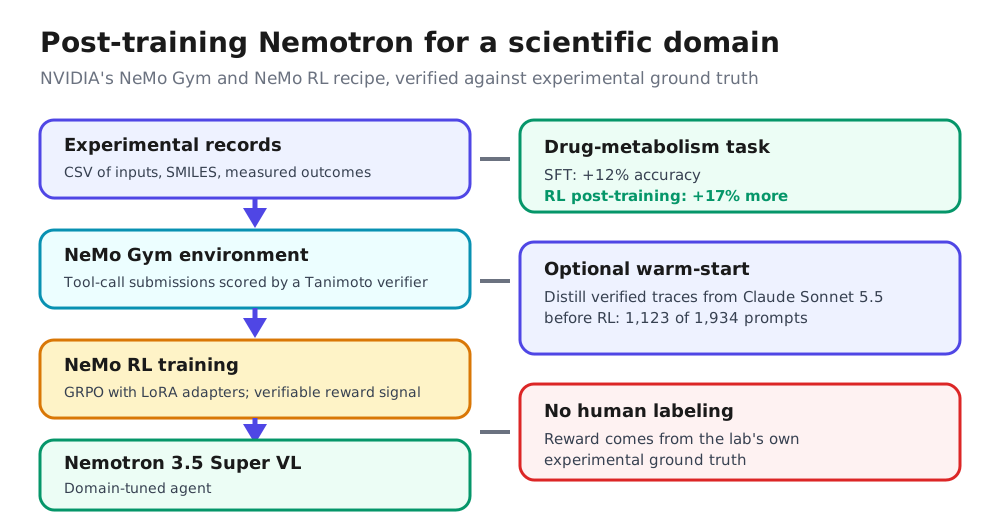
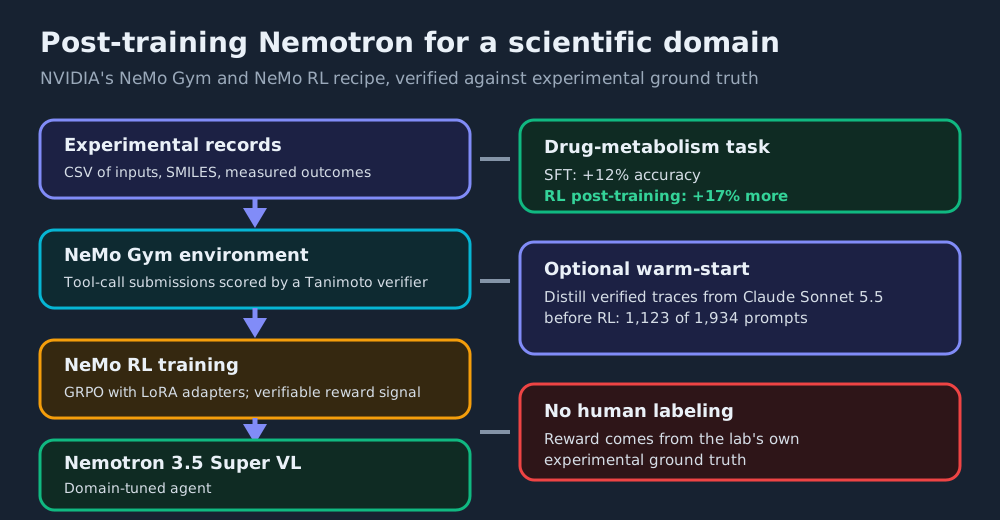
That recipe matters more than any single benchmark: it turns a lab’s own experimental data into the reward signal, which is the mechanism that makes a general model domain-specific without vendor involvement.
Quantum, briefly
NVIDIA also expanded CUDA-Q with new quantum-software building blocks and a qubit error-mitigation algorithm, and said it is working with IBM and the Department of Energy’s Fermilab on a “modular quantum codesign platform” pairing DGX B200 systems with IBM quantum hardware, as SiliconANGLE noted.
Why this matters
This is a procurement-and-porting story, not a changelog. For research groups running AI-assisted scientific computing, the near-term consequences are concrete: open CUDA-X libraries and containerized single-cell tooling they can evaluate this quarter, a post-training recipe they can replicate with their own data, and a 2028 hardware horizon that makes Rubin HPC a planning input rather than a purchase. It also sharpens the distinction with NVIDIA’s other recent launches — the Vera Rubin MLPerf benchmark debut and the DGX Spark desk-side developer kit — which target inference benchmarking and individual developers rather than scientific workflows. NVIDIA’s bet at SC26 is that the next scientific-computing cycle will be steered by agents, and it is selling the full stack — silicon, libraries and post-trained models — for that thesis.