Musk says Google is interested in renting more AI compute from SpaceX
Elon Musk said Google expressed interest in more SpaceX compute. The June agreement specified about 110,000 Nvidia GPUs and a scheduled rate of $920 million a month.
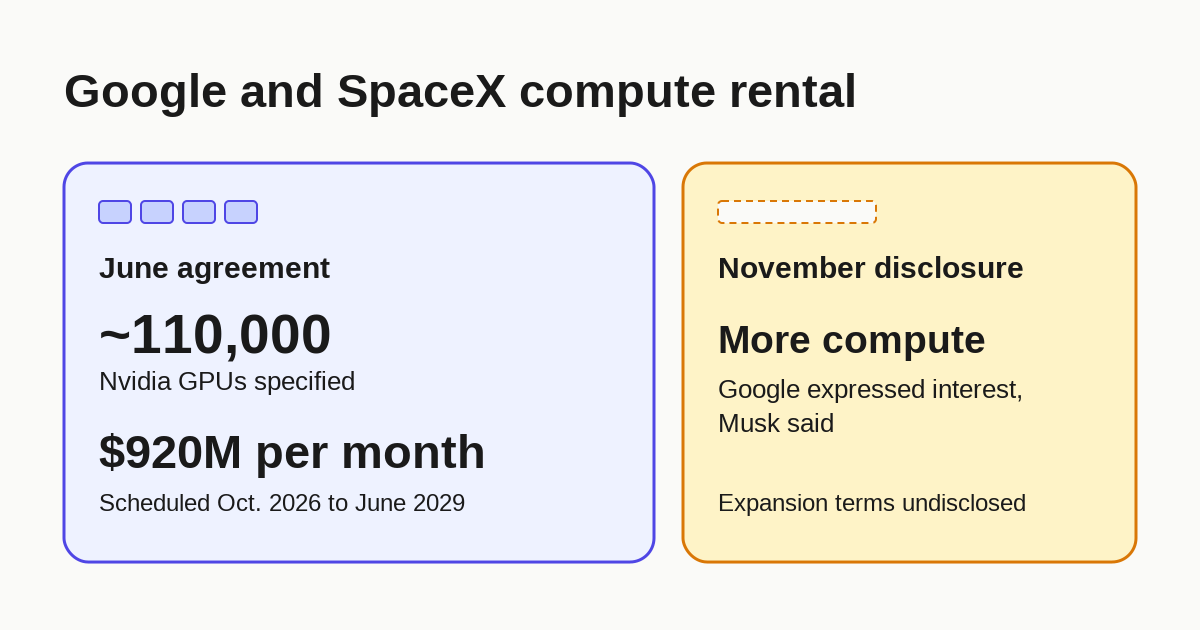
Elon Musk said on Nov. 28 UTC that Google had expressed interest in renting more computing capacity from SpaceX. The remark came in a reply on X to a user comparing how much Google and Anthropic might buy, Bloomberg reported. Musk gave no figure for the additional capacity, delivery date or price. The buyer he named already had a compute agreement with SpaceX whose scheduled monthly fee approached $1 billion. Musk’s post on X · Bloomberg’s reporting
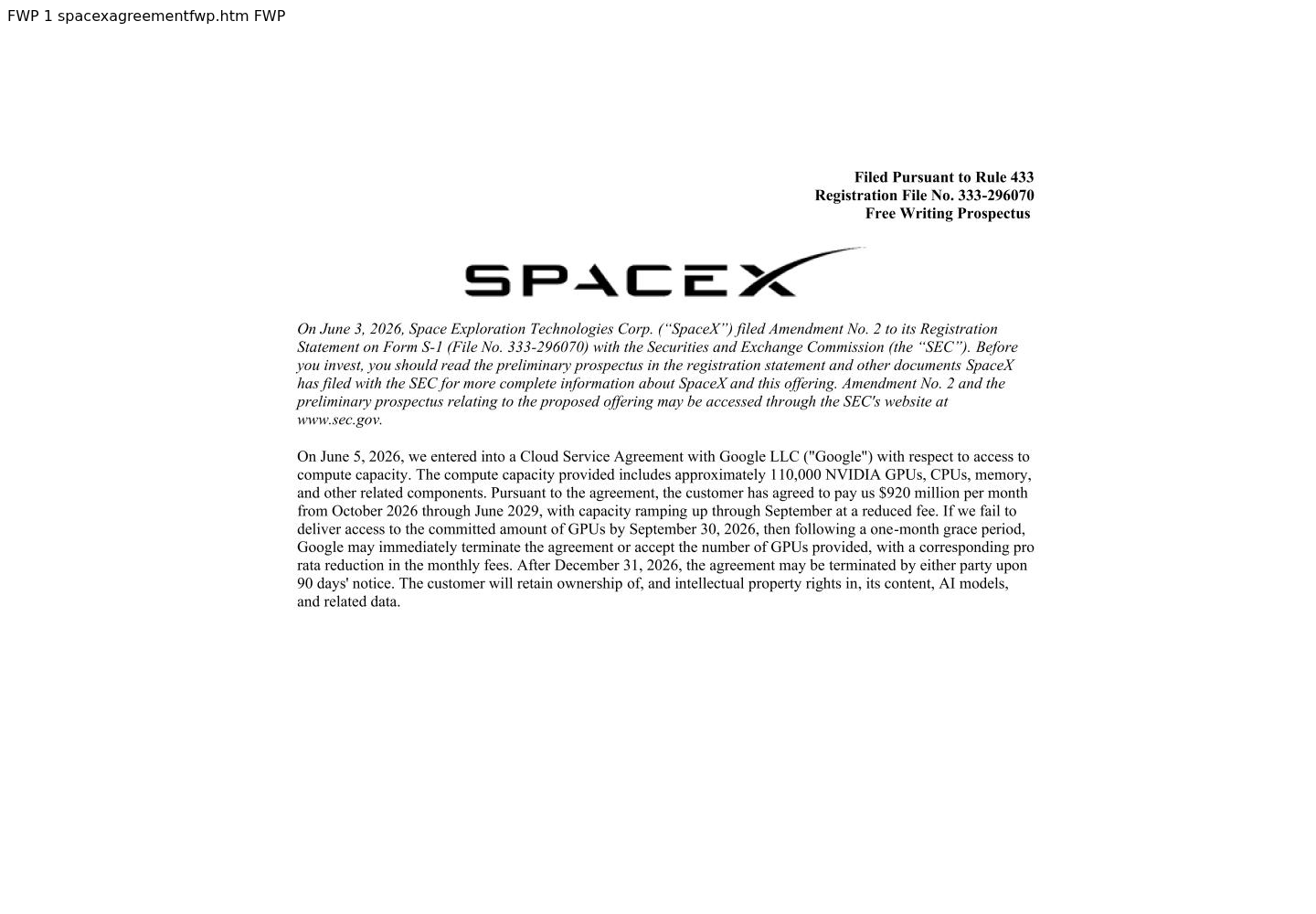
SpaceX said it signed a Cloud Service Agreement with Google LLC on June 5, 2026, covering access to approximately 110,000 Nvidia GPUs, along with CPUs, memory and related components. Google agreed to a scheduled rate of $920 million a month from October 2026 through June 2029, following a capacity ramp through September at a reduced fee. For AI infrastructure buyers, the filing provides a benchmark for the scale of a single purchase from SpaceX. For investors, the payment schedule and delivery clauses show how the supplier’s billings could vary even under a signed agreement. SpaceX’s free writing prospectus on SEC EDGAR
The June deal ties the bill to delivery
SpaceX’s prospectus specified what would happen if it missed the Sept. 30 deadline to provide access to the committed GPU count. After a one-month grace period, Google could terminate immediately or accept the GPUs available with a proportional reduction in monthly fees. The filing also says either party may terminate on 90 days’ notice after Dec. 31, 2026. Google retains ownership and intellectual property rights in its content, AI models and related data. SpaceX’s prospectus
Twelve months at the scheduled rate would cost $11.04 billion. The reduced-fee ramp, the shortfall provision and the termination clause each affect how much of the scheduled spending could materialize. The June prospectus describes the original terms. The number of GPUs Google ultimately accepted and the amount SpaceX has billed so far remain open questions in the available disclosures. SpaceX’s prospectus
Dividing the fee by the GPU count would allocate the cost of the whole bundle across the accelerators. That calculation would also spread the cost of CPUs, memory and related components across each GPU. A buyer comparing the June agreement with a quote for another cluster would need to know what each quote includes and how much of the system is available during the ramp. Two offers with the same eventual GPU count can give buyers access to very different amounts of compute in the first months of a contract. SpaceX’s prospectus
What an expansion would clarify
A capacity figure and a delivery schedule would show how much additional compute Google could plan around and when. The configuration would also matter. In distributed training, accelerators exchange data as they work, and the speed of those exchanges affects how much work a cluster can do. The GPU count is one part of that comparison. The June agreement also gives buyers a commercial benchmark for evaluating any expansion, including whether a new monthly rate would apply during a ramp and what remedies would be available for late delivery. Musk’s reply supplied none of those details. SpaceX’s prospectus · Musk’s post on X
Google has also appeared in a separate capacity arrangement as a backstop for Anthropic’s Kentucky data center leases. The June prospectus names Google itself as the customer buying access from SpaceX. Those roles carry different obligations. In the SpaceX agreement, the company responsible for paying the scheduled fee also holds the right to accept a smaller allocation at a reduced fee if SpaceX misses the delivery deadline and grace period. Any disclosed expansion terms would show whether SpaceX had committed more capacity to that customer and what Google would pay for it. Automater’s coverage of the Kentucky leases · SpaceX’s prospectus