OpenRouter's Price per Token Fell 83% in 2026 — and Under 1% of It Was a List-Price Cut
OpenRouter says its effective price per token fell 83% in 2026: 47 points from better caching, 30 from open-weight model mix, and under 1 from list-price cuts.
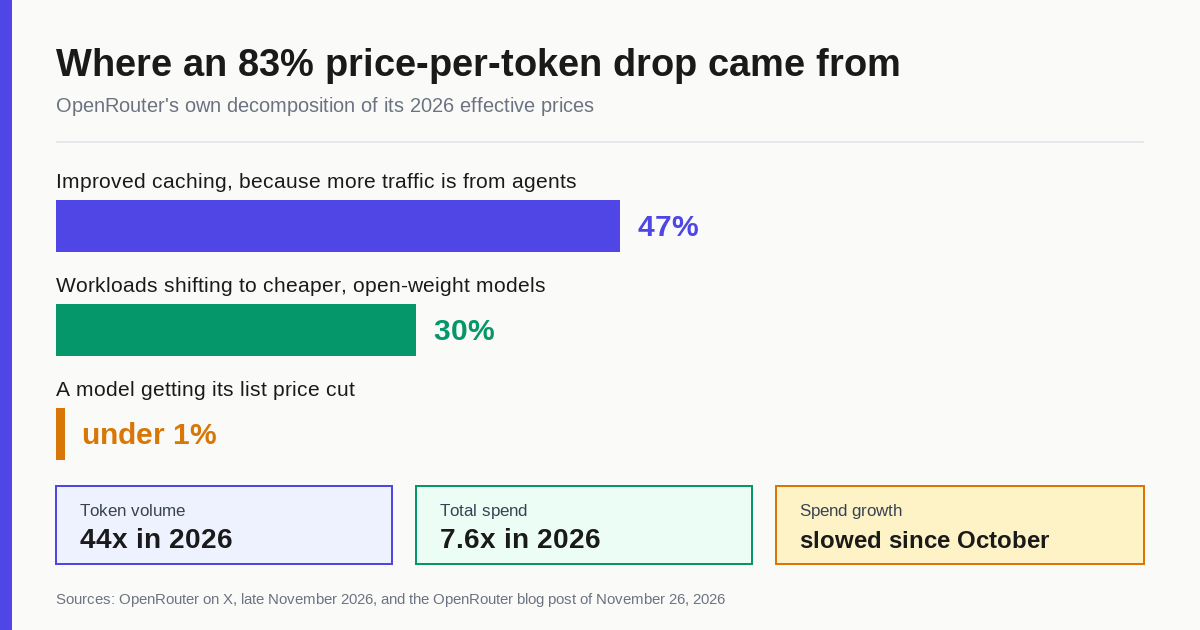
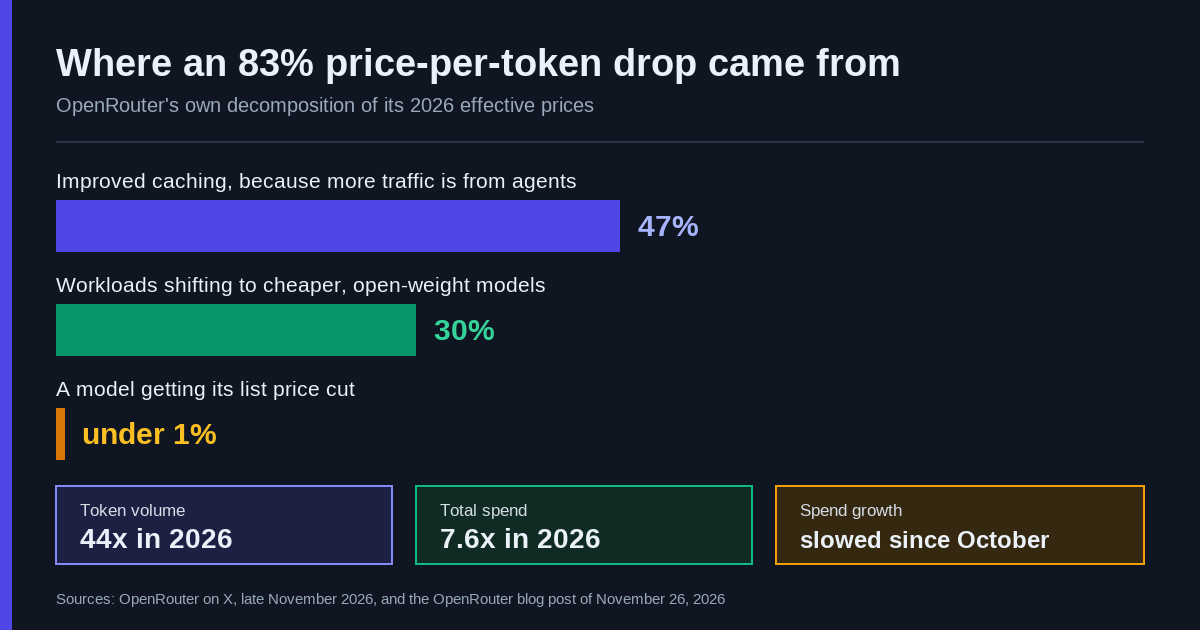
OpenRouter spent 2026 publishing a number that reads like a contradiction, then took it apart.
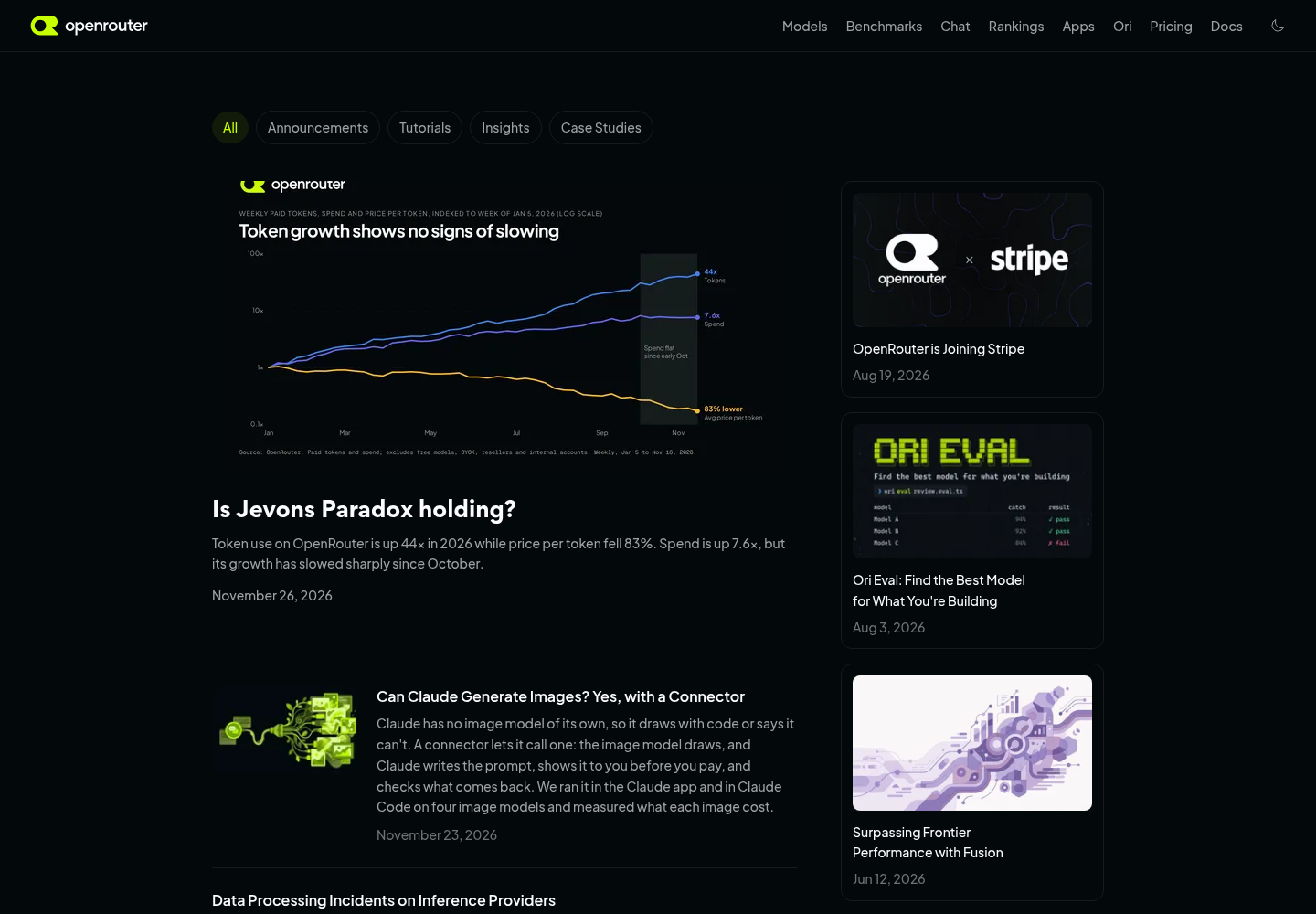
On November 26, the post “Is Jevons Paradox holding?” on the OpenRouter blog reported that token use on OpenRouter is up 44x this year while price per token fell 83%, and that total spend is up 7.6x — with spend growth slowing sharply since October. Volume up 44x, price down 83%, spend up 7.6x: the price collapse is why the spend multiple stayed in single digits.
In a post on X in late November, OpenRouter split that 83% into three parts.
| Driver, per OpenRouter | Share of the 83% drop |
|---|---|
| Improved caching, because more traffic is from agents and reuse itself improved | 47% |
| Workloads shifting to cheaper, open-weight models | 30% |
| A model getting its list price cut | Under 1% |
Read that table as an instruction, not a statistic. Negotiated list-price cuts explain less than one percent of a blended price that fell by more than four fifths. Almost all of the rest came from two decisions operators actually control: how a prompt is structured for reuse, and which models the traffic lands on. That inverts the usual advice — the bill now moves with your cache hit rate and your model mix, not with the discount a vendor negotiated.
A cache hit is now a pricing decision
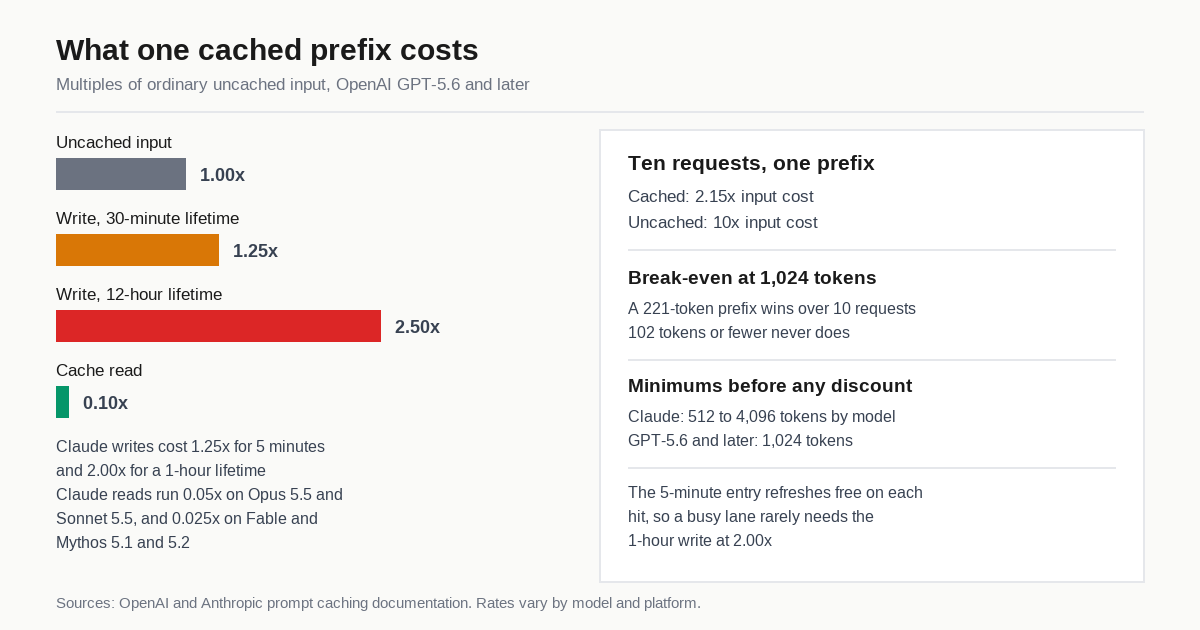
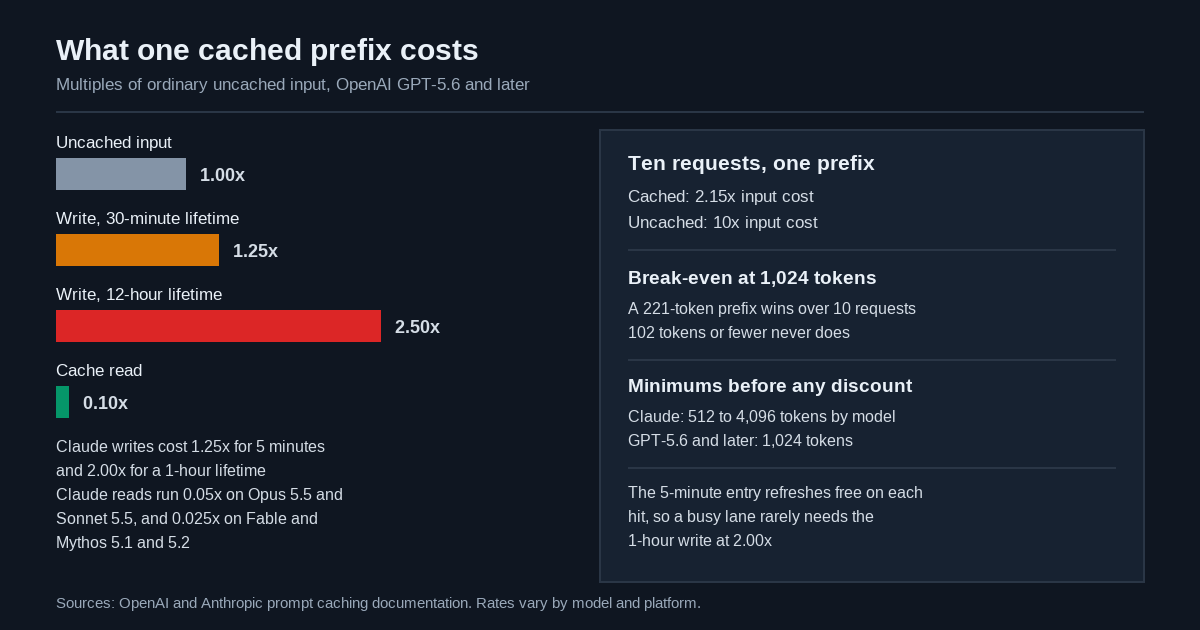
Both major vendors sell reuse at a discount and charge a premium to store it. OpenAI’s prompt caching guide sets the shape for GPT-5.6 and later: a 30-minute cache write costs 1.25x the uncached input rate, a 12-hour write 2.5x, a read 0.1x (0.05x on GPT-6.2 Astra and Sol and on GPT-6.1 Sol and Terra), and a prefix must reach 1,024 tokens to qualify at all.
Anthropic’s documentation is the same shape on a different clock: a 5-minute write is 1.25x base input, a 1-hour write 2x, a read is 0.1x — and lower on the newest families, 0.05x for Opus 5.5 and Sonnet 5.5, and 0.025x for Fable 5.1, Fable 5.2, Mythos 5.1 and Mythos 5.2. The default lifetime is five minutes, refreshed free on each hit, and one request can carry up to four breakpoints.
Once caching works that way it stops being an optimization and becomes the price. OpenAI’s docs do the arithmetic: write one prefix once and read it nine times, and ten requests cost 2.15x ordinary input instead of 10x. Below the minimum cacheable length you pay full price forever. With a 1,024-token floor, expanding a prefix of at least 221 tokens pays for itself over ten requests, while a prefix of 102 tokens or fewer never does.
Model mix is the other 30 points
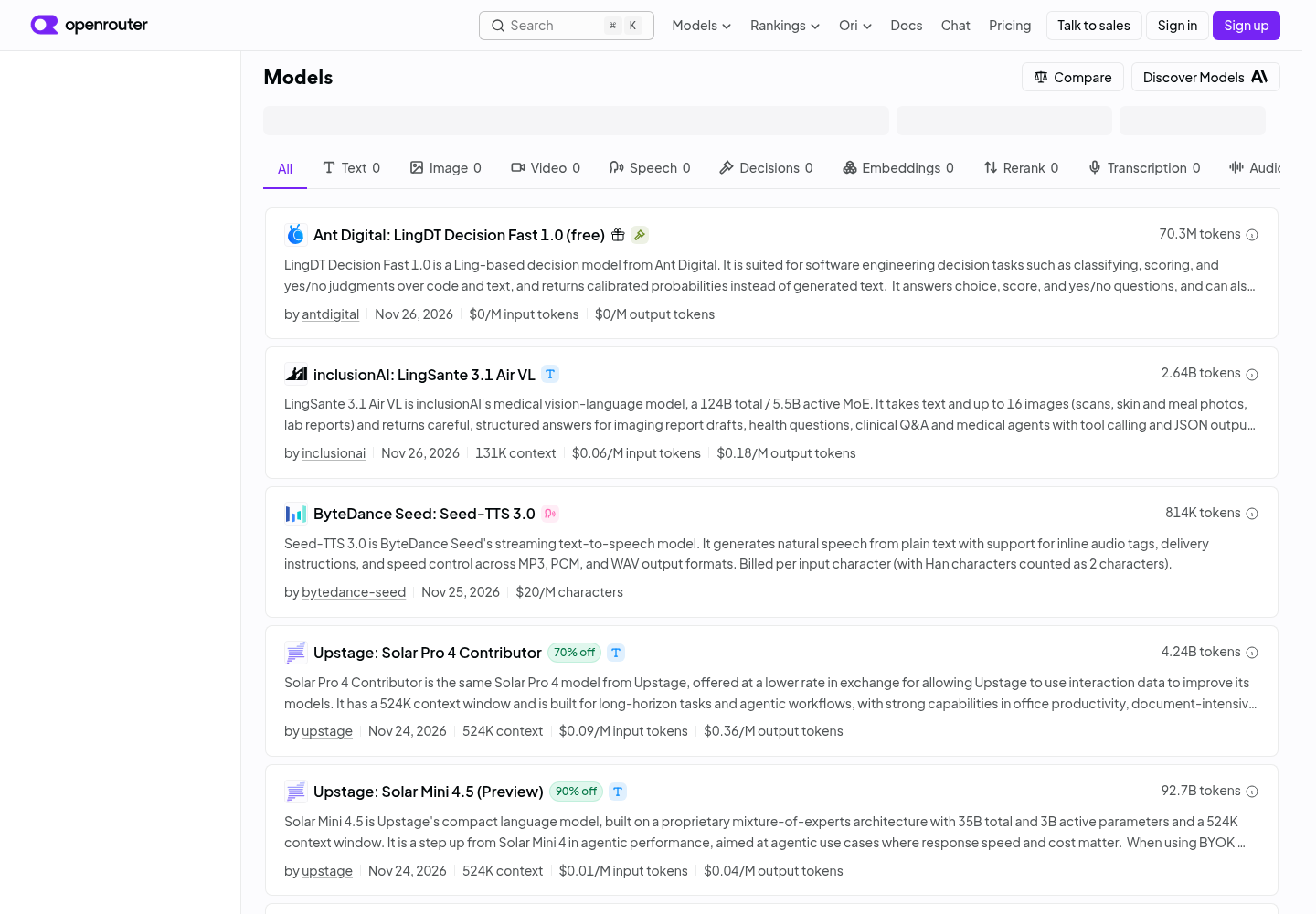
The second half is where the traffic lands. The OpenRouter catalog shows the spread under one roof: input prices run from $0.01 per million tokens for Solar Mini 4.5 and $0.02625 for the open-weight Inkling 2 Mini, up to $3 for Gemini 4 Neon, with a $1.50 batch variant of that model and free entries at the floor. Moving a workload down that list is worth more than any rebate a vendor will negotiate — and the shape of the bill matters as much as the rate, as the comparison of GPT-6.1 Sol and Claude Sonnet 5.5 shows.
What to change this sprint
-
Measure the hit rate per workload, not the average. Anthropic reports
cache_read_input_tokens,cache_creation_input_tokensandinput_tokens; OpenAI reportscached_tokensandcache_write_tokens. Divide reads by total input and split the result by workload and by day, the way our overnight cache-read meter does it end to end.u = response.usage read = getattr(u, "cache_read_input_tokens", 0) or 0 created = getattr(u, "cache_creation_input_tokens", 0) or 0 plain = getattr(u, "input_tokens", 0) or 0 total = read + created + plain hit_rate = read / total if total else 0.0 -
Put the breakpoint on the last block that stays identical. Anthropic’s lookback only finds entries earlier requests already wrote, so a breakpoint on a block holding a timestamp writes a fresh entry every time and never gets a read. OpenAI’s docs add a matching trap: switching from implicit to explicit-only caching can miss a prefix an earlier turn saved.
-
Respect the minimums and pick the lifetime deliberately. Claude’s minimum cacheable length runs from 512 to 4,096 tokens by model and platform, and GPT-5.6 and later need 1,024. Below the floor there is no cache and no discount. The 5-minute entry refreshes free on every hit, so it usually wins on a busy lane; the 1-hour entry costs 2x to write and pays off when hits are less frequent than every five minutes.
-
Route by task and price the finished job. A workload that does not need frontier reasoning should not pay frontier prices, and a batch workload should not pay interactive prices. Measure cost per completed task rather than per token, the argument in cost per completed task beats price per token, and keep watching the open-weight floor with the DeepSeek effect.
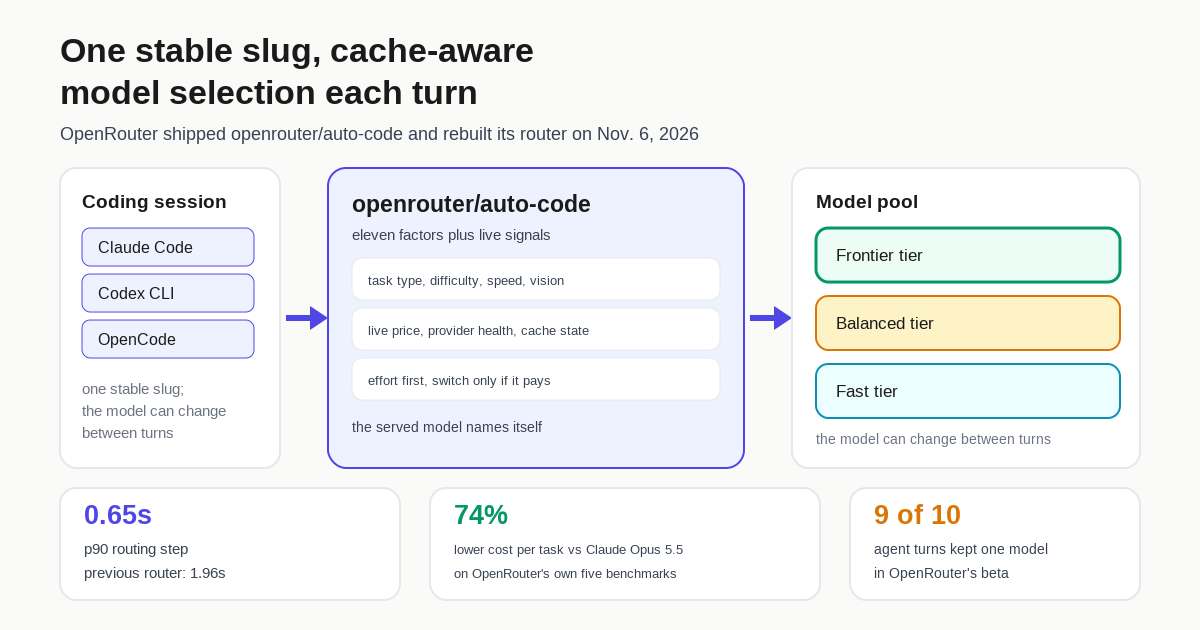
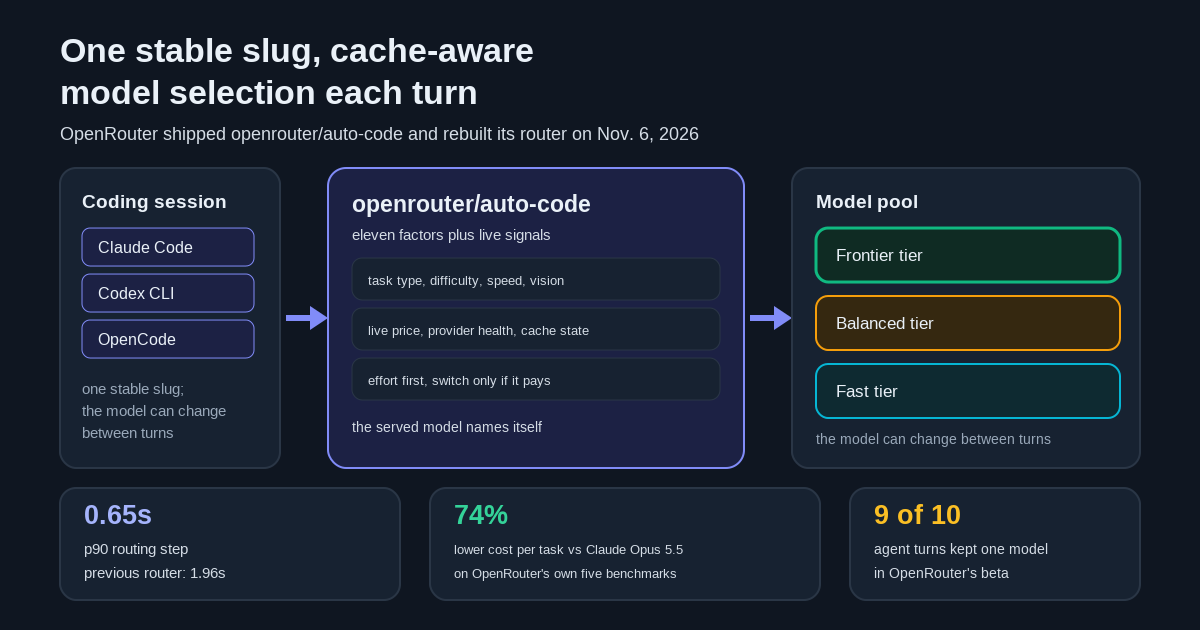
This is not theory for a large buyer. Cloudflare cut its AI code reviewer’s bill 68% by hunting cache writes rather than buying bigger models, and OpenRouter’s own Auto Code Router shipped earlier this year on the same logic.
What this does not prove
OpenRouter’s split is its own attribution on its own traffic mix, and its own post says spend growth has slowed sharply since October, so the mix shift may already be decelerating. A falling price per token is also not a falling bill: token volume rose 44x while spend rose 7.6x, because 44 times the volume at roughly a sixth of the price lands near the spend it reports. The price decline absorbed most of the volume growth, and it keeps doing so only while the hit rate and the mix hold.
Sources
- OpenRouter on X: "Why has the effective price per token has fallen 83% this year? 47% = Improved cache, both b/c more traffic is from agents and caching itself has gotten better 30% = shifting workloads to cheaper, open-weight models Less than 1% comes from a model getting its list price cut" / X
- Blog — OpenRouter Blog
- Compare AI Models: Pricing, Context & Benchmarks | OpenRouter
- Prompt caching | OpenAI API
- Prompt caching - Claude Platform Docs