Liquid AI's d1.3-ultra Posts 76 on the Artificial Analysis Decision Index at Median Cost — With No Announcement Yet to Explain It
Artificial Analysis lists Liquid AI's d1.3-ultra #1 of 27 on the Decision Index at median cost and average speed. No vendor announcement is verified yet. What that means for agent gates.
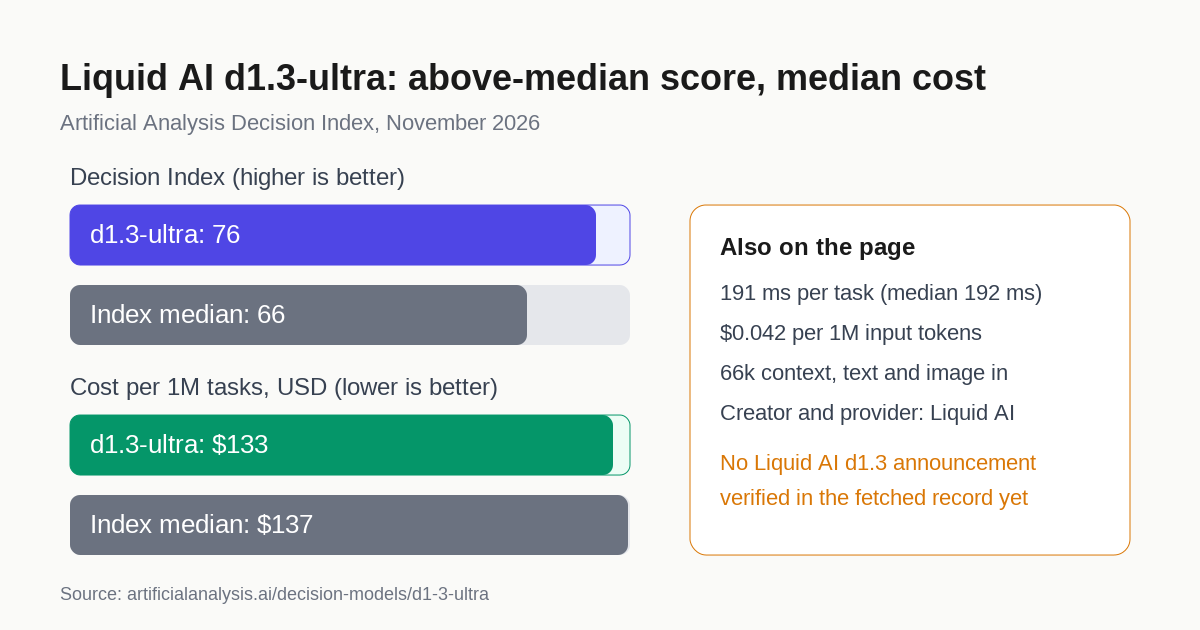
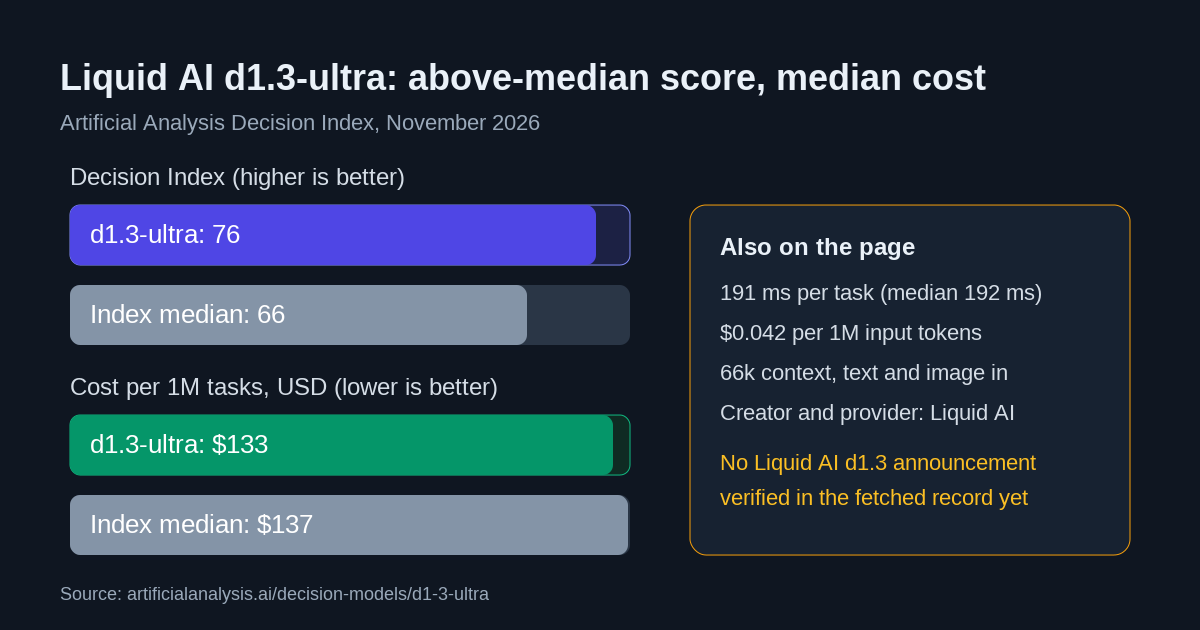
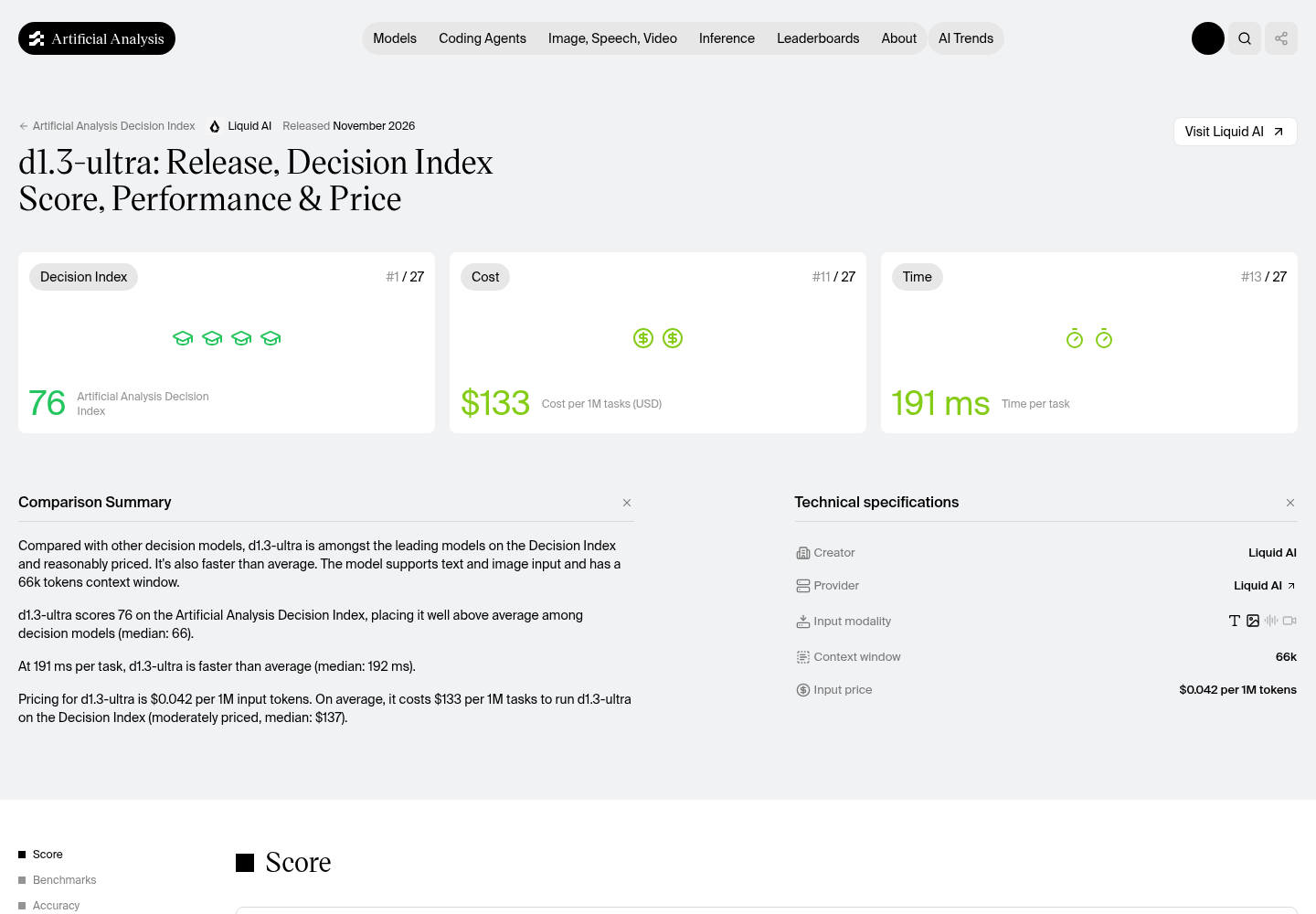
Artificial Analysis’ decision-model page for Liquid AI’s d1.3-ultra now records a Decision Index score of 76 — which the page ranks #1 of 27 — ten points above the 66 median, at $133 per 1M tasks against a $137 median and 191 ms per task against a 192 ms median. That combination — a top-of-index Decision Score, median cost, average-plus speed — is exactly the profile a routing gate wants, and it is why the model is worth operators’ attention this week.
What the verified record does not yet include is a Liquid AI announcement. The company’s most recent fetched release post covers d1.2 and d1.2-ultra, which it reported at 75 on Decision Index v2.1, the then-highest score, at the same $0.042 per 1M input tokens d1.3-ultra now lists. Note the comparison limit: Liquid’s 75 is a v2.1 figure, the current Artificial Analysis page does not name which index edition d1.3-ultra’s 76 comes from, and d1.2-ultra’s score on that same current listing is not in the fetched evidence. Two published numbers whose editions may differ are not a verified delta — treat any vendor-level framing beyond the listing itself as unconfirmed until Liquid publishes its own page for d1.3-ultra.
What the numbers say
Artificial Analysis’ summary of the model is specific:
| Metric | d1.3-ultra | Index median |
|---|---|---|
| Decision Index | 76 (#1 of 27 per the page) | 66 |
| Cost per 1M tasks | $133 | $137 |
| Time per task | 191 ms | 192 ms |
| Input price | $0.042 per 1M tokens | — |
| Context window | 66k | — |
| Input modality | text and image | — |
The page describes it as “amongst the leading models on the Decision Index and reasonably priced,” and faster than average. Liquid AI is listed as both creator and provider, so the model is served directly by Liquid AI rather than a third-party host.
The score itself is not a raw accuracy figure. Decision Index v2’s Decision Score is accuracy less the Brier score of the chosen answer’s probability — each question pays for being right and for the confidence attached to the answer, and a confident wrong answer costs more than a hesitant one. The index also folds in a Symmetry Score measuring whether a reworded question earns an equivalent probability. As our earlier analysis of the v2 calibration change explained, those choices make the headline number a statement about models that gate tool calls, not just about models that answer questions.
Why the gate model matters
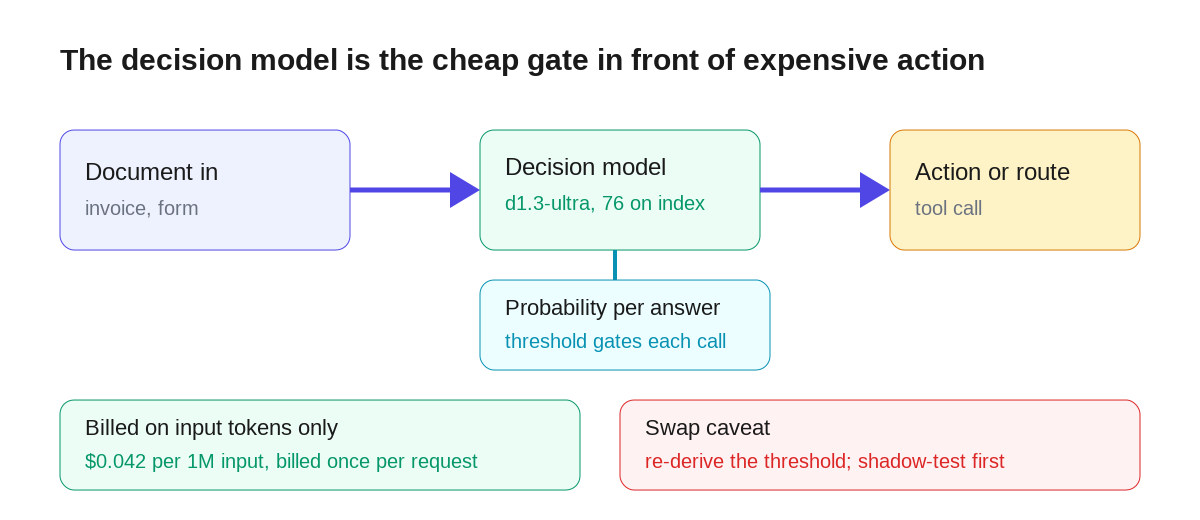
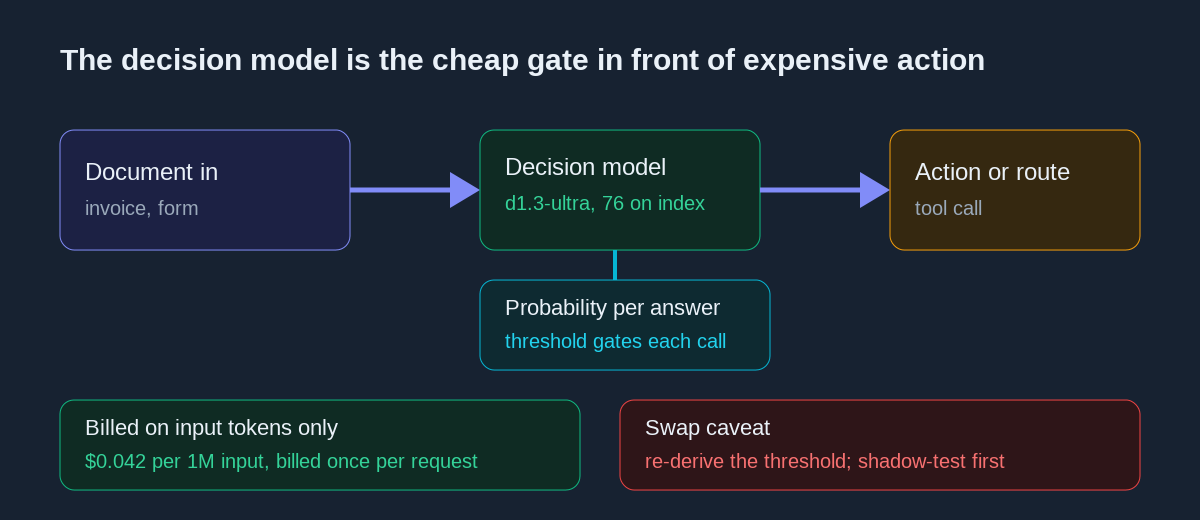
Decision models are the cheap classifier in front of expensive action: they read a document, decide whether a tool call should run, and attach a probability you threshold on. Because they bill input tokens only, the listing’s economics are directly relevant: an unchanged $0.042 input price means swapping the gate model does not change what each document’s input costs to read. Whether the higher listed score translates into better decisions in your pipeline, though, is a candidate hypothesis, not a verified fact — the index is a calibration-weighted score over benchmarks you cannot reproduce, so the only way to confirm the gain is a shadow-mode bake-off on your own documents before you re-point the gate.
Two checks temper the swap. First, per the v2 methodology, a model’s calibration and wording sensitivity decide whether your confidence threshold means what you think it means. Before swapping the gate, check the model’s AA-Symmetry and Brier numbers on the same page, and re-derive your threshold rather than carrying it over — the confidence-gating pattern we documented for Jev applies to any gate model. Second, Liquid’s d1.2 post documents a billing shape worth confirming still holds for d1.3-ultra: input billed once per request, each extra question adding only its own text, and a 1024x1024 image costing 1,536 tokens at the text rate. If that shape carries over, asking five questions of one invoice bills the document’s input once rather than multiplying it by five — which is what would keep a multi-question task near the $133 per 1M tasks figure, though that number is Artificial Analysis’ weighted average across its own index benchmarks, not a quote for your invoice. Confirm the shape on your own request before trusting the arithmetic — the cost-per-completed-task discipline we keep coming back to.
Availability, and what remains unverified
The Artificial Analysis page confirms the model exists, is served by Liquid AI, and posts the numbers above. It does not confirm a launch date beyond “Released November 2026,” a changelog, or which tasks d1.3-ultra supports beyond text and image input — Liquid’s d1.2 generation added audio input and five typed answer tasks, and whether d1.3-ultra carries all of them forward is not established by the fetched evidence. No pricing or availability statement from Liquid AI for this specific model is in the record either; the $0.042 figure is Artificial Analysis’ price listing, not a vendor announcement.
The practical read for agent builders: the model is real and measurable now, it tops the page’s own ranking at median cost, and the right next step is a shadow-mode bake-off on your own documents — the private 45% of the index means nobody can reproduce the ranking for you, as our v2 coverage noted. Log the index edition next to any score you cite internally, and hold off on quoting vendor-level claims about d1.3-ultra until Liquid AI publishes its own release page.
Sources: Artificial Analysis, d1.3-ultra model page; Liquid AI, d1.2 release post; Automater, Decision Index v2 calibration analysis.