Trainium3 and TPU Join SemiAnalysis AgentX: Most of the 2.28x Lead Over GB300 Comes From Cost, Not Speed
SemiAnalysis put AWS Trainium3 and Google TPU on its InferenceX/AgentX agentic benchmark and reports 1.2x to 2.5x better performance per dollar than Nvidia. Most of the headline Trainium3 lead comes from a cost estimate, so here is how to recheck it with your own prices.
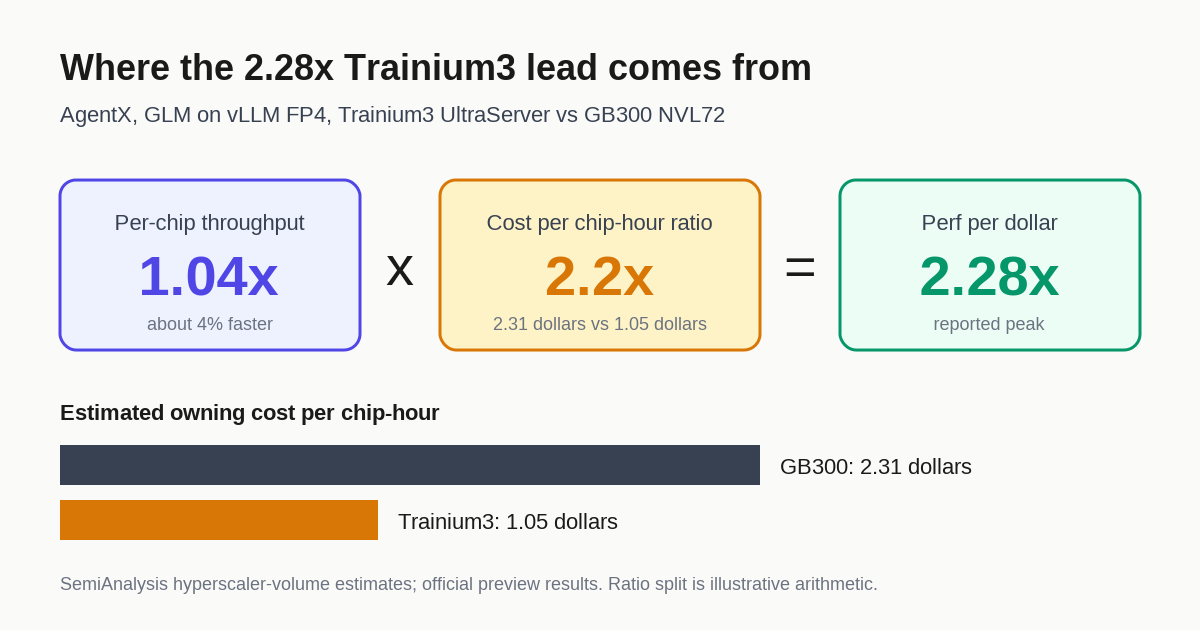
SemiAnalysis announced on X that Google’s TPU and Amazon’s Trainium now appear on InferenceX and AgentX, its inference benchmarks. It says both chips deliver “anywhere from 1.2x to 2.5x the performance per dollar of NVIDIA GPUs.” The post opens by noting that seven months ago Nvidia CEO Jensen Huang said neither chip would ever show up on the benchmark.
The new result is Amazon’s first AgentX submission. AgentX is SemiAnalysis’s agentic-inference test, and its workload comes from real coding-agent sessions, so the comparison bears on what coding agents cost to serve. The headline multiplier deserves a closer look, though: most of it comes from a cost assumption, not from Trainium3 being faster.
What was submitted
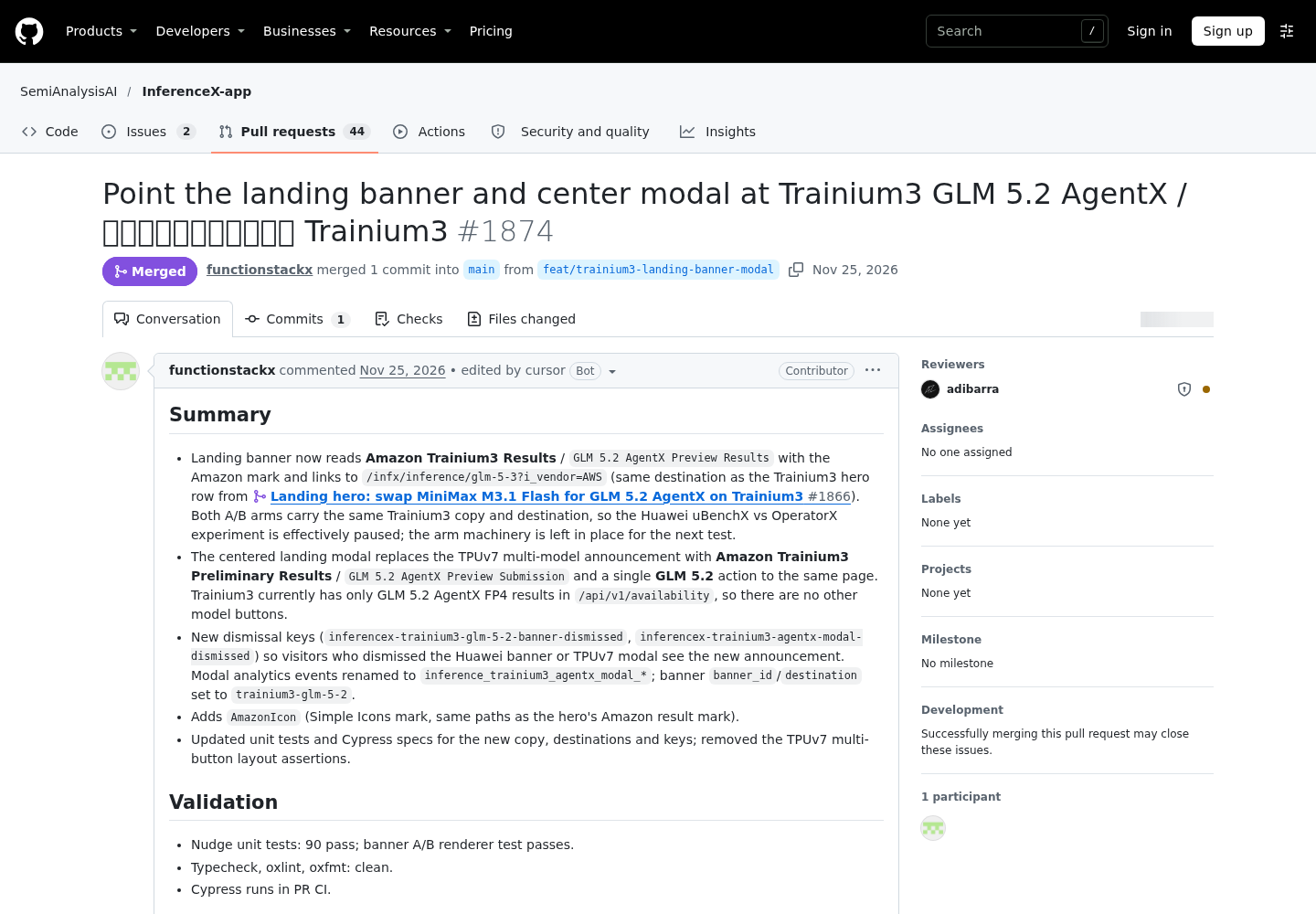
SemiAnalysis’s site code shows the rollout. Pull request #1874 in the InferenceX-app repository merged on November 25, 2026. It replaced the landing banner with “Amazon Trainium3 Results / GLM 5.2 AgentX Preview Results” and changed the launch modal to “Amazon Trainium3 Preliminary Results.” The PR also says Trainium3 “currently has only GLM 5.2 AgentX FP4 results” in the site’s availability API. That means this is one model, one precision and one workload. It isn’t a broad sweep.
The sources don’t agree on the model’s name. The PR copy says GLM 5.2, but its link points to a glm-5-3 page. OfficeChai writes “GLM-5.2/GLM-5.3” and describes it as Z.ai’s 744-billion-parameter model served on vLLM in FP4. N Globe calls it GLM-5.3.
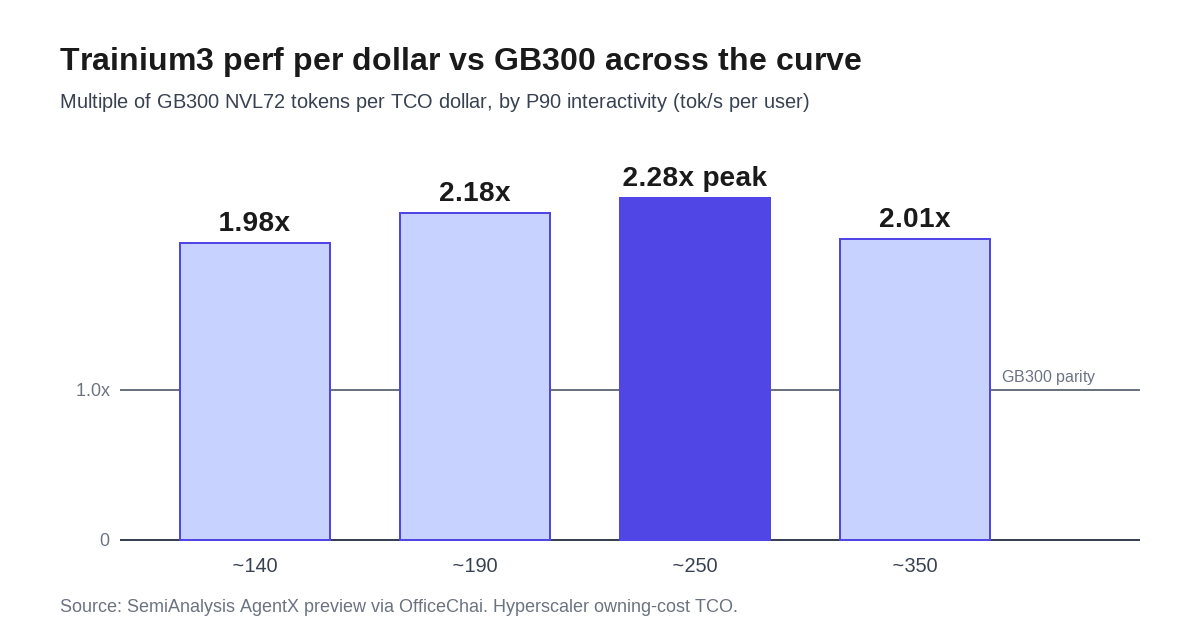
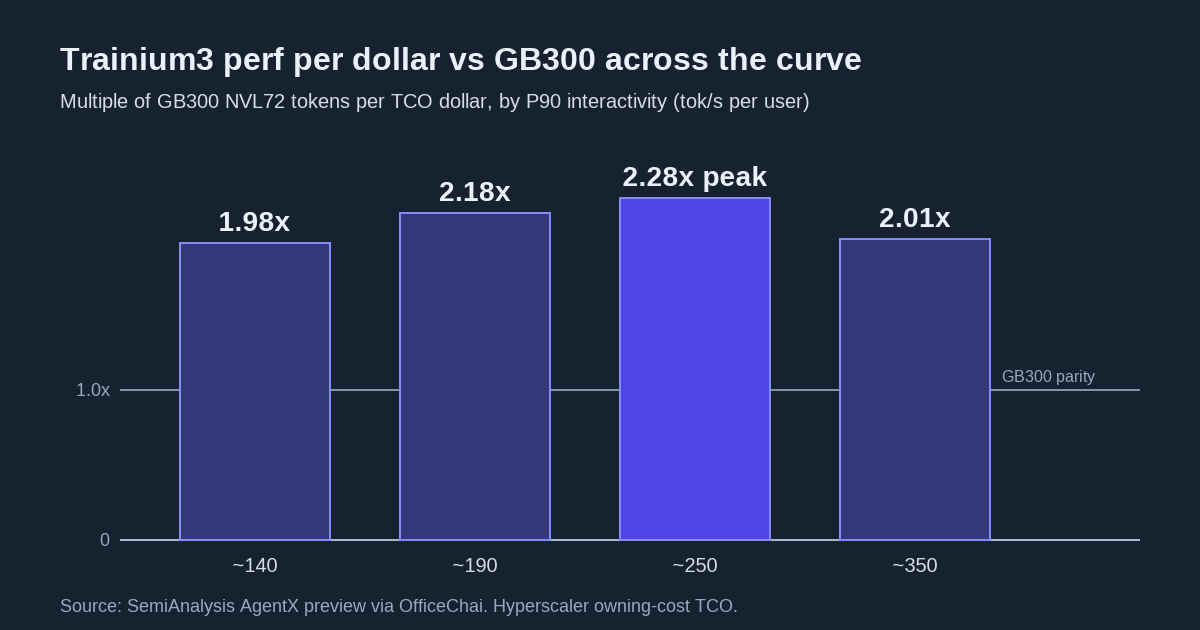
OfficeChai’s account of SemiAnalysis’s numbers has a Trainium3 UltraServer ahead of Nvidia’s GB300 NVL72 and B300 and AMD’s MI355X at every measured point on the curve. The metric is tokens per dollar of total cost of ownership, plotted against P90 interactivity:
| P90 interactivity (tok/s per user) | Trainium3 perf per dollar vs GB300 |
|---|---|
| ~140 | ~1.98x |
| ~190 | ~2.18x |
| ~250 | ~2.28x (peak) |
| ~350 | ~2.01x |
OfficeChai adds that the Trainium3 curve extends past 450 tok/s per user, further than any Nvidia or AMD system tested. SemiAnalysis calls these numbers an “official preview” that may change as validation continues.
Split the multiplier into speed and price
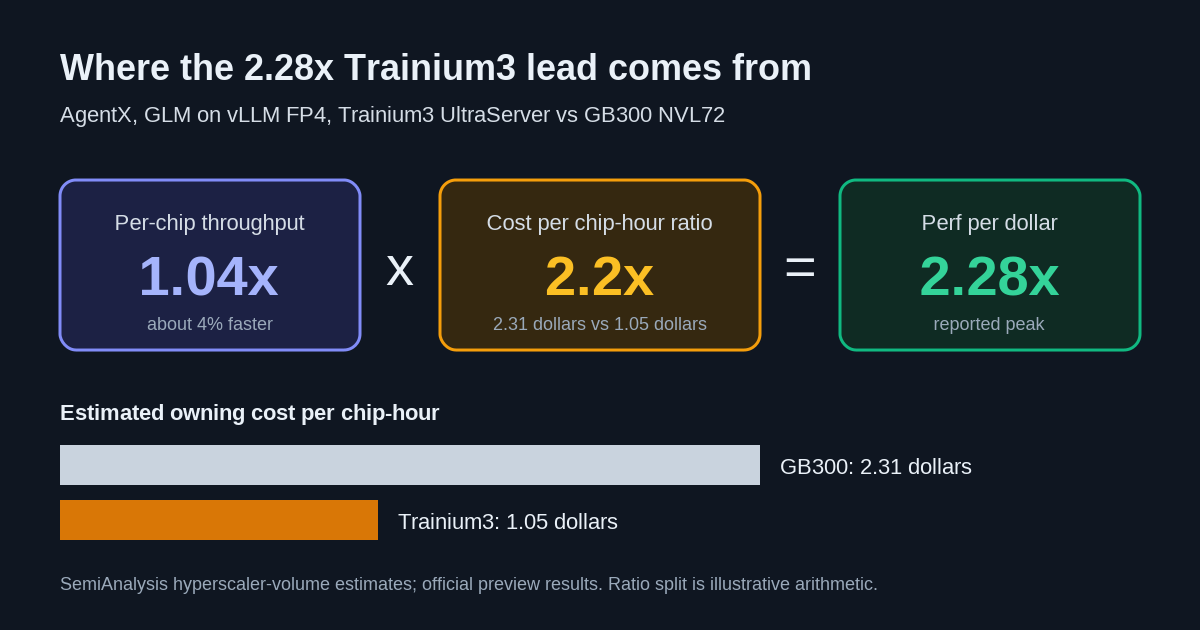
According to OfficeChai, SemiAnalysis estimates the hourly cost of owning each chip at hyperscaler volume at $2.31 for GB300, $2.26 for B300, $1.86 for GB200, $1.50 for MI355X and $1.05 for Trainium3. N Globe reports that at the same interactivity point, Trainium3’s per-chip throughput was only about 4% higher than GB300’s.
Those two figures account for nearly the whole headline:
perf-per-dollar lead = (throughput ratio) x (cost ratio)
                     = 1.04 x (2.31 / 1.05)
                     = 1.04 x 2.20
                     = about 2.29x   (reported peak: 2.28x)
That calculation is ours. It uses figures from two outlets, not a SemiAnalysis formula, but it matches what N Globe says in words: Trainium3 “wins by being cheaper, not faster.” So the result is a cost claim, and you can check a cost claim against your own prices.
SemiAnalysis’s Vera Rubin AgentX write-up explains how the metric works. Tokens per dollar is total throughput divided by all-in serving cost, which is dollars per chip-hour times the number of chips. InferenceX shows two default cost scenarios: owning at large hyperscaler volume, or a three-year rental commitment. Users can also enter the compute prices they actually pay.
The arithmetic is easy to redo. Hold throughput at about 1.04x and assume your effective price gap is 1.5x instead of 2.2x. The lead drops to about 1.56x. If the gap closes completely, roughly 1.04x is left. These are illustrative numbers. OfficeChai makes the same point: the $1.05 figure is SemiAnalysis’s estimate of what a hyperscaler pays to own the chip, and outside customers renting one may pay quite differently.
Why the workload matters for coding agents
AgentX isn’t a single-question chat test. N Globe reports that it replays 393 Claude Code sessions provided with user consent. The median request has about 142,016 input tokens and 444 output tokens. SemiAnalysis describes four traits of the workload: multi-turn sessions, long context, high prefix reuse and bursts of sub-agents with fresh context. In that shape, input processing and the KV cache take up most of the work, and output generation is a small slice.
That makes this benchmark closer to coding-agent traffic than older throughput tests are. A chip that is cheap per token on short prompts can look very different once contexts grow. OfficeChai also notes that Anthropic already runs Trainium at large scale for Claude production inference.
Nvidia’s counter and the missing systems
N Globe reports that the comparison left out Nvidia’s newest Vera Rubin systems. It also says Nvidia responded on the same dashboard that Vera Rubin NVL72 delivers 3.3x the tokens per dollar of Trainium3. Separately, SemiAnalysis’s September Rubin article reported large per-TCO gains for Rubin over GB300, and it flagged that those results ran on early pre-release software. Neither claim settles the question. Both systems are moving targets.
On Google’s side, OfficeChai says TPUv7 had already beaten GB300 NVL72 on performance per dollar across most of the curve in an earlier AgentX submission. What’s new is that Trainium has now joined the leaderboard too.
What to do with this
- If you pick API providers: Read this as a sign that serving costs for agent-shaped traffic may diverge by hardware. Don’t expect your price per token to change because of it. List prices depend on more than one benchmark.
- If you self-host open-weight models: The comparison uses vLLM in FP4 on a GLM-class model, the same kind of stack you might run. Enter your own rental or reserved prices in the InferenceX calculator before treating 2.28x as your number. Keep in mind that Trainium3 results exist for only one model so far.
- If you set latency targets: Choose the P90 interactivity your agents actually need, then read the multiple at that point. Don’t use the peak.
- If you plan capacity: Wait for the preview label to come off. Also wait for Vera Rubin to be measured under the same assumptions before you commit to anything long-term.
For context on how agentic inference benchmarking reached MLPerf, see our earlier report on Vera Rubin’s MLPerf debut. For the software side of running models on Amazon’s chip, see AWS TorchNeuron making Trainium a native PyTorch device.
Sources
- SemiAnalysis on X: "BREAKING NEWS🚨: 7 months ago, NVIDIA’s former and current CEO, Jensen, said that TPU & Trainium would never come to InferenceX to prove their performance claims. Today, we are happy to announce that both Trainium & TPU are on InferenceX/AgentX, the industry standard for inferen…
- Point the landing banner and center modal at Trainium3 GLM 5.2 AgentX / 首页横幅与居中弹窗改为 Trainium3 by functionstackx · Pull Request #1874 · SemiAnalysisAI/InferenceX-app · GitHub
- 7 Months After Jensen Huang Said TPU And Trainium Would Never Show Up On InferenceMAX, Both Are Beating NVIDIA On It
- Amazon's Trainium3 beats Nvidia's GB300 by up to 2.28x on cost in agentic AI benchmark|N環球
- Rubin NVL72 Agentic Inference: 67x better Performance per Dollar