NVIDIA Lets Models Manage Their Own Context: A Context API Nearly Triples GPT 6.1's Score at a 32K Budget
NVIDIA's controlled comparison of model-driven context management: in its open NOOA harness, GPT 6.1 nearly triples its OfficeQA Pro v2 score at a 32K budget, Kimi K3 uses up to 41% fewer input tokens, and suffix KV-cache reuse cuts prefill compute up to 15% per request.
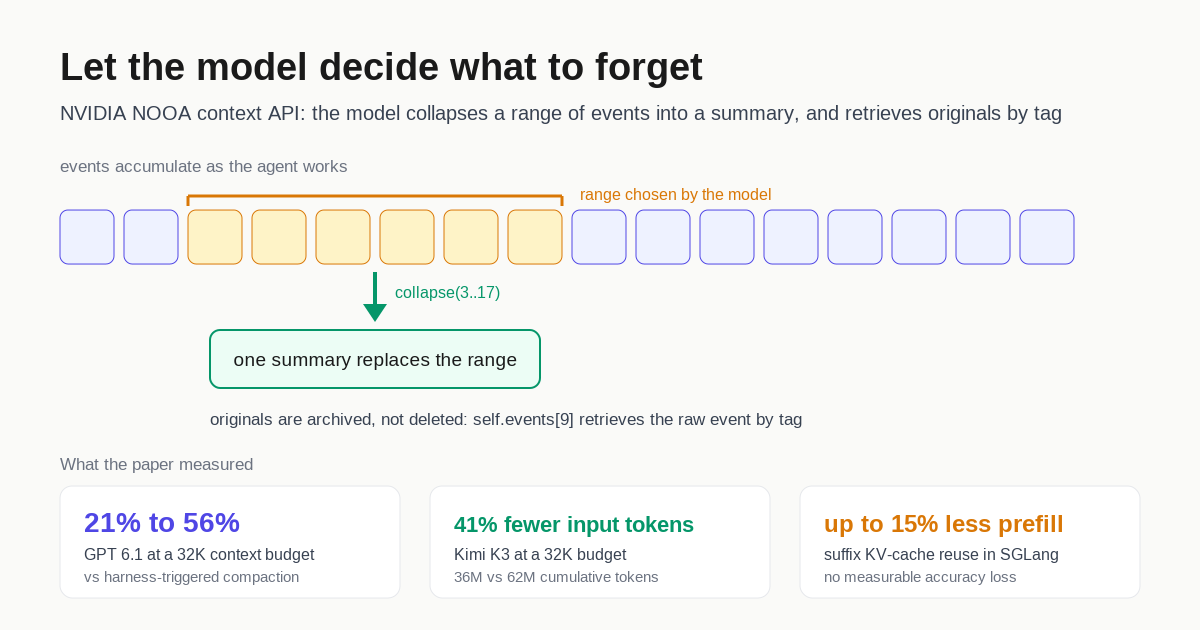
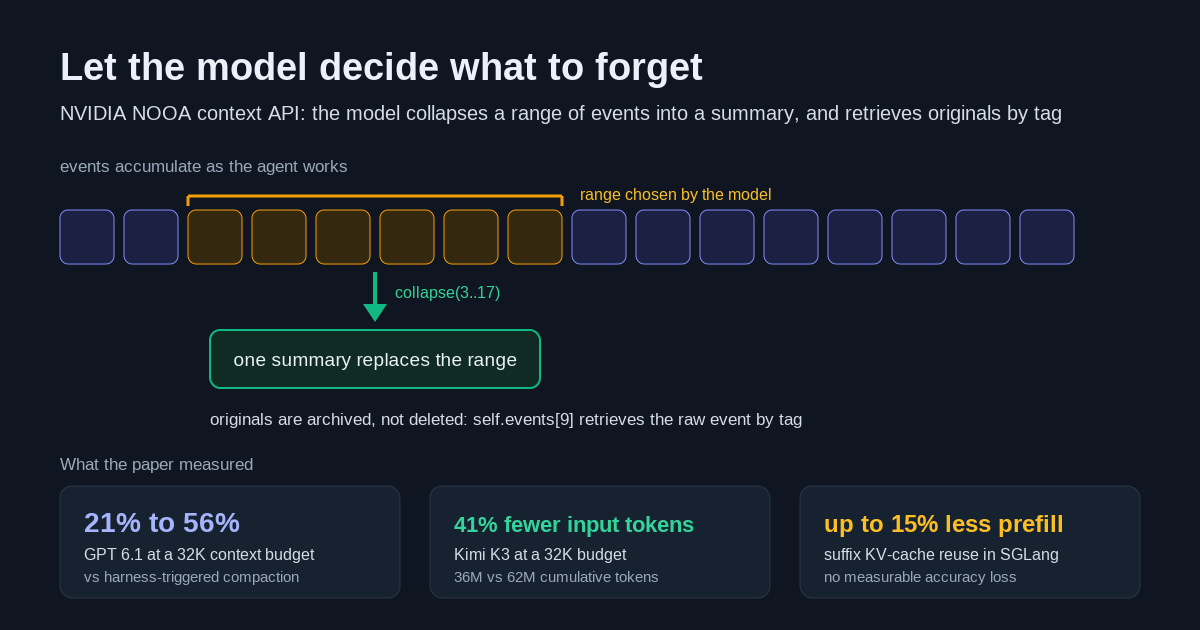
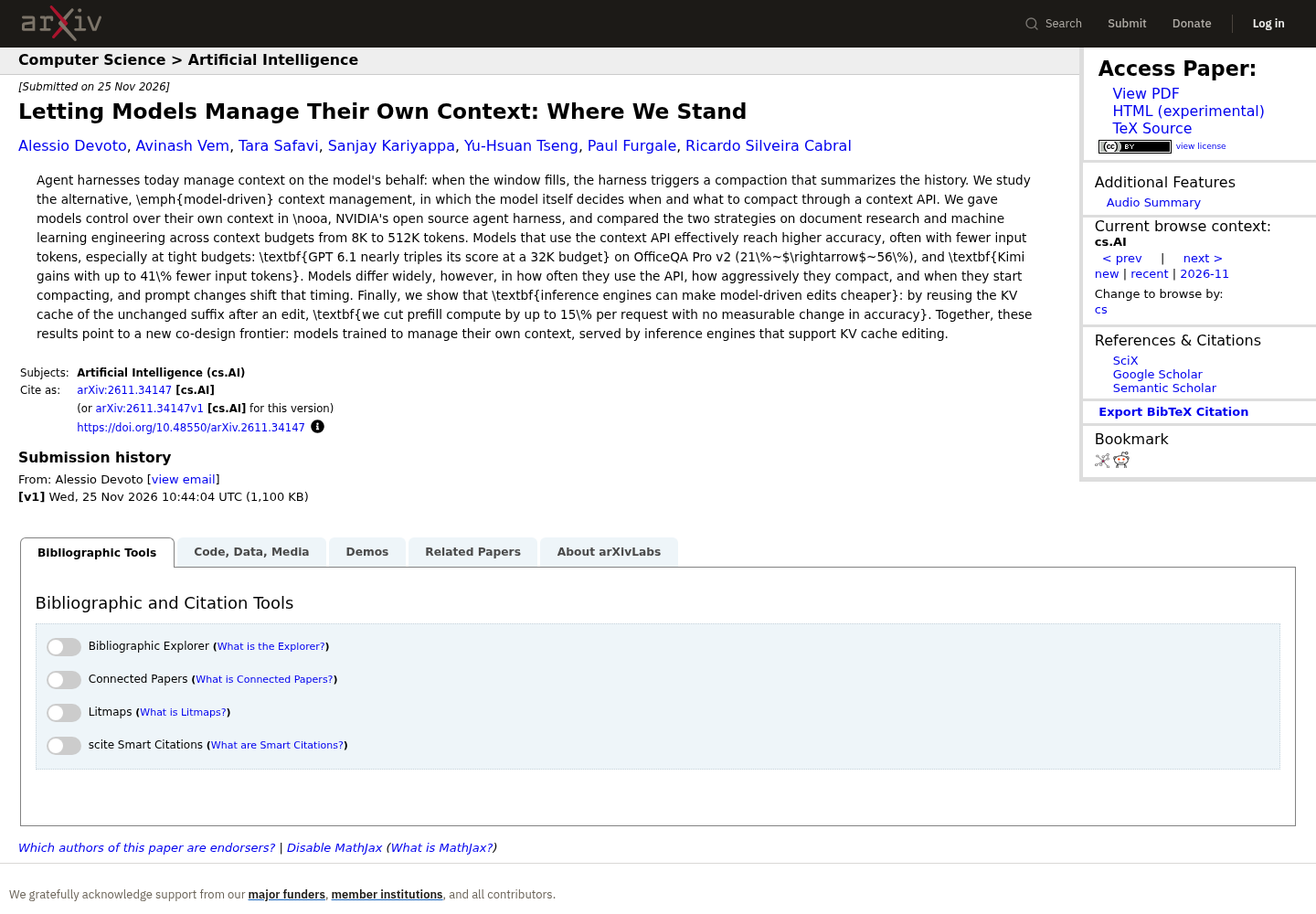
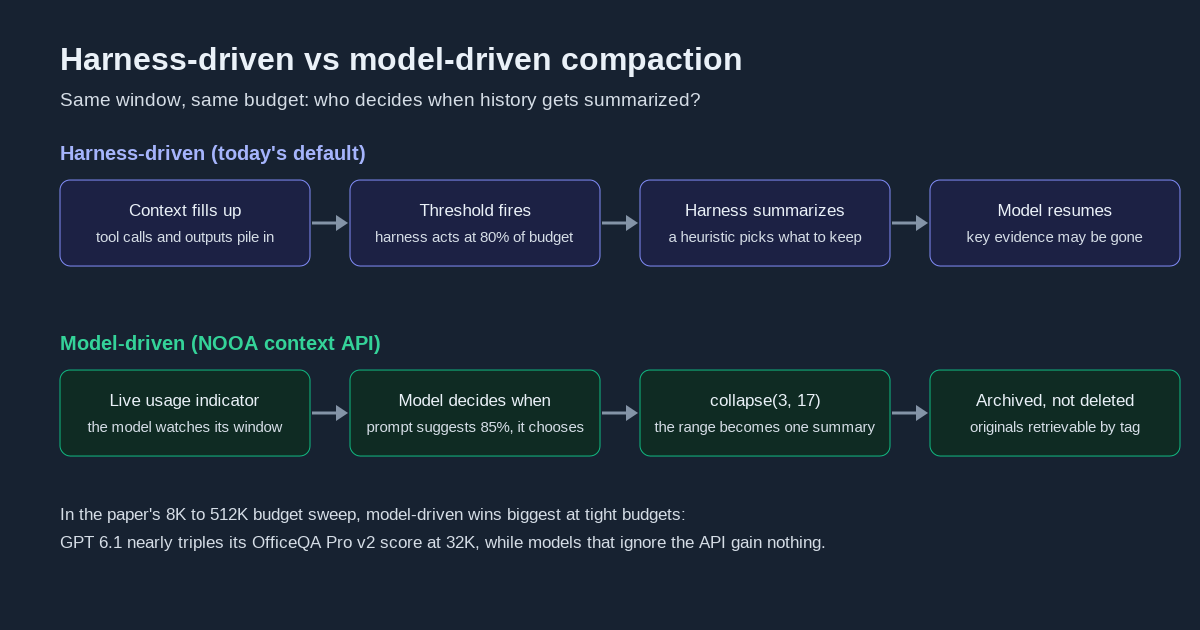
When an agent’s context window fills, something decides what the model keeps remembering. In almost every harness shipping today, that something is the harness itself: a heuristic watches token usage and, once the window crosses a threshold, summarizes history on the model’s behalf. A new paper from NVIDIA researchers, submitted to arXiv on November 25 and detailed in the team’s Applied Research dev notes, tests the alternative head-to-head: hand the model a context API and let it decide when and what to compact, across context budgets from 8K to 512K tokens.
The headline result matters for anyone running long-horizon agents on tight budgets. At a 32K context budget on OfficeQA Pro v2, GPT 6.1 nearly triples its score under model-driven management, from 21% to 56%, against the harness-triggered compaction that the authors note is the default in today’s harnesses. Kimi K3 gains with up to 41% fewer input tokens. The paper was listed on Hugging Face Papers, submitted by lead author Alessio Devoto of NVIDIA.
Two ways to forget
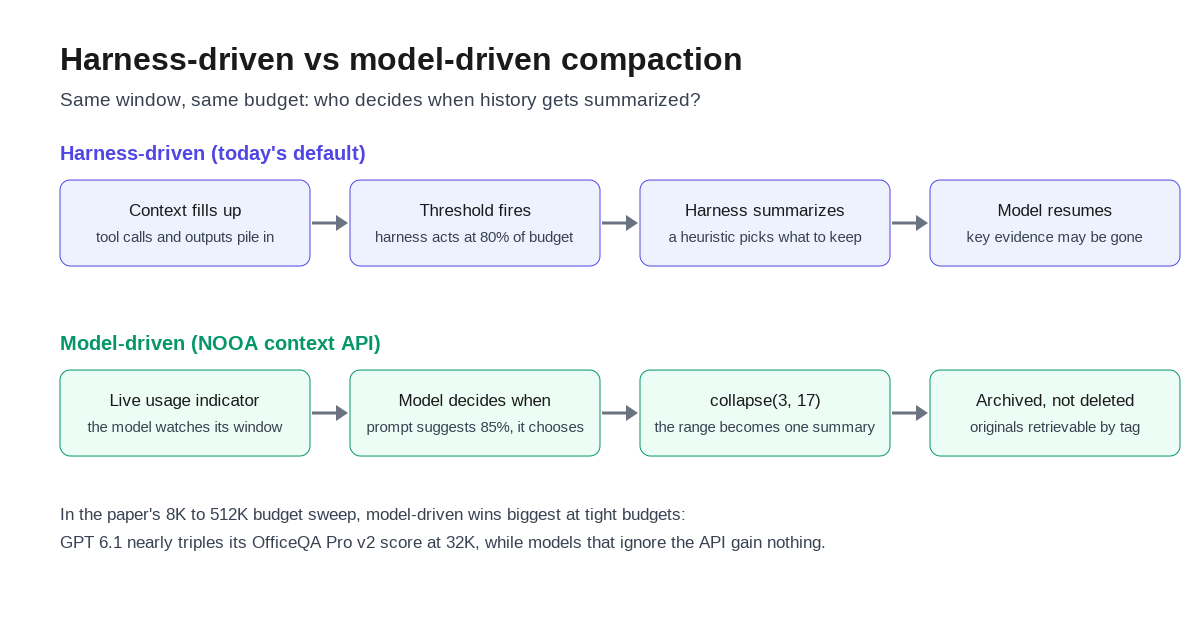
In harness-driven management, the harness summarizes earlier history once usage crosses 80% of the budget, preserving the initial instructions and the ten most recent events. The model only writes the summary; a fixed policy picks the moment and the range, and it can drop task-critical detail the model never gets to miss on purpose.
In model-driven management, the model gets three things: NOOA’s context API, a live context-usage indicator, and a warning as the window nears its limit. It can inspect its history and replace any range of events with a summary. Compacted events are archived, not deleted, so originals stay retrievable by tag:
# Replace events 3..17 with a summary; returns the summary tag "3..17"
summary_tag = self.events.collapse("3", "17", summary_text="Explored the repo.")

# The originals are archived, not deleted: retrieve any event by its original tag
original = self.events["9"]
The team ran both strategies inside NOOA, NVIDIA’s open-source agent harness (Apache 2.0, installable with uv add nooa), on two benchmarks: OfficeQA Pro v2, 90 questions over a large corpus of U.S. federal receipts and expenditures, and MLE-bench Lite, 22 Kaggle competitions. Each budget is a hard limit on request size.
The numbers
Gains concentrate at tight budgets, where the agent must manage its history repeatedly, and shrink as the budget grows. On MLE-bench Lite, whose tasks need far less context, the effect is much smaller and limited to the tightest budgets.
Models also differ sharply in whether they use the capability at all. GPT-6.1 Sol, Kimi K3 and DeepSeek-V4-Pro call the API in 42-53% of tasks. Opus 5.5 edits its context in just 4%, often finishing before compaction is needed.
| Model | Median shrink per compaction | Archived content retrieved again | Under pressure at 64K |
|---|---|---|---|
| GPT-6.1 Sol | 3.7x | 19% of compactions | Reads the API docs first in 69% of episodes |
| Kimi K3 | 2.1x | 7% | Compacts straight away in 49% |
| DeepSeek-V4-Pro | 1.8x | 3% | Inspects event history first in 46% |
| Opus 5.5 | 1.5x | 14% (noisy estimate) | Mostly wraps up and answers instead |
GPT’s pattern — knows when to call, compacts hardest per call, goes back for archived content when needed — is what effective use looks like. Kimi shows the efficiency version: at a 32K budget the model-driven agent processed 36M cumulative input tokens versus 62M harness-driven while scoring slightly higher (43% vs 41%); at 64K it used about 11% fewer tokens and scored higher (57% vs 52%).
Context anxiety
Even models that use the API can compact too early — what the authors, following prior work, call context anxiety. With an instruction to consider compacting only at 85% usage, most models wait. Remove it and timing collapses: Kimi’s median first compaction drops from about 84% of budget to 29% at 128K, DeepSeek’s from 83% to 40% at 256K, and Opus — which almost never compacts with the instruction — starts compacting early without it. At 128K and above, the no-instruction variants score about 8 points below the harness baseline for Kimi and DeepSeek. One prompt sentence was doing real work.
Cheaper inference, not just fewer tokens
A shorter context is not automatically cheaper: today’s engines reuse the KV cache only up to the first edit, then recompute everything after it, including unchanged text. The team paired NOOA’s API with a suffix KV-reuse prototype in the SGLang serving engine using Qwen3.6-27B, and cut prefill compute by 4-15% per request across OfficeQA Pro, MLE-bench Lite and the DeepSWE coding benchmark, with no measurable accuracy change. Savings were largest on OfficeQA Pro because the suffix surviving an edit averages about 10K tokens, roughly 60% of the prompt.
What builders can do now
First, this is reproducible: the harness is open and the repo ships an events-API tutorial notebook. Second, measure before trusting — the timing instruction and the model’s own disposition decide whether model-driven compaction helps or quietly costs 8 points, exactly the lane-level check behind who owns compaction on an unattended lane and the context engineering playbook. Third, watch the co-design signal: the authors expect models trained to manage their own context served by engines that support KV-cache editing, and OpenAI’s Codex has already introduced an experimental context-management mode combining history and notes with a new_context tool.
The caveats are real. Gains are not uniform — DeepSeek improves less, and Opus barely participates. The study ran in NVIDIA’s own harness on chosen benchmarks, and the conjecture that training explains GPT’s comfort with the API is explicitly unproven. But as a controlled comparison it moves compaction from a harness heuristic to a measurable model capability — extending the thread from NVIDIA’s earlier token-cost research, which found late tokens may cost far more than early ones.
Sources
- [2611.34147] Letting Models Manage Their Own Context: Where We Stand
- Letting Models Manage Their Own Context: Where We Stand - Applied AI Research Dev Notes
- GitHub - NVIDIA-NeMo/labs-OO-Agents: NVIDIA Object Oriented Agents: the Pythonic way to build AI Agents. · GitHub
- Paper page - Letting Models Manage Their Own Context: Where We Stand