Qwen Code v0.28.7 Runs Claude Code Mods and Drops Its Tool-Call Safety Net
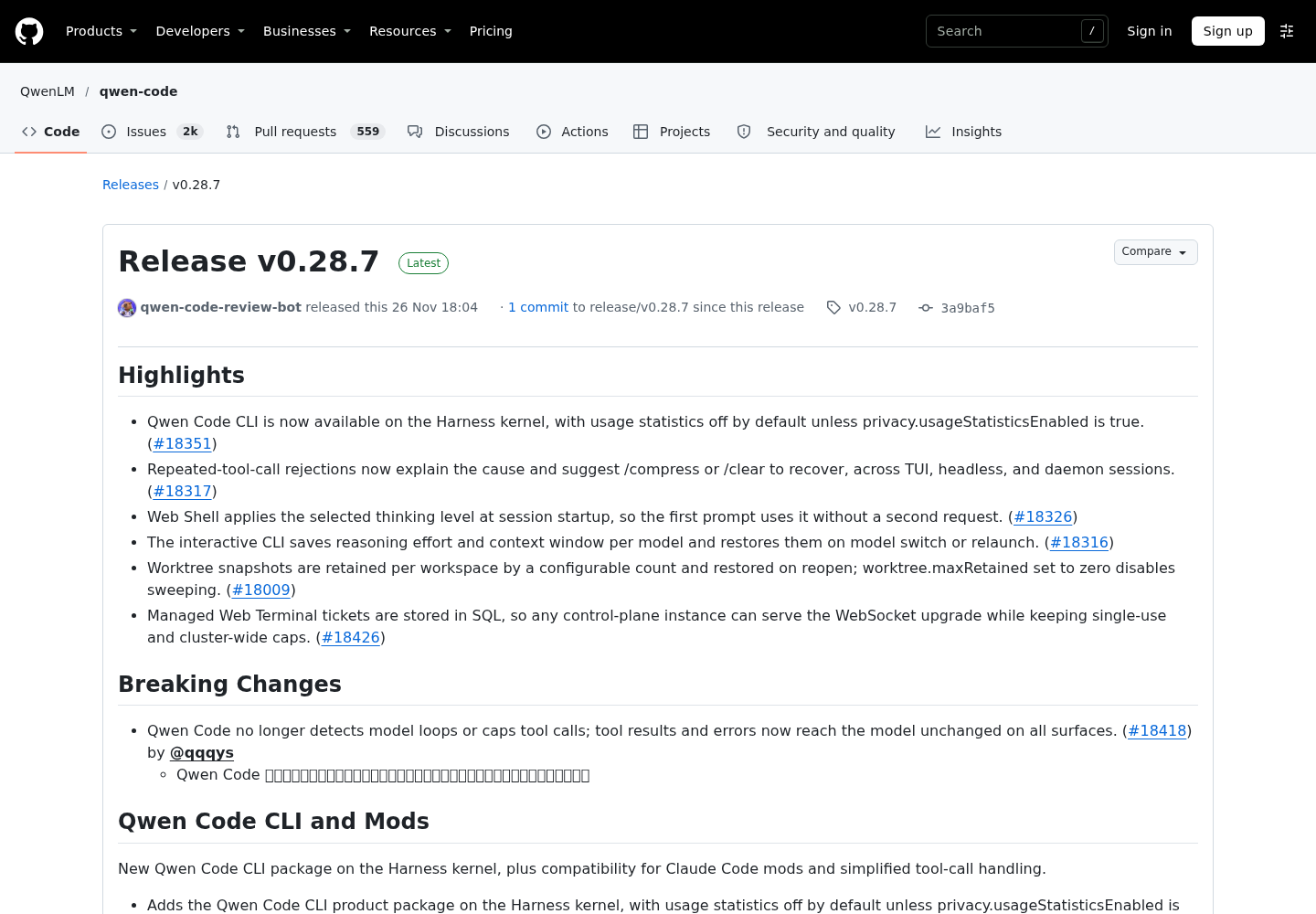
Qwen Code v0.28.7 loads Claude Code 2.1.332 mods on the Harness kernel, turns usage statistics off by default, and stops capping tool calls.
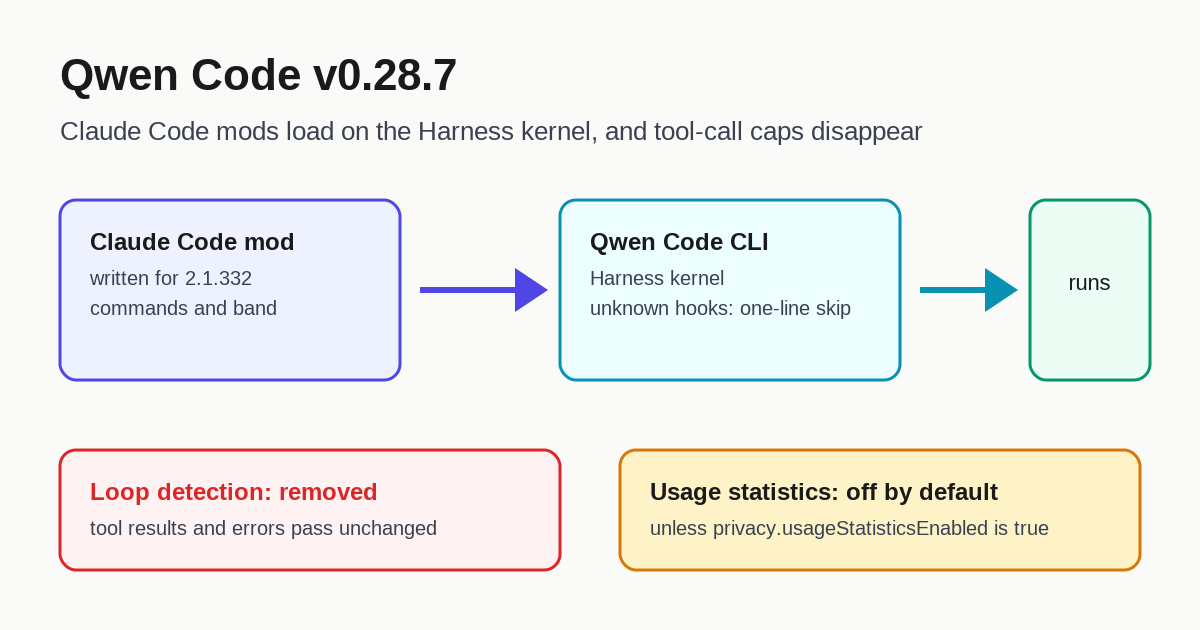
The Qwen Code team shipped v0.28.7 today, and the headline change is not another iteration of the managed-session machinery we covered in v0.28.6 — it is a cross-harness compatibility move: mods written for Claude Code 2.1.332 now load in Qwen Code, registering their commands and drawing their band, with hook names Qwen Code does not recognize skipped via a one-line diagnostic rather than a hard failure. If your team has invested in Claude Code mods — in-process extensions that rewrite replies or add commands — this is a concrete portability path onto Qwen’s Harness kernel, and a reason to re-read your extension manifest inventory before assuming a mod is single-harness.
What actually changed
The release bundles three operator-facing shifts:
- Claude Code mod compatibility (#18435, #18351). The new Qwen Code CLI product package runs on the Harness kernel and loads Claude Code 2.1.332-era mods. Commands register, the mod’s band renders, and unknown hook names degrade to a one-line diagnostic. That skip-don’t-crash behavior matters for fleet operators testing the same mod set across harnesses.
- Usage statistics off by default. The new Qwen Code CLI package on the Harness kernel keeps usage statistics off unless
privacy.usageStatisticsEnabledis set to true. Check that setting before you upgrade if you rely on those numbers. - Breaking: loop detection and tool-call caps removed (#18418). Qwen Code no longer detects model loops or caps the number of tool calls; tool results and errors now reach the model unchanged on every surface — TUI, headless and daemon. This is the item to plan around.
Why the removed loop cap changes unattended runs
Loop caps were a crude but effective brake on runaway unattended sessions: a model repeatedly invoking the same tool would eventually be stopped by the harness. v0.28.7 removes that brake everywhere. The model now sees the full tool result or error each iteration — the project calls this simplified tool-call handling — but it means a genuinely stuck model can spend far more tokens, API calls and shell invocations before a human notices.
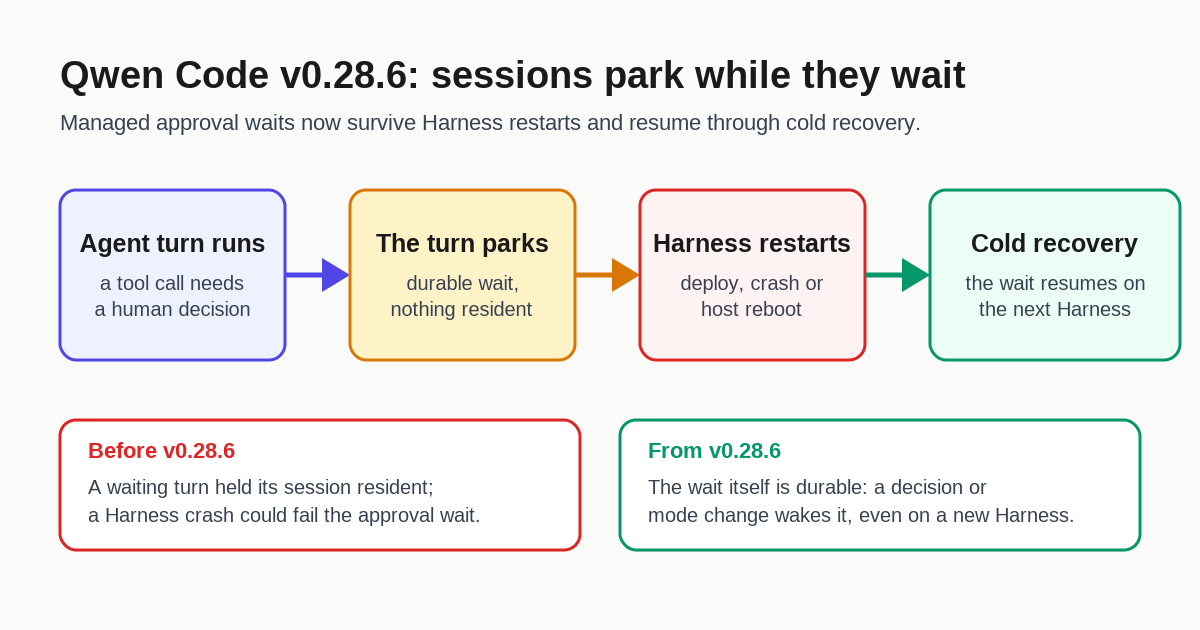
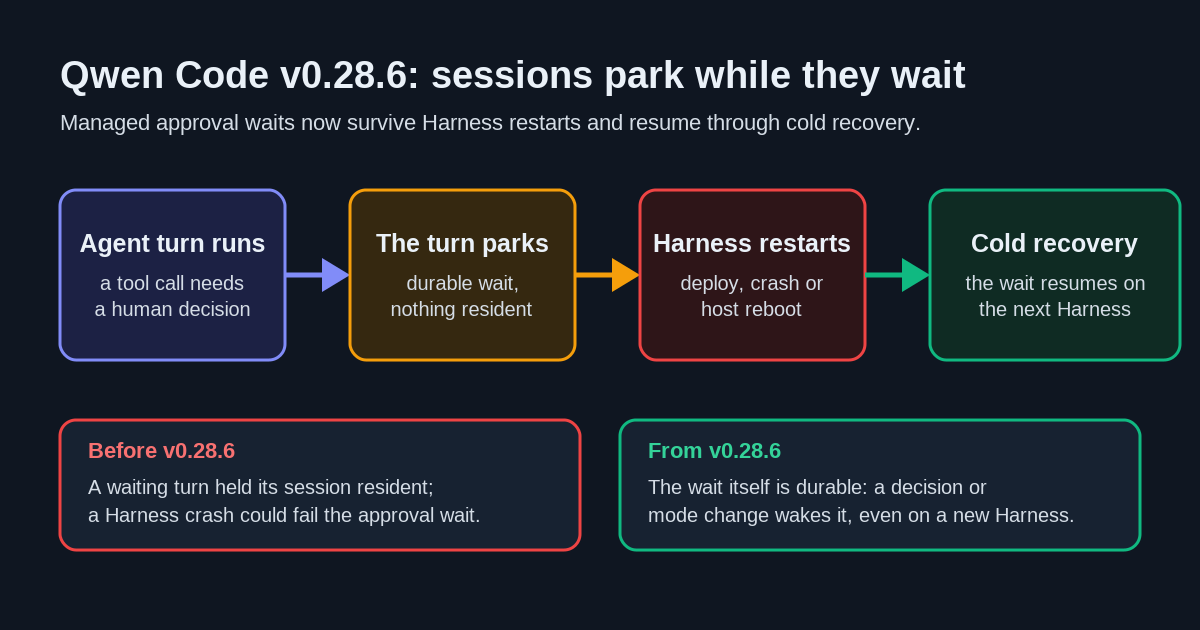
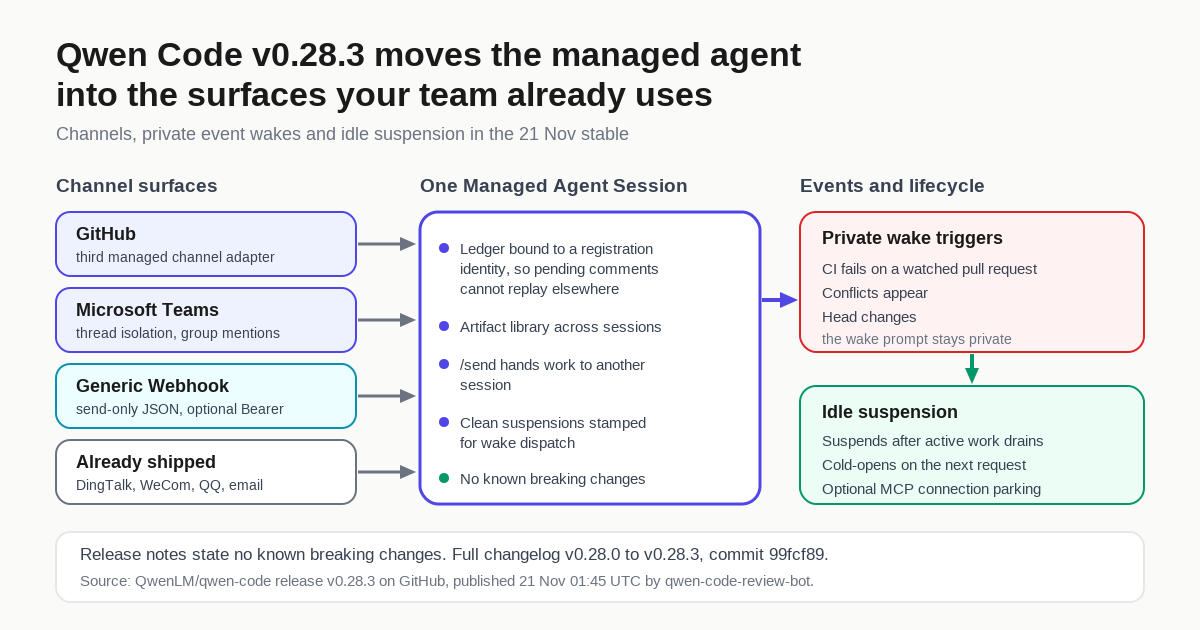
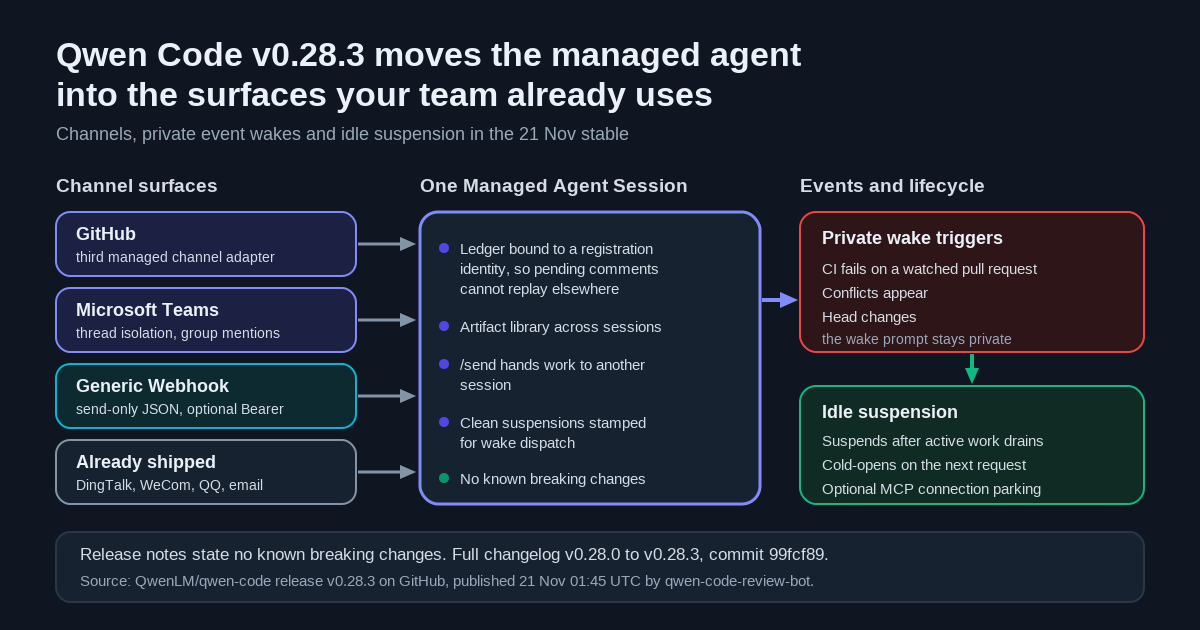
The release pairs the change with better recovery messaging: when a provider rejects a request for repeated tool calls, the error now explains the cause and suggests /compress or /clear across TUI, headless and daemon sessions (#18317). That helps interactive users; it does nothing for a cron-driven overnight lane. If you run unattended Qwen Code jobs, the loop cap was doing quiet work for you, and after this upgrade you own that job yourself. This continues a pattern we tracked when v0.28.3 put managed agents in GitHub and Teams and started suspending idle sessions: each release pushes more durability into the harness and more policy judgment onto the operator. The practical mitigations are external stop rules, per-run token budgets and a completion check the transcript has to prove — none of which live inside the harness loop anymore.
Smaller changes worth knowing
| Change | What it does |
|---|---|
| Per-model persistence (#18316) | The interactive CLI saves reasoning effort and context window per model and restores them on switch or relaunch. |
| Worktree snapshots (#18009) | Snapshots are retained per workspace by a configurable count and restored on reopen; worktree.maxRetained: 0 disables sweeping. |
| Thinking level at startup (#18326) | Web Shell applies the selected thinking level at session start, so the first prompt uses it without a second request. |
| Prompt-prefix caching (#18257) | The effective permission mode is appended to model requests only when it changes, preserving the cacheable prefix across resume and compaction. |
| Terminal tickets in SQL (#18426) | Any control-plane instance can serve the Web Terminal WebSocket upgrade while keeping single-use and cluster-wide caps. |
Getting it
The releases page lists v0.28.7 as latest, with standalone archives for macOS and Linux plus a Windows OpenTUI preview archive, published at 18:04 UTC; the official docs describe the standalone installer and provider setup, including Qwen subscription, QwenCloud, ModelStudio, third-party and custom providers. If you are running Qwen Code against local or third-party models, the release notes list no provider-setup changes.
The short version: mods written for Claude Code now have a second harness that loads them, usage statistics are opt-in, and the safety net that stopped runaway tool loops is gone. Two of those are conveniences; the third is a policy change for anyone running agents without a human watching.