Qwen Code v0.28.6 Lets Managed Sessions Park While Awaiting Approval and Survive Harness Restarts
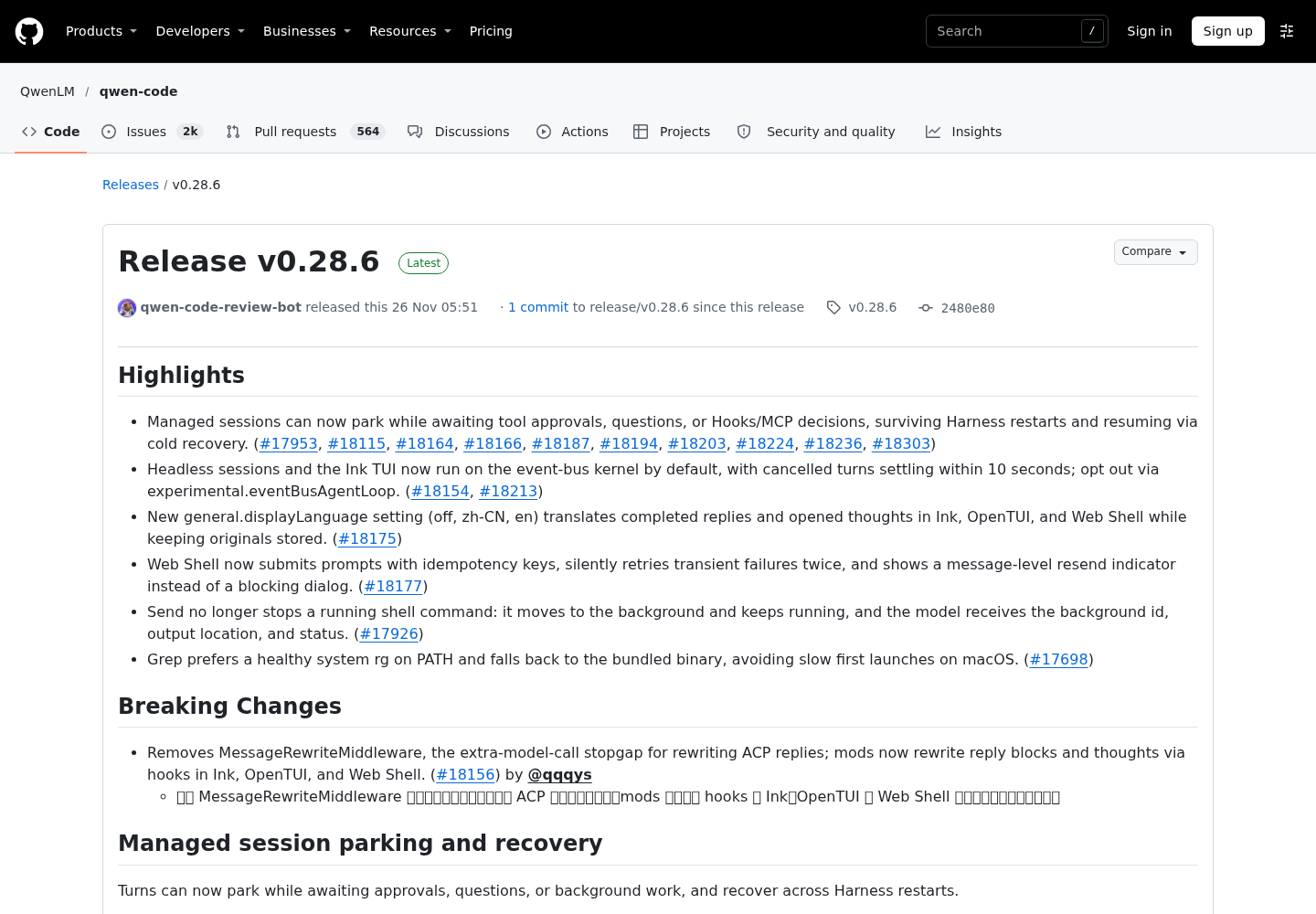
Qwen Code v0.28.6 lets managed sessions park while awaiting tool approvals, questions and Hooks or MCP decisions, resuming via cold recovery after a Harness restart. Send now backgrounds running shell commands, and MessageRewriteMiddleware is removed.
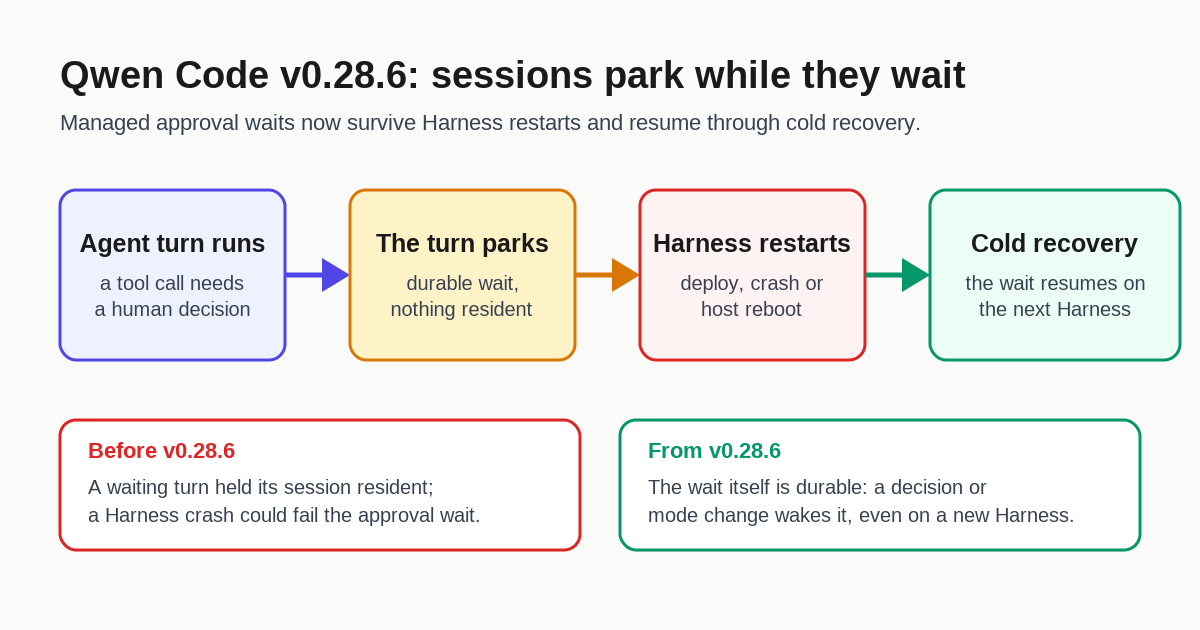
QwenLM released Qwen Code v0.28.6 on November 26, 2026, and the headline change targets one of the most stubborn costs of running coding agents at scale: waiting for a human. Managed sessions can now park while awaiting tool approvals, questions, or Hooks and MCP decisions — and because the wait itself is durable, the session survives a Harness restart and resumes through cold recovery.
For teams running approval-gated or unattended agent lanes, that rewrites a basic assumption. Until now, a turn that paused to ask “may I run this command?” kept its session resident until someone answered. v0.28.6 turns the wait into a stored state instead of a running process.
What can park now
The rollout spans the managed-agent surface:
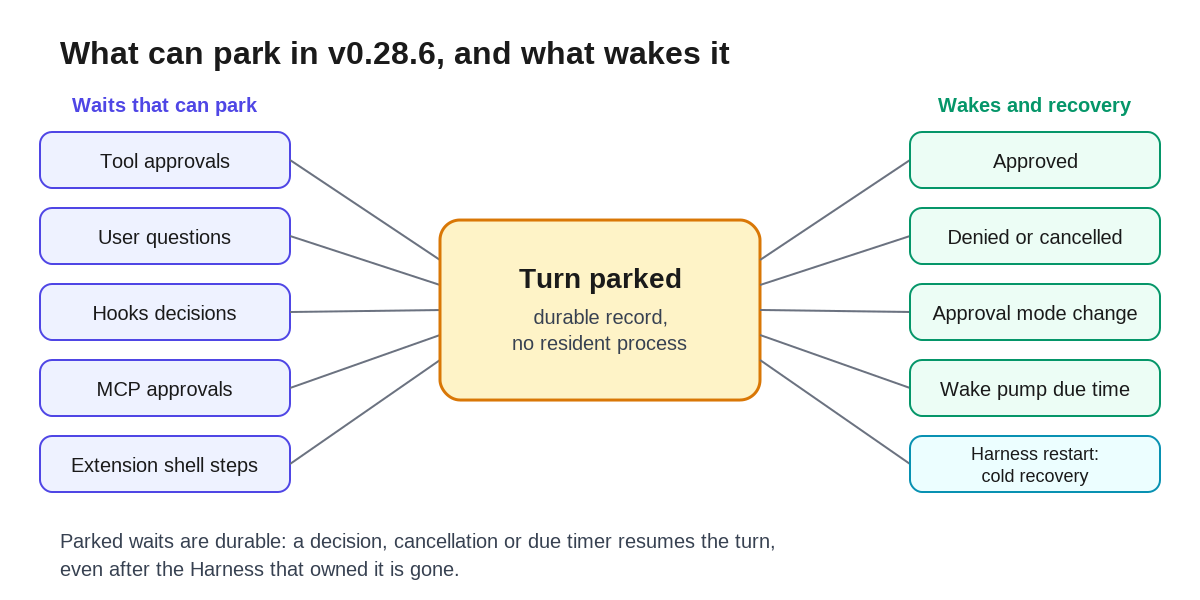
- Idle hosted sessions suspend while a recoverable tool-approval action awaits a decision, resuming on approval, cancel, or an approval-mode change.
- Approval waits requested by extension command steps, such as shell commands inside extensions, can park while awaiting the decision.
- Approval waits whose prompt contains only images or attachments can park and survive a Harness crash through cold recovery.
- Wake-started turns can park while waiting for tool approval, with the wake pump resuming them at the park’s due time instead of keeping the session resident.
- Child-session turns, channel and PR-event turns, and Hooks and MCP session approval waits can all park; version-0 public Shell sessions park approval waits on both Shell lanes.
Crash behavior is the practical core. A wake-started turn that was waiting for tool approval when its Harness crashed now resumes that approval wait on the next Harness instead of failing, and a turn that crashes mid-wait advances the session checkpoint so follow-up turns can start. A separate guard stops the parked-MCP reclamation job from retiring MCP connections that belong to sessions with a parked turn.
Why operators should care
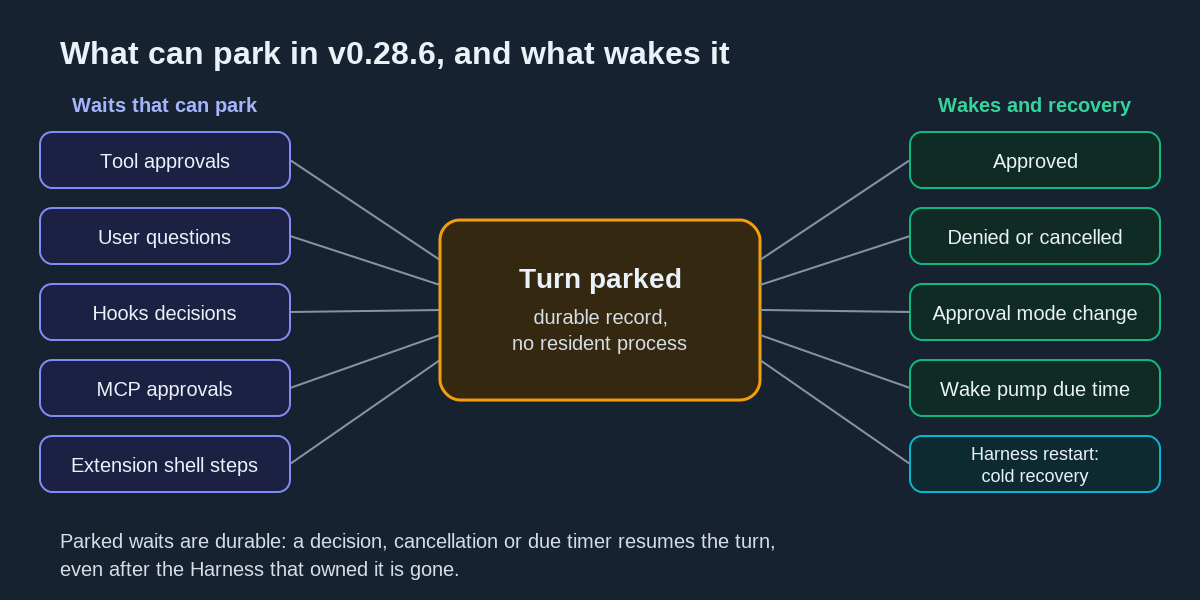
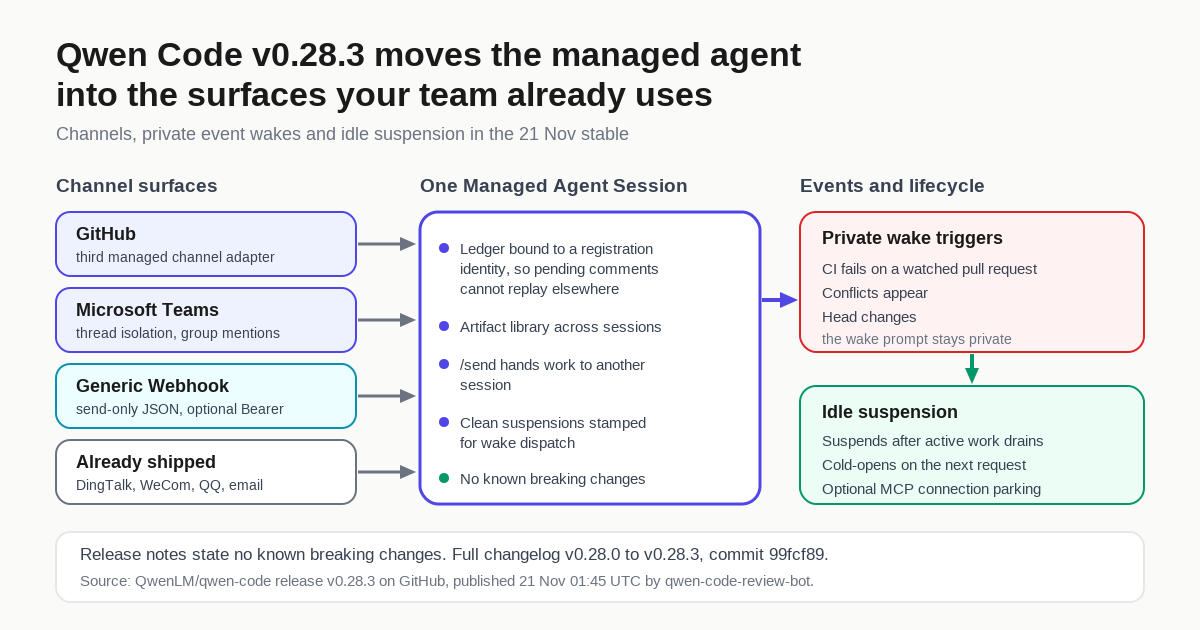
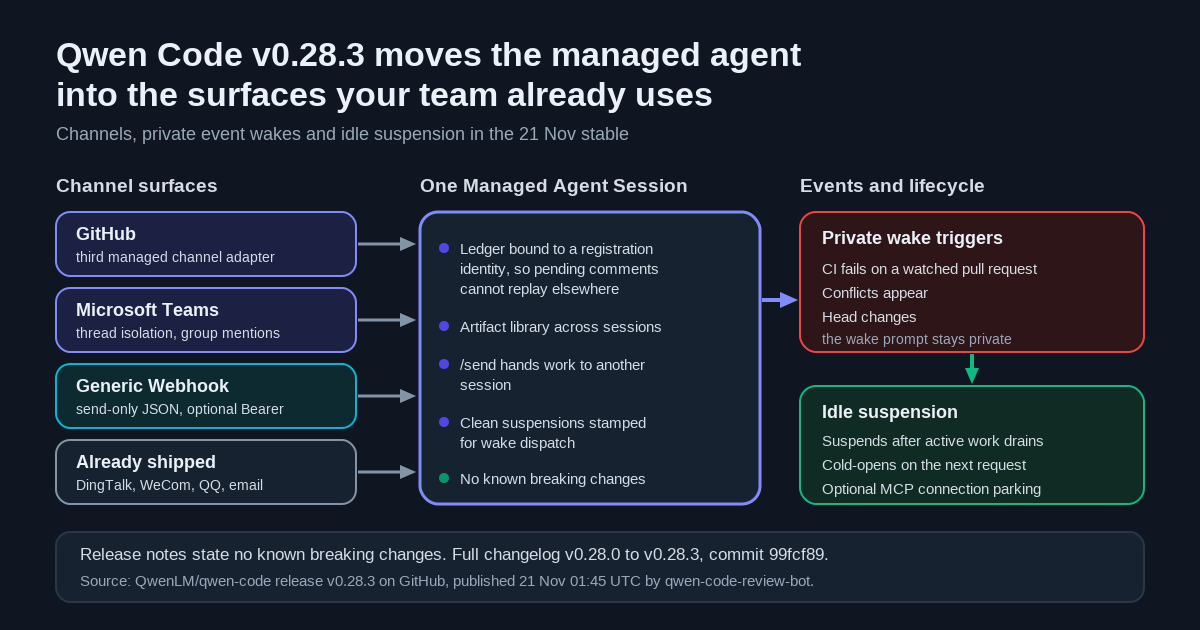
The direction has been visible across the 0.28 line. v0.28.3 added idle-session suspension and private PR wakes, and v0.28.4 built out the Web Shell around managed sessions. Parking closes the loop: the expensive “a human must decide” state no longer pins a resident process or dies with its host. Concretely, teams can now:
- Queue approval-gated work overnight and let sessions park at each gate instead of holding resident sessions until morning.
- Restart, upgrade, or lose a Harness without stranding every turn that happened to be mid-decision.
- Observe the behavior directly: the instance metrics route now reports suspension counts — clean suspensions, reverted attempts, eligibility failures, and cold opens — under a new suspension field.
Send no longer kills a running command
A second change will be felt daily. Sending a follow-up message while a shell command was running used to stop that command. Now Send moves the running command to the background and keeps it running, and the model receives the background id, output location, and status. Steering an agent mid-run no longer sacrifices a long build or test suite.
Event-bus kernel becomes the default loop
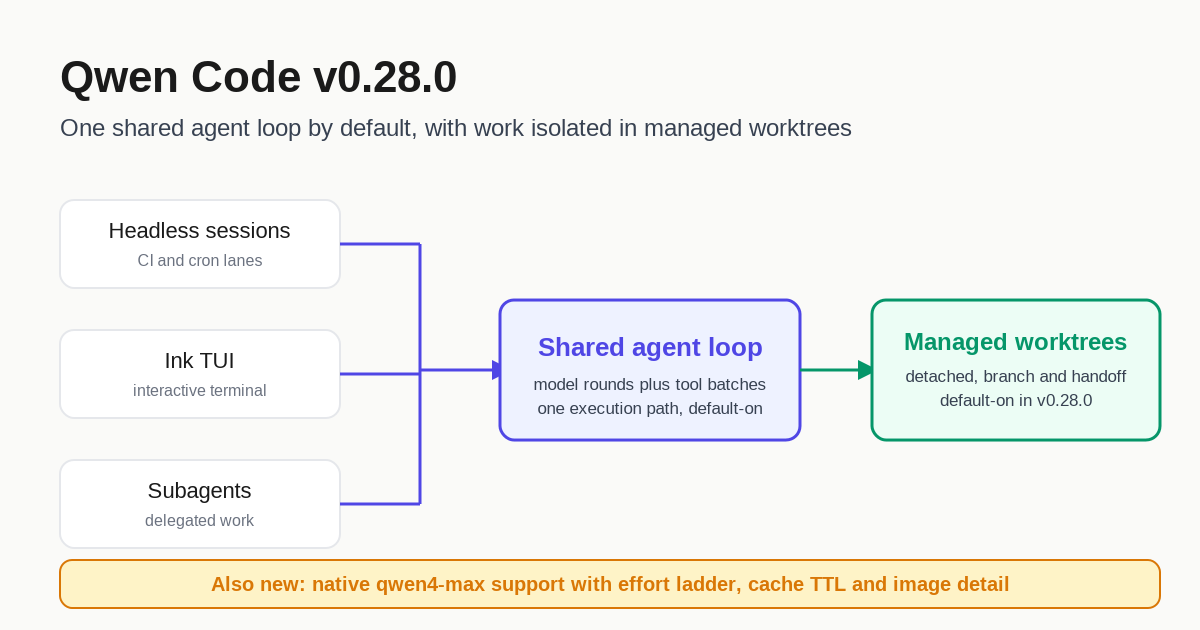
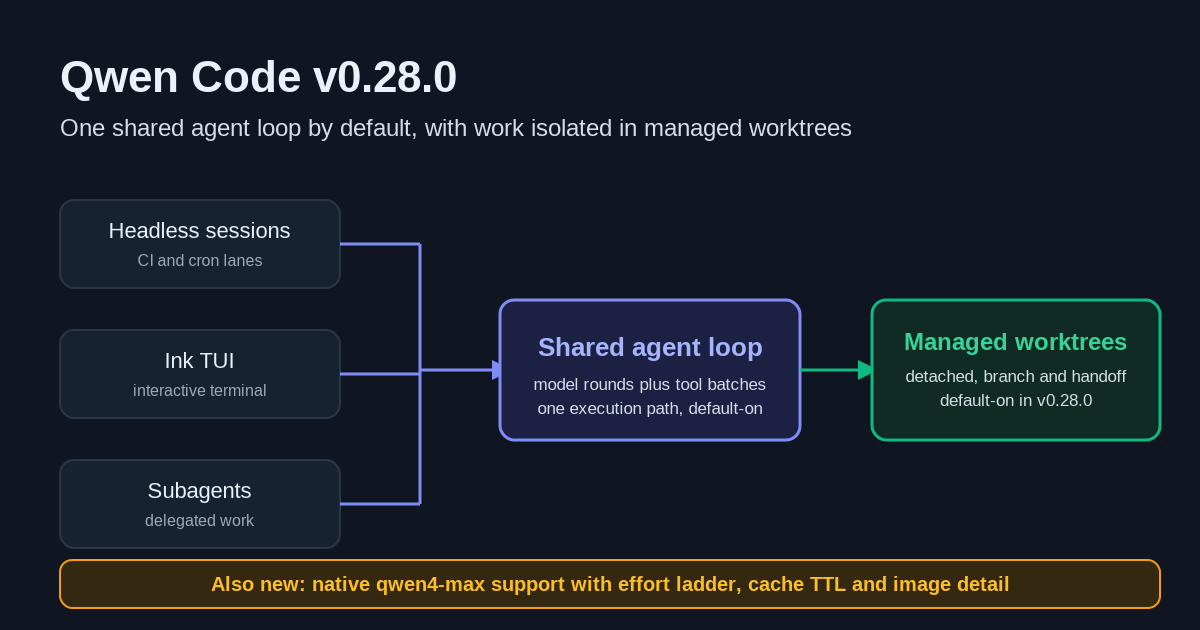
Headless sessions (-p, stream-json, and SDK) and the Ink TUI now run the shared agent loop on the event-bus kernel by default, with cancelled turns settling within 10 seconds. Fleets that need the old behavior can opt out via experimental.eventBusAgentLoop — worth pinning while you validate cancellation semantics, since this continues the loop consolidation that v0.28.0 started when it made the shared agent loop the default.
Breaking: MessageRewriteMiddleware is removed
Mod authors must act before upgrading. v0.28.6 removes MessageRewriteMiddleware, the extra-model-call stopgap for rewriting ACP replies. Mods now rewrite reply blocks and thoughts via hooks in Ink, OpenTUI, and Web Shell; the release includes a complete zh-display example mod showing the hooks-based pattern. Any fleet mod still importing the middleware will break on this version.
Also in v0.28.6
| Change | What it does |
|---|---|
| general.displayLanguage | New setting (off, zh-CN, en) translates completed replies and opened thoughts in Ink, OpenTUI, and Web Shell while keeping originals stored |
| Web Shell prompt retries | Prompts submit with idempotency keys, transient failures silently retry twice, and a message-level resend indicator replaces the blocking dialog |
| Grep binary selection | Prefers a healthy system rg on PATH, falling back to the bundled binary, avoiding slow first launches on macOS |
| Reasoning options | Gemini 4 Neon and Hydrogen gain xhigh reasoning effort (high stays default); Kimi K3 gets built-in detection on OpenAI-compatible gateways with low, high, and max |
| Long-session resilience | Context-overflow errors worded as “longer than the model’s context length” now trigger automatic compaction instead of failing |
Getting it
v0.28.6 is marked Latest on the Qwen Code releases page, with standalone archives for macOS, Linux, and Windows next to the cli.js bundle. New users can start with the official Qwen Code overview, which covers the 30-second installer. If your fleet runs managed sessions behind approval gates, plan the upgrade: audit mods for MessageRewriteMiddleware, decide whether any lanes should temporarily opt out of the event-bus kernel, and then let your waiting sessions do the thing they finally can — wait without staying awake.