Sber Ships GigaChat 4: A 708B MIT-Licensed MoE With a Terminal-Bench Agentic Leap and Day-0 SGLang Support
Sber's GigaChat 4 708B is MIT-licensed, merges instant and reasoning into one model, and jumps from 13%/30% to 60%/71% on Terminal-Bench 2.0 with day-0 SGLang support.
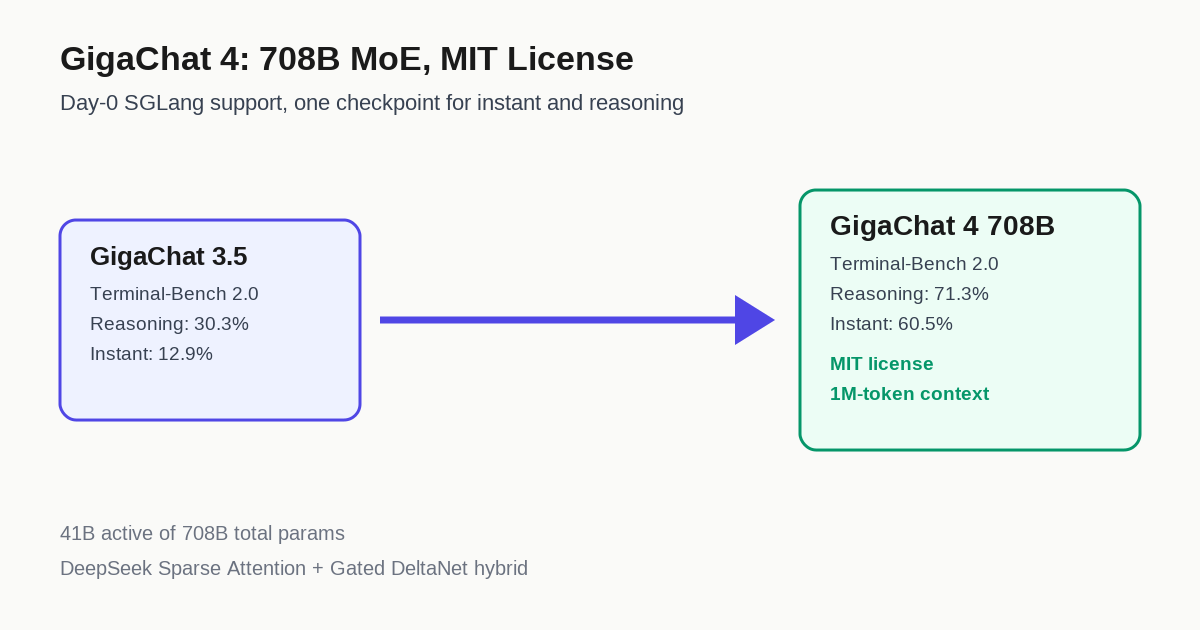
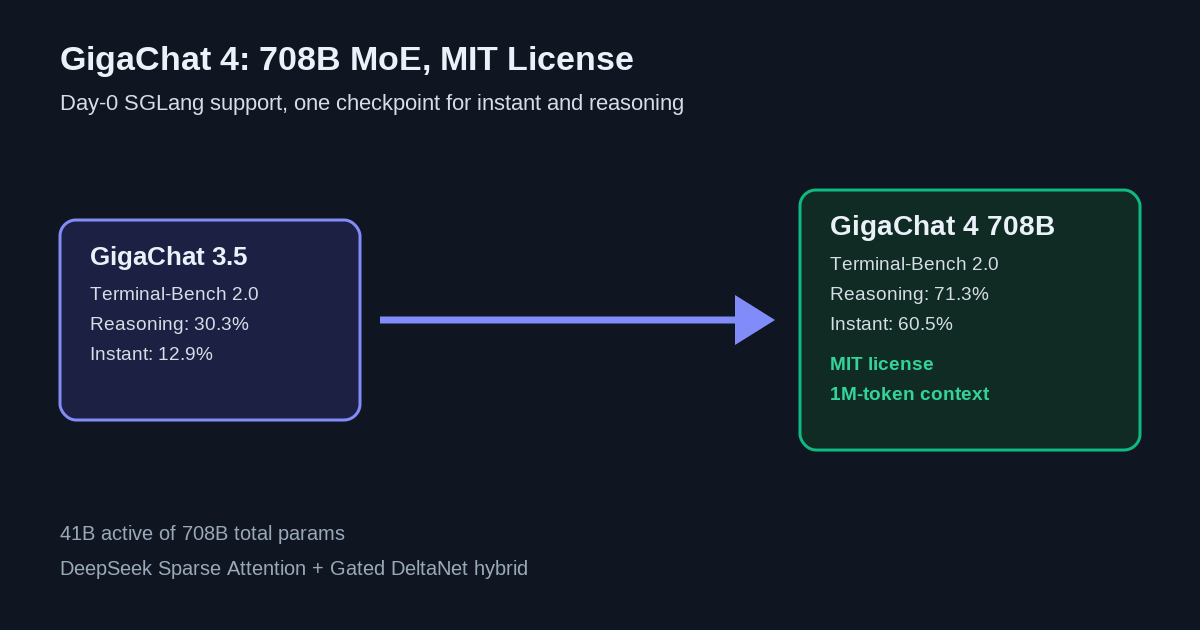
Sber’s AI Sage team published GigaChat 4 on November 26, 2026, and the release is unusual on three counts at once: the 708-billion-parameter flagship ships under a true MIT license, it collapses Sber’s previous split between “instant” and “reasoning” checkpoints into one model, and it already runs day-0 in SGLang with a published deployment cookbook. For teams evaluating whether another open-weight giant is worth a download, the concrete number to look at is Sber’s own benchmark delta between this release and its predecessor on an agentic-coding test, not the spec sheet.
What actually shipped
GigaChat 4 is a Mixture-of-Experts model with 708B total parameters and 41B active per token, built on the same hybrid backbone Sber introduced with GigaChat 3.5: Gated DeltaNet (GDN) recurrent layers interleaved with DeepSeek Sparse Attention (DSA) on top of multi-head latent attention. The 64-layer model mixes 48 GDN layers with 16 DSA layers in a 3:1 ratio, routes each token to 8 of 256 experts plus one shared expert, and was trained up to a native 1,048,576-token context window using YaRN scaling. A smaller 37B/4B-active sibling, GigaChat4-37B-A4B, shipped alongside it for lighter deployments.
The bigger structural change is that GigaChat 4 folds Sber’s separate instant and reasoning checkpoints into a single model, selectable per request via a chat_template_kwargs.reasoning flag. The Hugging Face model card below confirms the 708B repository is released under the MIT License, a rarer choice at this parameter count than the research or restricted licenses that typically accompany frontier-scale open releases — commercial use, fine-tuning and redistribution are all permitted.
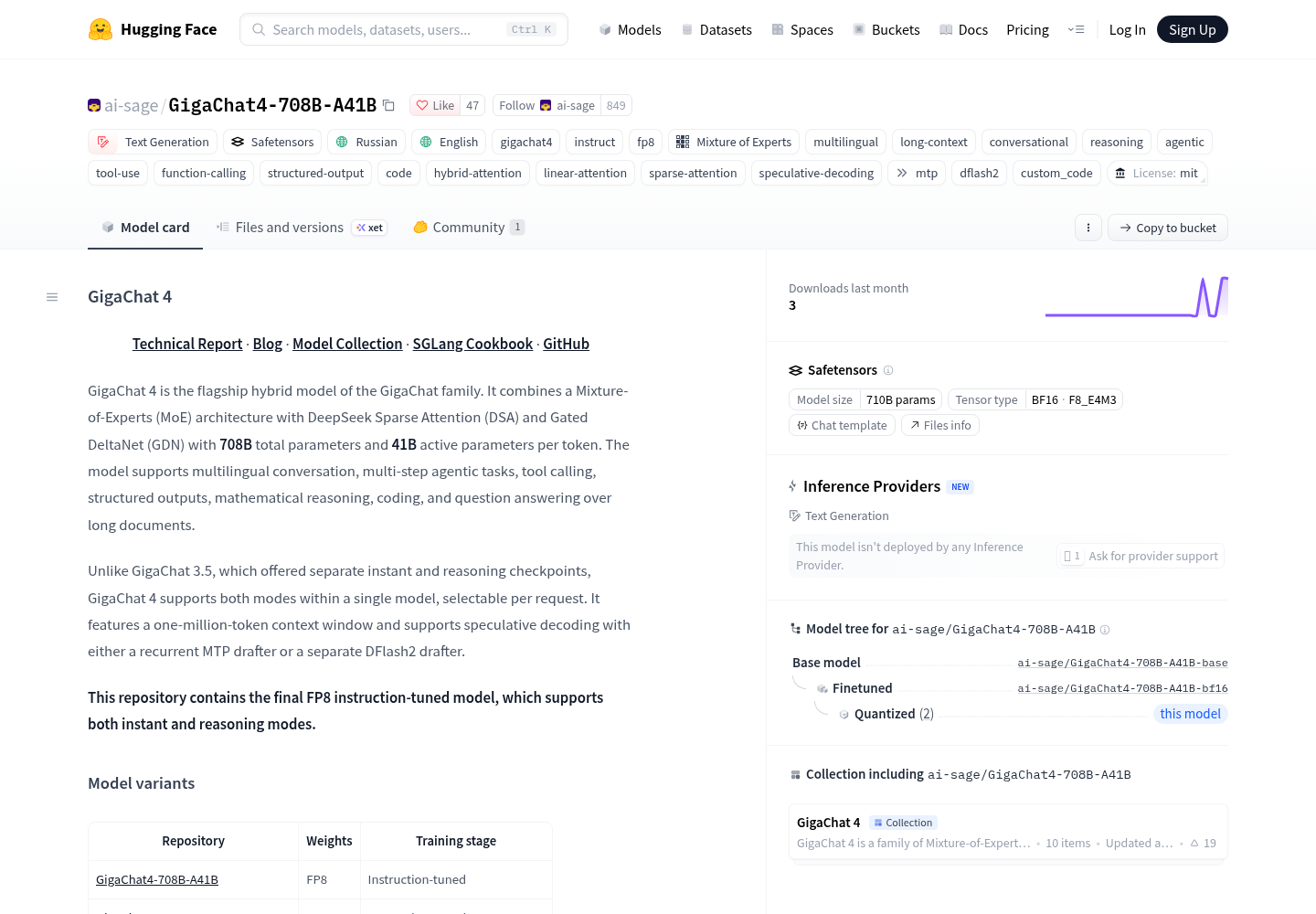
Hugging Face’s page for GigaChat4-708B-A41B, showing Sber’s MIT License declaration, architecture summary and benchmark tables for the 708B checkpoint.
The number that matters: a Terminal-Bench jump, not a changelog bump
Sber’s announcement post and model card both report GigaChat 4’s scores against its own prior generation on Terminal-Bench 2.0, an agentic benchmark that scores a model’s ability to complete multi-step tasks inside a real terminal:
| Mode | GigaChat 3.5 Ultra 432B | GigaChat 4 708B |
|---|---|---|
| Instant | 12.94% | 60.47% |
| Reasoning | 30.30% | 71.26% |
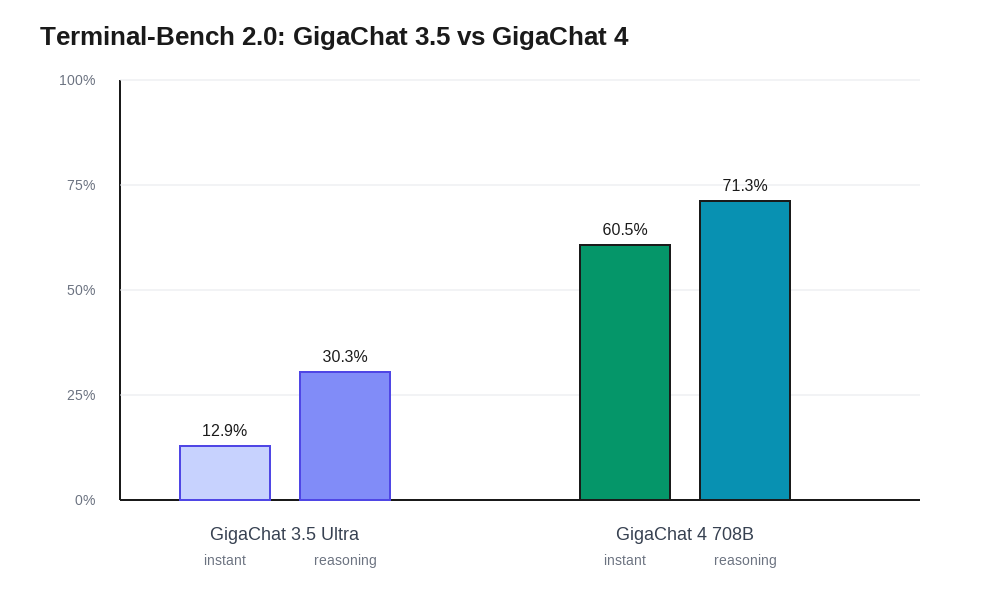
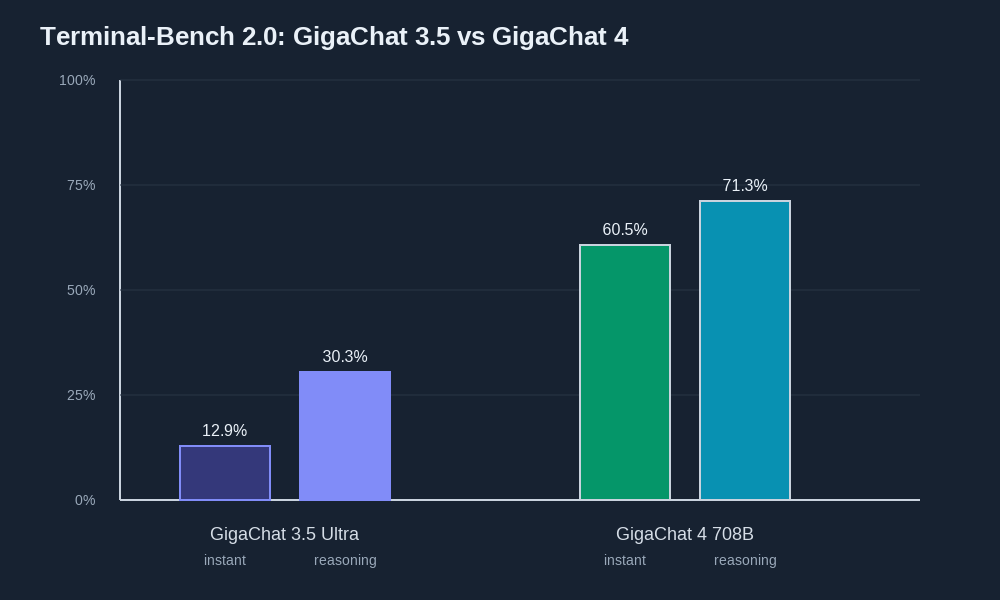
That is not a routine point release: Sber’s own numbers show the instant mode going from barely functional at agentic terminal tasks to clearing 60%, and reasoning mode more than doubling. The gain tracks the architecture story Sber tells in the announcement — agentic trajectories across nine harnesses (including OpenHands, Qwen Code and internal tooling) were folded into supervised fine-tuning, then distilled back into the merged checkpoint through what Sber calls multi-teacher on-policy distillation, with reinforcement learning on coding, repo-fixing, tool-use and multi-turn agent tasks feeding separate domain experts before consolidation.
Caveat worth carrying forward: these are Sber’s own numbers, not an independently reproduced result, and they don’t make GigaChat 4 best-in-class. On the newer Terminal-Bench 2.1, GigaChat 4 708B’s reasoning score of 69.66% trails DeepSeek V4.1 Flash-1017 (87.64%), GLM-5.3 (88.70%) and Mistral Large 4 (83.33%). The real story is the leap within Sber’s own lineage and the fact it’s a day-0-deployable, MIT-licensed model — not a claim to the overall agentic-coding crown.
You can actually run it today
Unlike a spec-sheet announcement, GigaChat 4 has working inference paths now. SGLang’s cookbook documents a tested two-node, 16x H100 80GB (TP16) deployment for the FP8 checkpoint, with recipes for both the model’s built-in recurrent Multi-Token Prediction drafter and a separately trained DFlash2 speculative decoder that predicts tokens in parallel using an eight-position block, one anchor token and seven draft positions. A vLLM integration PR (commit c0c9083) is also referenced on the model card for teams that prefer that stack.
A minimal SGLang launch command for the low-latency recipe looks like this:
sglang serve \
 --model-path ai-sage/GigaChat4-708B-A41B \
 --tp 16 --nnodes 2 --node-rank "$NODE_RANK" \
 --dist-init-addr "${HEAD_IP}:20000" \
 --speculative-algorithm EAGLE --speculative-num-steps 3 \
 --reasoning-parser auto --tool-call-parser auto
Both instant and reasoning modes run through the same OpenAI-compatible endpoint; flipping chat_template_kwargs.reasoning between false and true is the only change needed to switch modes on a request-by-request basis. Sber also published tested configurations for three agent harnesses — Pi, Codex CLI (via a Responses-to-Chat-Completions gateway), and DeepSeek Harness — with sample config files for each, so self-hosters aren’t left guessing at integration details.
What to do with this
For anyone already running open-weight models in a coding-agent pipeline — see our guide to open-weight models that can actually drive a harness — GigaChat 4 is worth a bench-test specifically because the license removes the usual commercial-use friction that comes with Chinese and research-lab releases, and because the SGLang path is already validated rather than theoretical. Teams evaluating the speculative-decoding options should also check our llama.cpp speculative decoding breakdown before assuming the DFlash2 numbers translate directly to other serving stacks, and anyone standing up DeepSeek Harness as one of the three supported integrations should read our DeepSeek Harness review first. The honest framing: this is a real, benchmarked agentic-capability jump for Sber’s own model family, served through infrastructure you can stand up this week, with the standard caveat that vendor-reported numbers still need independent verification before they drive a procurement decision.