LangChain Details the Agent Lake Architecture for Turning Production Agent Traces Into Fixes and Fine-Tuned Models
LangChain details the Agent Lake architecture pairing SmithDB traces and LangSmith outcomes with AI Search, Engine v2, Smithtune, and ISO 42001 audits.
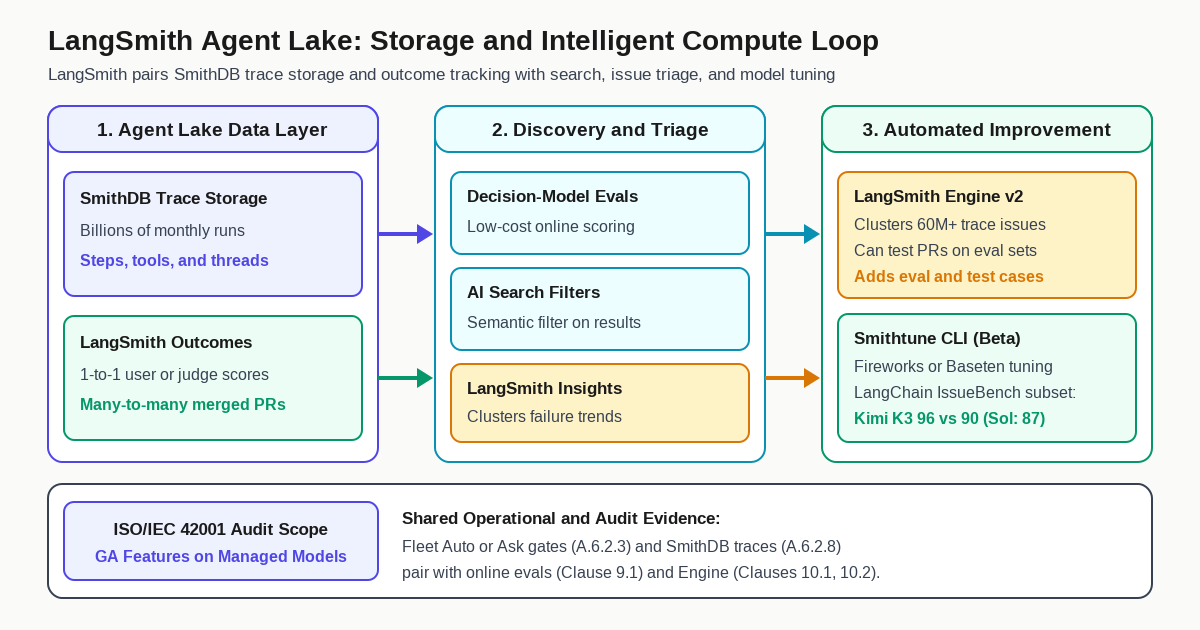
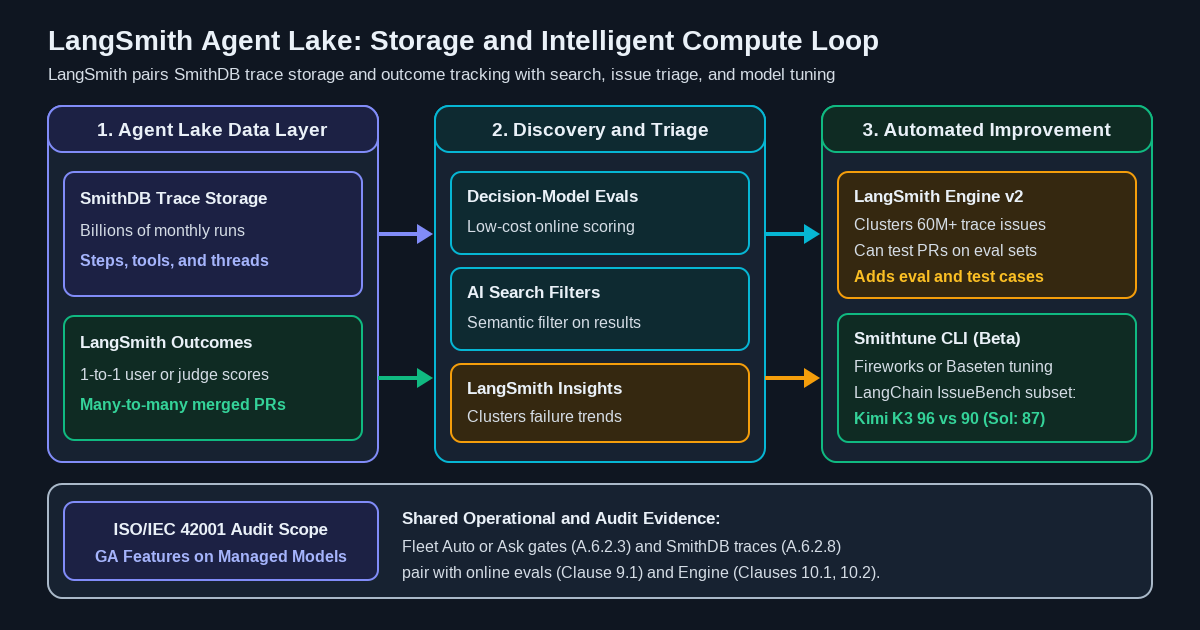
On November 24, 2026, LangChain published The Agent Lake by Sam Crowder, detailing how LangSmith pairs its SmithDB trace database with an “intelligent compute” layer for continuous agent improvement. Because manual debugging fails at scale—LangSmith ingests billions of monthly runs, and customers like Clay send hundreds of millions of daily events—teams need automated trajectory analysis.
LangChain argues that conventional data lakes such as Snowflake and Databricks lack storage and compute optimized for unstructured agent reasoning traces. It therefore structures LangSmith as an agent lake combining SmithDB trace storage with LangSmith outcome tracking, where compute modules filter trajectories, propose pull-request fixes, fine-tune models, and provide audit evidence.
SmithDB Trace Storage and LangSmith Outcome Tracking
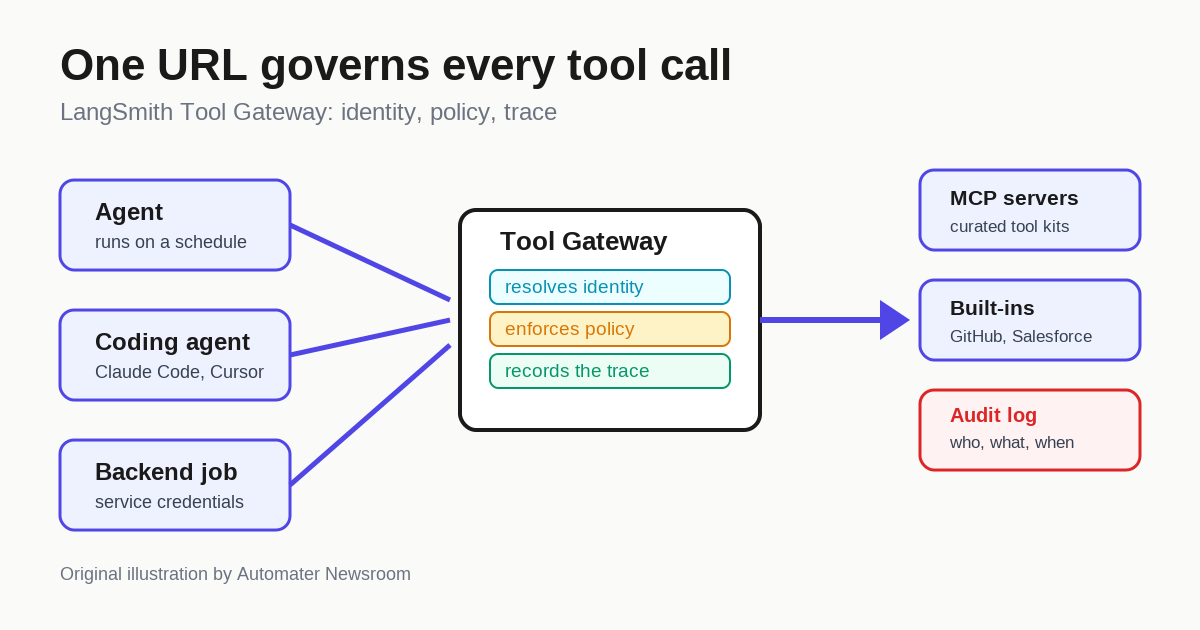
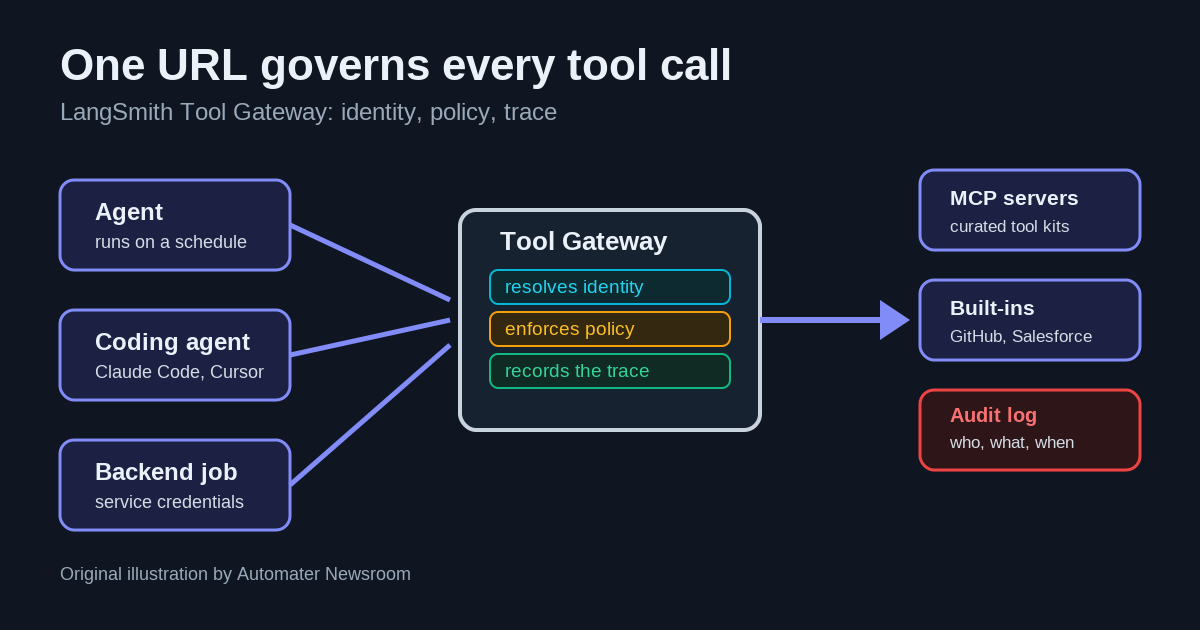
Each SmithDB trace records an agent run from user input through model and tool calls to final output, grouping multi-turn conversations into threads. This builds on LangChain Rebuilds LangSmith Around a Single Agent Record and LangSmith Tool Gateway Enters Public Beta.
While SmithDB stores execution traces, LangSmith tracks outcomes along two dimensions:
- Cardinality: Outcomes map one-to-one to a trace or thread (user thumbs-down or low conversation score) or many-to-many (under LangSmith’s coding agents type, one thread can open multiple merged PRs, or several threads can contribute to one merged PR).
- Generation source: Outcome signals come from direct user feedback, external system state (merged PRs or copied code snippets), LLM-as-a-judge proxy scores, or developer annotation queues.
Discovery and Triage: Decision Models, AI Search, and Engine
To avoid expensive full LLM-as-a-judge runs on every turn, LangSmith uses lower-cost decision models—introduced by TypeSafe AI in September—for online trace classification alongside tuned prompts for hallucination, toxicity, and user satisfaction.
For ad hoc discovery without pre-defining an evaluator, engineers specify a natural-language semantic filter in AI Search (such as "threads where the user got frustrated" or "traces that contain PII"), optionally combined with structured queries, and LangSmith runs a fast decision model over retrieved search results to apply that filter. LangSmith Insights answers traffic questions like "where is my agent failing?" by clustering recent and incoming traces into failure categories.
For automated remediation, LangChain launched LangSmith Engine in public beta on May 13, 2026, when Cogent, Harmonic, and Campfire used it across thousands of traces to cluster tool errors, timeouts, evaluator failures, latency or token spikes, unexpected step counts, and negative feedback into named issues. In its November 24, 2026 Agent Lake post, LangChain reported that Engine has analyzed over 60 million production traces across its customer base, and that with a connected repository Engine v2 can test a proposed pull-request fix against an evaluation set before team review.
Operator Workflow: Harness Fixes Versus Trajectory Fine-Tuning
Consider the subscription cancellation failure from the Engine launch post: across 12% of weekly support sessions after a deployment, users ask about cancellation options, and an ambiguous tool description causes the bot to attempt cancellation while latency stays normal. An engineer resolves and verifies this failure in four steps:
- Correlate trace and outcome: Inspect the multi-turn SmithDB thread alongside LangSmith’s negative user feedback and failed online evaluator scores, which Engine clusters into a named issue.
- Fix the harness first: Repository inspection shows the model followed an ambiguous tool schema. Following the same regression-backtest pattern detailed in LangSmith Backtesting for a Wrong Order Lookup, Engine drafts a pull request clarifying the tool description (which Engine v2 can test against an evaluation set or preview deployment before review), proposes a custom online evaluator to catch recurrences, and adds failing traces to the offline dataset.
- Fine-tune when harness tuning plateaus: When prompts and tool schemas are explicit yet reasoning errors persist, teams use the beta Smithtune CLI (or its coding-agent skill) to filter trajectories via queries or model judges, split full trajectories into disjoint training, validation, and test sets, and fine-tune on Fireworks or Baseten. LangChain reported running Smithtune on trajectories from one of its internal LangSmith Engine agents to fine-tune Kimi K3; on a subset of IssueBench—LangChain’s internal benchmark for detecting and grouping trace issues—tuned Kimi K3 scored 96, versus 90 for base Kimi K3 and 87 for GPT-5.6 Sol on that workload.
- Verify trajectory match versus task completion: As Smithtune’s documentation specifies, its experiment evaluations measure how closely a model matches recorded trajectory behavior on test splits without executing generated tool calls. Engineers must verify end-to-end task completion separately by testing the deployed endpoint (such as on LangSmith Agent Server) against offline backtests and production outcome evaluators.
ISO/IEC 42001 Audit Scope and Capability Mapping
In its companion November 24, 2026 post How We Achieved ISO 42001 with LangSmith, LangChain reported that its certification covers the AI management system behind every generally available LangSmith feature running inference on a model LangChain manages, with annual surveillance audits adding newly shipped AI features. External auditors verified Fleet authority controls (workspace permissions, creation-fixed shared or invoking-user OAuth credentials, Fleet view and edit permissions for the system prompt, and per-tool Auto versus Ask approval gates demonstrated via a rejected Slack call), fixed datasets built only from LangChain-operated systems (throwing out duplicate traces and any tests a blank answer could pass, while validating graders against known-correct answers), unified trace logs, and Engine’s trace-to-PR remediation loop (where Engine can test a proposed fix on a preview deployment before code review). LangChain’s two-person governance team scales policy mapping, GRC narratives, code risk scoring, and monthly roadmap reviews using an internal Security Agent built on Deep Agents under the same traced controls.
| Documented LangSmith Capability | ISO/IEC 42001 Appendix Mapping |
|---|---|
| Fleet config and per-tool Auto or Ask gates | System requirements, design docs, responsible use (A.6.2.2, A.6.2.3, A.9.3) |
| Versioned datasets and trace-derived eval data | Data resources, acquisition, enhancement, provenance (A.4.3, A.7.2, A.7.3, A.7.5) |
| Version-linked experiments, evaluators, and queues | AI system verification and validation (A.6.2.4) |
| Project-bound tracing, alerts, and online evaluators | Event logs (A.6.2.8), operation monitoring (A.6.2.6), evaluation (Clause 9.1) |
| LangSmith Engine issues, fix PRs, and dataset cases | Operation monitoring (A.6.2.6), data enhancement (A.7.2), Clauses 10.1 and 10.2 |