Ant Group's inclusionAI Ships Ming-Image-0.2-Design: Open Weights Now Top the Full Text-to-Image Leaderboard
inclusionAI's 6B, MIT-licensed Ming-Image-0.2-Design ranks first among open-weight models on Artificial Analysis's full T2I board, not just a UI/UX slice, and pairs with Ling-3.2-flash to turn design prompts into coded pages.
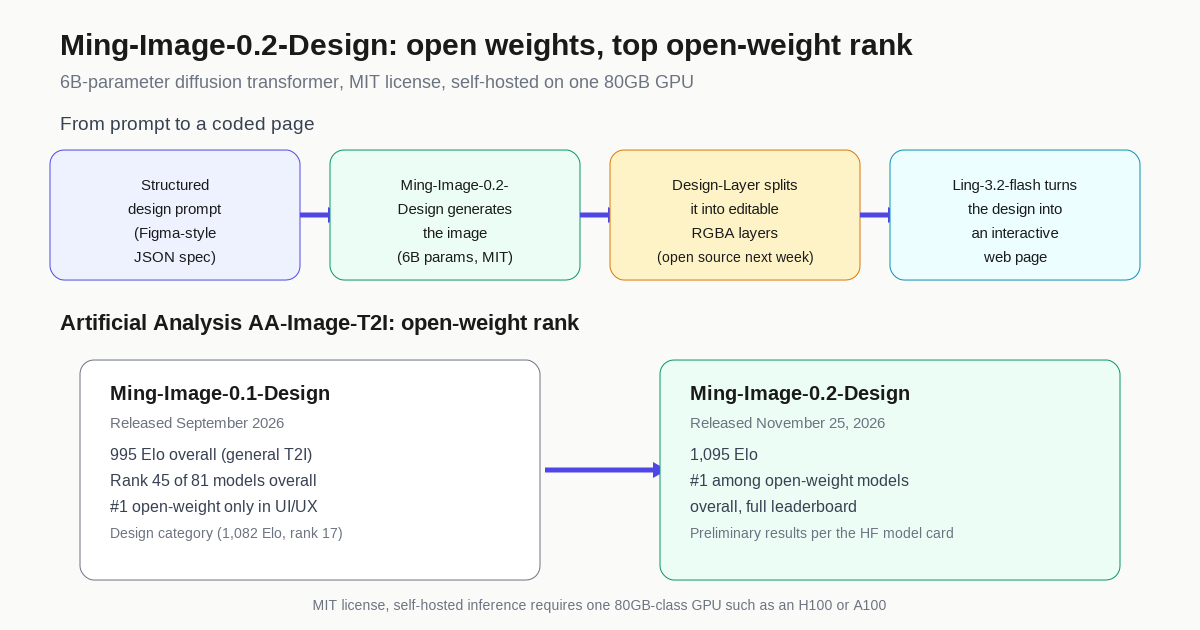
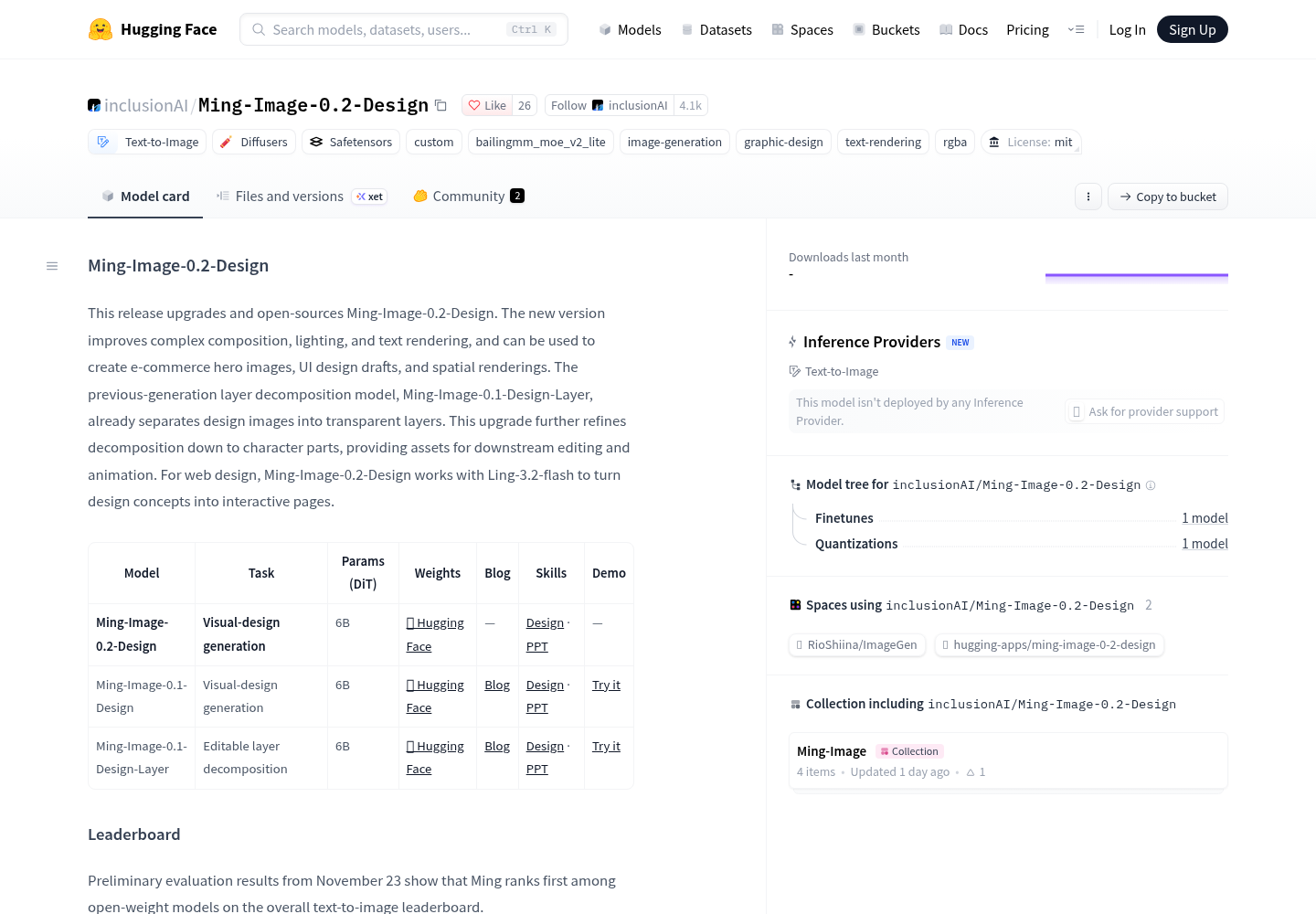
Ant Group’s inclusionAI team (the lab behind the Ling and Ming model lines) has released Ming-Image-0.2-Design on Hugging Face and GitHub. Per the model card, preliminary results from Artificial Analysis as of November 25, 2026 put it first among open-weight models on the full AA-Image-T2I v2.1 leaderboard, with an Elo of 1,095 (Hugging Face model card). Ant Ling announced the release on X the next day, alongside plans to open-source a companion layer-decomposition model, Ming-Image-0.2-Design-Layer, “next week” (Ant Ling on X).
A jump from a category specialist to the overall leader
That ranking is a real step up in scope from the prior release. Ming-Image-0.1-Design, which shipped in September, only led the open-weight field in Artificial Analysis’s narrower UI/UX Design category: 1,082 Elo and 17th of 81 models in that slice. On the general text-to-image board it placed 45th overall with a 995 Elo – a specialist result, not a leading one (AlphaSignal). Ming-Image-0.2-Design is inclusionAI’s first release to top the overall board rather than just one use-case slice, and it ships under the same permissive MIT license as its predecessor (GitHub repository).
| Ming-Image-0.1-Design (Sep 2026) | Ming-Image-0.2-Design (Nov 25, 2026) | |
|---|---|---|
| Overall T2I rank among open-weight models | Not #1 (45th overall, 995 Elo) | #1 overall (1,095 Elo) |
| Best category | #1 open-weight in UI/UX Design (1,082 Elo, 17th of 81) | #1 open-weight on the full leaderboard |
| License | MIT | MIT |
| Params (DiT) | 6B | 6B |
Both leaderboard results are labeled preliminary by their sources and can move as Artificial Analysis collects more preference votes, so treat the rank as directional rather than final.
What the model actually does
Ming-Image-0.2-Design is a 6-billion-parameter diffusion transformer built for visual-design generation: e-commerce hero images, UI design drafts, posters, infographics and spatial renderings, with an emphasis on legible rendered text and complex composition. The companion repository shares inference code with the 0.1 line, so existing scripts mostly just swap the model ID (GitHub repository):
git clone https://github.com/inclusionAI/Ming-Image
cd Ming-Image
pip install -r requirements.txt
python infer.py \
 --model inclusionAI/Ming-Image-0.2-Design \
 --task text-to-image \
 --prompt "Landing page for a productivity app..." \
 --width 2048 --height 2048 \
 --output-dir outputs/flow
The recommended settings are narrow and specific: 2048x2048 output by default (1024x1024 for faster square jobs), 12 sampling steps, a CFG scale of 1.0, BF16 precision, and a validated minimum of one CUDA GPU with 80 GiB of memory, per the model’s own repository (GitHub repository). AlphaSignal’s separate reporting on the prior 0.1 release names that same 80GB hardware tier by brand – NVIDIA’s H100, H200 and A100 datacenter GPUs (AlphaSignal). There is no first-party or hosted inference endpoint yet, so running it means operating that hardware yourself.
The practical hook: layers and a coding handoff
The part that matters for agent builders isn’t just the leaderboard rank – it’s what comes after the image. inclusionAI’s prior release, Ming-Image-0.1-Design-Layer, already decomposes a flattened design into separate transparent RGBA layers so a headline, a logo or a background can be edited independently instead of re-running generation and disturbing the rest of the composition. The upcoming Ming-Image-0.2-Design-Layer, due next week, refines that decomposition down to individual character parts, which the model card frames as asset prep for downstream editing and animation.
For web and UI work specifically, inclusionAI pairs Ming-Image-0.2-Design with its Ling-3.2-flash coding model: the image model produces the visual design, and Ling-3.2-flash turns that design concept into an interactive page. That gives teams building design-to-code pipelines a self-hosted, inspectable component to sit in front of a coding agent, rather than depending on a closed image API whose outputs and weights they can’t audit or fine-tune. The repository also ships two ready-made agent skills built on this chain: a UI-design skill that generates visual references and checks the resulting code against them, and an image-to-editable-PPT skill that turns a generated slide image into a native PowerPoint deck.
What to weigh before adopting it
The deployment profile hasn’t changed from the 0.1 generation: this targets datacenter GPUs, not a laptop or a typical workstation card, and there’s still no hosted API to fall back on. The Layer model that makes the output editable isn’t public yet – only the base Design model is available today, with the Layer variant promised for next week. And because both the 0.1 and 0.2 leaderboard placements come from preliminary, vendor-linked evaluation data that sources say will keep shifting – AlphaSignal’s coverage of the 0.1 release notes that “rankings remain dynamic as Artificial Analysis collects additional votes” – teams should treat the #1 open-weight claim as a current snapshot to re-check rather than a fixed fact before committing infrastructure around it.
For operators already running other inclusionAI/Ant releases, such as the recently covered Ling-3.1-flash open-weight MoE, Ming-Image-0.2-Design extends the same self-hosted, inspectable-weights approach from text generation into design and image work. It’s worth weighing alongside the broader landscape of open-weight models built to drive agent harnesses and the wider pattern of Chinese labs shipping frontier-adjacent open models at a pace that keeps resetting what a self-hosted default looks like.
Sources
- inclusionAI/Ming-Image-0.2-Design · Hugging Face
- GitHub - inclusionAI/Ming-Image · GitHub
- Ant Ling on X: "We're introducing Ming-Image-0.2-Design and Ming-Image-0.2-Design-Layer. We're open-sourcing Design today and plan to open-source Layer next week. Ming-Image-0.2-Design ranks #1 among open-weight models on Artificial Analysis's AA-Image-T2I v2.1 with 1,095 Elo." / X
- Ant Group's Ming-Image Tops Open-Weight UI Design Rankings Among 81 Models