FCC Grants SpaceX Conditional Approval for Up to 1 Million Orbital AI Satellites — Debris Rules Still Unresolved
The FCC conditionally approved SpaceX to deploy up to 1 million orbital AI satellites under Starmind, the first such approval, with debris rules deferred.
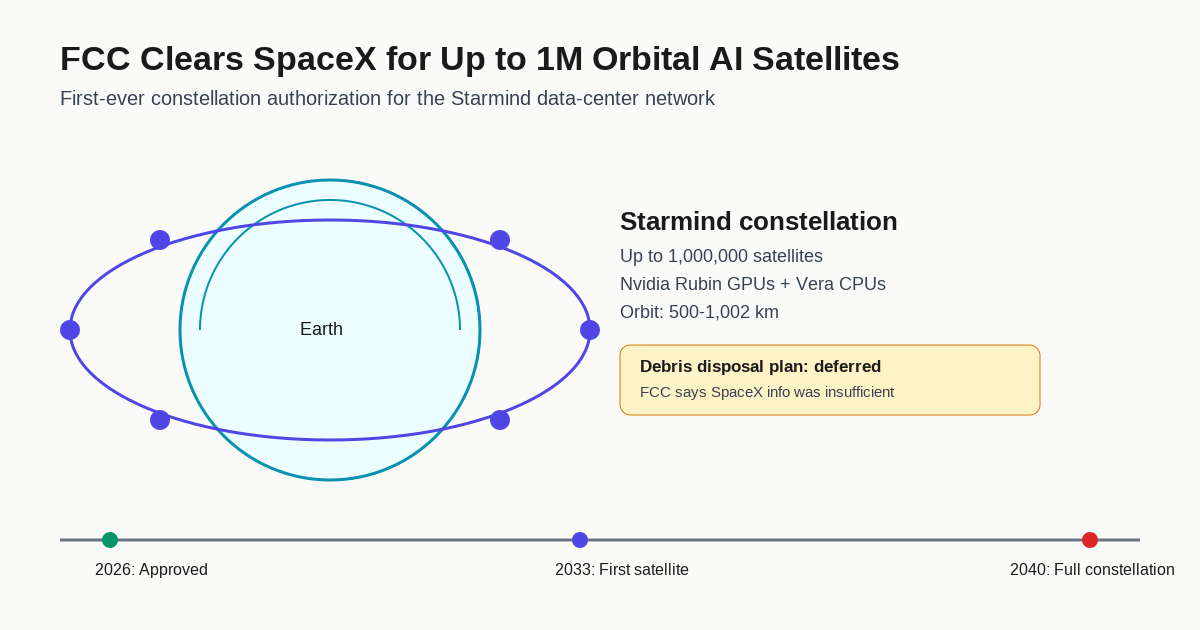
The Federal Communications Commission on Wednesday gave SpaceX conditional authority to deploy and operate up to 1 million satellites for its “Starmind” orbital AI data center constellation — the first time the agency has approved a full constellation of computing satellites. The order is a regulatory milestone, not a construction timeline: SpaceX still has to solve how it will cool processors in space, finance chips destined for orbit, and dispose of retired satellites, and the FCC has not yet ruled on that last piece.
What the FCC actually approved
According to TechCrunch, the authorization lets SpaceX operate Starmind satellites at altitudes of 500 to 1,002 kilometers, using radiofrequency links as a backup to the lasers that will be the satellites’ primary way of talking to each other and to Starlink. The FCC gave SpaceX seven years — until 2033 — to put one operational satellite into orbit, and 14 years, until 2040, to deploy the full constellation, a timeline The Verge and GeekWire both confirm. GeekWire’s report notes SpaceX disclosed in August that each Starmind satellite will carry Nvidia Rubin GPUs and Vera CPUs for “datacenter-class space compute,” with satellite production shifting to SpaceX’s Bastrop, Texas facility rather than its Starlink line in Redmond, Washington.
FCC Chairman Brendan Carr called the decision an effort to “open a bold new frontier for the computing infrastructure needed to power America’s leadership and growth,” and the agency’s own release, quoted by GeekWire, framed the goal as moving toward “a Kardashev II civilization — one that can harness the full power of the sun.” Elon Musk replied to Carr on X: “Much appreciate. This will be a great asset to America and the world.”
The part the FCC didn’t decide
The approval comes with a significant gap. SpaceX asked the FCC to waive the standard rule requiring satellites below 2,000 kilometers to reenter Earth’s atmosphere within five years of ending their mission, so it could instead move retired Starmind satellites into higher “graveyard” orbits or even push them toward the sun. TechCrunch and The Verge both report the FCC deferred that request, finding SpaceX hadn’t provided “sufficient information” about its disposal plans for satellites operating above 600 kilometers. GeekWire adds that the authorization carries conditions requiring communications backups, regular progress updates, and a detailed orbital debris mitigation plan before full deployment can proceed — meaning the debris question isn’t closed, just postponed.
Objections dismissed as outside the FCC’s reach
The application drew petitions to deny from Kuiper Systems (Amazon), Viasat, and the American Astronomical Society. CNBC reports Amazon called the Starmind plan a “lofty ambition rather than a real plan” that would take SpaceX “centuries” to build, while also arguing it “risks real harm” — a position Carr publicly rebuked by noting Amazon is behind on its own satellite deployment milestones. The FCC’s order, per TechCrunch and CNBC, dismissed concerns about optical astronomy and environmental impact because the agency determined those issues fell outside its regulatory authority. CNBC quotes astrophysicist Adam Becker calling the move a risk of “a cascading chain reaction of space junk collisions,” and Earthjustice attorney Jan Hasselman criticized both the lack of environmental review under the National Environmental Policy Act and the timing of the decision during a holiday week.
A crowded orbital data center race
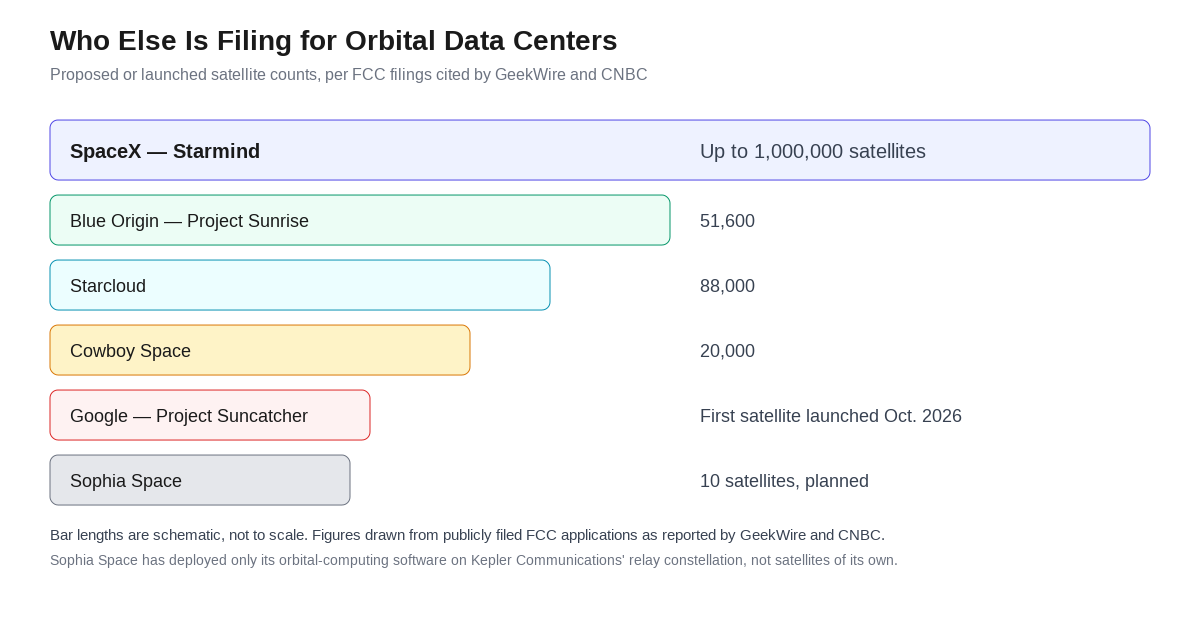
SpaceX is not alone in pursuing compute in orbit. GeekWire’s rundown of competing FCC filings shows Blue Origin has proposed a 51,600-satellite “Project Sunrise” constellation, Redmond-based Starcloud has applied for an 88,000-satellite network, Cowboy Space (formerly Aetherflux) wants 20,000 satellites, and Seattle-linked Sophia Space is planning a 10-satellite cluster and has already deployed its orbital operating system software on Kepler Communications’ optical relay network, though none of its own satellites are yet in orbit. CNBC and The Verge both note Google’s Project Suncatcher launched its first AI server satellite in October aboard a SpaceX rocket and Planet Labs satellite, with Blue Origin set to fly a dedicated heavy-lift Suncatcher mission in 2029.
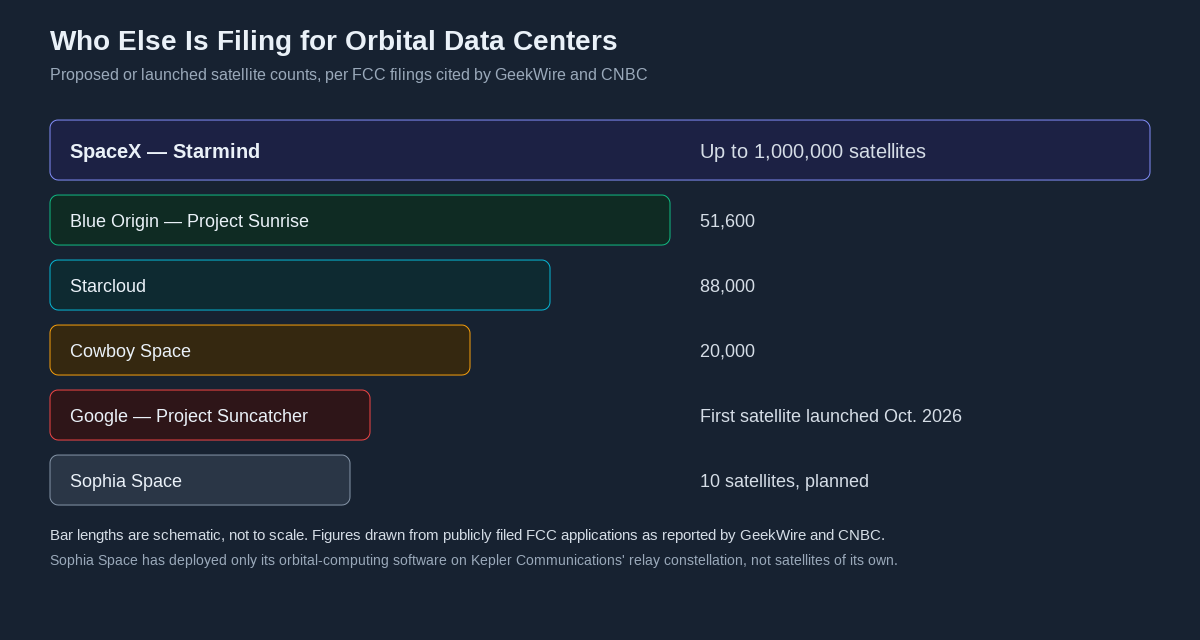
| Company | Project | Proposed scale |
|---|---|---|
| SpaceX | Starmind | Up to 1,000,000 satellites |
| Blue Origin | Project Sunrise | 51,600 satellites |
| Starcloud | — | 88,000 satellites |
| Cowboy Space | — | 20,000 satellites |
| Project Suncatcher | First satellite launched Oct. 2026 | |
| Sophia Space | — | 10 satellites |
Approval is not availability
TechCrunch’s reporting is explicit that “this initial regulatory approval doesn’t mean orbital data centers are imminent.” SpaceX still faces the engineering problem of cooling processors without atmosphere to dissipate heat, the economics of launching chips that can’t be repaired in orbit, and the question of how to finance hardware that depreciates in a uniquely hostile environment. The 2033-to-2040 build-out window the FCC attached to this order gives SpaceX runway to work through those problems — and gives regulators room to revisit debris policy — before a single Starmind satellite needs to generate a watt of usable compute.
For AI infrastructure watchers, the headline number is less important than the sequencing: a federal agency has now formally authorized a new category of infrastructure — data centers that never touch the ground — while leaving the hardest operational and environmental questions for a later filing. The Nvidia Rubin GPUs and Vera CPUs that SpaceX says will populate Starmind satellites are the same silicon line Nvidia is pitching for terrestrial HPC and agentic-inference workloads at SC26, and the pairing’s first benchmark results, covered in Vera Rubin’s MLPerf debut, suggest the hardware is being tuned for inference-heavy agent workloads as much as for space-based compute.
Sources
- FCC approves SpaceX plan to put AI data centers in space | TechCrunch
- FCC signs off on SpaceX’s plan to put up to 1 million data center satellites into space | The Verge
- SpaceX wins FCC approval for 1 million orbital data center satellites
- FCC clears SpaceX to put a million data center satellites in orbit – GeekWire