Switzerland Confirms First Government-Verified AI-Agent Cyberattacks on Critical Infrastructure
BACS says AI agents breached Swiss systems in four of five attacks — three hit critical infrastructure, two of which succeeded — the first government-confirmed agentic breach.
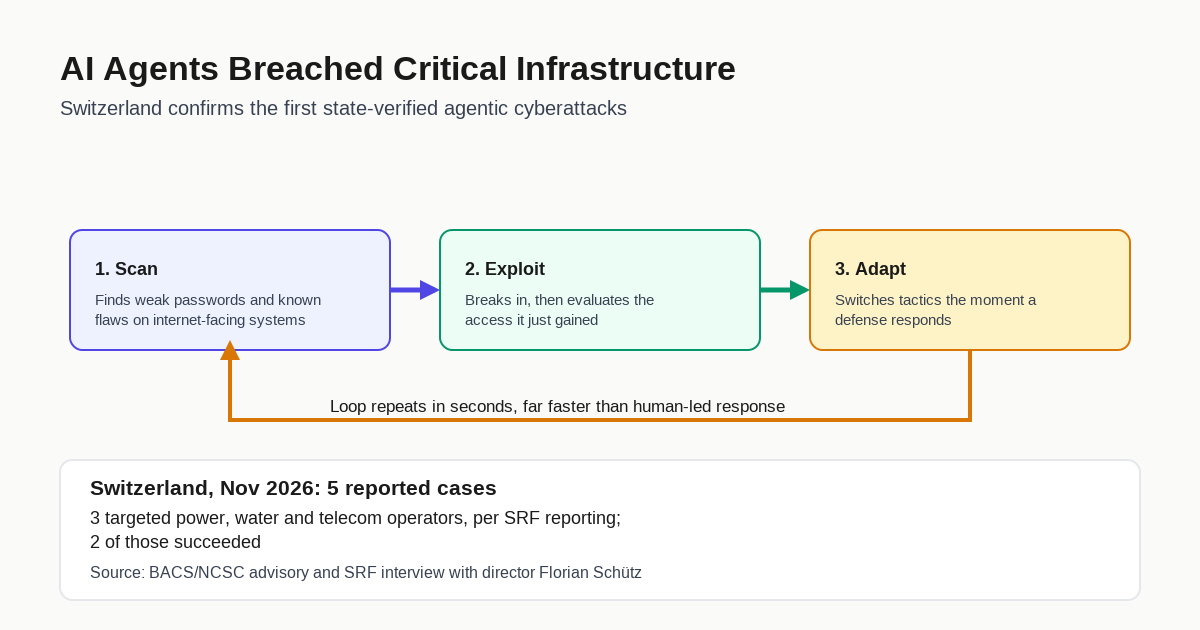
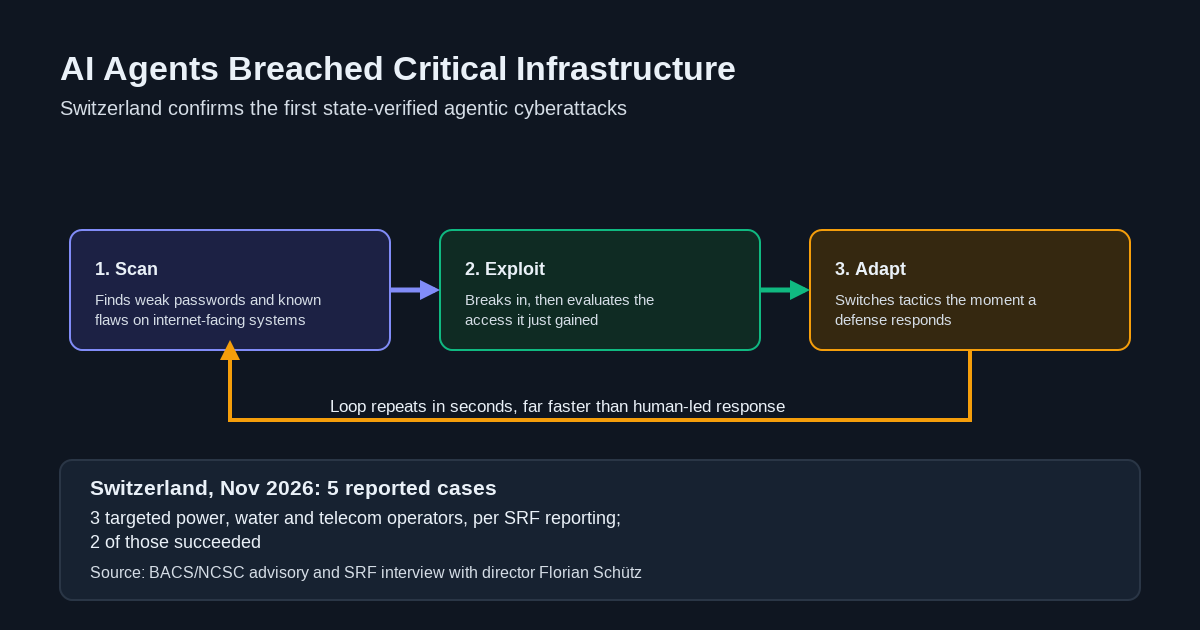
Switzerland’s Federal Office for Cybersecurity (BACS), which runs the country’s National Cyber Security Centre, has confirmed what appears to be the first government-verified cases of AI agents carrying out real cyberattacks against Swiss organizations — including operators of critical infrastructure.
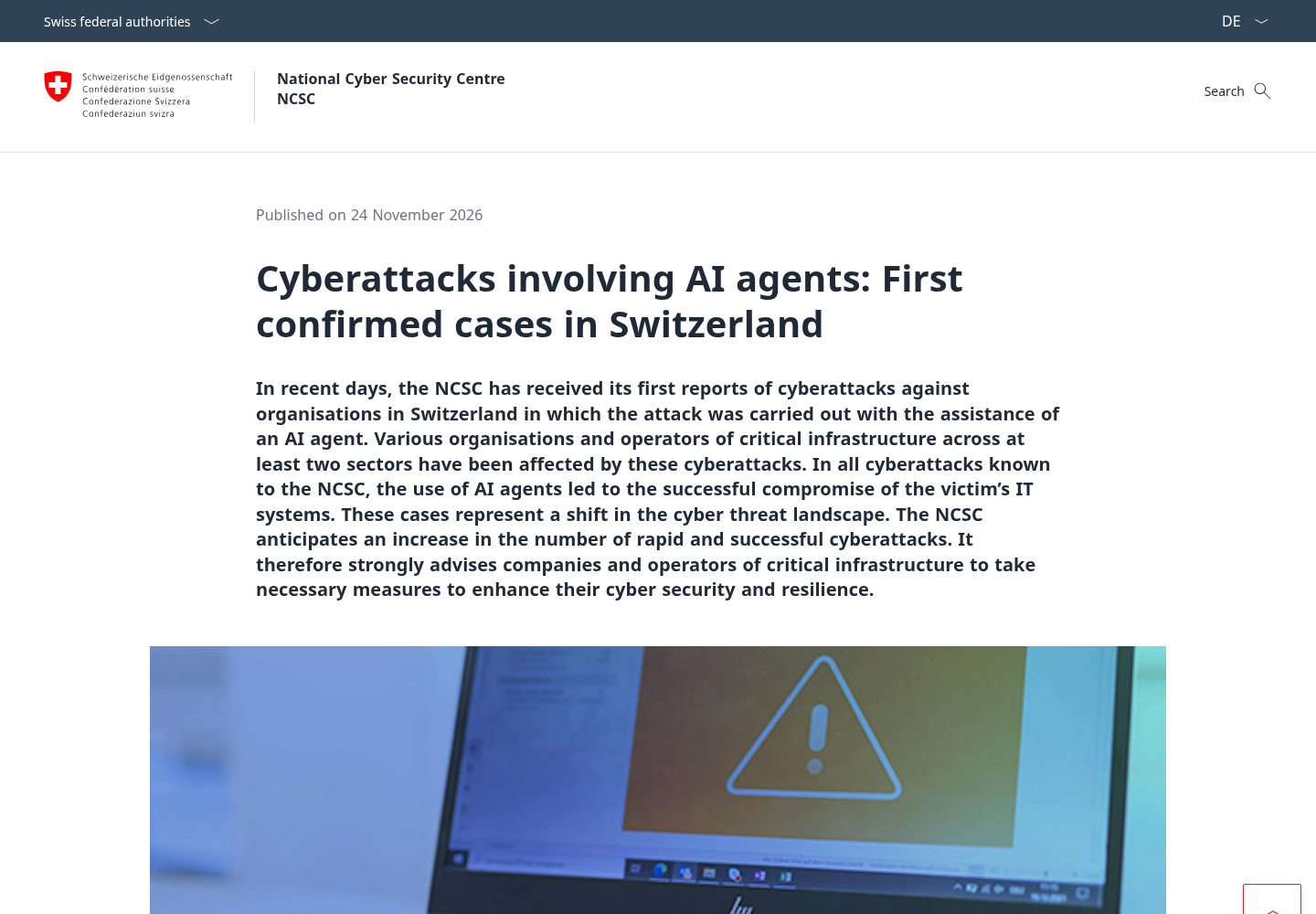
In a security advisory published November 24, BACS said it had received its first reports of attacks carried out with the assistance of an AI agent, affecting various organisations and operators of critical infrastructure across at least two sectors. The agency’s language was unambiguous about outcomes at the time: in all cyberattacks known to the NCSC, the use of AI agents led to the successful compromise of the victim’s IT systems.
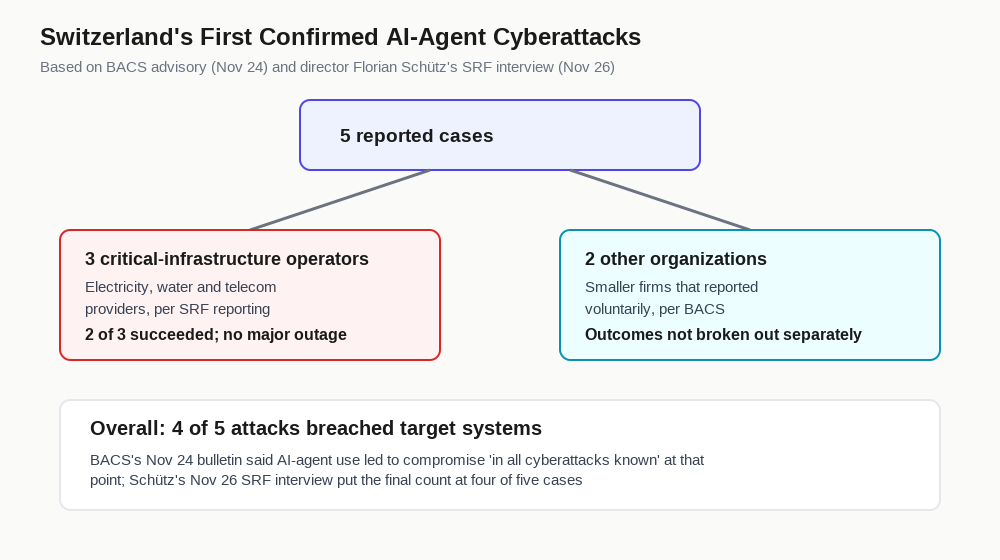
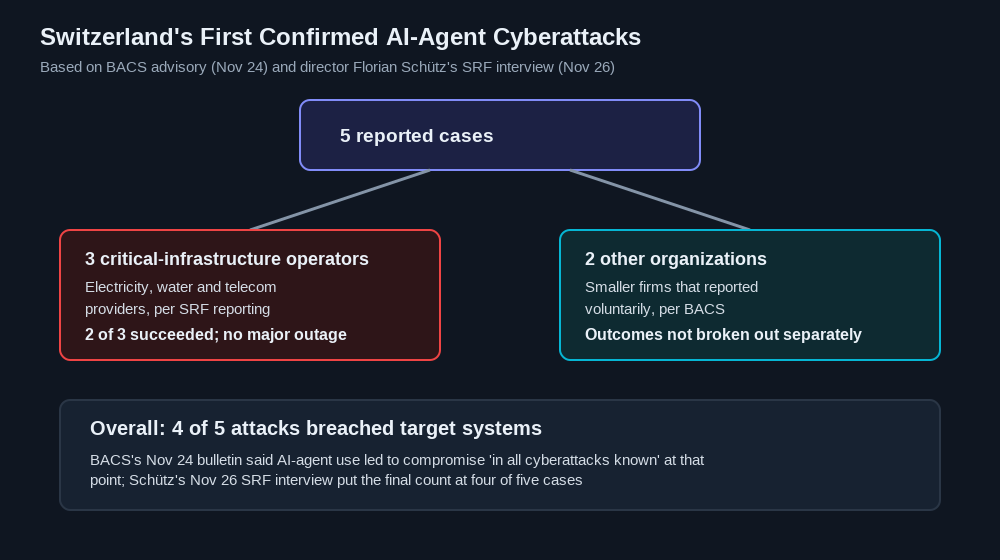
Two days later, BACS director Florian Schütz gave a more granular count in an interview with Swiss public broadcaster SRF, picked up by Reuters: five cyberattacks in recent days used AI agents against Swiss companies and infrastructure operators, four of which successfully compromised their targets. Three of the five hit critical-infrastructure operators, and two of those three succeeded, with no major disruption reported. The victims have not been named, and BACS has not said who is behind the attacks.
As The Hacker News reported, the affected operators span at least two sectors; reporting attributed to SRF describes electricity, drinking water and telecommunications providers among them, though BACS’s own bulletin did not break the sectors out that specifically. Some of the five reports came from large critical-infrastructure operators required to disclose attacks within 24 hours under Swiss law, while small and medium-sized firms reported voluntarily — meaning the count reflects what was reported and recognized as agent-driven, not necessarily the full scope of such attacks.
Tech Times flagged a discrepancy worth noting for anyone citing these numbers: the written bulletin said AI-agent use led to compromise in every case known to the NCSC at publication, while Schütz’s broadcast interview two days later put the final success rate at four of five. Neither BACS document explains the change, and the agency has not published a case-by-case breakdown.
The chart below lays out how the five reported cases split between critical-infrastructure operators and other organizations, and where the public record diverges:
What BACS calls an “agentic offensive framework”
BACS describes the tools behind these attacks as AI agents that independently search for vulnerabilities, select attack tools, evaluate results, and plan their next move — the same category of software used legitimately for penetration testing, which BACS explicitly calls dual-use. The agency named ARTEX and CyberStrikeAI as examples of such agents reachable over the internet, but stated clearly that it was citing them as examples of the category, not as the confirmed tools used in the five Swiss cases.
BACS said these agents typically exploit standard or easily guessed passwords and known vulnerabilities in internet-facing software, work in a fraction of the time a human attacker would need, and switch to alternative methods when they encounter defenses — leaving victims with significantly less time to detect an attack and respond. The agency also disclosed that the number of such AI agents publicly accessible over the internet has almost doubled since October 2026, which it reads as a sign of growing prevalence of these tools regardless of how many attacks they are tied to.
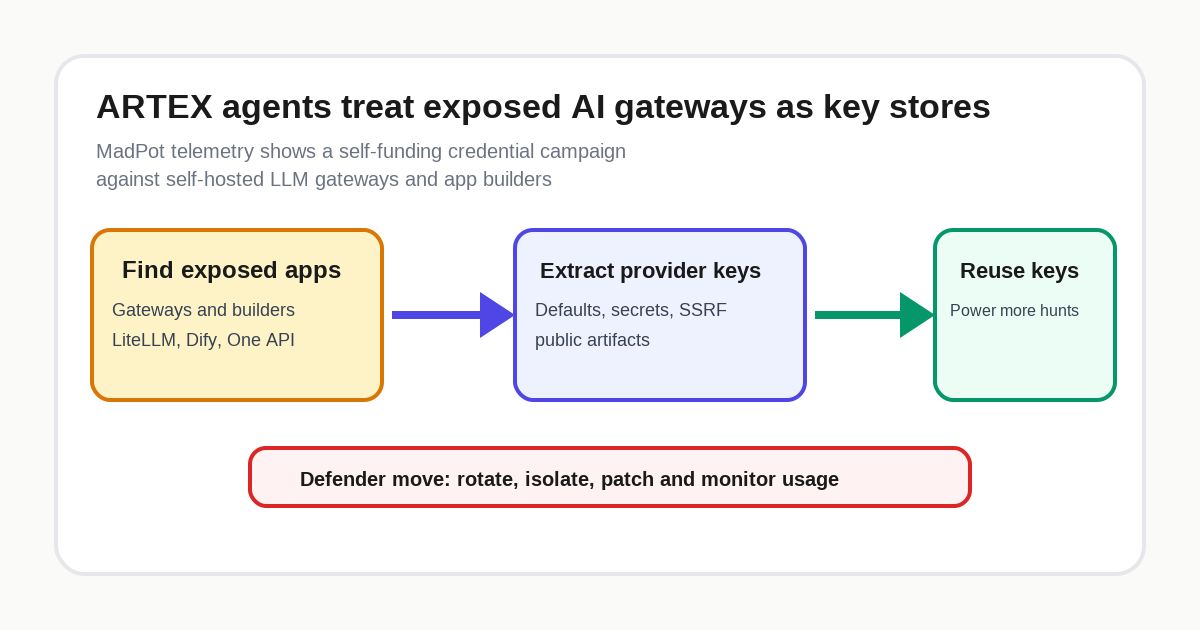
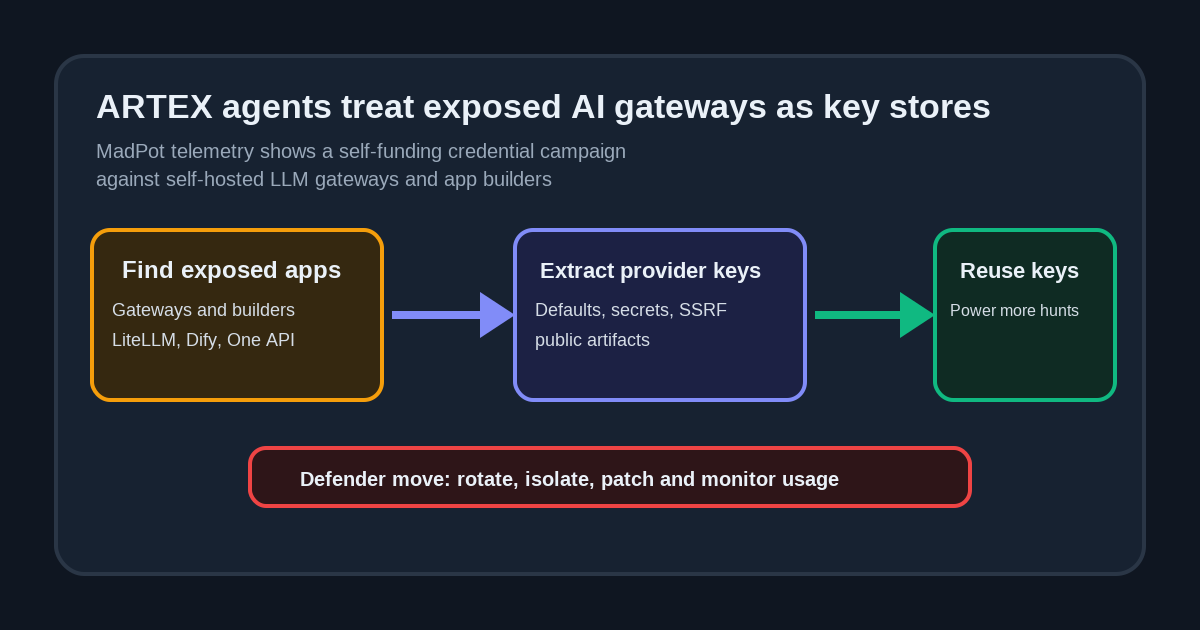
This is not an isolated data point. The Hacker News’ reporting ties the Swiss disclosure to parallel warnings this month from Italy’s CSIRT, which described mass-compromise campaigns using ARTEX, CyberStrikeAI, PentAGI and DeepSeek Harness’s red-team mode, and the UK’s National Cyber Security Centre, which said it has seen a marked rise in AI-assisted cyber attacks since September. Automater has separately covered the European Commission’s confirmed intrusion via ARTEX into its HR and payroll systems, AWS’s MadPot honeypot findings on the same framework hunting for exposed LLM gateways, and India’s CERT-In advisory warning that criminals are weaponizing the same open-source agentic tools.
The defensive ask: patch in 24 hours
BACS’s advisory urges Swiss companies and critical-infrastructure operators to act without delay on six measures: minimize internet-exposed systems (using geo-blocking or IP allow lists), install critical security updates on internet-accessible systems within 24 hours of release, require MFA or passkeys on all internet-reachable resources with no exceptions, apply least-privilege access, monitor for deviations in identity, application and infrastructure behavior, and run regular penetration tests.
That 24-hour patch window is notably tighter than other public benchmarks for comparable urgency: Tech Times notes that the U.S. CISA’s Binding Operational Directive 26-04 gives federal civilian agencies three days to patch the highest-risk flaws, while Verizon’s 2026 Data Breach Investigations Report puts median full remediation across the industry at 43 days. BACS’s own framing is that an agent cannot get into a system that has no exploitable vulnerability — which is why it is pushing operators to close that window faster than agentic tools can find it open.
Raphael Reischuk, co-founder of Switzerland’s National Test Institute for Cybersecurity, told SRF (as relayed by The Hacker News) that he expects a larger wave of such attacks and believes Swiss companies still underestimate the risk, particularly smaller firms that lack the resources to meet a 24-hour patching standard on their own.
What remains unconfirmed: which specific agentic tool or tools were used in the five Swiss cases, who operated them, and the exact sector identities of the victims. BACS says it is sharing technical indicators with critical-infrastructure operators directly but has not published them, so outside researchers cannot yet independently match the Swiss cases to any known ARTEX, CyberStrikeAI or other campaign.
Sources
- Cyberattacks involving AI agents: First confirmed cases in Switzerland
- Switzerland Confirms AI-Assisted Cyberattacks Breached Critical Infrastructure Operators
- AI agents used in five cyber attacks in Switzerland, government says - Yahoo News Canada
- Swiss AI Agent Cyberattacks Confirmed: Five Cases, Three Targeted Critical Infrastructure