AWS Launches Amazon Neptune Graph Sessions With Scale-to-Zero Per-Agent Memory Graphs
AWS makes Amazon Neptune Graph Sessions generally available, running Neptune Analytics in isolated Lambda MicroVMs with 4 or 8 s-NCU base sizes, 2x memory headroom, and 15-minute scale-to-zero for AI agents and GraphRAG.
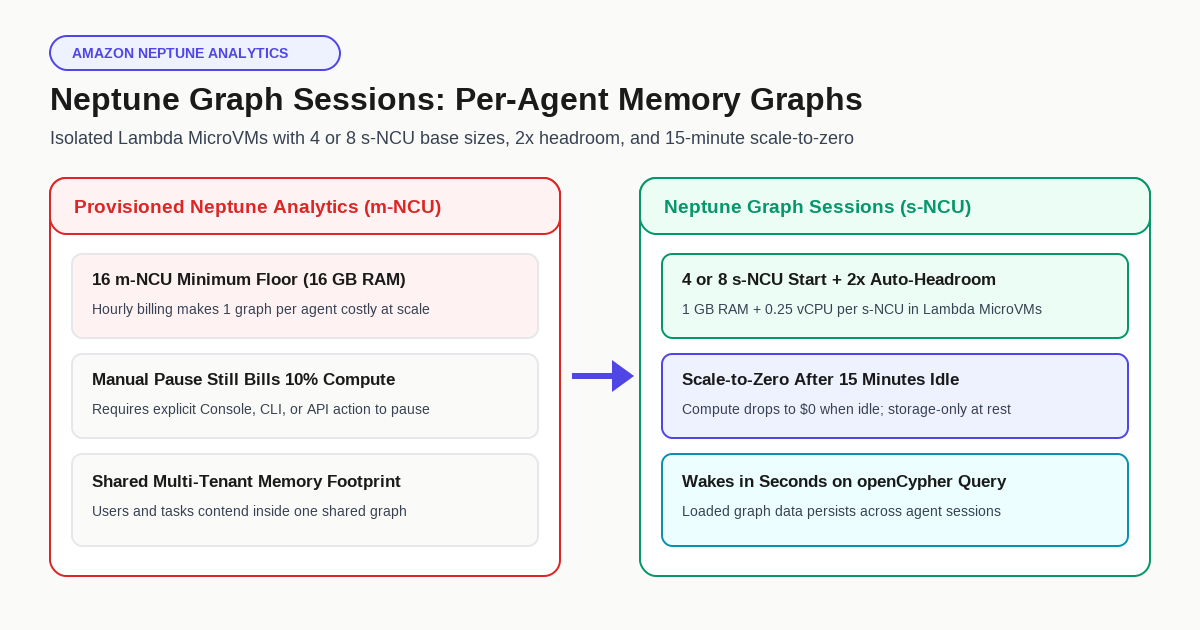
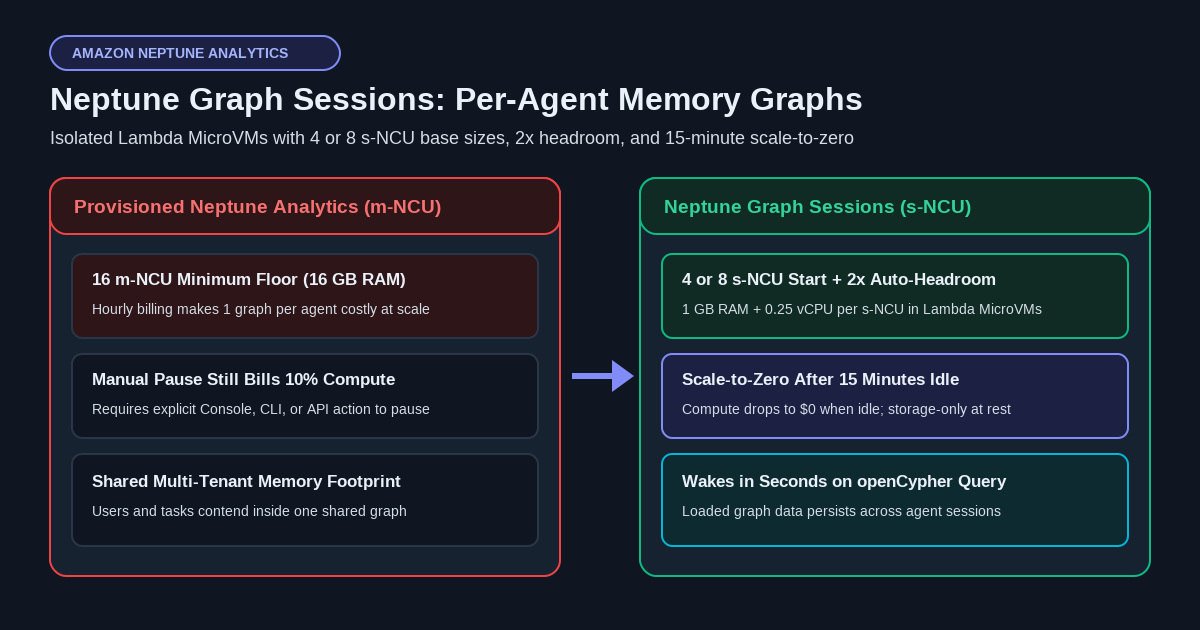
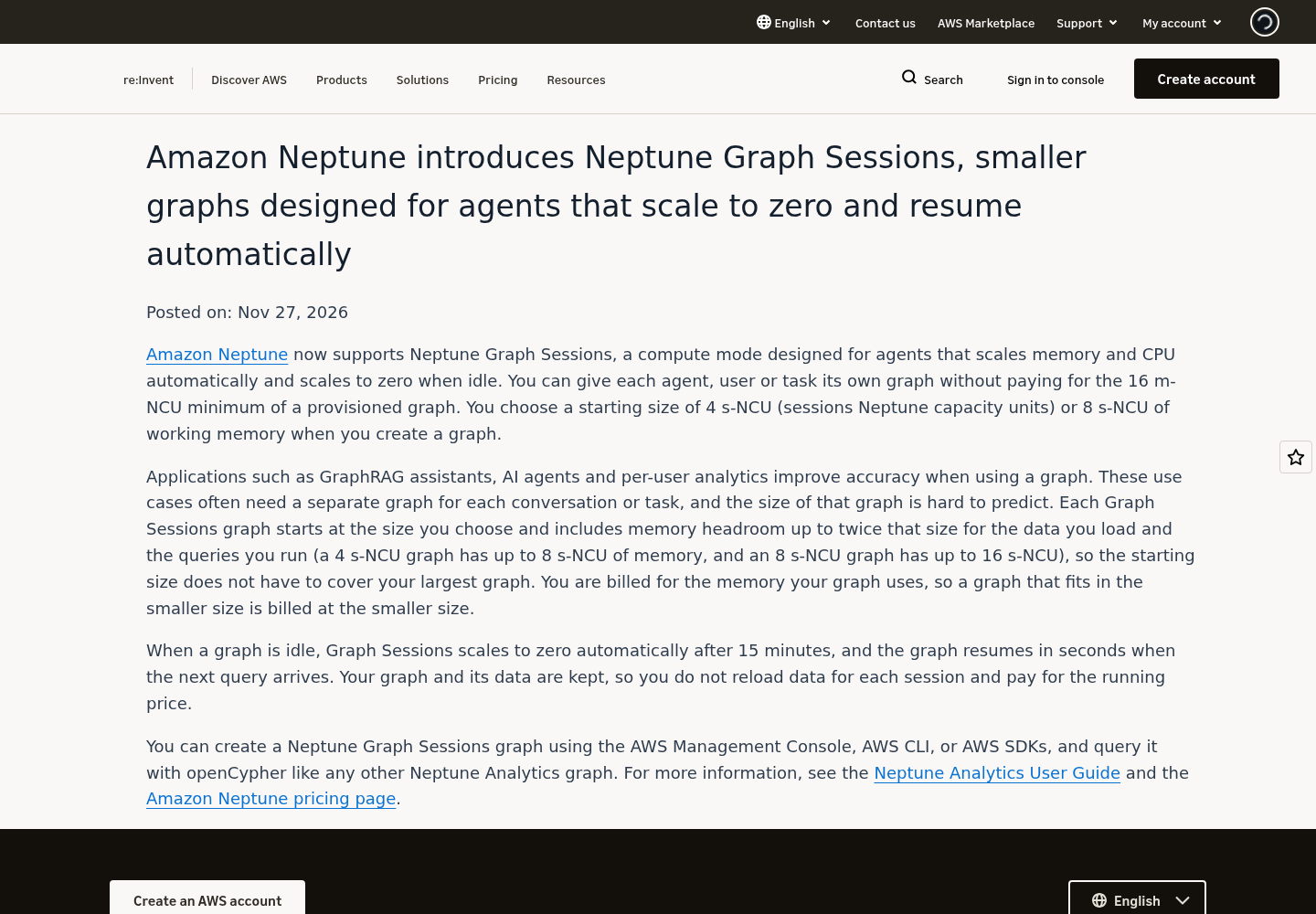
AWS announced the general availability of Amazon Neptune Graph Sessions on November 27, 2026, introducing a scale-to-zero compute mode in Amazon Neptune Analytics purpose-built for AI agents, GraphRAG assistants, and per-user analytics. Instead of forcing engineering teams to keep a minimum 16 m-NCU provisioned graph running around the clock—or crowd multiple users into a single shared graph—Neptune Graph Sessions lets operators allocate dedicated graphs starting at 4 s-NCU or 8 s-NCU, burst up to twice that working memory automatically, and scale compute down to zero after 15 minutes of inactivity.
Breaking the 16 m-NCU Floor for Per-Agent Graphs
Until now, teams using Amazon Neptune for agentic memory and GraphRAG faced a structural trade-off between workload isolation and infrastructure cost. Neptune Analytics stores large graph datasets in memory to run low-latency openCypher queries, built-in graph analytic algorithms, and vector searches within graph traversals. However, standard provisioned Neptune Analytics instances require a minimum baseline of 16 m-NCU (16 GB of memory plus corresponding compute and networking billed hourly).
For multi-tenant AI assistants or task-scoped coding and research agents that need a separate graph per conversation, user, or workflow, provisioning a 16 GB minimum graph per session is cost-prohibitive. Even when operators manually pause a provisioned Neptune Analytics workload through the console, CLI, or API, Amazon Neptune pricing still bills 10% of the normal compute rate while the graph is paused. Meanwhile, Neptune Serverless applies only to transactional Amazon Neptune Database clusters rather than the in-memory Neptune Analytics engine.
Neptune Graph Sessions closes that gap by running the Neptune Analytics engine inside isolated AWS Lambda MicroVMs—extending the microVM isolation pattern seen when AWS connected Lambda Durable Functions to isolated MicroVM sandboxes.
How s-NCU Sizing, 2x Memory Headroom, and Scale-to-Zero Work
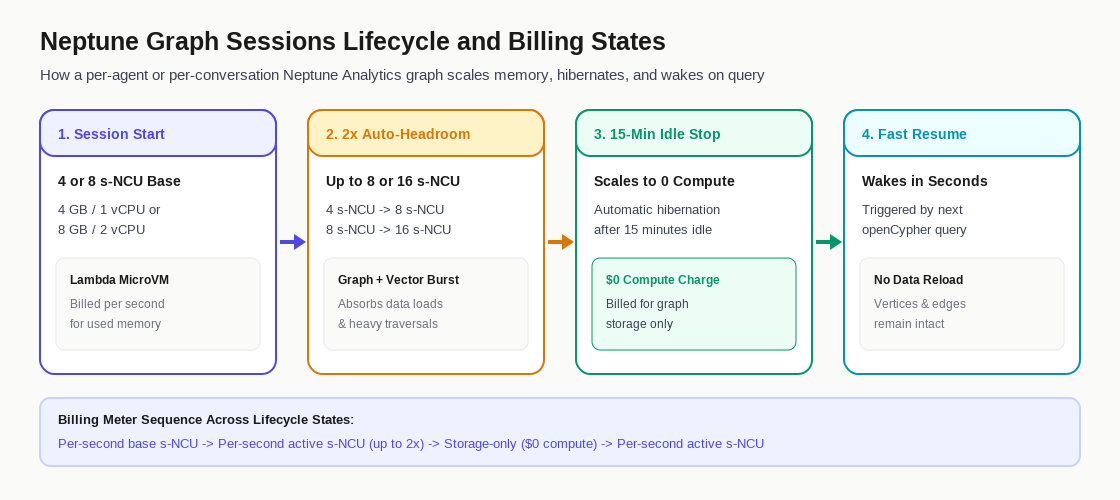
In Neptune Graph Sessions, capacity is measured in sessions Neptune capacity units (s-NCU). According to the Amazon Neptune pricing page, each s-NCU allocates 1 GB of RAM and 0.25 vCPU of compute, billed per second while the graph is running.
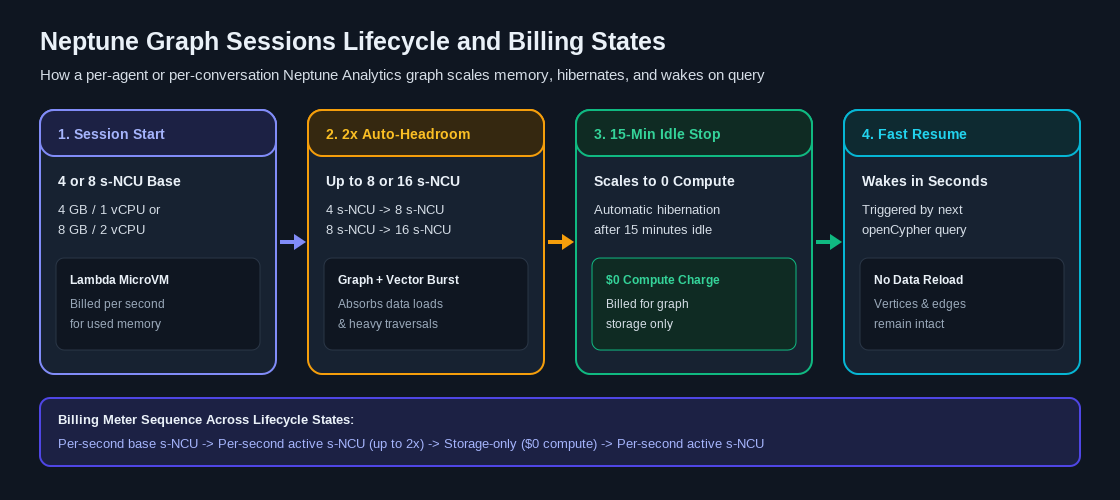
When creating a Graph Sessions graph via the AWS Management Console, AWS CLI, or AWS SDKs, teams select one of two starting working-memory sizes:
- 4
s-NCUstarting size (4 GB RAM and 1 vCPU), which automatically includes up to 8s-NCU(8 GB RAM) of memory headroom. - 8
s-NCUstarting size (8 GB RAM and 2 vCPUs), which automatically includes up to 16s-NCU(16 GB RAM) of memory headroom.
Because conversation-level and task-level knowledge graphs grow unpredictably as an agent ingests documents or records observations, the automatic 2x memory ceiling removes the need to over-provision every graph for worst-case peaks. Billing tracks the memory the graph actually uses: a session graph that fits within its 4 s-NCU starting size is billed at the 4 s-NCU rate, and only incurs higher charges when loaded data or active queries expand into the headroom tier.
When no queries arrive for 15 minutes, Graph Sessions automatically scales compute down to zero. While stopped, the graph incurs zero compute charges and is billed only for storage. When the next openCypher query arrives, the graph resumes in seconds with all previously loaded data intact—eliminating the latency and compute expense of reloading data from Amazon S3 or Neptune snapshots at the start of each session.
Comparing Amazon Neptune Compute Modes
The table below compares Neptune Graph Sessions against provisioned Neptune Analytics and Neptune Database Serverless across capacity definitions, scaling limits, and idle billing rules documented by AWS:
| Capability | Neptune Graph Sessions | Provisioned Neptune Analytics | Neptune Database Serverless |
|---|---|---|---|
| Target Engine | Neptune Analytics (in-memory) | Neptune Analytics (in-memory) | Neptune Database (transactional) |
| Execution Substrate | Isolated Lambda MicroVMs | Dedicated memory-optimized compute | Managed database cluster |
| Capacity Unit | 1 s-NCU = 1 GB RAM, 0.25 vCPU |
1 m-NCU = 1 GB RAM + compute/network |
1 NCU ≈ 2 GB RAM + CPU/network |
| Starting Size | 4 s-NCU or 8 s-NCU |
16 m-NCU minimum |
1 NCU minimum |
| Auto Memory Headroom | Up to 2x start (8 or 16 s-NCU) |
Provisioned capacity tier | Dynamic NCU scaling |
| Billing Granularity | Per second while running | Per hour while running | Per second while active |
| Idle / Stopped Behavior | Auto scale-to-zero after 15 min idle | Manual pause via Console, CLI, or API | Auto scale-down (under 5 min latency) |
| Stopped Compute Cost | $0 compute (billed for storage only) |
10% of normal compute price while paused |
Billed for active minimum NCU and storage |
| Query Languages | openCypher | openCypher | Gremlin, openCypher, SPARQL |
Practical Impact for GraphRAG and Stateful AI Agents
For AI platform teams building on AWS, Neptune Graph Sessions complements higher-level memory services such as Amazon Bedrock AgentCore Memory’s long-term session summaries and Amazon Bedrock’s Agentic Retrieve for managed knowledge bases. While managed vector and summary stores handle broad semantic recall, GraphRAG assistants and multi-step reasoning agents frequently require explicit entity-relationship traversal that combines vector similarity with multi-hop graph queries.
Because a Graph Sessions instance behaves like any other Neptune Analytics target, agents can query their dedicated session graph using standard openCypher traversal syntax:
MATCH (u:User {id: $sessionUserId})-[:DISCUSSED]->(topic:Concept)
-[:DEPENDS_ON*1..2]->(dep:Artifact)
WHERE dep.status = 'active'
RETURN topic.name AS concept, dep.uri AS artifactUri, dep.updatedAt AS lastUpdated
ORDER BY dep.updatedAt DESC
LIMIT 10
According to the Amazon Neptune overview and Neptune Analytics User Guide, teams can load graph data from Amazon S3 or existing Neptune Database graphs and snapshots, and pair Neptune with Amazon Bedrock Knowledge Bases, the Strands AI Agents SDK, and agentic memory tools. By combining per-second Lambda MicroVM billing with a 4 s-NCU entry point and automatic 15-minute hibernation, AWS makes tenant-isolated and task-isolated graph memory practical for intermittent agent workloads that sit idle between user turns.
Sources
- Amazon Neptune introduces Neptune Graph Sessions, smaller graphs designed for agents that scale to zero and resume automatically - AWS
- What is Neptune Analytics? - Neptune Analytics
- Amazon Neptune Pricing
- AWS Launches Amazon Neptune Graph Sessions, Bringing Scale-to-Zero Per-Agent Memory Graphs to Neptune Analytics
- Managed Graph Database – Amazon Neptune – AWS