Google's Gemini Team Packs a Research Agent Into a 16-Line Skill File
Google's Gemini team shipped a 16-line deep-research skill that installs into Claude Code, Codex, Cursor and Antigravity for cited, parallel research.
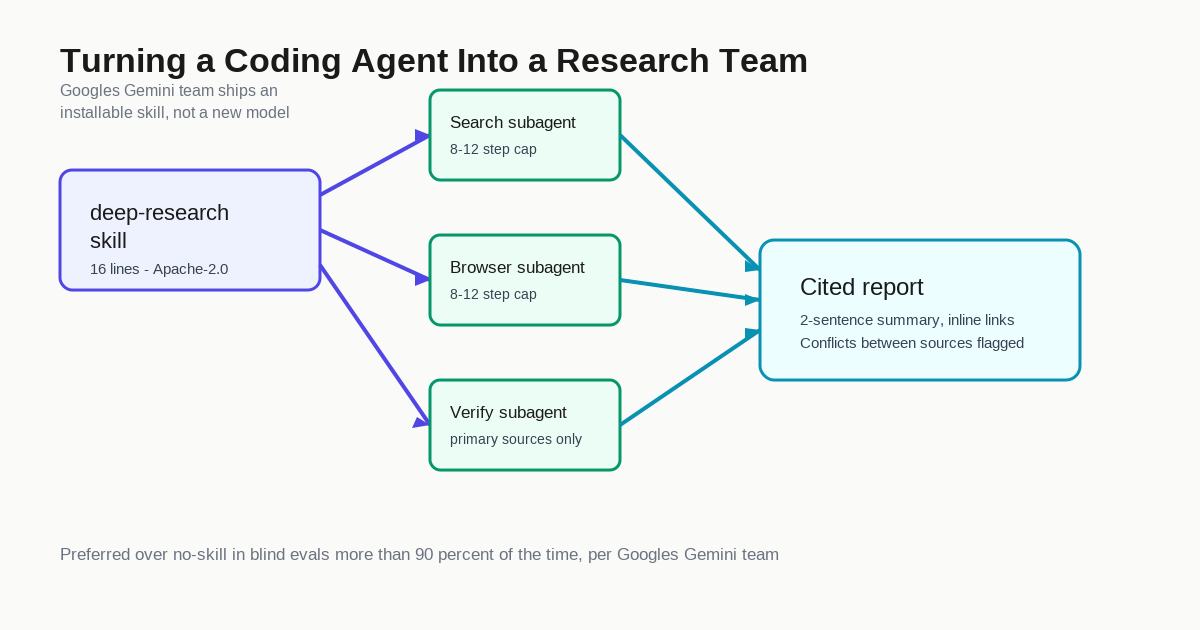
Google’s Gemini team just shipped something unusual for a frontier-lab update: not a model, but a 16-line text file. On November 27, 2026, Google AI Studio’s Philipp Schmid announced on X that the team had published an experimental deep-research skill inside the public google-gemini/demolab repository on GitHub — a short instruction file that reorganizes how a compatible coding agent handles open-ended research questions.
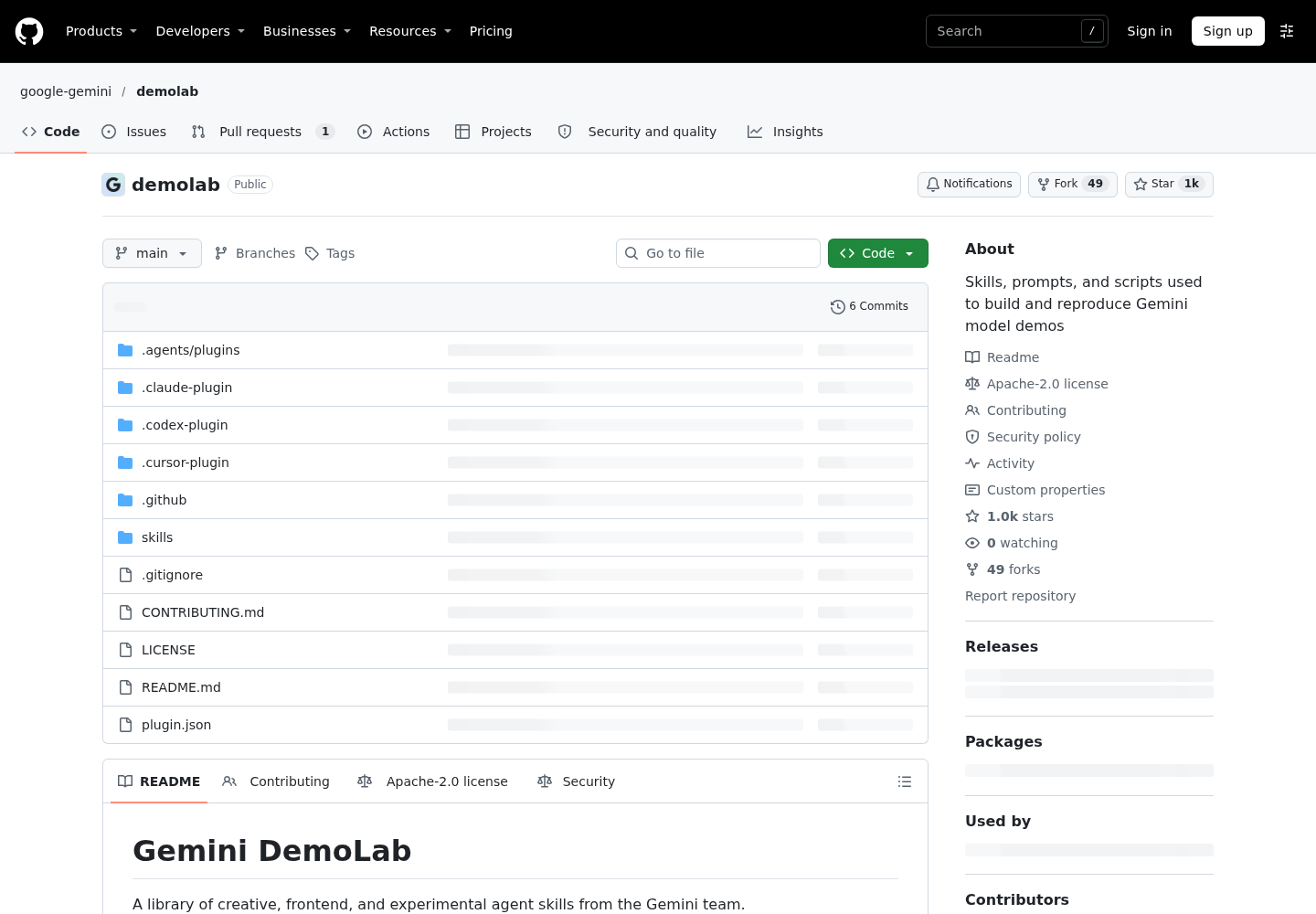
A “skill” in this sense is not a model or a plugin binary. It is a plain-text instruction file an agent loads only when a task matches its description, keeping specialized guidance out of unrelated prompts. The demolab repo’s README lists two such skills — deep-research and gemini-frontend-design — each with its own directory in the skills folder, and ships under an Apache-2.0 license with a disclaimer that it is “not an officially supported Google product.”
What the 16 lines actually constrain
Schmid’s post and an AlphaSignal writeup both break the skill down into a small set of rules that bound an otherwise open-ended research task:
| Stage | What the skill tells the agent to do | Why it matters |
|---|---|---|
| Scope | Answer simple, direct questions in one pass; split broad questions into three to five angles | Stops the agent from delegating trivial questions while giving complex ones clear boundaries |
| Delegate | Spin up parallel search or browser subagents, each capped at 8-12 steps | Bounds tool use so one runaway subagent can’t burn the whole research budget |
| Verify | Require primary filings, papers, reports and PDFs; never treat a search-result snippet as a citable source | Keeps claims traceable to material a reader can actually open |
| Recover | Cancel subagents that stall, and allow at most one follow-up round | Caps total latency instead of letting slow workers drag out the task |
| Report | Produce a two-sentence summary with inline links, and flag where sources conflict | Makes the final output something a human can verify quickly |
This fits a broader pattern operators have started calling harness engineering: writing the rules that bound what an agent does at each step, rather than just picking a bigger model and hoping it behaves.
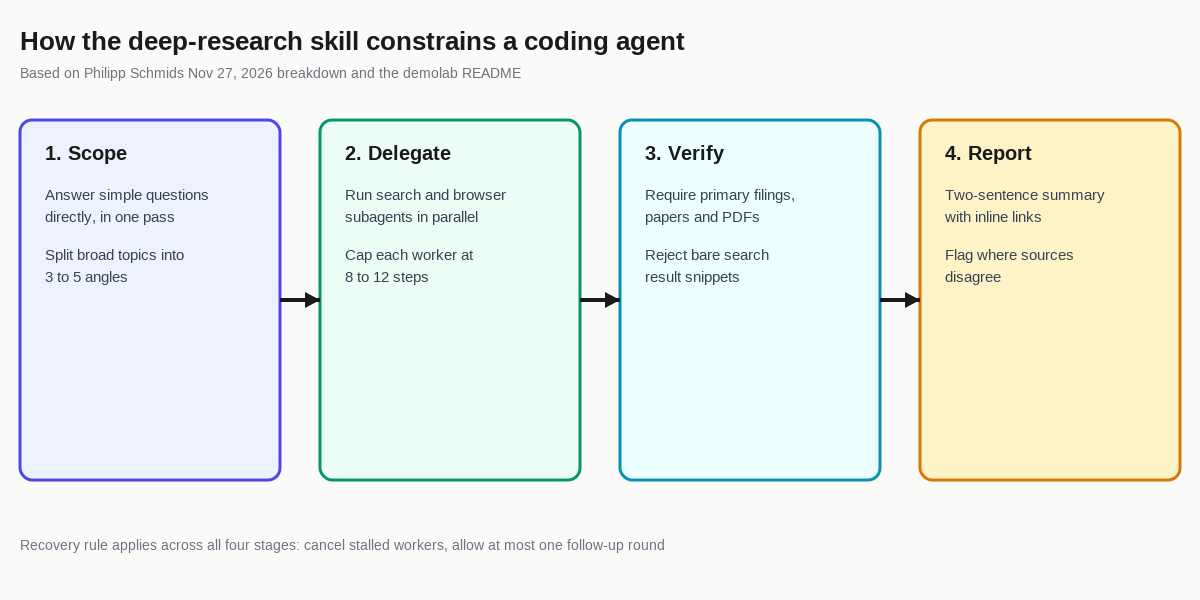
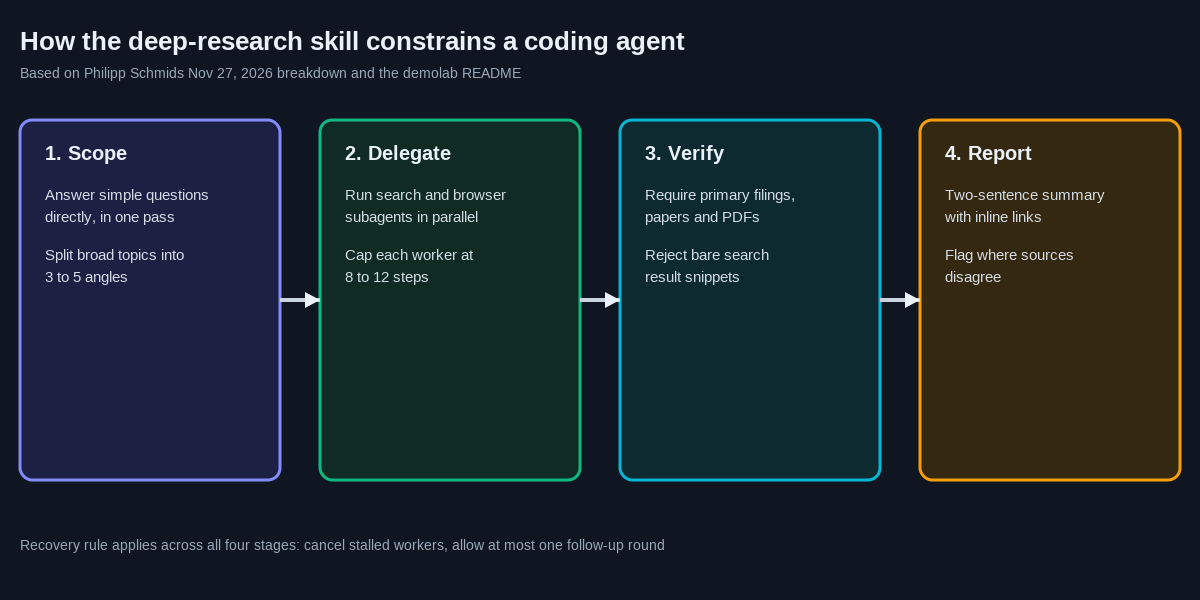
This is the same shape as the manual research playbooks operators already write for agent fleets — scope the question, fan work out to bounded subagents, demand primary sources, and cap retries — just packaged as a file an agent can load on demand instead of guidance a person has to remember to paste into every prompt.
Installing it: four agent surfaces, six install paths
What makes this worth testing rather than just reading about is that the repo documents six concrete install paths — Vercel skills CLI, Context7 skills CLI, Antigravity, Claude Code, Cursor and OpenAI Codex — in one README, rather than being a Gemini-only trick:
# Vercel skills CLI
npx skills add google-gemini/demolab --skill deep-research

# Context7 skills CLI
npx ctx7 skills install /google-gemini/demolab deep-research

# Antigravity
agy plugin install https://github.com/google-gemini/demolab

# Claude Code
/plugin marketplace add google-gemini/demolab
/plugin install demolab@demolab

# Cursor
/add-plugin google-gemini/demolab

# OpenAI Codex
codex plugin marketplace add https://github.com/google-gemini/demolab
codex plugin add demolab@demolab
For operators already running Claude Code skills or juggling subagent fan-out across a fleet, this is a drop-in way to test whether a written research protocol changes output quality more than switching models does.
The evidence, and its limits
Schmid’s post states the skill was “preferred over no skill more than 90% of the time” across “hundreds of blind evaluations” run with Gemini 4 models, a figure the repo’s README repeats verbatim for the deep-research skill specifically. That is a real, stated result — but it is Google’s own internal blind-eval claim, not an externally reproduced benchmark. The repo does not publish the evaluation set, the judge model, or a methodology beyond the headline percentage, and the project explicitly disclaims official support and vulnerability-rewards eligibility. Readers should treat the 90%-plus figure as a vendor-reported result worth testing on their own tasks, not as an independently verified score.
The practical significance is still real: this is a reusable, inspectable text file — not a new model, API, or paid feature — that any team running Claude Code, Codex, Cursor or Antigravity can install today and compare directly against their current research prompts. For anyone whose agents currently paste raw search snippets into reports, the primary-source rule and the stalled-worker cancellation alone are testable, concrete changes rather than generic advice to “use subagents.”
What to check before trusting it on real work
Before wiring this into a production research workflow, verify three things locally: that the 8-12 step cap actually stops a subagent partway through a page rather than truncating its output silently, that the “primary sources only” rule holds up against paywalled or JavaScript-heavy pages where an agent can’t easily reach the underlying filing, and that the single allowed follow-up round doesn’t quietly drop an angle the first pass missed. None of those are visible from the README alone — they only show up once you run the skill against a question you already know the answer to.
Sources
- GitHub - google-gemini/demolab: Skills, prompts, and scripts used to build and reproduce Gemini model demos · GitHub
- demolab/skills at main · google-gemini/demolab · GitHub
- Philipp Schmid on X: "We built an experimental deep research skill for Gemini 4 Neon, turning coding agents into researchers 🚀 What the skill focuses on: 1. Scope: simple direct, broad ones in 3-5 angles 2. Subagents: parallel search or browser, 8-12 step cap 3. Sources: primary filings and PDFs,…
- Google Packs a Full Research Agent Workflow Into 16 Lines