Cursor Projects Goes Multiplayer: Teammates' Coordinator Agents Now Trade Plans and Flag Conflicts Before a PR
Cursor rebuilt Projects so teammates' coordinator agents share context and talk directly, flagging overlapping work before code reaches a pull request.
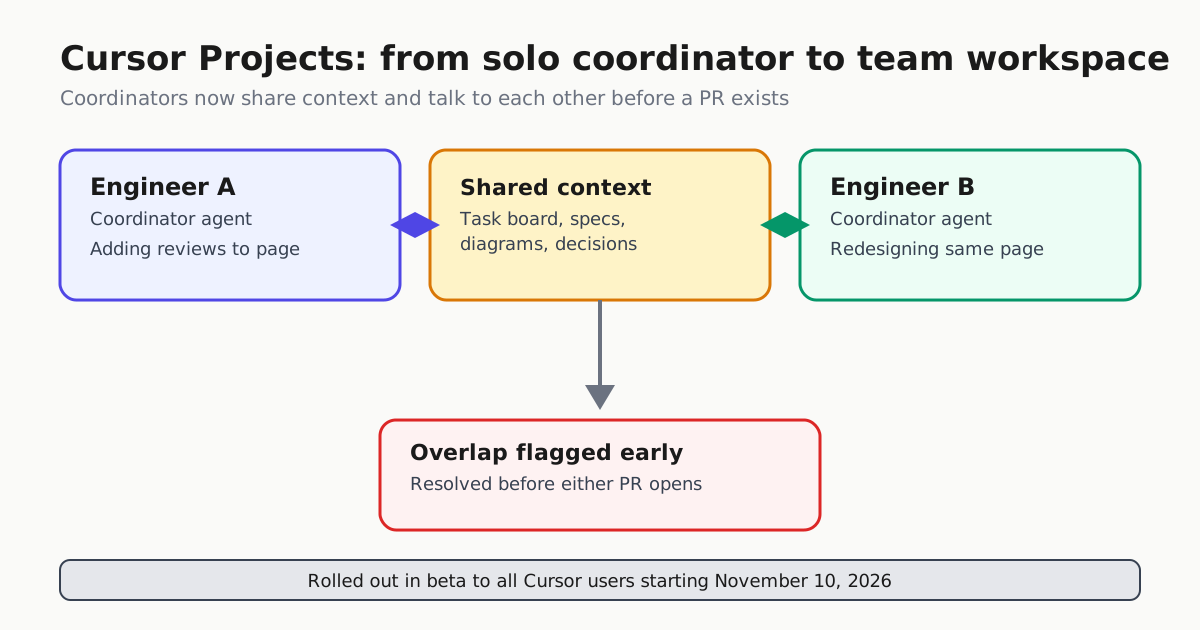
Cursor has rebuilt Projects, the coordinator-agent system it shipped in September, into a tool a whole engineering team can run together. Until November 10, a Project was strictly single-player: one engineer directed one coordinator agent that fanned work out to subagents. Now teammates can be invited into the same Project, and their individual coordinator agents can see each other’s context and talk directly, catching conflicts while work is still in progress instead of at merge time.
What actually changed
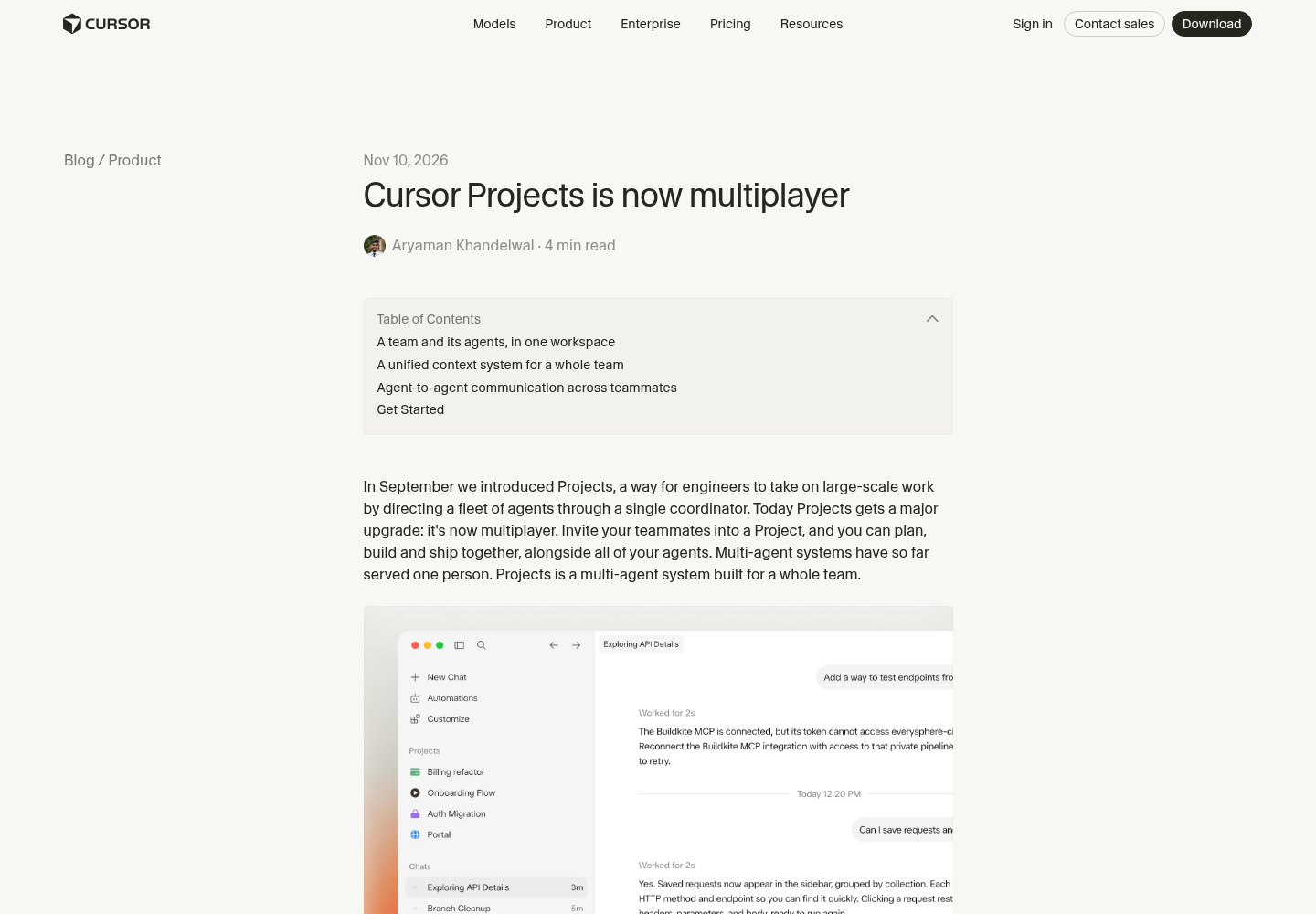
Cursor’s own post on the update, “Cursor Projects is now multiplayer”, and the company’s announcement on X, describe three concrete additions layered on top of September’s single-user Projects:
- A shared task board. Everyone in a Project sees who is doing what, what every teammate’s agents are working on, and the pull request tied to each task — one unified view for humans and agents alike.
- A shared context layer. Each teammate keeps a private one-to-one chat with their own coordinator and workers, but Projects now also maintains a team-wide layer of requirements docs, diagrams, tech specs and mockups. A decision made in one person’s chat becomes visible to every agent in the Project, and a newly invited teammate’s agent inherits that context instead of starting cold.
- Agent-to-agent communication across people. Coordinators belonging to different teammates can now talk to each other directly to plan around overlapping work.
Cursor’s own examples of that last point are the most concrete part of the release: an engineer adding reviews to a product page while a designer redesigns the same page have coordinators that “spot the overlap early and sync up,” so the reviews land inside the new design rather than needing a refactor later. Similarly, if one person’s feature reads from a database table while a teammate is changing that table’s schema, the two agents can agree on an order of operations up front — avoiding the merge conflict that would otherwise surface only when both changes hit the same PR.
Why the September version hit a ceiling
Projects launched in September as a way for one engineer to direct a coordinator that split large work — migrations, feature builds, ongoing “gardening” tasks — across many subagents, as Cursor detailed in its original “Introducing Projects” post. That version maintained context over months of work and ran agents in parallel on cloud machines, but all of it was scoped to a single person’s chat history. Context didn’t transfer between teammates, so every new engineer joining a codebase had to rebuild it from scratch, and nothing stopped two people’s agents from independently planning changes that collided once both reached code review.
The November rebuild targets exactly that gap. As an independent write-up on the release from DEV Community puts it, the update is really an answer to three problems that show up the moment agents stop being personal assistants and start acting like team members: who is doing what, whose context is current, and what happens when two agents step on each other’s work.
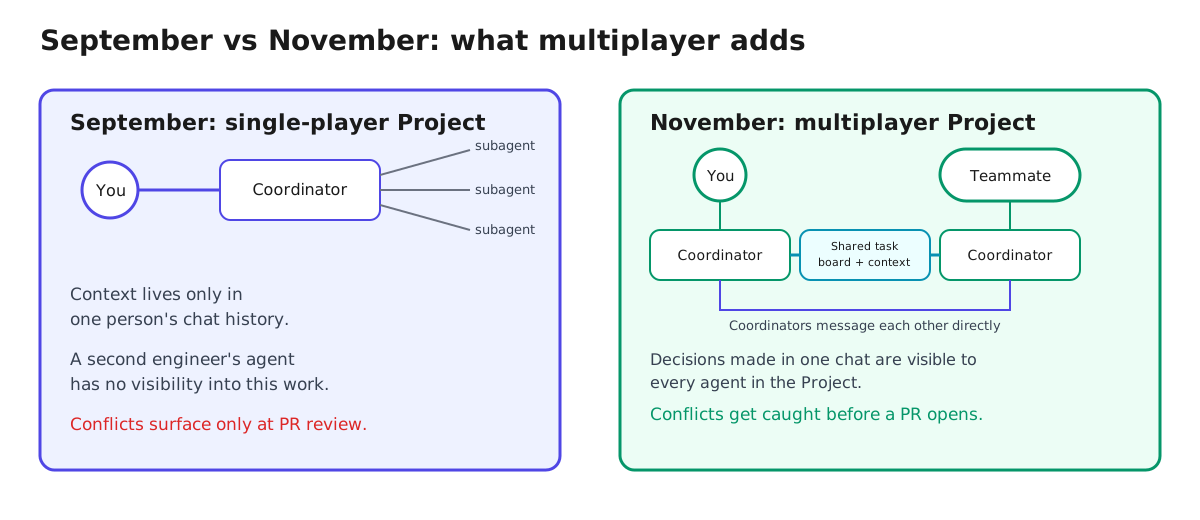
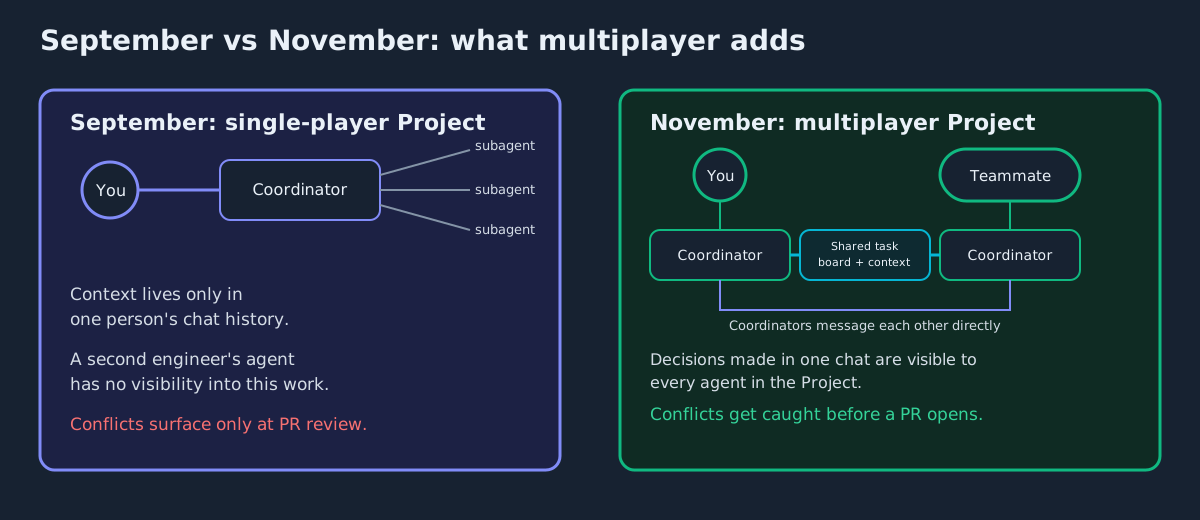
| September Projects | November multiplayer Projects | |
|---|---|---|
| Scope | One engineer, one coordinator | A whole team, each with their own coordinator |
| Context | Private to one person’s chat | Shared layer plus each teammate’s private chat |
| Conflict detection | None — surfaces at PR/merge time | Coordinators plan around each other before code ships |
| Onboarding | New teammate rebuilds context from scratch | New teammate’s agent inherits pre-configured context |
For operators already weighing who should own a fleet coordinator as teams scale up parallel agent work, our analysis of Cursor Projects vs. the Tray covers the tradeoffs between a vendor-hosted coordinator and a locally run one — a question multiplayer Projects makes more pressing, since the coordinator now also holds shared team context.
The on-call example is the clearest workflow case
Cursor says several of its own teams already run on-call rotations inside a shared Project. When an engineer takes over a rotation, their coordinator checks in first, then picks up exactly where the handoff left off: what work is in flight, which issues are unattended, what needs to be passed along, and which Slack channels, Linear boards and threads to watch. In-progress work can be handed off directly, with the new person’s agent simply taking it over rather than requiring a manual rebrief.
A crowded field for shared agent coordination
Cursor is not alone in pushing toward team-shared coordinator agents. Anthropic has been building out its own cloud-coordinator model inside Claude Code Projects, which we examined in Claude Code Projects: Anthropic’s Cloud Coordinator — a useful point of comparison for anyone deciding which vendor’s shared workspace to standardize on. The push toward multi-agent collaboration is also visible in Factory’s acquisition of HumanLayer, which Factory is open-sourcing as part of its own bet on human-in-the-loop coordination across agent fleets. Multiplayer Projects is Cursor’s most direct answer yet to that broader competitive shift.
What to actually do with this
For any team already running more than one person on Cursor’s coordinator agents, this changes how you split and merge work, not just where you chat. Practical steps:
- Create a Project from the left-hand nav and invite teammates, rather than running parallel solo Projects on the same codebase — that’s the only way coordinators get visibility into each other’s plans.
- Move specs, diagrams and schema decisions into the shared context layer early, since the conflict-avoidance behavior Cursor describes (reviews built into a redesign, agreed ordering around a schema change) depends on both coordinators having access to the same documents, not just the same codebase.
- Treat the shared task board as the source of truth for in-flight work before assigning overlapping features, especially around shared tables, shared UI surfaces, or any code path two people are likely to touch in the same sprint.
Multiplayer Projects is rolling out in beta to all Cursor users starting November 10. The practical question for operators now is less whether to try shared agent workspaces, and more how review and ownership change once multiple coordinators have jointly planned a piece of work before a human ever opens the PR.
Sources
- Cursor Projects is now multiplayer · Cursor
- Cursor on X: "Your agents can now coordinate with your teammates’ agents. Projects has been rebuilt for multiplayer: every teammate and their agents can now work together in one unified workspace." / X
- Introducing Projects · Cursor
- Cursor Projects Goes Multiplayer: Your Whole Team — and All Its Agents — in One Shared Workspace - DEV Community