ExecuTorch Brings PyTorch Models to Browser GPUs, With an Experimental Compatibility Catch
PyTorch's experimental WebGPU backend runs exported models locally in browser tabs. It opens a direct deployment path for web AI, but operator coverage needs careful validation.
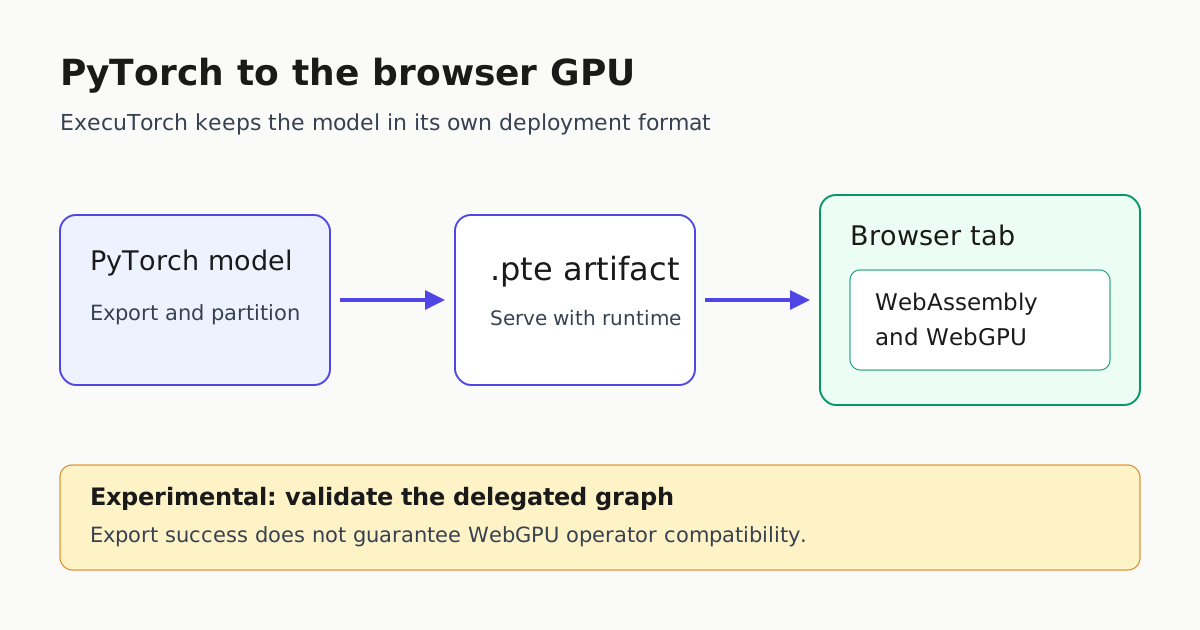
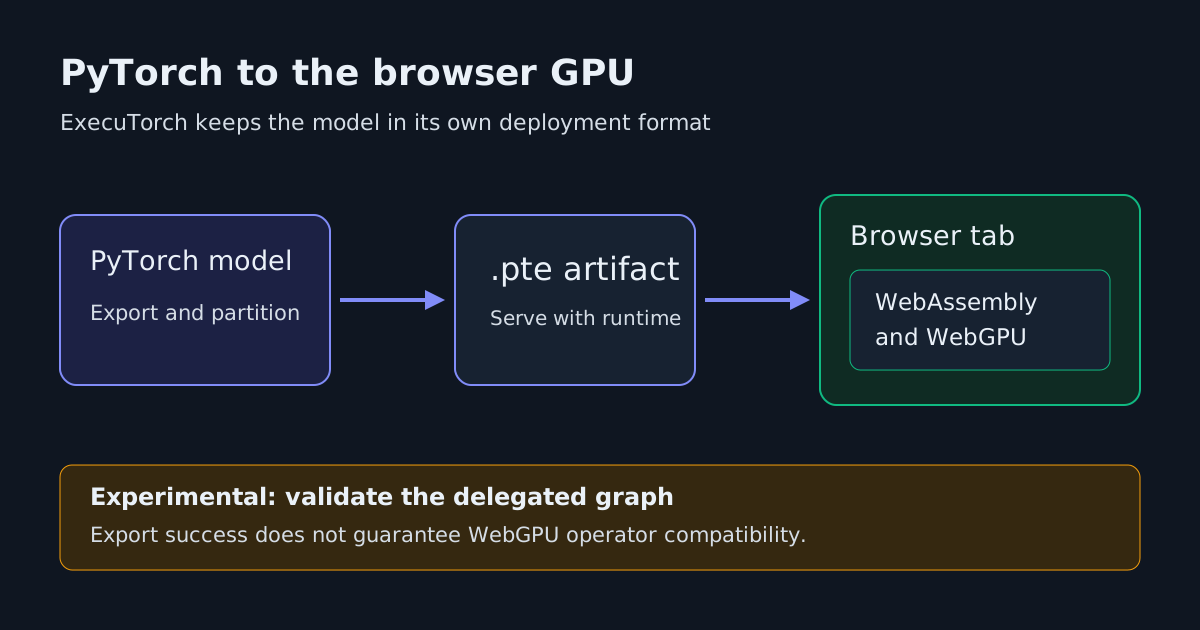
PyTorch developers building browser assistants, image tools and speech interfaces now have a GPU deployment path that stays inside the PyTorch toolchain. The new experimental ExecuTorch WebGPU backend takes an exported .pte model artifact and runs it through a WebAssembly runtime in a WebGPU-enabled browser, without conversion to another framework’s model format.
The consequential change is the deployment boundary: a supported model can execute on the user’s GPU inside a web page. Developers can explore local inference without requiring users to install a native application or routing every inference request through a hosted model server. But the backend’s documentation exposes an important qualification: successful export does not establish that the WebGPU runtime supports the resulting graph.
A browser target for more than chat
The PyTorch announcement reports validation across small language models, SmolVLM image understanding, segmentation, depth estimation, object detection, super-resolution and Whisper speech recognition. It also describes on-device LoRA and DiReFT fine-tuning demonstrations. These are publisher-reported demonstrations, rather than evidence that arbitrary models in those categories will work.
For a web developer, that creates several concrete starting points: image captioning without uploading the image for inference, speech transcription performed in the tab, or a small local text assistant. PyTorch provides a playground and says the demonstrated models’ repositories include .pte artifacts and export recipes. Starting with one of those known examples is a more bounded experiment than exporting an unfamiliar architecture immediately.
Local inference also needs a precise privacy description. PyTorch says inputs and outputs stay on the device in its playground. That supports the inference architecture’s potential; it does not establish the behavior of every application that integrates the runtime. Developers still control surrounding application code and network requests. Our guide to enforcing and verifying local-only AI provides related context for distinguishing local execution from an application-wide data guarantee.
What the speed claim actually measures
PyTorch reports WebGPU performance of 4–7 times its browser CPU path on prefill and 2–10 times on decode. Prefill processes the input context; decode generates subsequent tokens. The comparison used quantized Llama 3.2 1B and Qwen3-0.6B in Chrome on an Apple M1 Pro, across contexts from 128 to 8,000 tokens. Results were medians of five runs after three warmups.
The baseline was ExecuTorch’s own multithreaded WebAssembly and XNNPACK CPU backend. The GPU used four-bit groupwise weights with FP32 activations, while the CPU used four-bit weights with dynamic eight-bit activations. Those details matter: this is a measured comparison between two specific execution configurations, not a universal browser speedup or a comparison against other browser inference frameworks.
The practical implication is that GPU execution can make these demonstrated workloads substantially faster on the tested machine. Teams should measure their own model, input lengths and target devices before using the headline ratios in a product performance promise.
Export is only the first compatibility check
The backend overview describes the path as torch.export, followed by WebGPUPartitioner, producing a .pte file. Browser execution uses Emscripten and its emdawnwebgpu bridge; operators execute as WGSL compute shaders. A browser with WebGPU enabled and the appropriate runtime build is required.
The catch is unusually specific. WebGPUPartitioner currently wraps the Vulkan partitioner and preserves its partitioning behavior, without independently checking WebGPU’s narrower capabilities. An operator accepted during export can therefore fail when the WebGPU runtime builds the graph, rather than falling back automatically.
That makes the operator support documentation essential reading. Compatibility depends on tensor rank, shape, layout and data type as well as operator name. FP16 paths require an adapter exposing shader-f16. Dynamic shapes allocate GPU buffers at the exported maximum shape, so a generous maximum can carry a memory cost even when actual inputs are smaller.
A useful first evaluation is consequently narrow: run a supplied model, confirm correctness on representative inputs, then test the intended device and browser combinations. For a custom export, validate the delegated graph against the WebGPU operator registry and tests before treating the artifact as deployable.
ExecuTorch’s new path is meaningful because it removes a model-format conversion step between PyTorch development and browser GPU inference. Its experimental status remains material: the opportunity is a direct route to local web AI, with graph compatibility and device capability still part of the developer’s job.