OpenAI Begins Testing Private Inference With Business Customers: Hardware Isolation and Zero Data Retention Move Into Live Testing
OpenAI is testing Private Inference — hardware-isolated, zero-data-retention inference — with a small customer group. What it changes for sensitive agent workloads, and what is still missing.
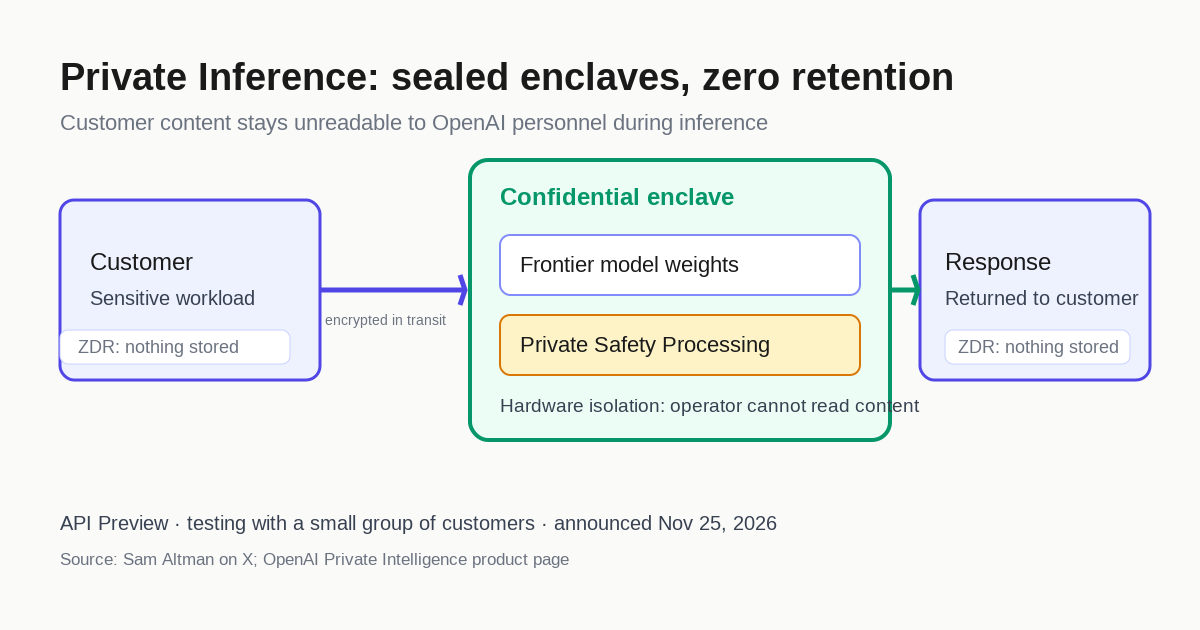
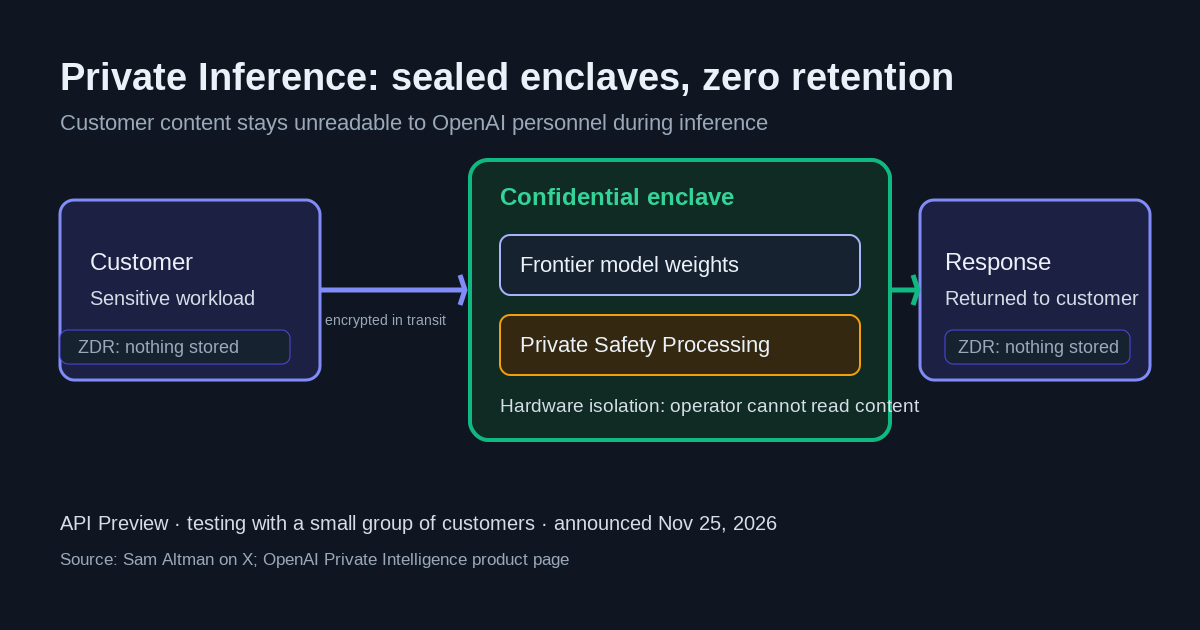
OpenAI has started testing Private Inference with a small group of business customers. Sam Altman announced the milestone on Nov. 25, 2026, describing it as the latest offering under OpenAI Private Intelligence and pairing it with a zero-data-retention safety pipeline that keeps human reviewers out of the content (Altman on X).
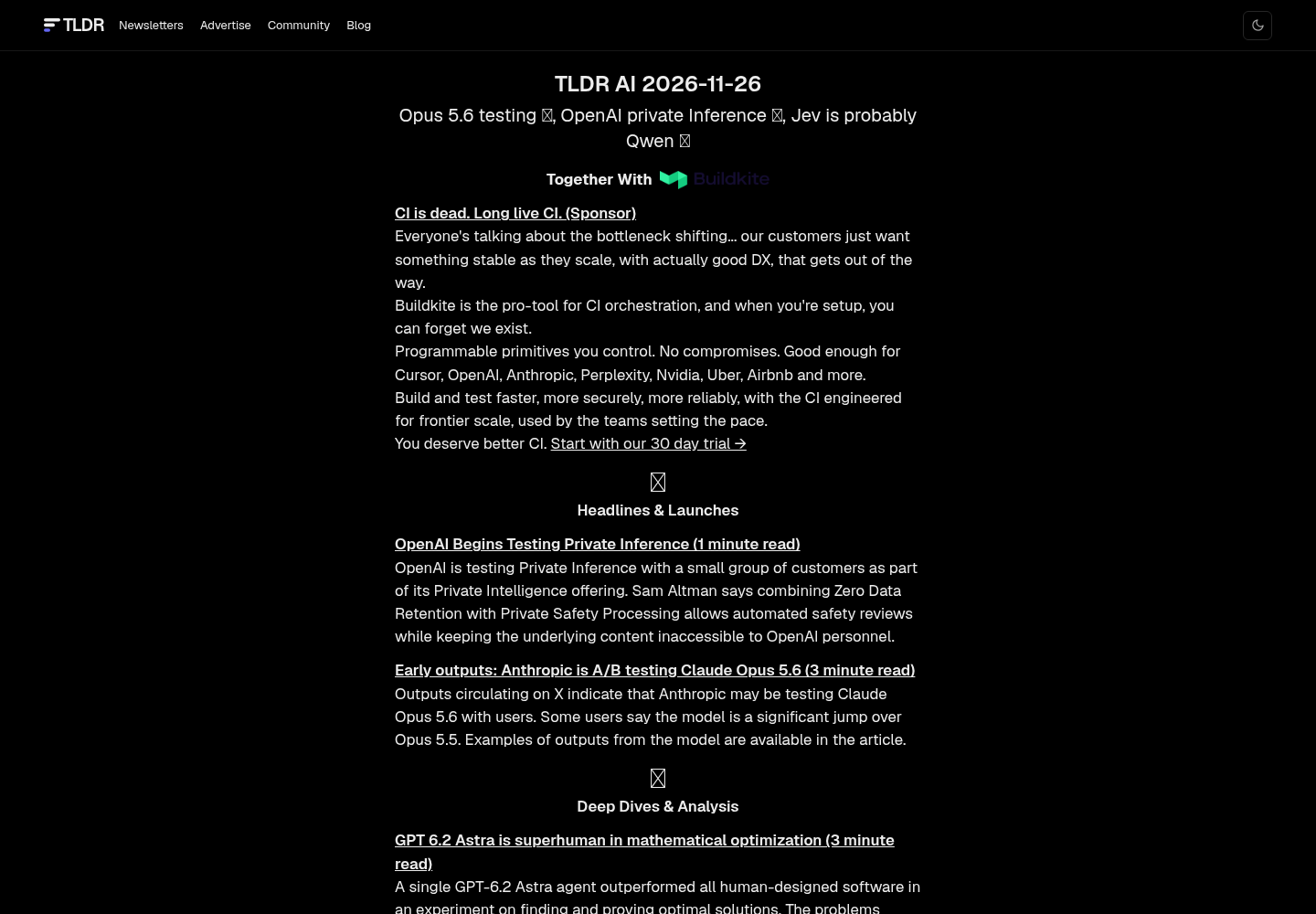
This is a test program, not general availability. But it is a real milestone: the hardware-isolated inference option that OpenAI previewed as part of its Private Intelligence suite has moved into live customer testing, and it changes which agent workloads a frontier API can plausibly serve at all.
What Private Inference actually is
OpenAI’s Private Intelligence page positions Private Inference alongside Zero Data Retention (ZDR) as the two access restrictions offered “for eligible workflows” (OpenAI, Private Intelligence). The page describes it as “confidential computing, strict verifiable controls” and currently labels it API Preview.
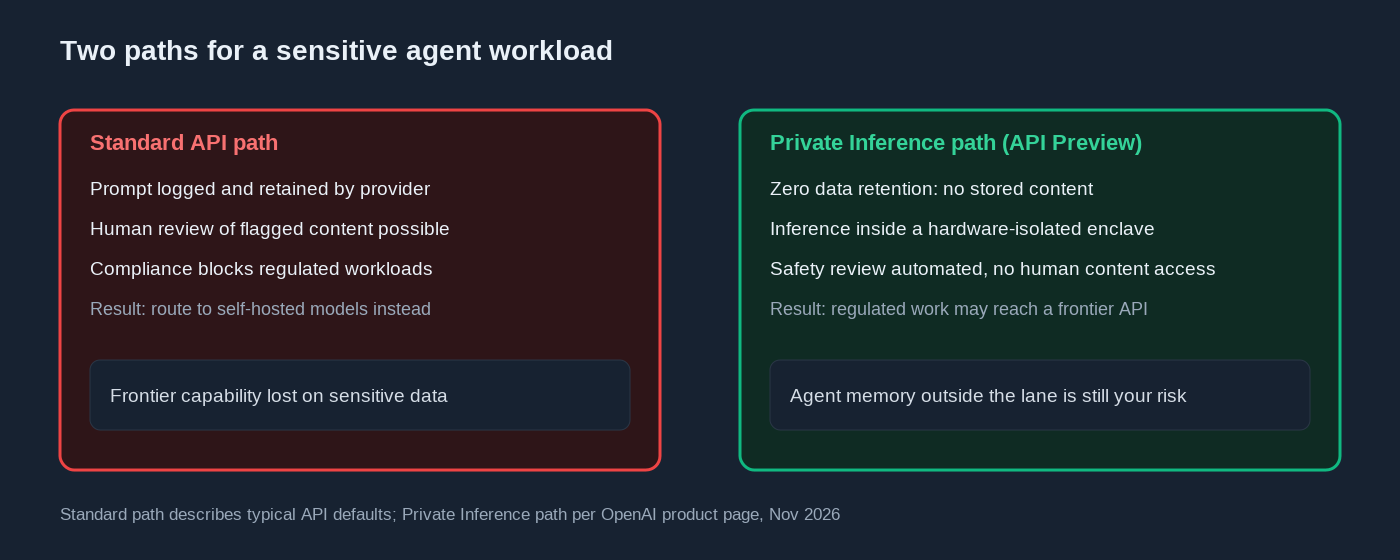
In confidential computing, inference runs inside hardware-isolated enclaves where the cloud operator — here, OpenAI — cannot read the prompts or outputs passing through. Combined with ZDR, the promise is that neither retained logs nor human access expose customer content. Altman’s post adds the piece that matters most for regulated industries: “ZDR with Private Safety Processing enables automated safety reviews without giving OpenAI personnel access to the underlying content.” In other words, the safety review layer runs on the encrypted or isolated content too, so oversight does not become the back door.
The same page frames the broader contract enterprises are being asked to evaluate: customers own their inputs and outputs, they decide what agents can access and which actions need approval, and OpenAI commits to encryption, strict access controls and ongoing threat detection.
Why operators should care
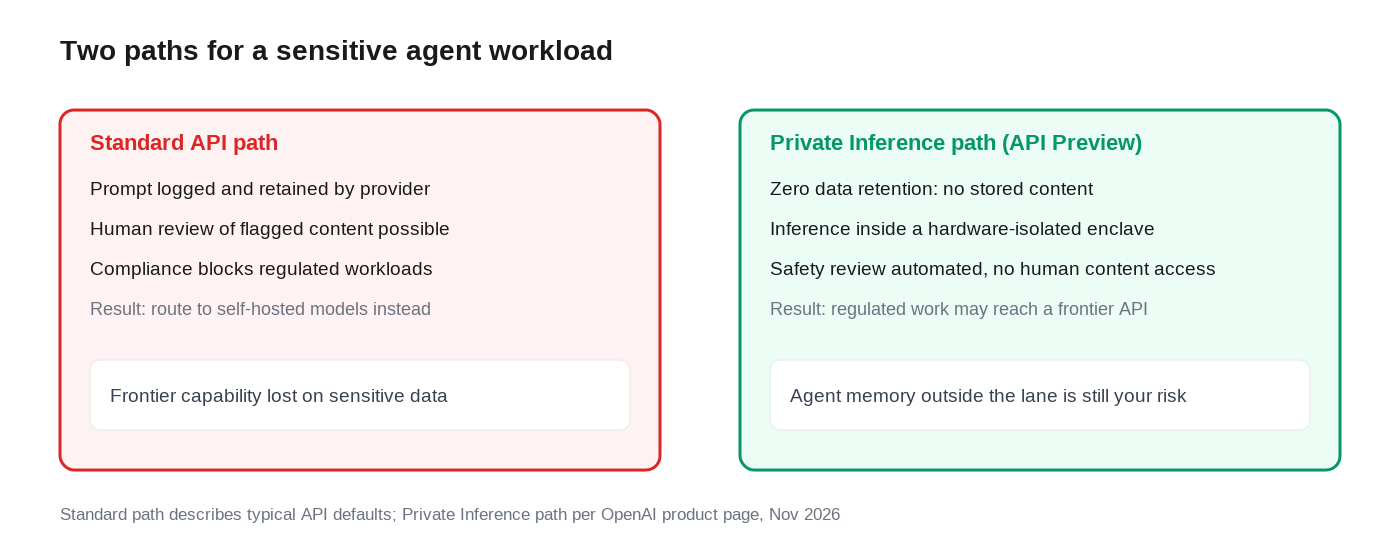
Today, the standard decision for a sensitive workload — clinical note summarization, legal document review, financial transaction analysis — is a fork: use a frontier API and accept that the provider may retain or human-review content, or route to self-hosted or regionally pinned models and accept lower capability. Private Inference is an attempt to delete that fork. Altman’s framing is explicit: “Stronger privacy protections will make frontier AI useful for a lot more work.”
For agent fleets the consequence is concrete. An agent that reads medical records or board documents through a ZDR-plus-confidential-compute lane can, in principle, be cleared by compliance without the data-residency exception work that normally blocks API adoption. Enterprise AI vendors across the industry have already had to build data-residency carve-outs and tiered review options precisely because privacy limits — not capability — are so often the actual blocker for adoption.
The operational caution is equally concrete. ZDR changes what the vendor keeps, not what your agent remembers. If your agent framework persists session summaries, tool outputs or memories outside the private inference lane, the retention promise stops at your own boundary — the same gap covered in Zero Data Retention AI Agents: Where Vendor Forgetting Meets Agent Memory.
What is verified and what is not
Verified from primary sources:
- Altman’s Nov. 25 announcement that testing has begun with “a small group of customers” (Altman on X).
- The Private Intelligence product page documenting Private Inference as confidential computing with verifiable controls, currently at API Preview status, alongside ZDR for eligible workflows (OpenAI).
- The combination of ZDR and Private Safety Processing enabling automated safety reviews without human access to content, per both Altman’s post and TLDR AI’s coverage (TLDR AI, Nov. 26).
Not yet verified or available:
- Pricing, latency overhead of enclave execution, or which models are served in the enclave.
- The exact attestation mechanism behind “verifiable controls” — the page names the concept but the fetched content does not document a customer-verifiable attestation endpoint.
- General availability timing. Interested customers are directed to contact OpenAI; there is no self-serve path yet.
Independent verification of the enclave claims also remains open. OpenAI links to third-party audits on its Trust Portal, but this specific inference configuration has no published independent assessment yet. Operators should treat “confidential computing” here as a vendor claim until an auditor or a customer attestation check confirms it — the same standard that shaped coverage when Vercel added independent audits to back its own ZDR claims after third-party findings contradicted gateway labels.
The takeaway
Privacy is becoming a product axis for frontier inference, not a policy footnote. For teams that have kept sensitive agent workloads off frontier APIs because of retention and human-review exposure, the practical move now is to evaluate eligibility: confirm which of your workflows qualify for ZDR, what Private Safety Processing reviews and what it cannot see, and where your own agent memory stores content the vendor no longer retains. Testing with a small customer group means the controls are still forming — which is exactly the right time to write down the requirements you would need before routing regulated work through the API. AWS GovCloud customers already have a documented pattern for pairing frontier models with zero-retention terms (Automater); Private Inference would bring an equivalent offer natively to OpenAI’s own stack.
Sources
- Sam Altman on X: "We’re now testing Private Inference, our latest offering as part of OpenAI Private Intelligence, with a small group of customers. Stronger privacy protections will make frontier AI useful for a lot more work, and business privacy is important for a healthy ecosystem. Reach out to…
- Private Intelligence | Frontier intelligence. Private by design. | OpenAI
- Opus 5.6 testing, OpenAI private Inference, Jev is probably Qwen | TLDR AI