Epic Delays Its Disney Shooter and Orders an AI-First Rebuild: No Hand-Written Code, Claude Generates, Humans Direct
Epic has delayed its Marvel and Star Wars shooter indefinitely and told staff there will be no more hand-written code, with Claude-generated code and full AI art workflows. What the first big-studio AI-first mandate means for teams building on coding agents.
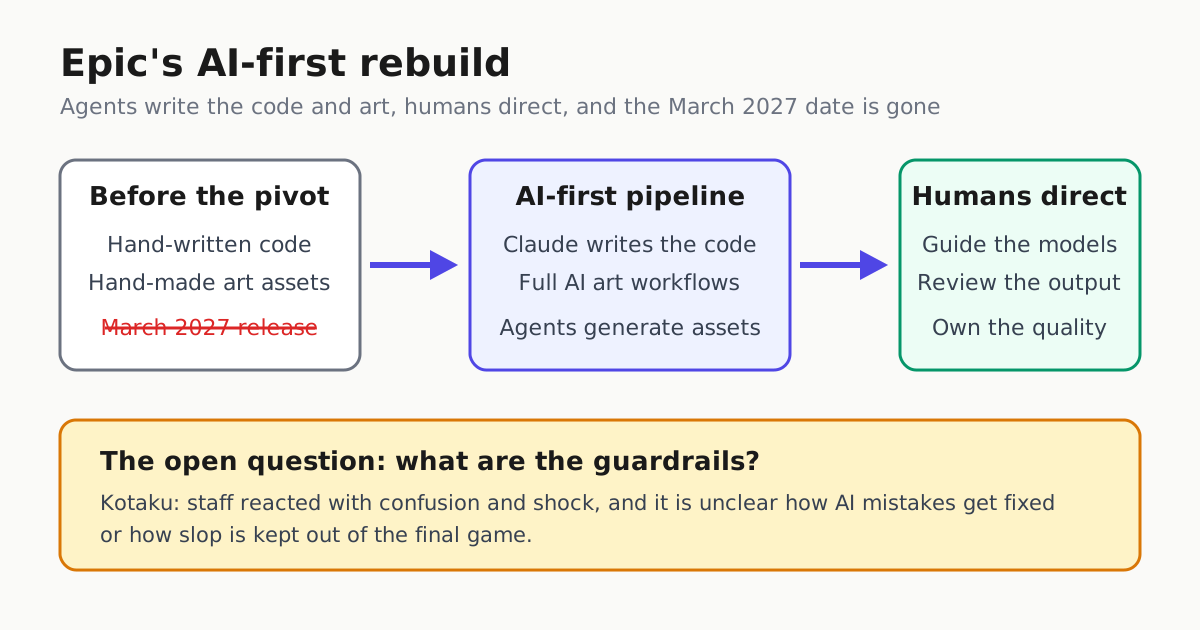
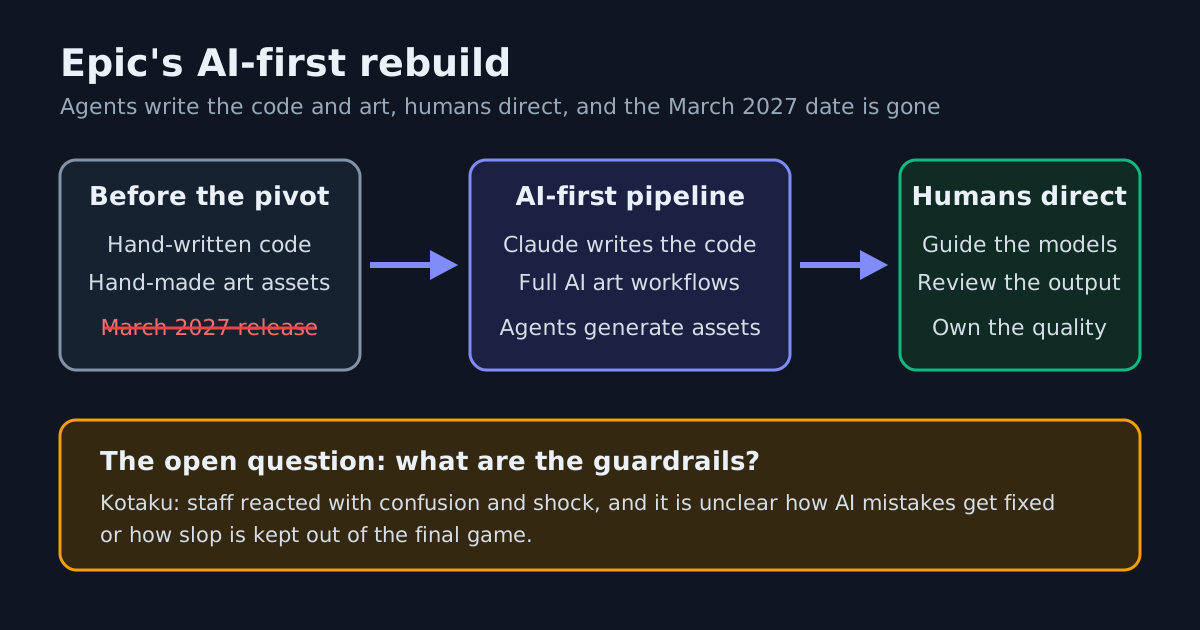
Epic Games has told the team behind its unannounced Marvel and Star Wars shooter that there will be “no more hand-written code.” According to a Bloomberg report published October 12 and carried by Ars Technica, the studio is shifting the project to an “AI first” production model in which models such as Anthropic’s Claude generate the code and art while human developers manage and guide the output. The shooter, part of the $1.5 billion Epic and Disney collaboration announced in early 2024, has been delayed indefinitely from its March 2027 release date amid the AI-related shakeup and understaffed, slower-than-expected development.

What the directive says
According to internal Epic employee messages viewed by Bloomberg, humans are being reassigned to direct AI-generated assets: code comes from models such as Claude, and art must be “generated with full AI workflows.” Kotaku’s account of the same reporting adds that the director of the unannounced game delivered the art mandate, and that many developers responded to the policies, which arrived last week, with confusion and shock. Kotaku also flags what the reporting leaves unresolved: it is unclear what Epic’s guardrails are for fixing AI mistakes and keeping “slop” out of the final product.
Epic confirmed the direction on the record. “We’re embracing AI-accelerated development, led by Epic developers who are the visionaries and creative drivers for everything we do,” the company said in a statement that Kotaku attributes to communications director Jake Jones. CEO Tim Sweeney wrote on social media shortly after the Bloomberg story posted: “We have a huge pivot underway here at Epic, moving developers around to retool for maximum AI acceleration. The aim isn’t to do the same stuff with fewer people, but to enable everyone here to build MORE and BETTER stuff, and to bring the benefits to all teams using Unreal.” That last clause matters beyond one studio: Epic builds Unreal Engine, so its tooling choices leak outward to every team licensing it.
A pivot under pressure
The mandate lands in a tense context. Epic laid off more than 1,000 employees in March, citing a downturn in Fortnite engagement; Kotaku adds the cost of ongoing antitrust litigation. Sweeney has spent years predicting an AI-driven game development revolution, telling IGN in June that small teams will soon create games with “immense amounts of characters and immense and interactive worlds,” and dismissing storefront AI disclosure tags like Steam’s last November as making “no sense.” The company’s public AI experiments have not all aged well: last May, an AI-voiced Darth Vader in Fortnite began repeating curse words before a hotfix. And the industry Epic leads is far from agent-first: a survey of more than 2,300 game industry professionals ahead of this year’s Game Developers Conference found 36 percent using generative AI at work, and among those AI users, 81 percent used it for research and brainstorming versus 47 percent for code assistance and 35 percent for prototyping.
Why every coding agent team should watch
Kotaku’s framing is the right one for anyone building software with AI: there has been no major gaming company attempting the technology at massive scale as the foundation of its development pipeline, even as improved models flood modding and homebrew scenes with vibe-coded projects. Epic is now that first big-studio test, running in public, with Disney’s Marvel and Star Wars characters on the line.
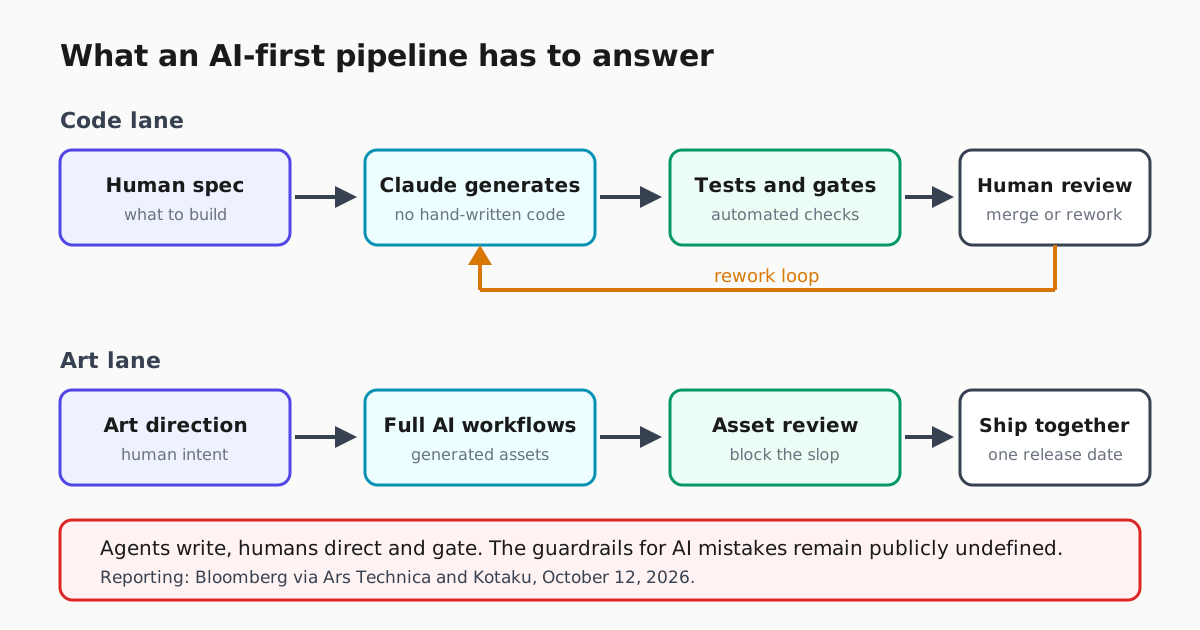
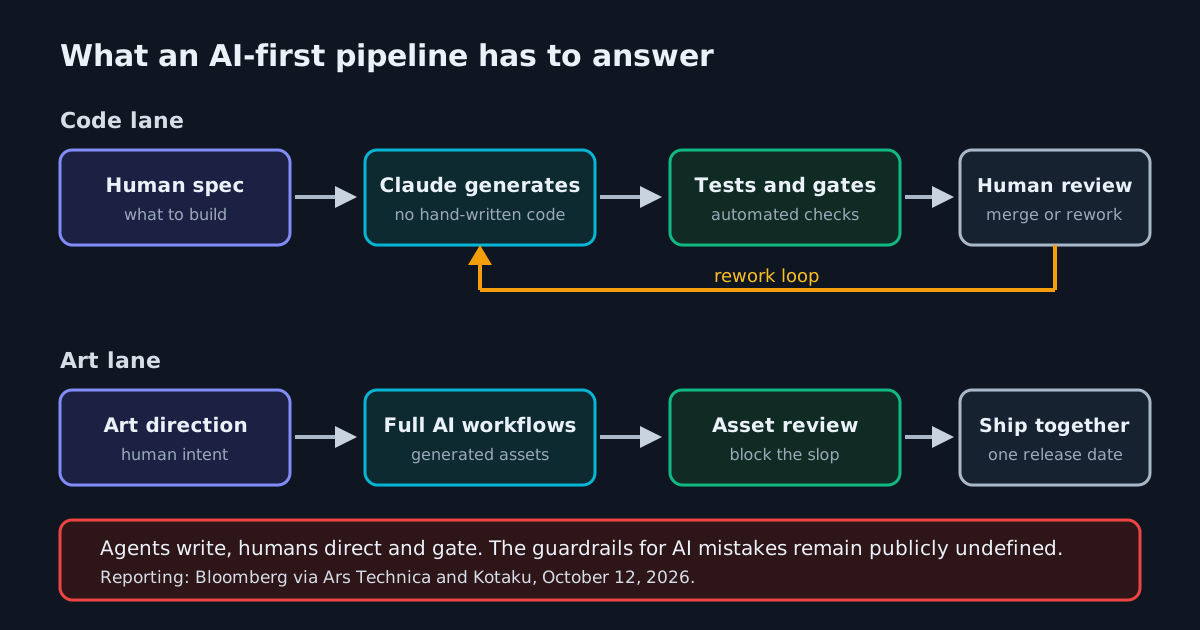
The open questions Epic must answer are the same ones any team faces when agents write most of the code and art. None are new, and we have covered the review side in AI PR Review Agent Policy: Agents Propose, Humans Merge and measurement in Evals for AI Agents, but no studio has been forced to answer them at this scale before:
| What Epic’s mandate exposes | The practical check for your pipeline |
|---|---|
| Undefined guardrails for AI mistakes | Define the rework loop: who catches bad agent output, with which automated gates |
| “Slop” risk in shipped assets | Keep human approval gates on anything player-visible |
| Review load as agent output grows | Cap how many agent PRs one human reviews per day |
| Schedule optimism about agents | Treat agent adoption as a retooling period, not an instant capacity recovery |
The delay itself is the data point: the Bloomberg report, as carried by Ars Technica and Kotaku, attributed the slipped date to understaffed, slower-than-expected development, and Epic is responding with more AI rather than more headcount. Whether that recovers the schedule or extends it is one of the most consequential experiments running in software development right now. If you are designing your own agent-first workflow, and What Is Agentic Coding? covers the vocabulary, Epic’s next eighteen months are a free pilot.
Confirmed versus reported
Be careful which details you rely on. Sweeney’s “huge pivot” and Epic’s “AI-accelerated development” statement are on the record; the no-more-hand-written-code directive, the Claude specifics, staff reaction and the indefinite delay all come from Bloomberg’s unnamed sources, and the original Bloomberg story is paywalled. Both Ars Technica’s gaming section and Kotaku led with the story on October 12, so the account is well corroborated, but the internal directive details should be treated as reporting rather than confirmed Epic policy documents.
What to watch next: whether Epic extends the AI-first model to other Unreal teams as Sweeney’s post suggests, whether the Disney shooter gets a new date, and whether the quality-gate answers arrive before the first gameplay footage does.