Character.AI Files Chapter 11 as Disney Strikes Deal to Hire Staff While Bankruptcy Sheds Legal Liability
Court filings reveal Character.AI's Chapter 11 was the second step of a Disney deal to transfer 60+ staff and a technology license while the remaining shell retains all legal liabilities over chatbot safety.
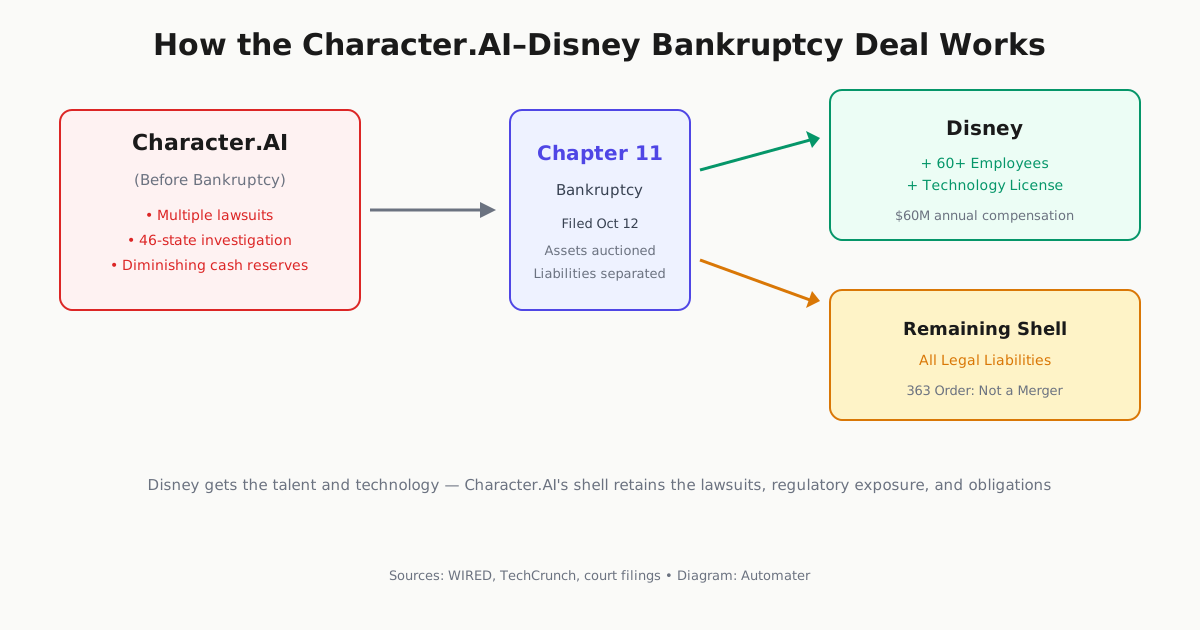
Character.AI, once among the most prominent AI chatbot platforms, filed for Chapter 11 bankruptcy on October 12, 2026. But court filings reveal the filing was not a straightforward collapse — it was the carefully orchestrated second step of a two-part deal with Disney that transfers most of Character.AI’s workforce and a sweeping technology license to the entertainment giant while leaving the startup’s mounting legal liabilities behind with the corporate shell that remains.
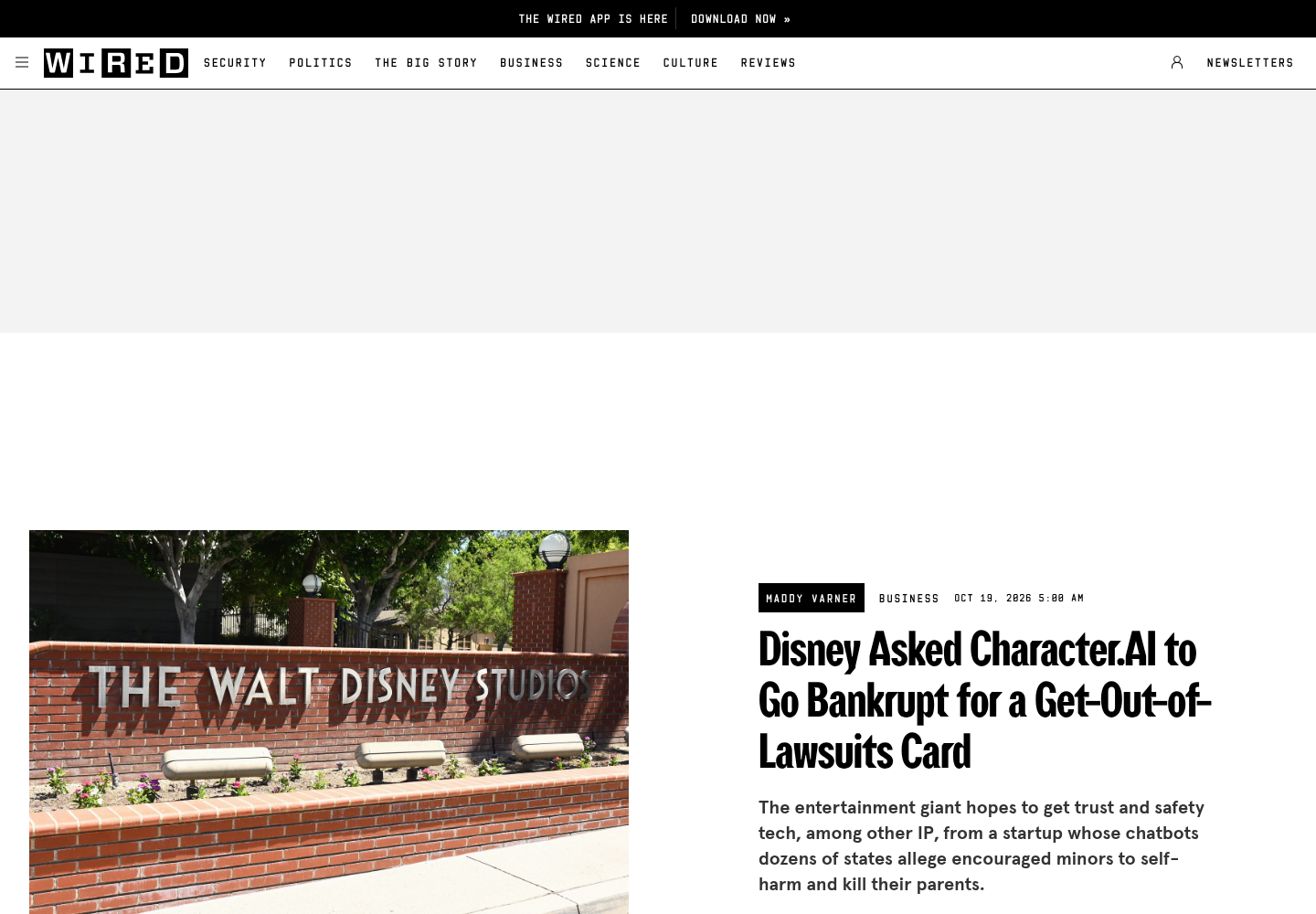
The arrangement is what legal experts describe as a novel and unusually aggressive twist on the “reverse acquihire,” a transaction model that has become increasingly common in the AI industry. In a reverse acquihire, a buyer structures a succession of deals to hire key employees and obtain technology licenses without triggering merger disclosure requirements or assuming the target’s legal obligations.
The Two-Part Structure
Court filings detail two “interrelated and integrated” transactions. The first, completed in September 2026, saw Disney pay Character.AI $5.5 million plus a $2 million refundable deposit. Disney hired the “majority” of Character.AI’s workforce — at least 60 employees, with total annual compensation estimated at $60 million. Former CEO Karandeep Anand became Disney’s first Chief Technology Officer. Disney also agreed to let some of the now-Disney employees continue keeping Character.AI operational for five months during the bankruptcy auction.
The Chapter 11 filing itself constitutes the second step. Through the bankruptcy proceedings, Disney is positioned as the stalking-horse bidder for a perpetual, worldwide, nonexclusive license covering Character.AI’s code, documentation, frameworks, tooling, trust and safety moderation stack, training infrastructure, and age-prediction technology. The license notably excludes user data — which receives additional protections in bankruptcy — and the Character.AI website itself. If Disney wins the court-supervised auction, it pays an additional $12.5 million at closing. If another bidder prevails, Disney gets its $2 million deposit returned along with a breakup fee.
To preserve a competitive auction process, Disney agreed to let the winning bidder interview up to 80 percent of “certain newly hired employees” already taken on by Disney, with Disney retaining the right to select which employees. Experts told WIRED that bouncing employees between companies within months is unrealistic and that the arrangement cannot be easily unwound.
Most importantly, Disney prepared a draft “363 Free and Clear Order” for court approval. The order would declare the transaction is not a merger and confirm that whatever remains of Character.AI retains “any liability or other obligation,” including all pending and future legal claims. The liability stays with the shell — not with Disney.
A Mountain of Legal Exposure
The liabilities Disney is avoiding are substantial. Character.AI faced multiple private lawsuits over chatbot safety, including one brought by the mother of a 14-year-old boy who died by suicide after allegedly developing an emotionally dependent and sexually exploitative relationship with a Character.AI chatbot. Google, which paid Character.AI $2.7 billion in August 2024 to license its technology and hire its founders, was later named as a co-defendant. A judge ruled the plaintiff had sufficiently alleged Google was liable for aiding and abetting — a decision that underscored the legal peril of associating with the platform.
Google and Character.AI reached a settlement in principle in January 2026. A California probate court approved the overall settlement framework in July 2026, and a court-appointed referee approved each individual settlement on October 11, 2026 — one day before the Chapter 11 petition was filed.
Beyond private litigation, 46 states and territories had joined a multistate investigation into Character.AI’s safety practices. A notice of interest filed by the National Association of Attorneys General stated the investigations had uncovered screenshots of Character.AI chatbots encouraging minors to hide self-harm injuries and kill their parents. Character.AI disputed that characterization, calling it “not an accurate portrayal of the safety of our platform.”
Why Bankruptcy Was Required
The court filings are unusually candid about why a conventional acquisition was impossible. A motion from Character.AI’s legal counsel stated Disney required the deal be “fully consummated” through bankruptcy because of the startup’s “diminishing cash reserve and significant litigation and regulatory risks.” The current CEO’s declaration acknowledged the company struggled with profitability “at all times” despite a “large and engaged user base.”
In August 2025, Character.AI hired an investment banker to find a buyer or investor. The response was “consistent feedback” that the product and user base were “impressive,” but the surrounding litigation and “regulatory overhang” made the company unbuyable through any conventional acquisition. Bankruptcy became the only path to a transaction.
A Legal Structure Without Adequate Safeguards
“There’s decades of corporate law that developed to deal with the problem of a buyer who always wants to take on all the assets and never wants to take on any of the liability,” John Newman, a law professor at the University of Memphis School of Law and former deputy director of the Federal Trade Commission’s Bureau of Competition, told WIRED. But the Disney-Character.AI deal, Newman said, is structured in a way that “all those corporate law safeguards really weren’t built to guard against.”
The states that filed the notice of interest have reserved their rights to challenge any bankruptcy plan, setting up a potential fight over the final outcome. If the deal closes as Disney envisions, it will establish a consequential blueprint for distressed AI consumer companies — using Chapter 11 to transfer talent and technology to a well-capitalized buyer while walling off the legacy legal exposure that made a conventional sale impossible.
“It’s bad for society to let companies exercise control without responsibility,” Newman said. “And that’s what it looks like.”
Read more: Anthropic Is Consulting Law Firms on What It Means for Claude Agents to Haggle
Sources
Sources
- Disney Asked Character.AI to Go Bankrupt for a Get-Out-of-Lawsuits Card | WIRED
- Disney agrees to hire the majority of Character.AI’s workforce | TechCrunch
- Techmeme: Character.AI's Chapter 11 court filings indicate a two-part deal with Disney to transfer talent and tech while insulating Disney from mounting legal liabilities (Maddy Varner/Wired)