Nvidia's First Post-Huang Move Is a Board Committee on National Security and Export Controls
Nvidia's first structural move after Jensen Huang's exit is a standing board committee over national security policy and export-control compliance — hours before Q3 earnings and new Commerce Department rules.
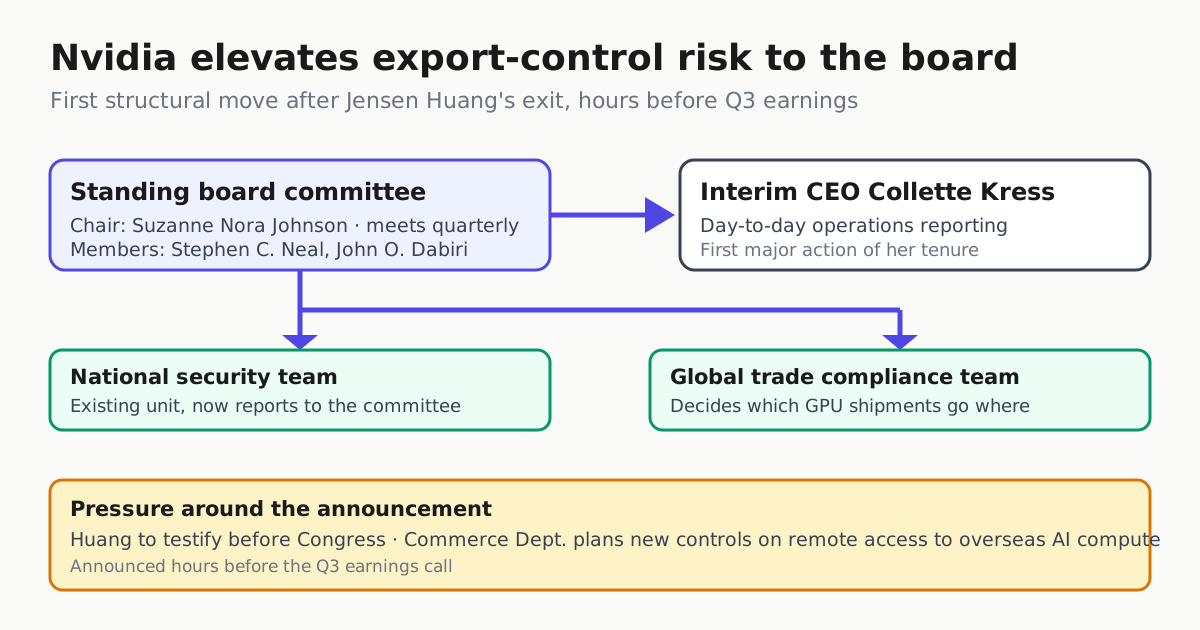
Hours before its most anticipated earnings call in years, Nvidia made its first structural move of the post-Jensen Huang era: a standing board committee with direct oversight of national security policies, export-control compliance and global trade risks.
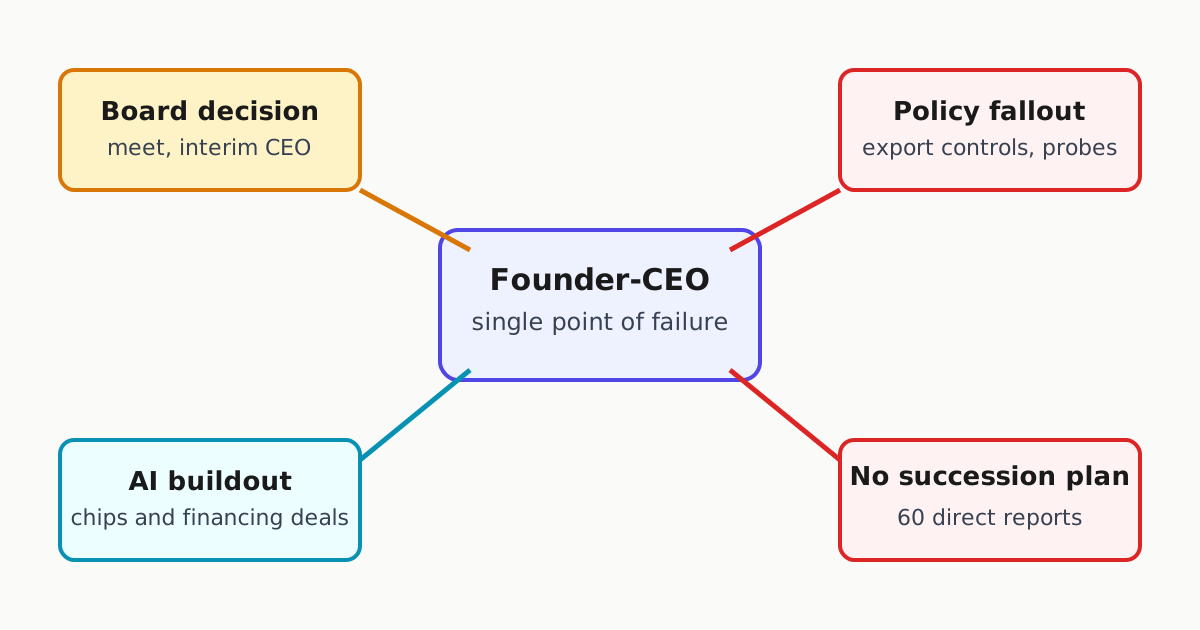
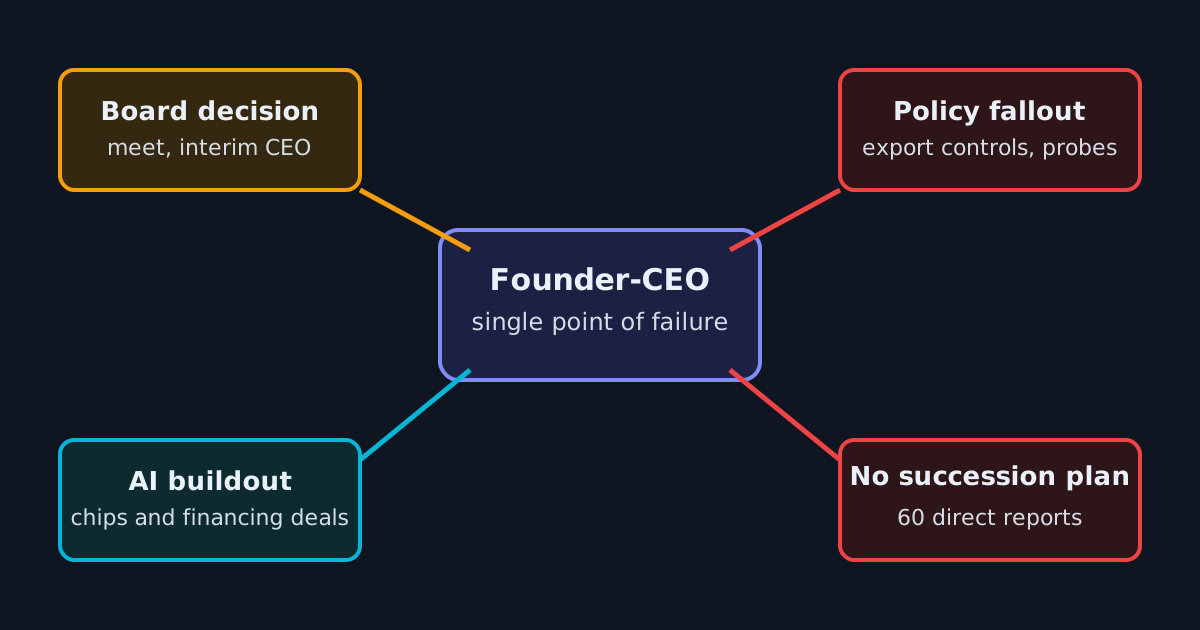
The company said Tuesday that the new committee will meet at least quarterly. It is chaired by director Suzanne Nora Johnson, with fellow directors Stephen C. Neal and John O. Dabiri as members. Nvidia’s existing national security team and global trade compliance team will now report to this board committee and to interim CEO Collette Kress on day-to-day operations, according to TechCrunch.
Why governance, not product, came first
The move follows the abrupt resignation of CEO Jensen Huang over allegations of an affair with a suspected Chinese spy who had links to one of the company’s customers. Kress, the CFO who took over as interim CEO after Huang stepped down last week, is under pressure from U.S. lawmakers scrutinizing Huang’s alleged ties and his earlier advocacy for easing restrictions on advanced AI chip exports to China. Huang has agreed to testify before Congress later this month.
The governance reset also lands amid active regulatory escalation. The Commerce Department said Monday it plans to introduce new export controls on AI chips and data centers outside the U.S., aimed at stopping companies in China and elsewhere from remotely accessing AI infrastructure in third countries to skirt existing rules. TechCrunch reports the interim rule was drafted in direct response to the unfolding chip smuggling scandal at Nvidia.
For the AI industry, this is more than a boardroom reshuffle. Nvidia is the primary compute supplier for nearly every frontier lab and large-scale agent deployment, and export-control compliance is currently the industry’s largest policy risk. A standing board committee elevates that risk from an operational compliance function to a board-level fiduciary concern — a signal about how Nvidia intends to de-risk its China exposure while the leadership transition plays out.
The earnings overhang
The committee announcement came just hours before Nvidia’s third-quarter earnings call, where analysts, media and shareholders expect the company to address the controversy and its operational impact. Semafor frames the quarter as sky-high profit expectations overshadowed by the succession dilemma and broader AI-bubble worries — and notes the committee was already in place before Kress faced the call.
Semafor also flags a second fault line beyond compliance: Kress’s reported reluctance to support Huang’s strategy of backstopping and investing in many of the companies driving the technology. Any sign Nvidia is pulling back from that open-checkbook role would have huge ramifications for the sector and the broader AI economy, given how many startups and infrastructure players depend on Nvidia’s capital and commitments.
The market’s focus is narrower. On Bloomberg Television, DA Davidson research head Gil Luria called growth guidance the pivotal point to watch: it would be “more alarming” if Nvidia had to pull its growth guidance entirely, which he described as “a big leg down” for the stock.
What it means for operators
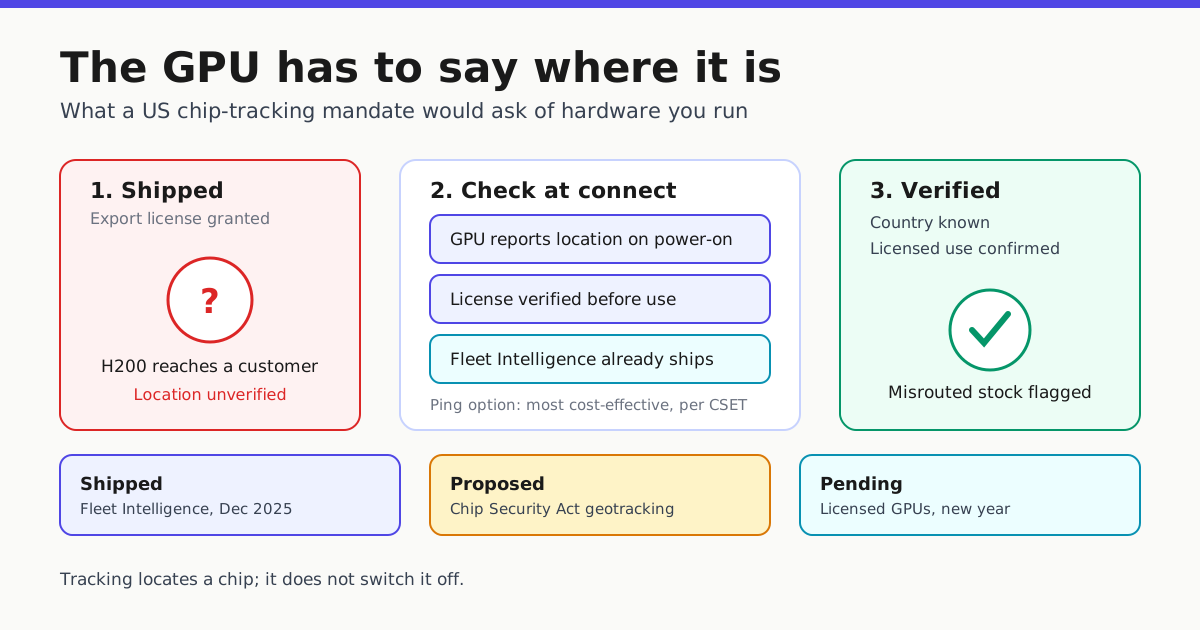
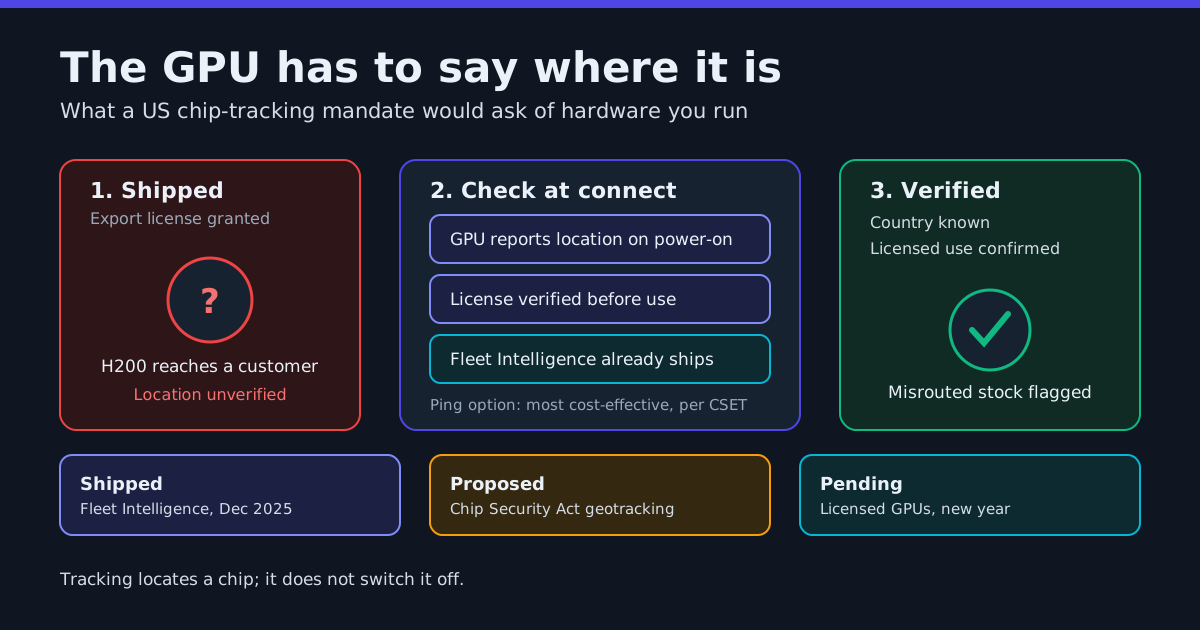
For teams building on Nvidia hardware — GPU fleets, sovereign AI programs, and the agent infrastructure layer — the practical consequences run through two channels. First, tighter export enforcement, including the planned rules against remote access to overseas AI data centers, could reshape where inference capacity can legally live and which customers Nvidia can serve in restricted regions; Congress’s earlier chip-tracking inquiry already pointed in this direction. Second, if the new leadership retreats from Huang’s investment-and-backstop posture, startups that treated Nvidia as a standing capital partner may need to re-underwrite their funding assumptions.
The committee itself is an accountability structure, not a product change. But its existence, its quarterly cadence and its authority over the compliance teams that decide which GPU shipments go where make it the clearest statement yet of how Nvidia plans to govern itself after Huang — and how much of the AI industry’s compute supply now runs through an export-control lens.
Related coverage: Nvidia’s board prepares to oust Jensen Huang and the chip-tracking mandate and congressional inquiry.