Four Gemini 4 Argon Agents Beat Minecraft End to End in 27 Hours
Google DeepMind researchers report that four Gemini 4 Argon agents, coordinating only through in-game chat and shared memory, defeated Minecraft's Ender Dragon in 27 hours — 2,783 self-written programs, 605 deaths and no human-written game logic.
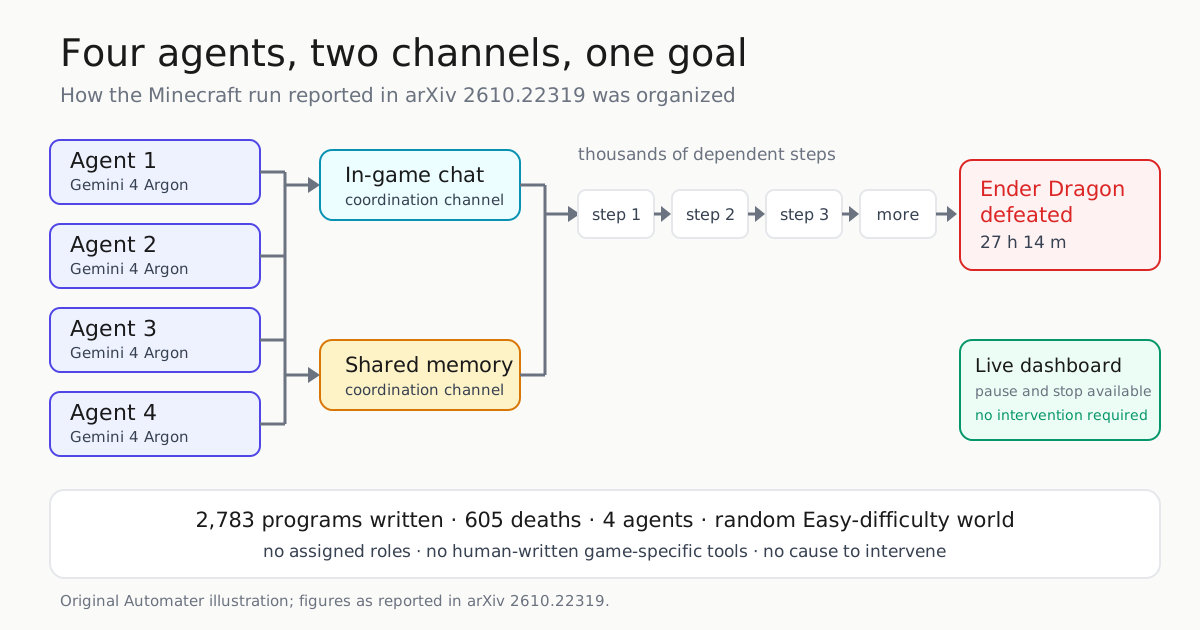
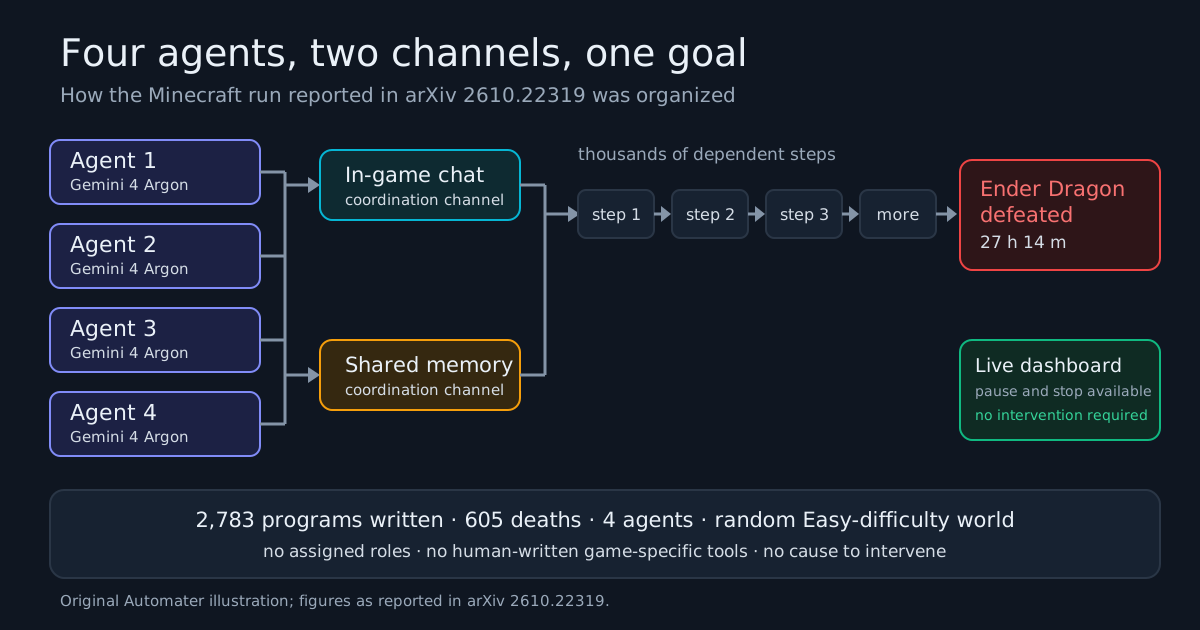
Google DeepMind researchers say four Gemini 4 Argon agents have completed Minecraft end to end, defeating the Ender Dragon 27 hours and 14 minutes after spawning into a randomly generated world — after writing 2,783 of their own programs and dying 605 times.
The result is described in “A team of Gemini 4 Argon agents beats Minecraft”, a paper submitted to arXiv on Oct. 15, 2026 by Maxence Faldor, Satinder Singh and Roberta Raileanu, and announced by Google DeepMind on X a day later. Hugging Face’s Papers page for the paper lists an Oct. 15 publication date and records that a community member submitted it to the site on Oct. 16.
What actually ran
Four Gemini 4 Argon instances shared one sandboxed Minecraft survival world, generated from a random seed on Easy difficulty, with a single objective: defeat the Ender Dragon, the boss at the end of the game. Each agent controlled its own player through Mineflayer, a standard open-source bot library, and coordinated with its teammates through the two channels the abstract names: in-game chat and a shared memory. The authors’ tooling claim is narrower than “no tools at all,” and worth keeping at its exact scope — in their words, the completion was “achieved using only the standard Mineflayer library without pre-scouted seeds or other game-specific tools written by humans.” No roles were assigned and no game logic was written by humans; the agents planned, wrote and debugged every one of their programs themselves.
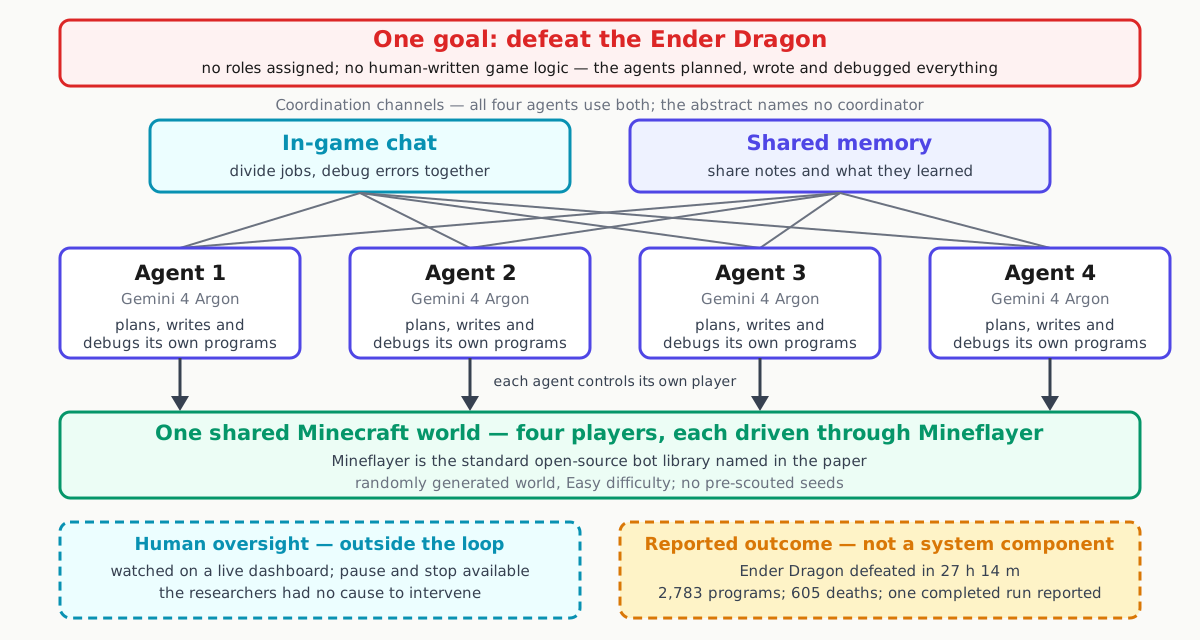
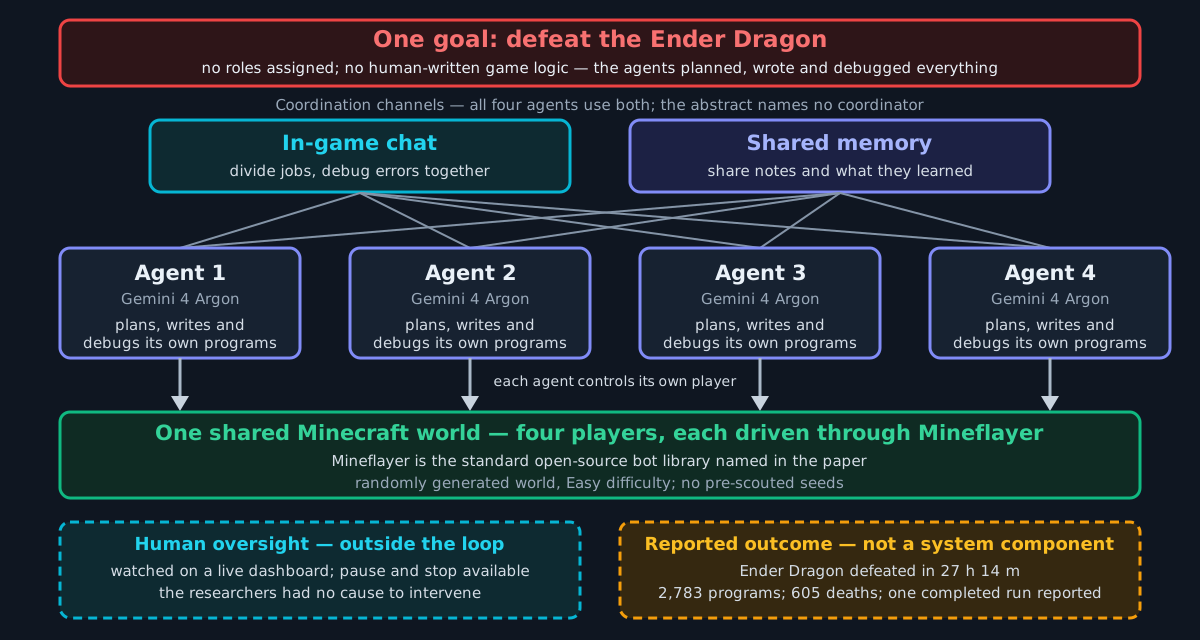
Humans stayed near the loop but never entered it, as described: researchers could watch a live dashboard and pause or stop the run at any point, but, in the authors’ words, “had no cause to intervene.”
The numbers
| Metric | Reported value |
|---|---|
| Agents | 4 Gemini 4 Argon instances |
| World | Randomly generated, Easy difficulty |
| Run duration | 27 hours 14 minutes |
| Programs written | 2,783 |
| Deaths | 605 |
| Human intervention | None required; pause and stop available |
| Human-written game-specific tools | None, per the authors; no pre-scouted seeds |
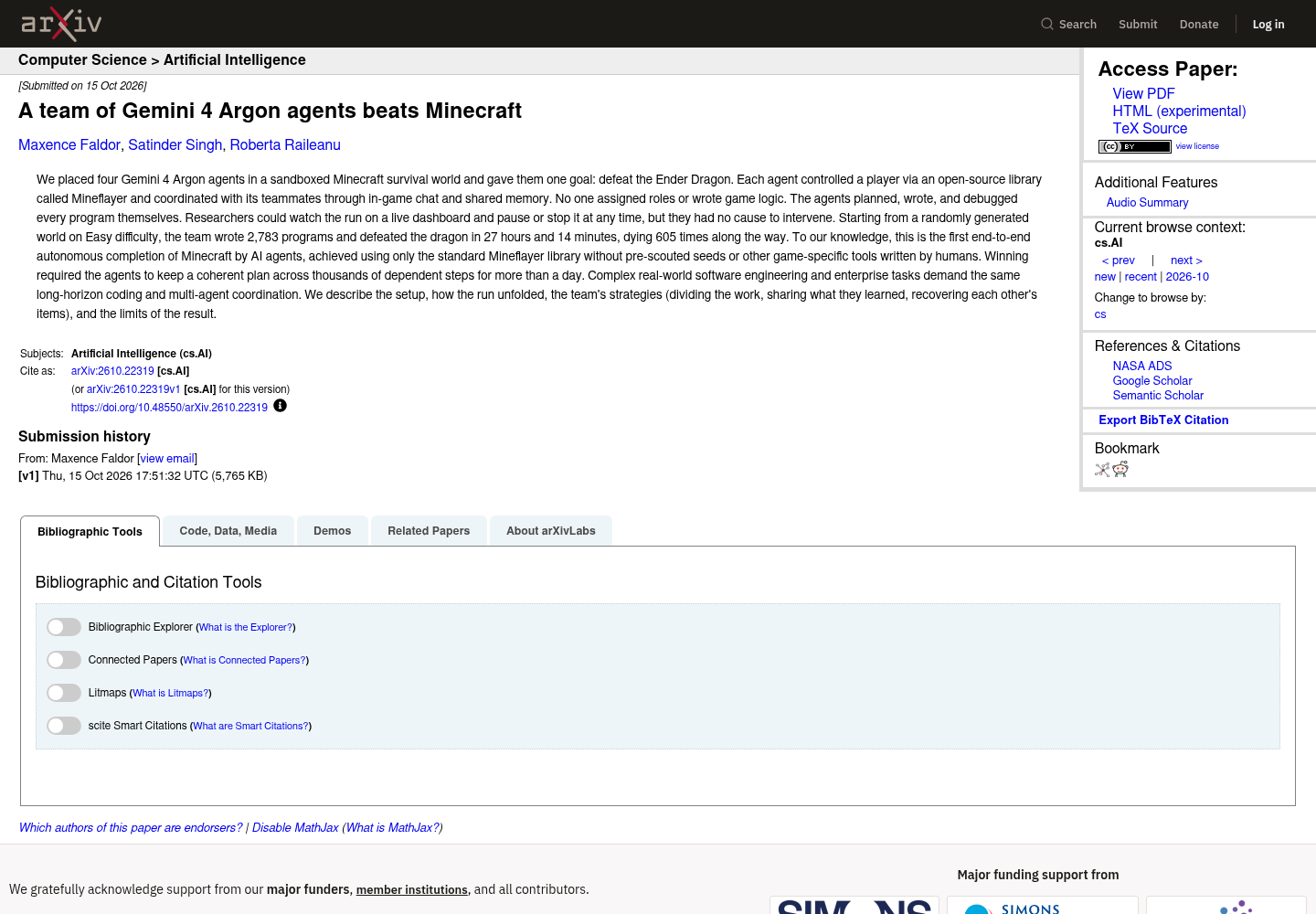
The headline claim, in the authors’ own framing on the arXiv page shown above: “To our knowledge, this is the first end-to-end autonomous completion of Minecraft by AI agents, achieved using only the standard Mineflayer library without pre-scouted seeds or other game-specific tools written by humans.”
Why this is more than a stunt
The interesting part is not Minecraft. It is the shape of the task. Minecraft gates its final boss behind a long chain of survival, crafting and exploration prerequisites, and the abstract’s own framing is the durable one: “Winning required the agents to keep a coherent plan across thousands of dependent steps for more than a day,” the authors write, adding that complex real-world software engineering and enterprise tasks “demand the same long-horizon coding and multi-agent coordination.” The supplied abstract does not narrate the agents’ specific route through the game — the authors say the full paper describes how the run unfolded and the team’s strategies — so the claim worth carrying on this evidence is the duration-and-coherence one, not any particular progression.
The team behaviors the abstract lists — dividing the work, sharing what they learned, recovering each other’s items after deaths — are exactly the behaviors operators try to engineer into multi-agent setups by hand. Here nobody scripted a division of labor. Four peers sorted it out over chat and notes.
For anyone running parallel coding agents, the honest yield is two questions for controlled follow-up experiments, not design rules. First, coordination substrate. In-game chat and shared memory are the only channels the abstract names, and it mentions no coordinator process or framework — but it also does not describe what else the harness contained, how each agent’s context was maintained, or how state was compacted. Does a shared plan carried on peer messages and notes survive a 27-hour, 605-death run better than one routed through a central orchestrator — the trade-off behind when not to use a coordinator? This run is consistent with that idea; it does not test it. Second, harness weight. The abstract names the game interface and coordination channels, but does not establish the complexity of the overall harness. The result demonstrates task completion under the reported restrictions; it does not isolate the contribution of the model from the surrounding system. What it cannot show, without a controlled comparison against a heavier framework, is which architecture generalizes better. Turning either question into an answer means rerunning this experiment with the harness varied; the supplied abstract answers neither.
Read the claim carefully
Three cautions belong next to the headline. “First” is the authors’ claim, scoped by their own “to our knowledge” and by the setup: standard Mineflayer, no pre-scouted seeds, no human-written game-specific tools. The abstract reports one completed run and does not say how many attempts, seeds or restarts preceded it; the authors say the paper covers the limits of the result, and those limits should travel with the number. And this is a research demonstration, not a shipped capability: DeepMind’s post announces a paper, and neither the post nor the abstract promises a public release of the harness or dashboard.
Context
Gemini 4 Argon is the Google frontier model that recently shipped across API, Cloud and Antigravity and then landed in Cursor and Vercel’s AI Gateway, matching Claude Opus 5.5 on CursorBench. This paper does not move a leaderboard. It demonstrates a property that saturated coding benchmarks measure poorly: self-directed, multi-agent completion of an open-ended task sustained for more than a day. The consequential version of this result arrives when the same property shows up in a real repository against a real deadline — not in a sandbox.
Sources
- Google DeepMind on X: "Four Gemini 4 Argon agents beat Minecraft from scratch in 27 hours. Operating in a sandbox using only code and text, they wrote 2,783 programs, divided up jobs over chat, shared notes, and debugged errors together - all with no human help ↓ https://t.co/uyIhDOQXGT" / X
- [2610.22319] A team of Gemini 4 Argon agents beats Minecraft
- Paper page - A team of Gemini 4 Argon agents beats Minecraft