ICLWorld Tests Whether AI Agents Can Follow a New Rule After the Demo Ends
A 160-task benchmark tests how agents apply rules learned from text or video. Even the strongest models struggled with simulated robot tasks, and one could usually identify a rule it rarely carried out.
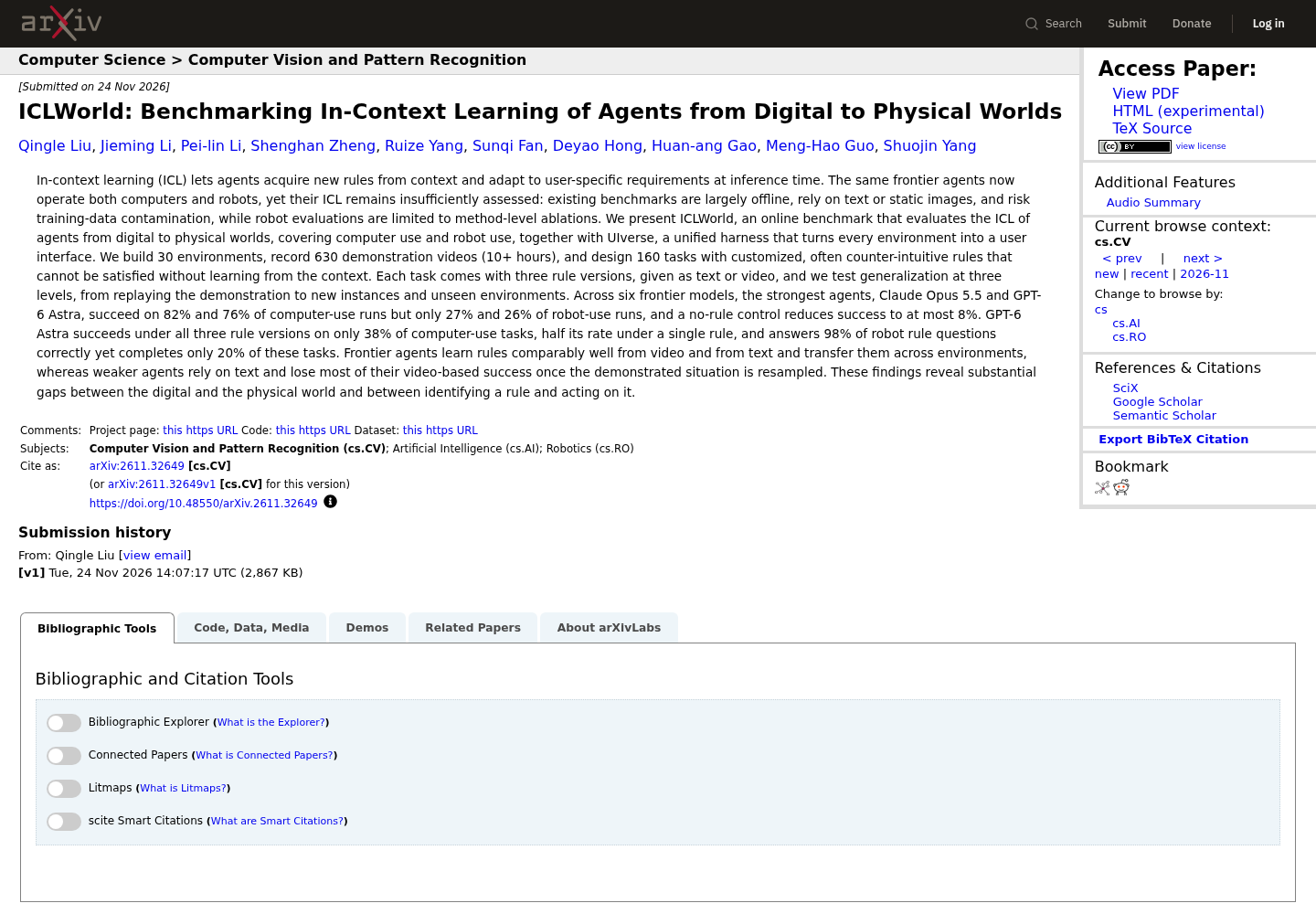
A computer-use agent can get the right result on a familiar screen and still follow the wrong procedure when the inputs change. ICLWorld, a benchmark introduced in a Nov. 24 arXiv preprint, gives agent evaluation teams a way to measure that failure. The researchers give an agent a rule in text or video, then check whether it can apply the rule in an interactive task. Across six tested models, success in the no-rule control reached at most 8%, suggesting that the goal alone rarely gave agents enough information to pass. Read the preprint.
The same goal can require three different actions
ICLWorld covers 75 web tasks, 35 desktop tasks and 50 robot tasks. Each task has three versions of its rule. The public goal stays the same, while the supplied rule changes what the agent must do to succeed. The authors built 30 environments and recorded 630 demonstration videos. The same UIverse harness presents the environments as graphical interfaces, and a verifier checks the final state against the rule. The robot execution results come from simulation, including when an agent learns from a demonstration recorded with a real robot. Project overview · Dataset documentation.
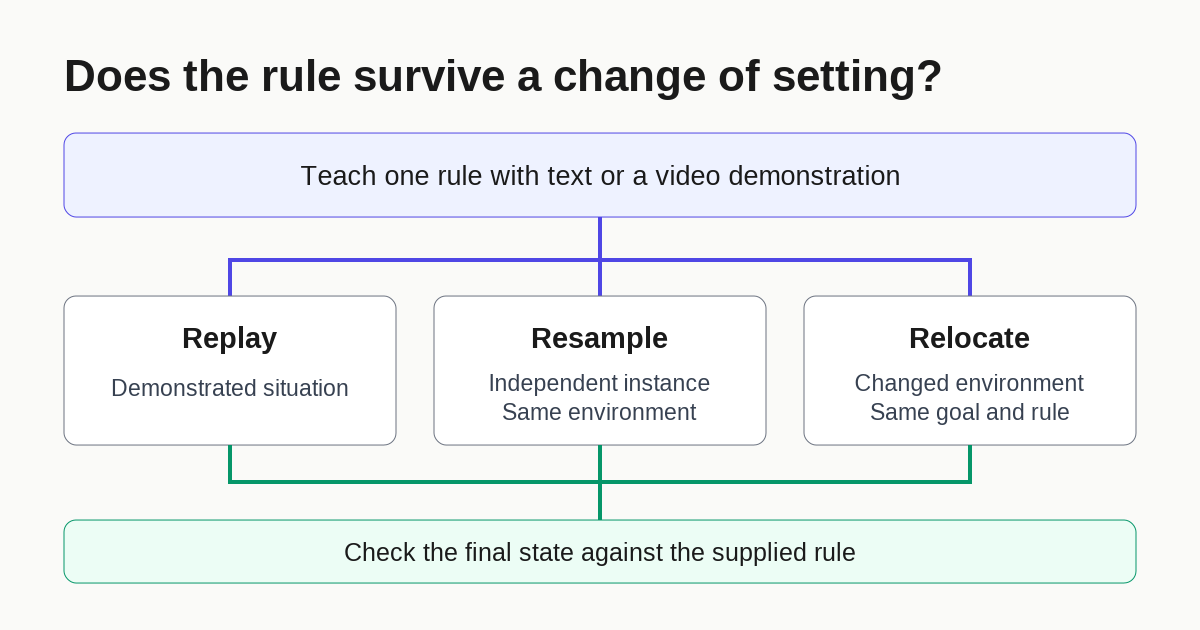
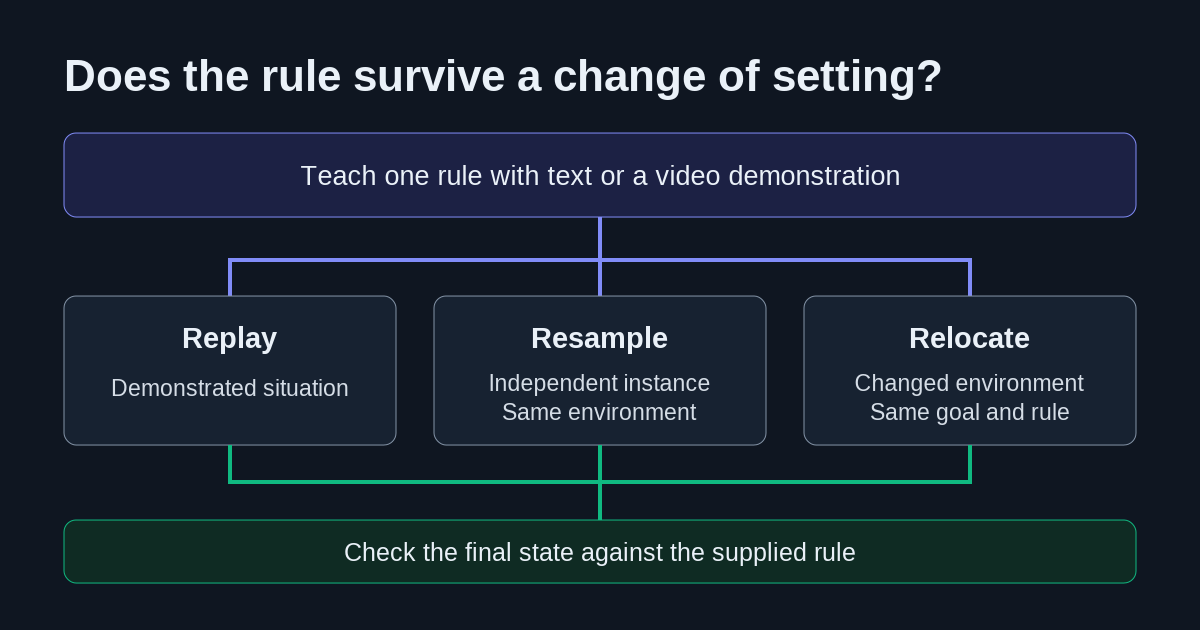
The three evaluation levels distinguish different kinds of transfer. Replay restores the demonstrated situation. Resample draws an independent instance from the same task distribution and environment. Relocate changes the environment while preserving the goal and rule. In paired web and desktop tests, Resample and Relocate use the same instance, goal and evaluator, so the comparison can isolate what happens when the interface changes. The public repository supplies environments, experiment plans and graders, while the dataset supplies task metadata and demonstration assets. Benchmark code and protocol · Dataset documentation.
Recognizing a rule and carrying it out are separate measurements
The two strongest agents in the study had much higher success rates on computer-use runs than on simulated robot-use runs. The figures are results for the authors’ tasks and harness. A shared graphical interface makes the evaluation setup more consistent across domains, while the tasks and actions still differ. Reported results.
| Model | Computer-use runs | Simulated robot-use runs |
|---|---|---|
| Claude Opus 5.5 | 82% | 27% |
| GPT-6 Astra | 76% | 26% |
A separate diagnostic makes the distinction concrete. GPT-6 Astra answered 98% of the robot rule questions correctly and completed only 20% of the corresponding tasks. The question is scored independently, and the answer never feeds back into execution. On computer use, another measure showed how much a single-rule score can hide. Astra succeeded under all three rule versions on only 38% of tasks, about half its success rate under a single rule. The 38% figure counts tasks that passed every variant, while the table reports success across runs. Preprint · Diagnostic protocol.
How to test a procedure your team already uses
Take a workflow with an outcome you can check. For a browser agent that sorts incoming requests, create three versions of the same assignment with different routing rules. Use a test workspace and keep the expected destination for each request in the grader. Run once with the demonstrated inputs, again with independently sampled requests, and then in a counterpart workspace with the same routing rules and a different layout. A control run with only the public goal can reveal whether the default inbox categories already give away the answers. Automater’s guide to evaluating software that acts.
Record final-state success for each rule and the share of tasks that pass every variant. If the team uses both written procedures and screen recordings, keep those scores separate. When failures cluster, a separate rule question can help narrow the investigation. An incorrect answer gives you a reason to inspect the instruction or demo. A correct answer paired with an incorrect final state points toward inspecting the execution trace, where you can see whether the agent selected the wrong record, lost track of state or failed to complete the required action. ICLWorld evaluation protocol.
Sources
- [2611.32649] ICLWorld: Benchmarking In-Context Learning of Agents from Digital to Physical Worlds
- GitHub - ICLWorld/ICLWorld: ICLWorld: Benchmarking In-Context Learning of Agents from Digital to Physical Worlds · GitHub
- Aoraku/ICLWorld · Datasets at Hugging Face
- ICLWorld: Benchmarking In-Context Learning of Agents from Digital to Physical Worlds