Marlowe raises $277 million to build AI inference sites with AMD and Etched
Accel confirmed Marlowe’s $277 million seed funding. An Etched site is planned for December 2026, with a larger AMD Helios deployment targeted for the second quarter of 2027.
Marlowe, an AI infrastructure startup founded by former Microsoft executives Dan Lewis and Kutta Srinivasan, announced $277 million in seed funding on Nov. 23. The company plans to build and operate data centers for inference, the work of running trained models in products. Its first two projects use chips from Etched and AMD. For AI application and platform teams that rely on Nvidia-based clouds, the projects offer two concrete tests of whether alternative chips can meet their production requirements. Marlowe’s announcement · Accel’s investment announcement
Accel led the funding announced Monday. Lewis told GeekWire that the $277 million total includes a smaller initial round led by Eclipse, and the founders said much of the money would go toward chips, networking equipment, site support and hiring. The company put its valuation at $1.15 billion, according to GeekWire. GeekWire’s interview with the founders
Two sites are under contract
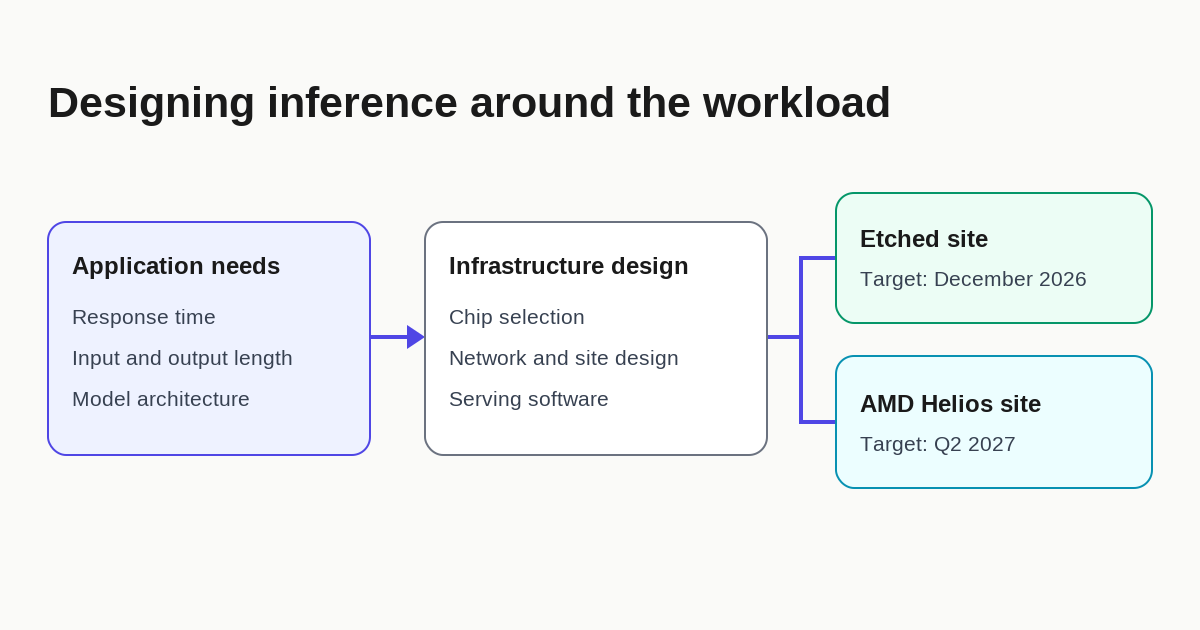
Marlowe says its first site is scheduled to go live in December 2026, and Etched co-founder Rob Wachen says the companies expect to deploy their first inference clusters together this year. AMD’s Vamsi Boppana says the companies plan to deploy Helios in 2027. The founders told GeekWire that the first site uses Etched chips and that the second, larger site uses AMD’s Helios systems and is targeted for the second quarter of 2027. These are deployment targets. Marlowe · GeekWire
GeekWire reported that both sites are under contract, a third is under a letter of intent, and Marlowe says it has signed three customer agreements. The company has kept customer names and site locations private. DatacenterDynamics reported that Marlowe intends to offer customers options ranging from infrastructure as a service to tokens as a service. That distinction matters for buyers because it determines how much of the serving stack they would have to operate themselves. The announcements give project milestones and describe customer agreements. Public pricing, a supported-model list and a timetable for broader access remain open questions. GeekWire · DatacenterDynamics
The workload determines where the savings can come from
Marlowe’s proposal starts with the demands of a particular application and works back to the chips, network, serving software and site. A voice assistant has to respond quickly enough to sustain a conversation. A service that summarizes long filings has to process a large input before the first token appears. Even within one request, processing the prompt, known as prefill, and generating the response, known as decode, are distinct stages. A headline generation speed tells a buyer little about how long a customer with a long prompt will wait for a response to begin. Marlowe’s description of its design
The economics depend partly on whether the software can keep the hardware busy as workloads change. Srinivasan told GeekWire that at previous employers, some non-Nvidia capacity sat idle or ran below its potential because engineers prioritized getting new models working on Nvidia hardware. Marlowe says its engineers will work directly with application companies to optimize their workloads for alternative chips. That makes support for the next model version part of the value buyers would be paying for, alongside the performance of the model they run today. GeekWire · Marlowe
Marlowe argues that gains across the system could compound into a two- to threefold advantage. The company presents this as its thesis, and the announcement supplies no independent production benchmark for either planned site. An application team evaluating that claim would need a comparison using the same model and quality target, with realistic request lengths, traffic and latency limits. A service that handles more tokens per watt can still cost more per completed task if it misses response deadlines or needs more retries. Marlowe · Automater’s guide to cost per completed task
The December Etched project is the first scheduled opportunity to see which workloads Marlowe can serve in production. The larger Helios project will test whether the company can apply the same approach with a second chip supplier. The funding makes both projects worth following. Their eventual model support, uptime and cost under real traffic will determine how much choice they give customers.