EU Court Adviser: Chatbot Answers That Reuse News Can Infringe Publishers' Rights, While LLM Training Largely Falls Under the TDM Exception
In Like Company v Google (C-250/25), Advocate General Szpunar sets out when RAG chatbot answers can infringe the EU press publishers' right. He treats LLM training as mostly covered by the TDM exception. The Opinion is not binding.
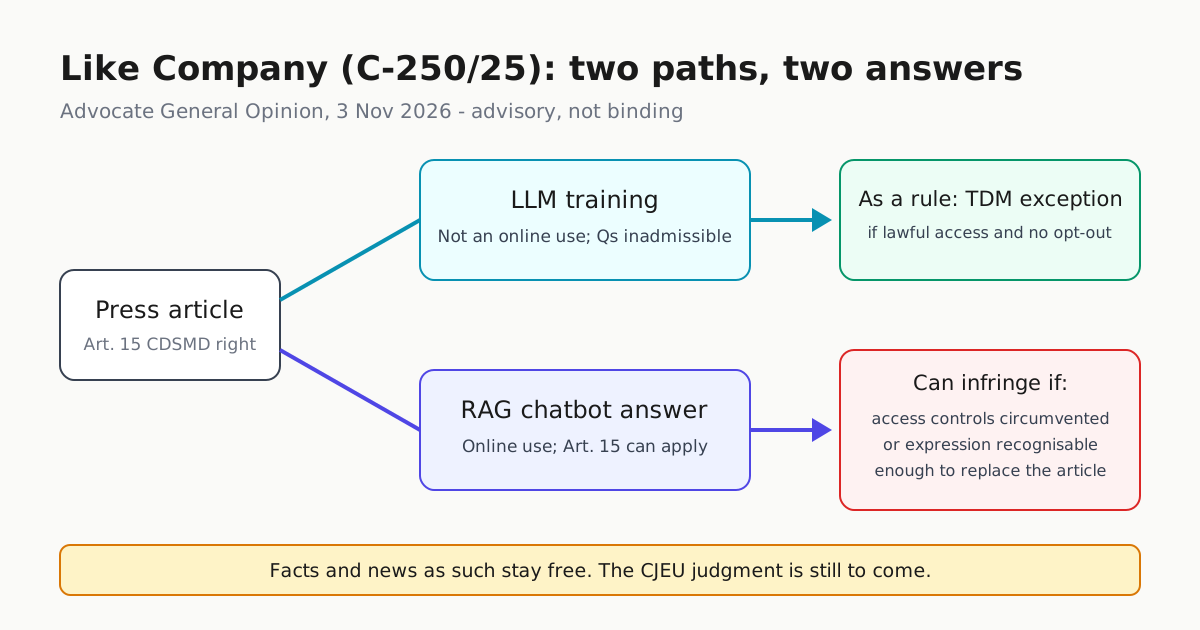
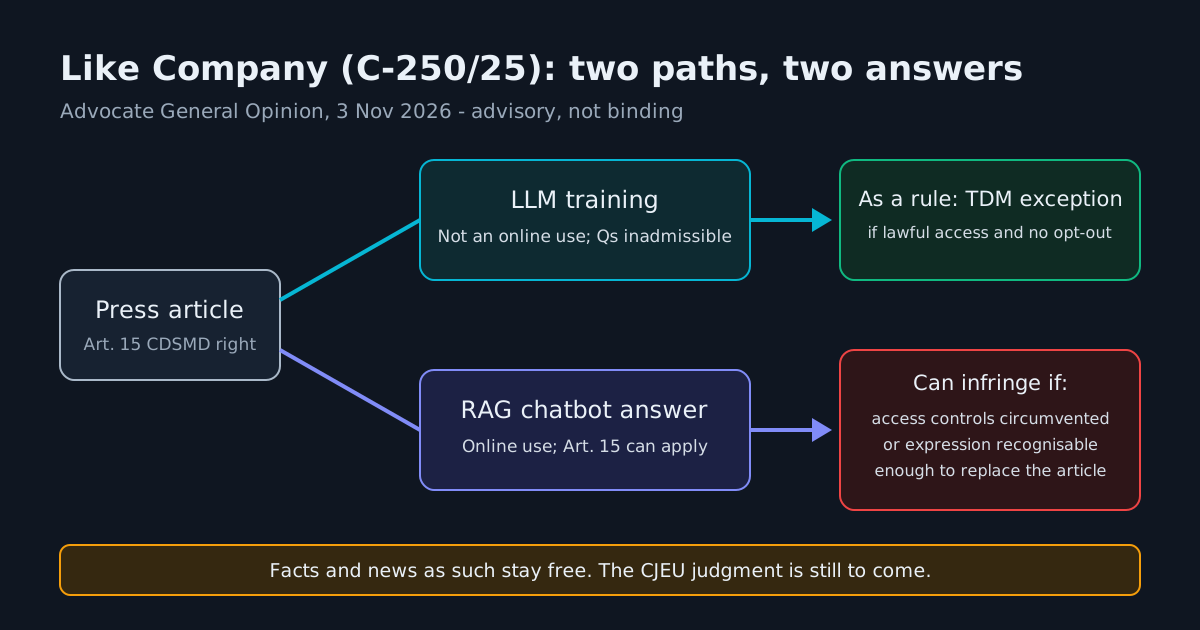
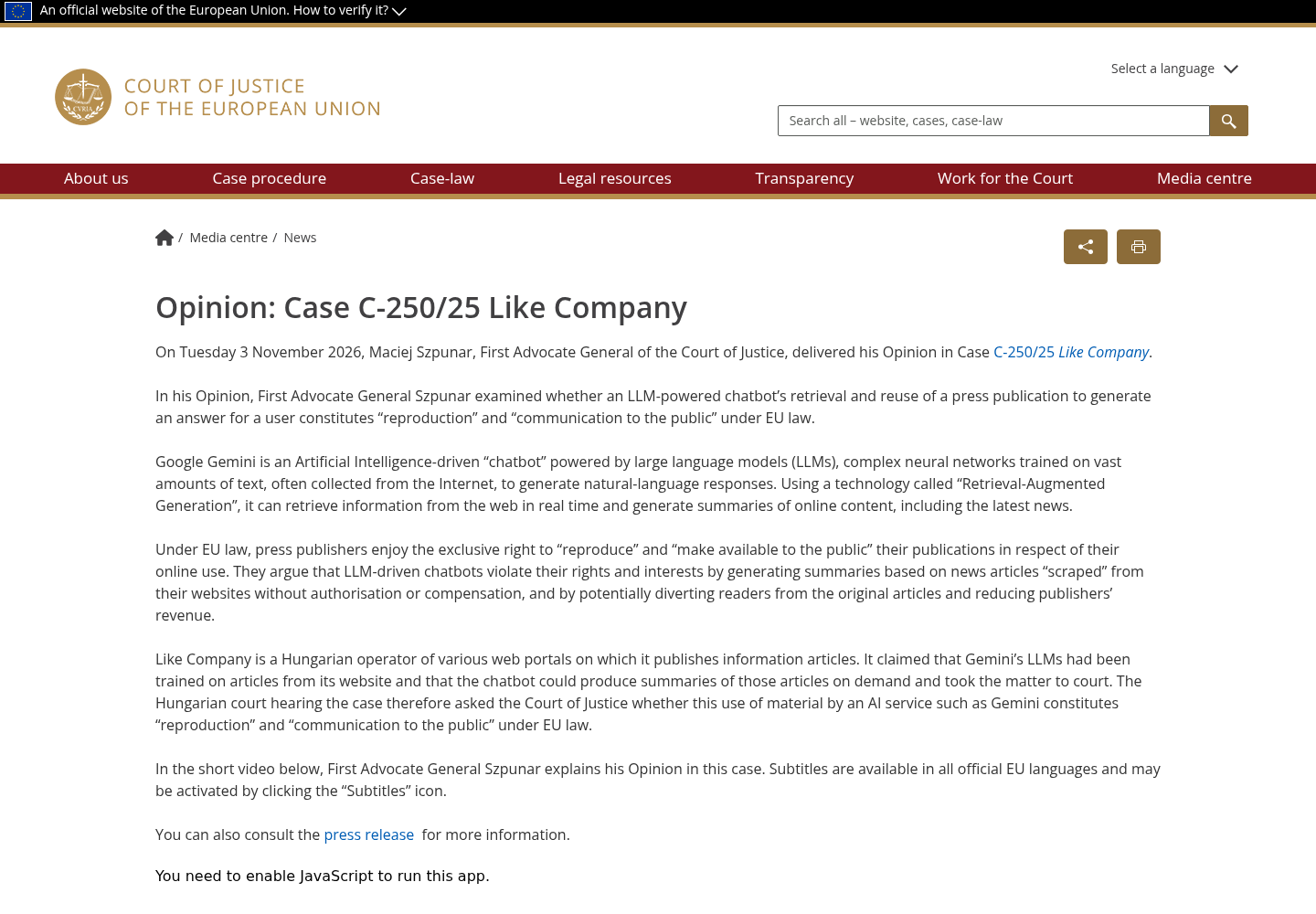
On Tuesday 3 November 2026, First Advocate General Maciej Szpunar delivered his Opinion in Case C-250/25 Like Company. It is the first case on generative AI and copyright to reach the Court of Justice of the European Union (CJEU). The Court’s case page describes the question as whether an LLM-powered chatbot’s “retrieval and reuse of a press publication to generate an answer for a user” counts as “reproduction” and “communication to the public” under EU law.
Treat this as guidance, not a ruling. An Advocate General’s Opinion does not bind the Court. As CEA Digital Law notes, the judges are now deliberating and will rule later. Opinions still tend to frame the judgment, and this one draws a line that every AI search, assistant and agent product grounding answers in European news will have to deal with.
The dispute
Like Company is a Hungarian publisher that runs several web portals. It sued Google Ireland before the Budapest Regional Court, relying on the press publishers’ related right in Article 15 of the Copyright in the Digital Single Market Directive (CDSMD). It alleges that Google trained Gemini on its articles and that, between 13 June 2023 and 31 May 2024, the chatbot reproduced those articles and made them available to the public (CEA Digital Law). The Court’s page explains that Gemini uses retrieval-augmented generation (RAG) to pull information from the web in real time and summarise it, including the latest news (curia).
The Hungarian court asked four questions: two about training and two about the chatbot’s answers. The AG’s central move is to separate them. Training a model is one thing. Using a trained model to retrieve an article and answer from it is another (Kluwer Copyright Blog).
The answer test: two separate routes to infringement
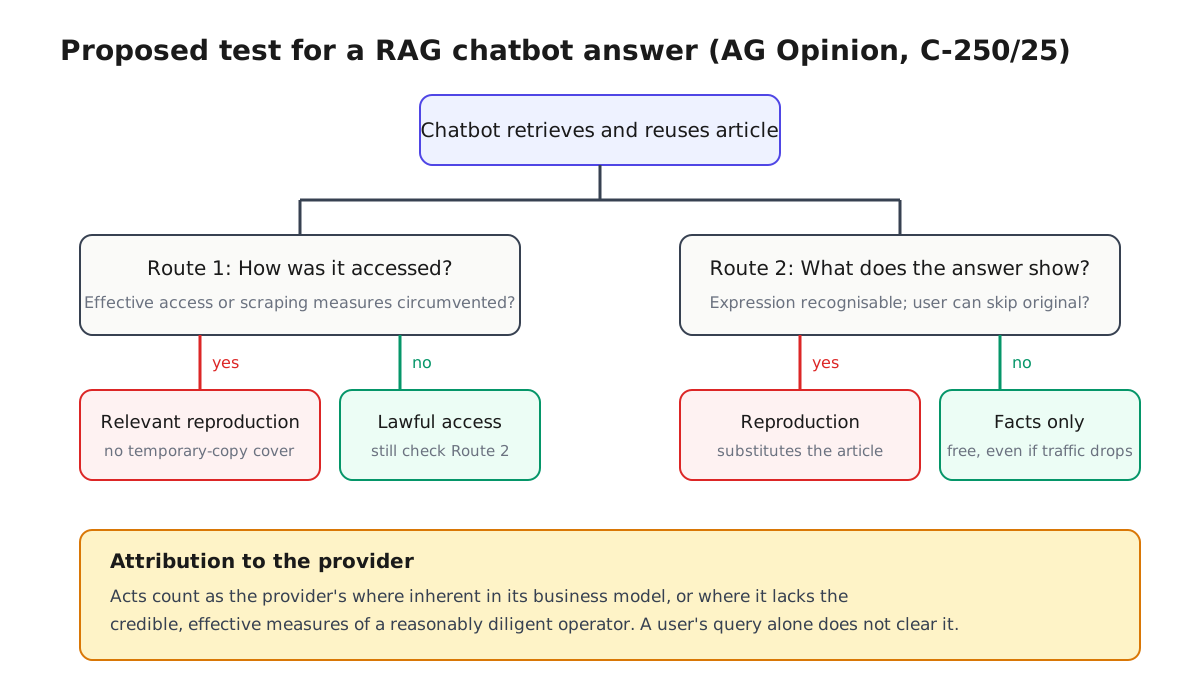
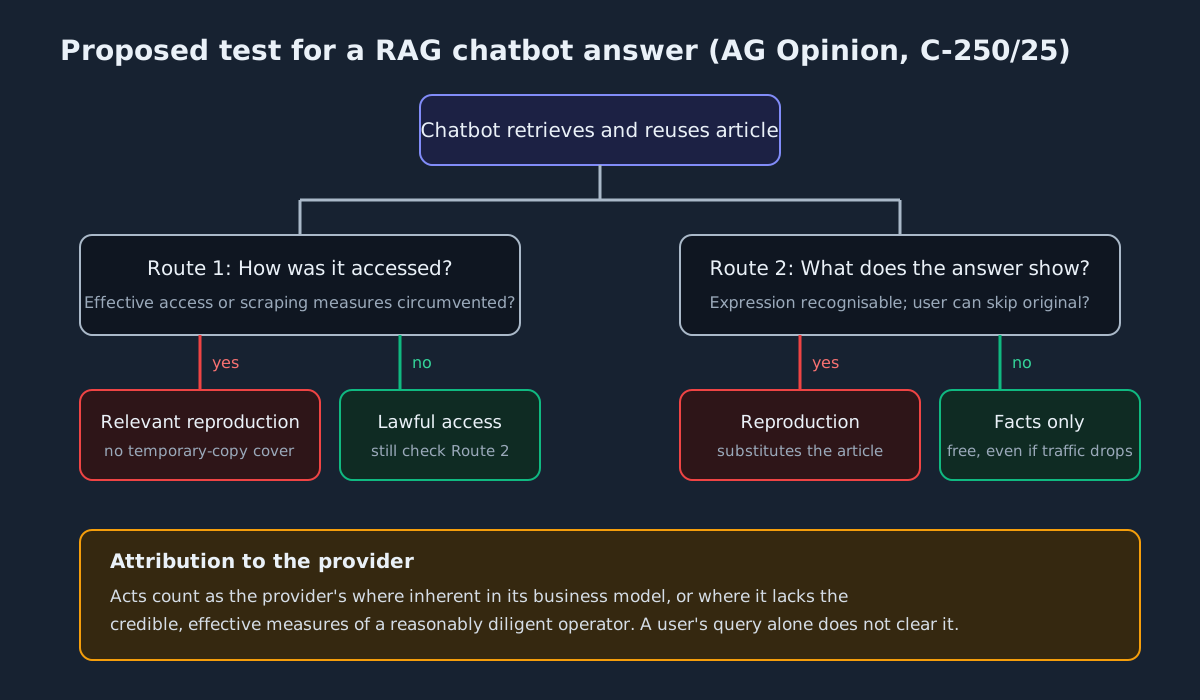
The AG treats retrieving a publication to build a chatbot answer as an “online use” that Article 15 can reach. He also says the text-and-data-mining (TDM) exception does not cover RAG, because RAG fetches specific content to improve an answer rather than extracting patterns. The temporary-copy exception in Article 5(1) of the InfoSoc Directive may still apply. According to João Pedro Quintais’s analysis on the Kluwer Copyright Blog, the AG’s proposed answer finds a relevant reproduction where a chatbot retrieves and reuses a press publication and either:
| Route | What triggers it | Practical reading |
|---|---|---|
| Unlawful access | Getting round effective technical measures that restrict access or scraping | Bypassing a paywall or anti-scraping control |
| Recognisable output | The article’s form of expression (arrangement, structure, phrasing) stays recognisable, even if paraphrased, so the user can do without the original entirely | An answer that substitutes for the article |
These routes are alternatives. Lawful access does not make a substitutive answer lawful. The AG also treats making the work available to the public as happening where the expression is systematically recognisable in answers to related queries.
The limit matters just as much. Facts and news as such stay free. An answer that reports the same facts without the article’s recognisable expression does not reproduce it, even if it pulls readers away from the publisher’s site (GSK Stockmann; Kluwer). Lost traffic alone is not infringement.
When the provider is responsible
Under the Opinion, the chatbot provider carries out the relevant acts where they are inherent in its business model, or where it has not taken the measures a reasonably diligent operator would take to counter them credibly and effectively. A user starting the query does not automatically clear the provider. The AG focuses on service design and safeguards rather than occasional mistakes (Kluwer; CEA Digital Law).
Applying his own framework provisionally to the example before the Hungarian court, the AG suggested the conditions did not appear to be met. The article’s expression did not seem recognisable in the response, and Google appeared to have mitigation measures in place. The final call belongs to the referring court (Kluwer).
Training: “inadmissible”, but addressed anyway
The AG advises the Court not to answer the two training questions. He gives two reasons. First, there is no evidence that Like Company’s articles were used to train Gemini. Second, training is not an “online use” of press publications, so the related right does not reach it. In his words, “the case in the main proceedings has nothing to do with LLM training” (Kluwer).
For completeness, he still says that training copies generally count as reproductions. As a rule, they are covered by the Article 4 CDSMD TDM exception, provided there is lawful access and no rights reservation (opt-out). He finds no general conflict with the three-step test, apart from “exceptional situations”. He also doubts that memorisation means a model stores a copy of the work (Kluwer; IPKat). On territoriality, he does not accept that releasing a model in the EU automatically brings training carried out abroad under EU law. He leaves room for EU law to apply to scraping from EU servers and calls for a legislative fix (IPKat). As the IPKat puts it, these remarks on questions the Court is told not to answer may matter as much as the rest.
Why it matters for builders and publishers
If the Court follows the AG, the legal risk in European news grounding moves away from whether a system reads the web and towards how it reads and what it outputs. Commentators draw out practical steps:
- Respect access controls. Retrieval that gets round paywalls or anti-scraping measures is the clearest route to liability (GSK).
- Design answers to inform and link, not replace. Synthesising facts and pointing to the source fits the AG’s balance. Answers that substitute for the article do not.
- Document safeguards. Liability turns on credible, effective measures, so output testing and guardrails need to be provable (GSK).
- Publishers: enforce against recognisable reproduction rather than information, and keep technical protections documented. GSK suggests using the Opinion in licensing talks.
This ties into earlier fights over access, such as sites blocking AI agents and the controversy over Meta’s scraping terms. It also sits alongside the EU’s transparency duties covered in our AI Act Article 50 guide.
Open questions
Critics question whether “recognisability” is a workable test (IPKat). CEA Digital Law asks how it will be measured and which safeguards will count as “credible and effective”. The bar of a user being able to “dispense entirely” with the original is high. Two more Hungarian referrals, Manchester United Fanatics Klub (C-806/26) and Mobilguru (C-829/26), are pending. The final judgment will shape those cases and national litigation such as GEMA’s cases against OpenAI and Suno (Kluwer). Until the Court rules, this is the most detailed signal yet of where the EU may draw the line, but it is not yet law.
Sources
- Opinion: Case C-250/25 Like Company - curia
- First Reflections on AG Szpunar’s Opinion in Like Company | Kluwer Copyright Blog
- AG Szpunar’s Opinion in Like Company is here: a landmark take on several questions facing AI and copyright/related rights, even though the CJEU is advised not to answer the questions on LLM training
- AI Spotlight | Like Company v Google (C‑250/25)
- Like Company (C-250/25): the Advocate General on AI chatbots and press | CEA Digital Law