S&P Puts Nvidia on CreditWatch for a Cut to AA-: Why the AI Trade's Collateral Is the Story
S&P Global may cut Nvidia from AA to AA- within 90 days over governance risk. Because Nvidia backstops billions in AI debt, the move reprices compute financing across the ecosystem.
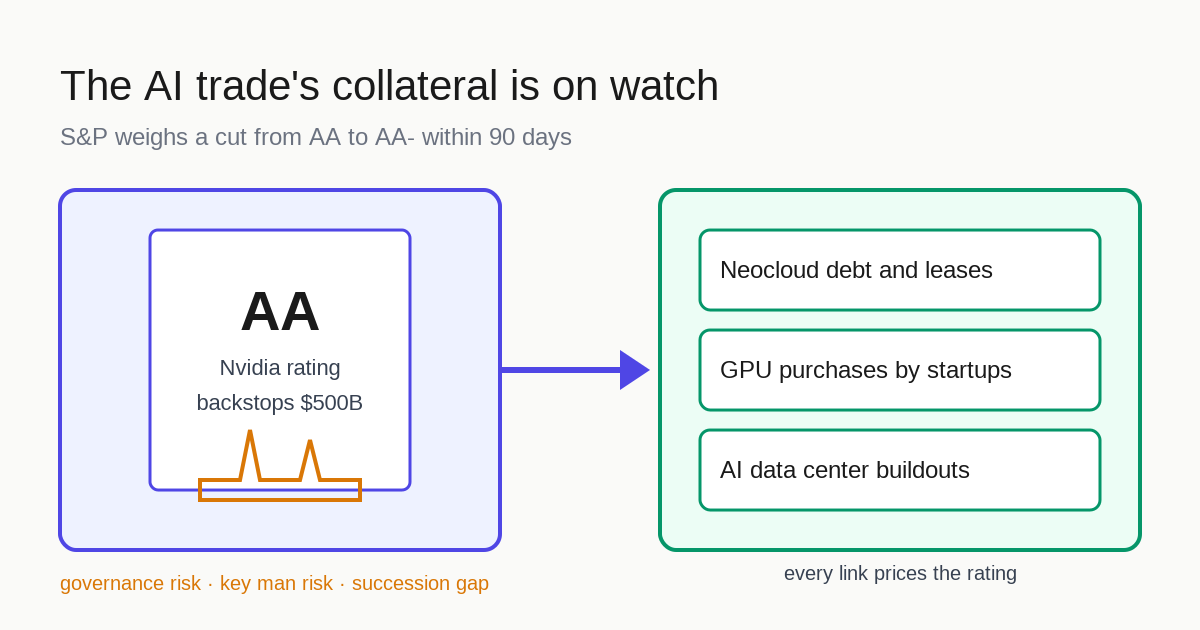
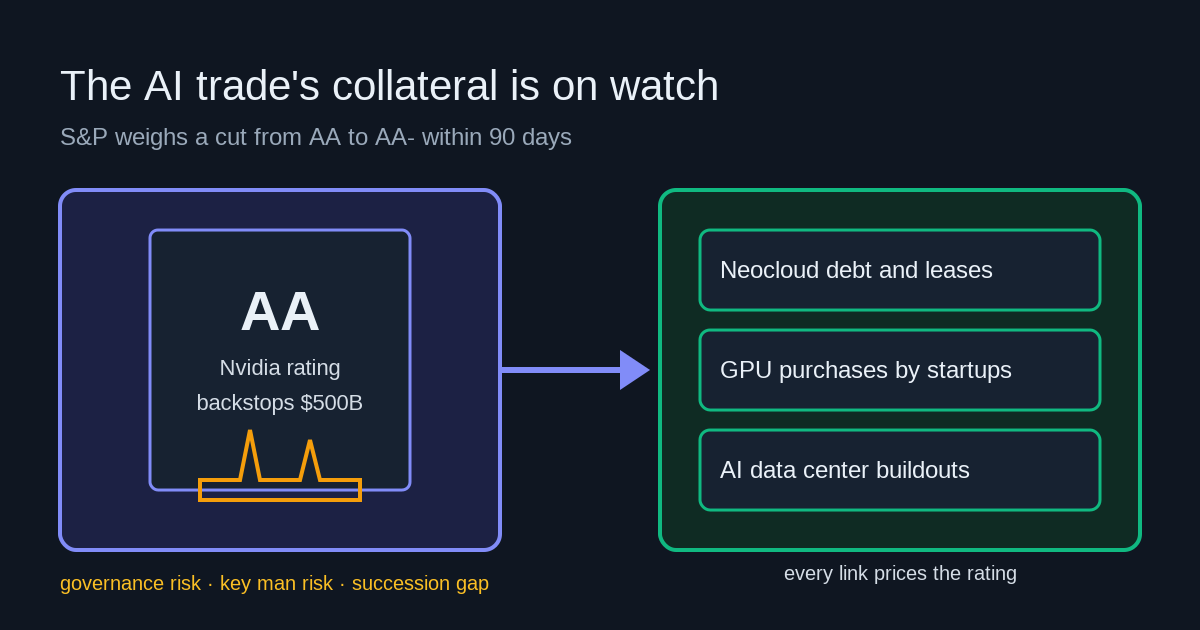
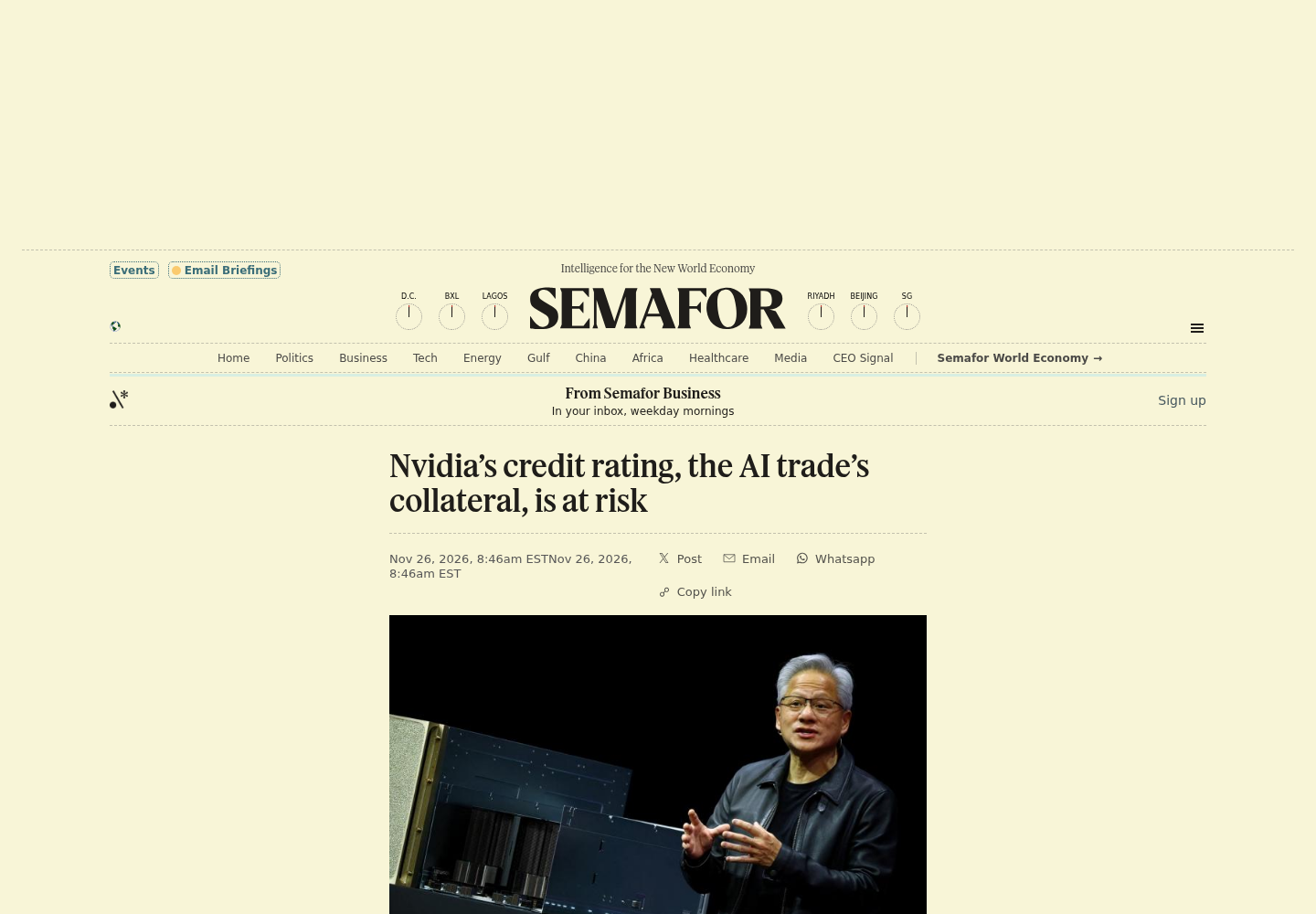
Nvidia’s AA credit rating has quietly done a job most companies never ask a credit score to do: it has been the collateral layer for the AI buildout. This week that layer came under review. S&P Global Ratings placed Nvidia on watch on November 25, saying it may cut the rating from AA to AA- — the fourth-highest on its scale — within 90 days, citing “weak executive oversight and lack of succession planning” and “key man risk” after CEO Jensen Huang’s ouster and rapid reinstatement, per TechCrunch’s report of S&P’s statement.
A one-notch cut at the top of the scale sounds like noise. It is not, because of how Nvidia’s rating is used.
Nvidia as the ecosystem’s co-signer
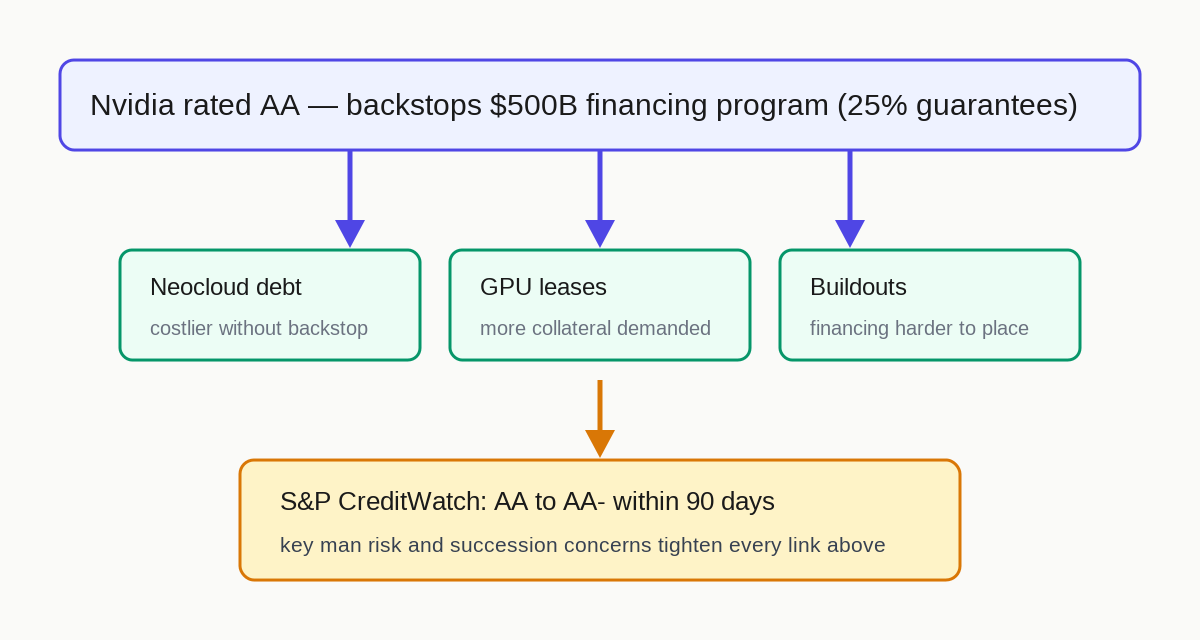
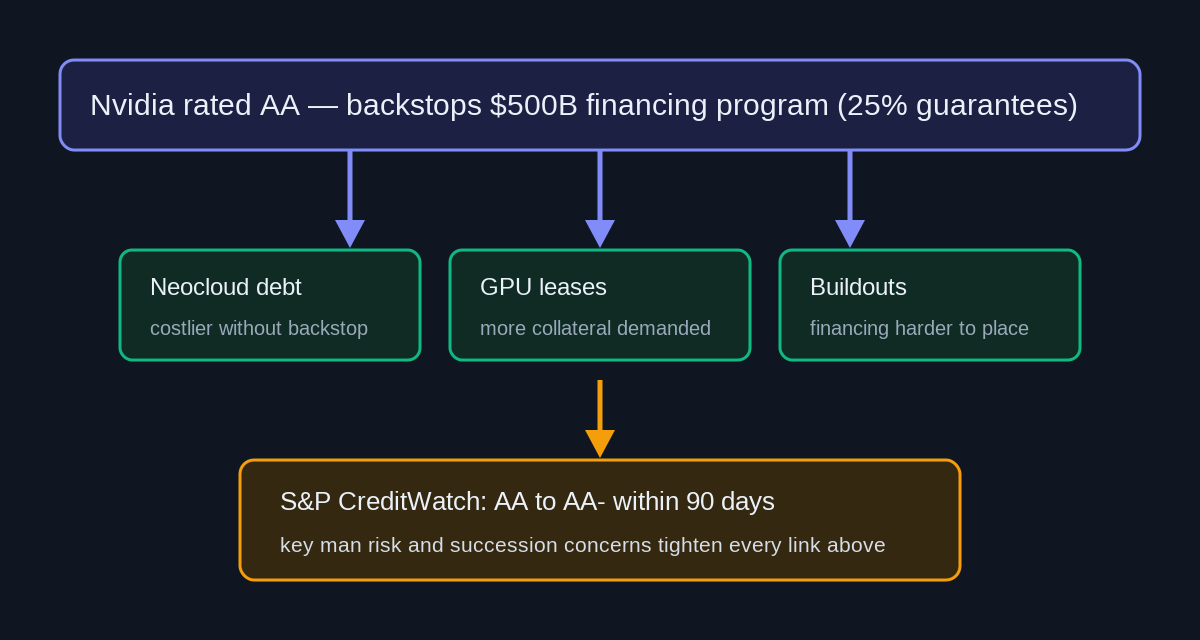
Nvidia routinely backstops debt, leases and hardware purchases for neoclouds and other infrastructure companies that could not borrow cheaply on their own credit. Semafor calls Nvidia “the central banker of the AI trade” and notes the company “essentially rents out its AA rating to less creditworthy companies” through credit enhancement — a technique Alphabet and Broadcom have used to help customers afford chips too (Semafor). Semafor frames an official downgrade as “a dramatic blow, not just to Nvidia, but to big customers, startups, and construction projects,” with AI risk concentrated “at a handful of tech giants just as interest rates are rising.”
The scale is enormous. In August, Nvidia announced plans to arrange $500 billion in financing for AI infrastructure with six financial institutions including Goldman Sachs, Apollo and Blackstone. Under the original terms Nvidia would guarantee 25% of the loans; even before the board drama, lenders were demanding bigger guarantees, and a downgrade would likely push them higher still, per TechCrunch. Moody’s has already moved its outlook from positive to stable, per Semafor.
Who actually pays when a notch slips
The blast radius is a financing chain, and every link prices Nvidia’s rating:
| Link | What changes on a downgrade |
|---|---|
| Nvidia | Higher borrowing costs, more collateral posted on its own guarantees |
| Neoclouds and lessors | Costlier debt, larger Nvidia guarantees demanded before deals close |
| Startups renting GPU capacity | Lease terms tighten as backstops get repriced |
| Construction projects | Financing for buildouts keyed to Nvidia paper gets harder to place |
The timing is not a coincidence
The watch placement lands in a week when AI credit is being actively repriced elsewhere. Semafor reports exclusively that banks including Citi and JPMorgan are marketing portfolios of AI-related loans, using synthetic risk transfers to shift loss risk to investors — partly routine year-end cleanup, partly because AI debt issuance has “crowded out Treasurys and some investors are starting to feel tapped out” (Semafor). The report’s blunt conclusion: “the risk isn’t so much disappearing as moving somewhere harder to see.”
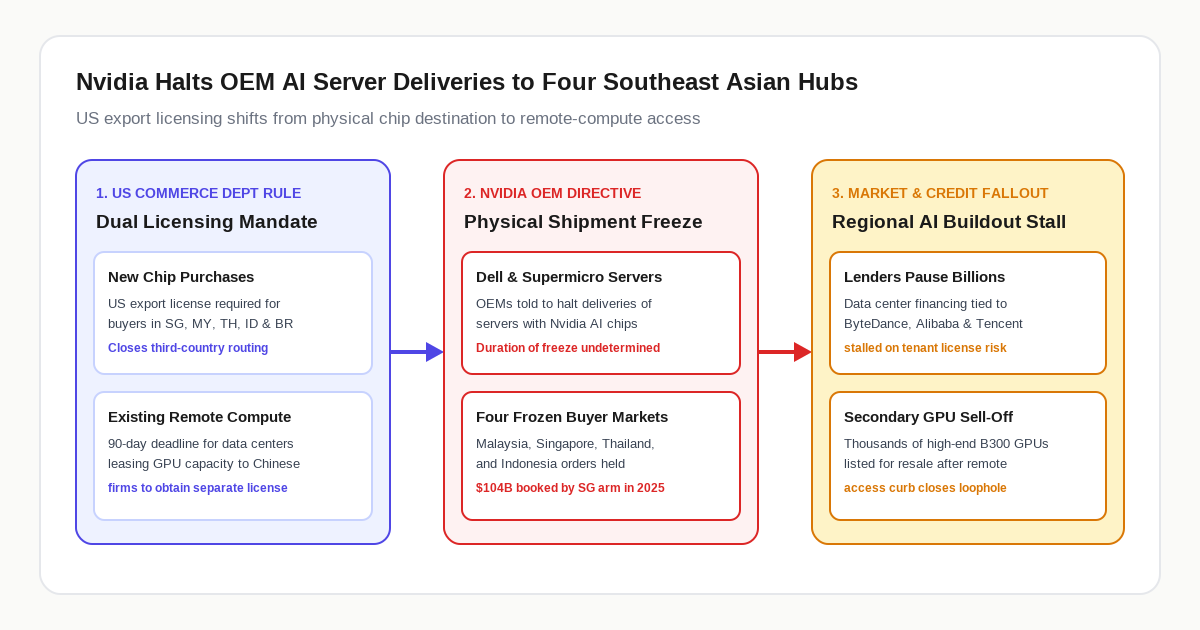
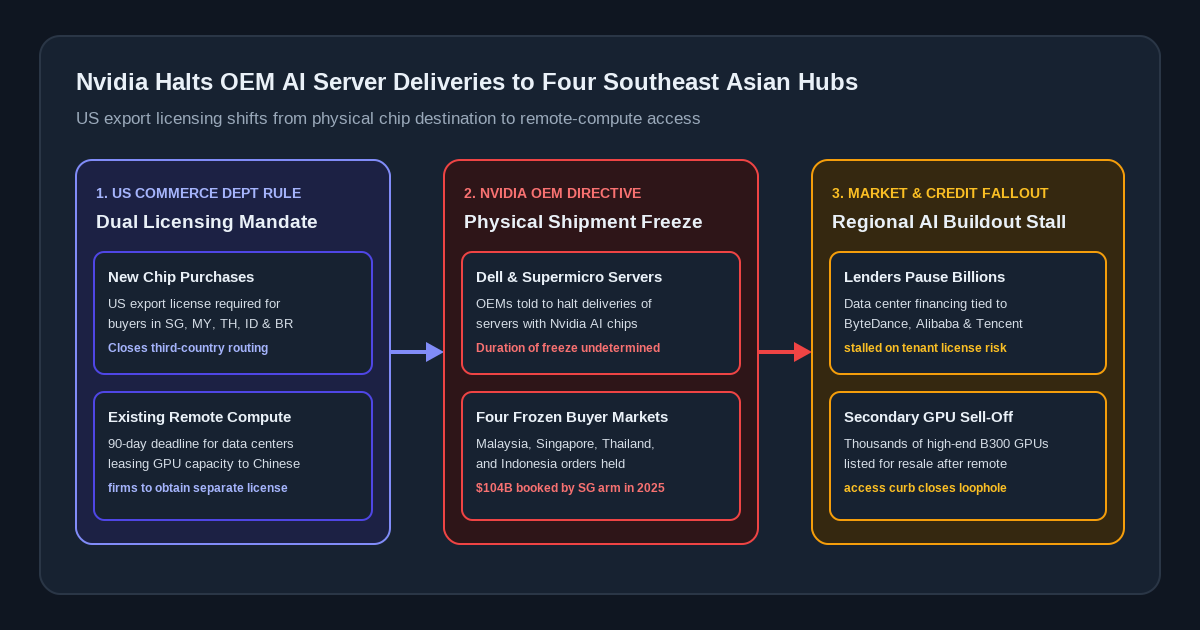
The governance angle that triggered the review also has an operational edge. A C4ADS investigation done for CBS News found China-linked ownership inside Nvidia’s reseller channel — including a “Nvidia preferred partner” that is a unit of Shenzhen-based Yuxing InfoTech, which signed a $120 million deal to lease Nvidia-powered servers to a Taiwanese whiskey company that earned $609,000 in profit last year (SiliconANGLE). We covered the downstream consequence earlier this week in Nvidia halts AI server shipments to Southeast Asia as a new US rule closes China’s remote-access loophole. Partner behavior does not itself trigger a downgrade, but it explains why buyers and lenders are auditing who actually sits behind the Nvidia name.
The pattern echoes what we saw when Google backstopped Anthropic’s $19B Kentucky data center leases: big-tech balance sheets are the hidden underwriting layer of AI infrastructure, and any wobble in those ratings shows up as someone else’s financing cost.
What to watch
- The 90-day review window. S&P expects to finish within 90 days. A AA- outcome would likely arrive with new demands on Nvidia’s guarantee ratios; Moody’s outlook is already stable.
- Guarantee terms on the $500B program. Watch whether the 25% guarantee share is renegotiated upward — that number is the direct price of Nvidia’s rating for neocloud borrowers.
- Neocloud lease repricing. The rate a smaller AI company pays for capacity embeds its landlord’s cost of capital. If backstop terms tighten, marginal AI capacity gets more expensive without any chip price changing.
For AI operators, the practical takeaway is modest but real: capacity contracts signed in the next quarter may carry financing terms that reflect Nvidia’s governance risk, not just GPU supply and demand. Nvidia remains certain to stay investment grade — this is about basis points and collateral demands across a very large stack, not solvency. But the week’s three datapoints together — a rating on watch, banks offloading AI loans, and a partner-channel investigation — mark the moment the AI trade’s collateral stopped being taken for granted.
Sources verified November 27, 2026. S&P’s statement is known through TechCrunch’s and Semafor’s reporting; a downgrade has not occurred and remains a possibility under review.