Fed Extends Third-Party Risk Comment Period to Dec. 16: Why AI Vendors Into Banks Should Read the Docket
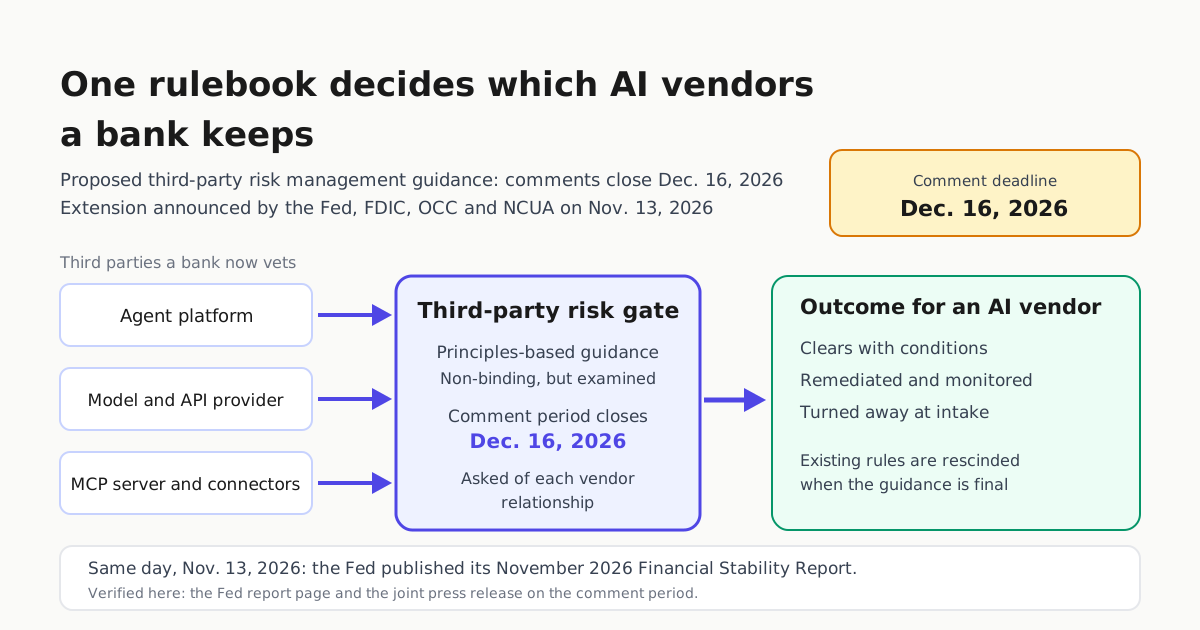
Nov. 13, 2026: the Fed, FDIC, OCC and NCUA moved the third-party risk comment deadline to Dec. 16, the rule banks will use to vet every AI vendor they onboard.
Two Federal Reserve moves landed on the same day
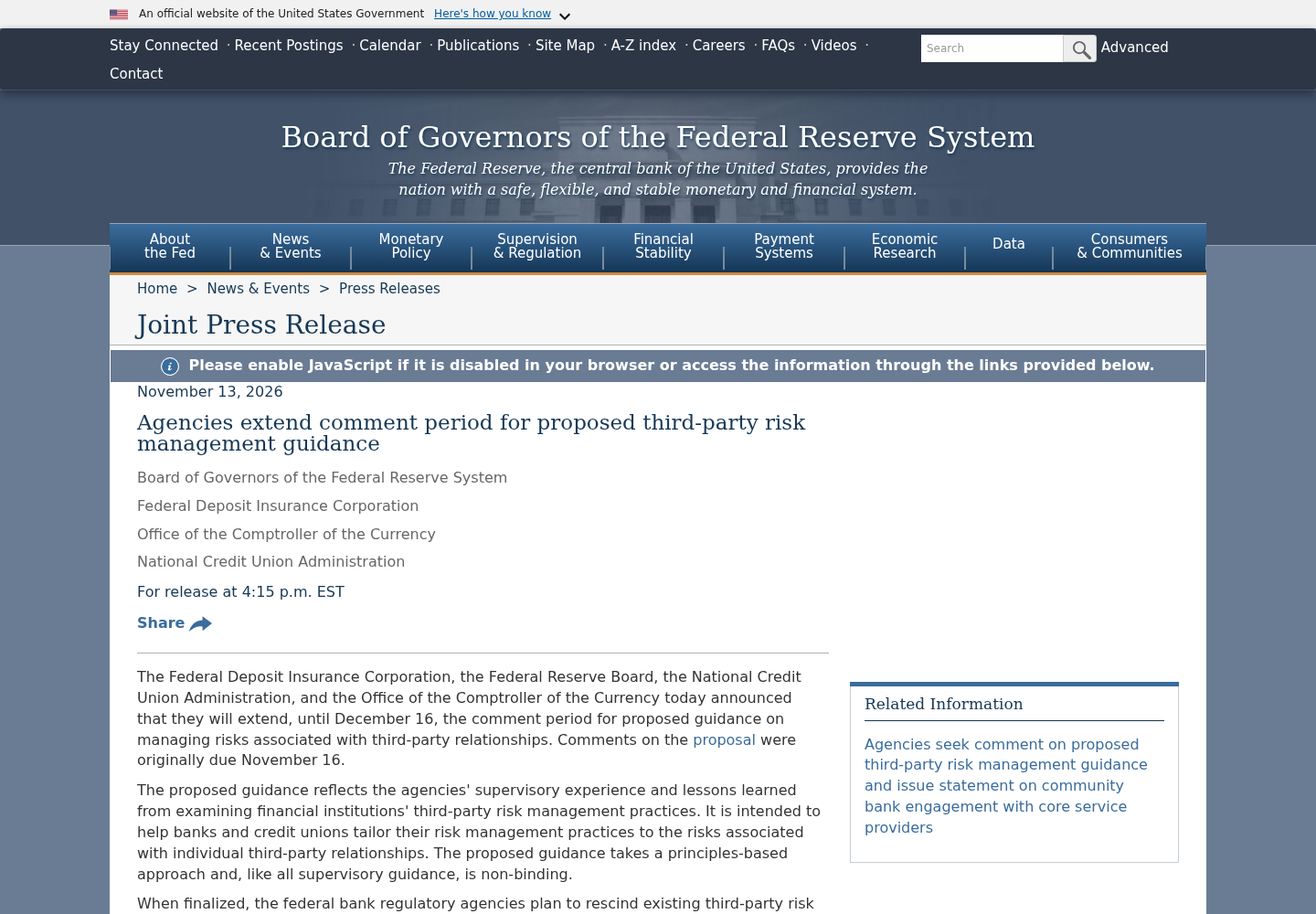
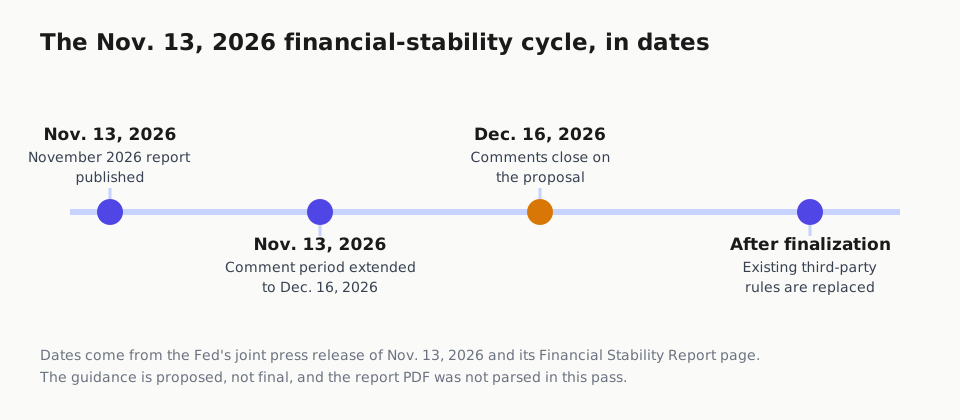
On November 13, 2026, the Federal Reserve Board published its November 2026 Financial Stability Report. The same day, the Federal Reserve Board, the FDIC, the OCC and the NCUA extended the comment period on their proposed third-party risk management guidance to December 16, 2026.
The report is the Fed’s periodic risk assessment, one pillar of its financial stability program, which tests whether markets and institutions stay resilient enough for households, communities and businesses to keep investing and participating. The comment-period extension is the other half of the same cycle: the supervisory rule that tells banks how they must assess the outside vendors they depend on, and in 2026 that vendor list includes model providers, agent platforms and connectors sitting in front of bank staff and customers.
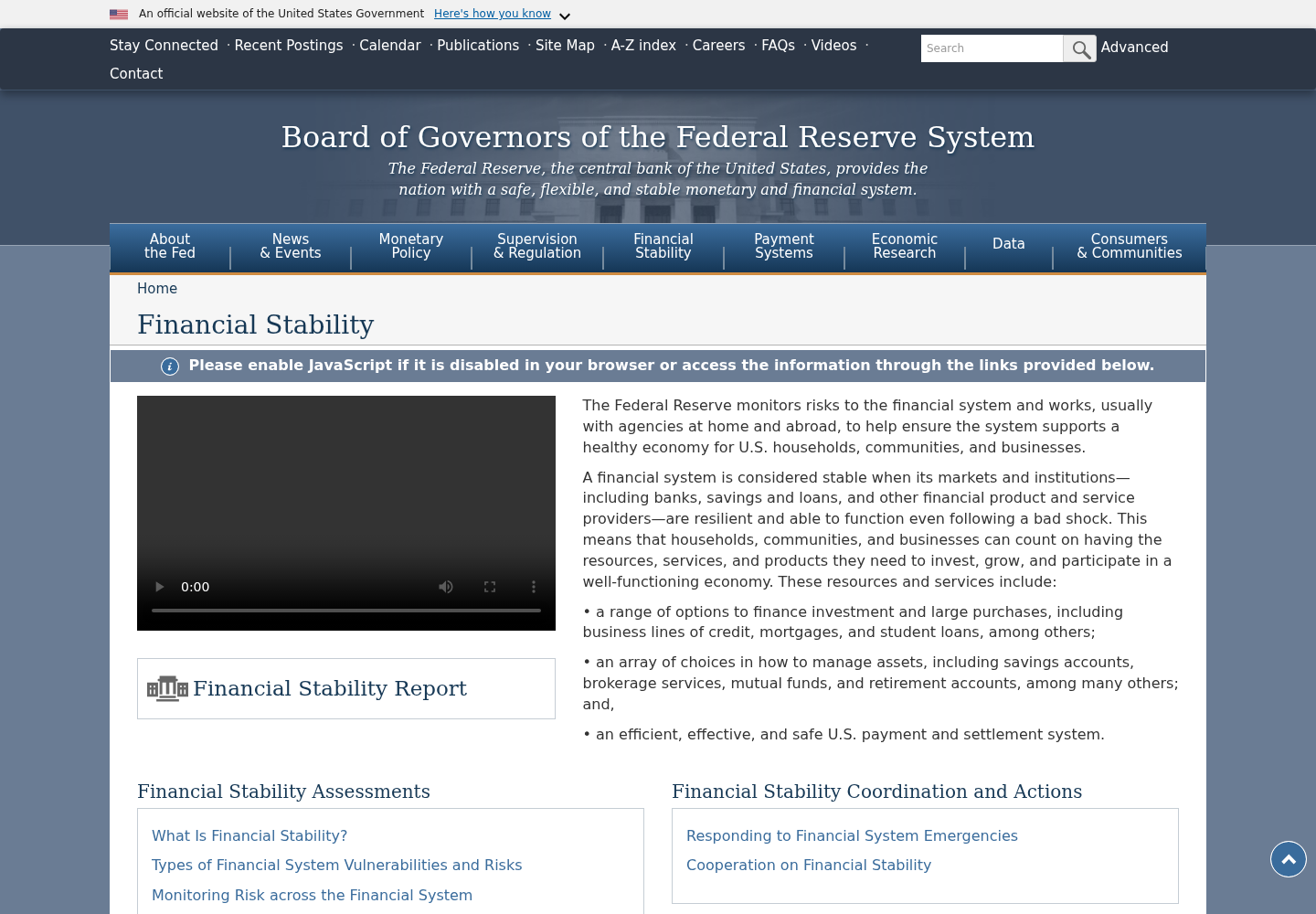
This article covers the rule, because that is where the operator action is. Automater’s verification pass could not parse the November report PDF (it exceeds the fetch size limit), so no finding from the report is asserted here.
What the November 13 release establishes
- The four agencies moved the comment deadline on the joint proposal from November 16 to December 16, 2026.
- The proposal is principles-based and, like all supervisory guidance, non-binding.
- Once finalized, the agencies plan to rescind their existing third-party risk management guidance and replace it with the new guidance; NCUA will rescind its own guidance and run its own reviews.
- The Federal Reserve also extended, to December 16, the comment period on its own proposed third-party risk management guide for Fed-supervised traditional community banks.
| Claim | Evidence status in this pass |
|---|---|
| Nov. 13, 2026 extension of the comment period to Dec. 16 | Verified, joint press release |
| Guidance is principles-based and non-binding | Verified, same release |
| Existing third-party risk guidance will be rescinded and replaced | Verified, same release |
| Fed’s separate community bank guide extension to Dec. 16 | Verified, same release |
| November 2026 Financial Stability Report published | Verified, Fed report page, last updated Nov. 13, 2026 |
| Findings inside the report | Not verified, the PDF exceeded the fetch size limit |
| Any AI-specific language, survey share or debt figure | Not asserted, no fetched page contains them |
Why a Dec. 16 docket matters to AI vendors
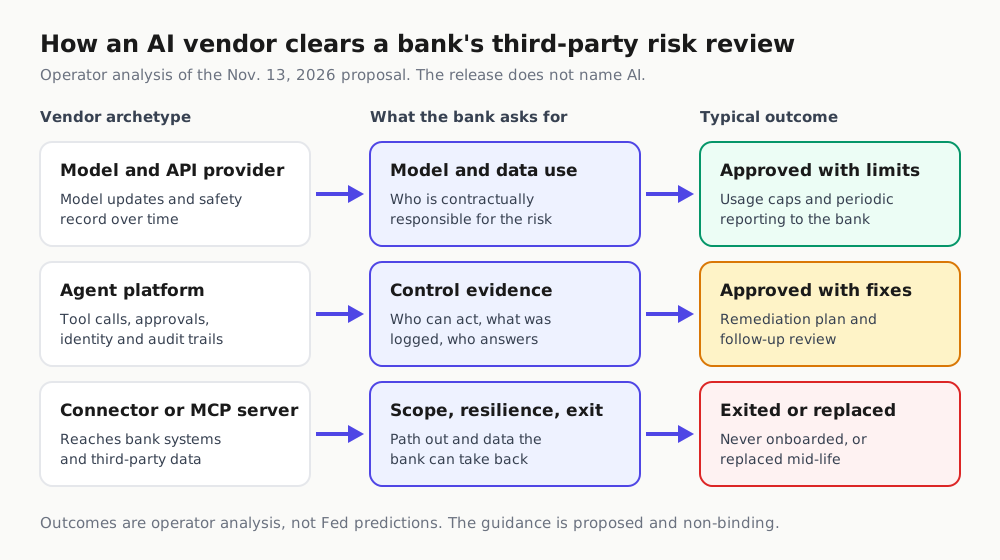
Bank third-party risk management is a gate, not a checklist. A principles-based standard asks the bank to show that it understands each relationship, has controls proportionate to it, can monitor it, and can leave it. The guidance is non-binding; the exam is not. What a bank can show about a vendor is what an examiner asks for.
Four consequences follow, and none of them require any document to say the word ‘AI’:
- The vendor is a stack, not a logo. An agent may run on a frontier lab’s API and call an MCP server that reaches the bank’s own systems. Diligence that stops at the invoice leaves the chain unexamined. Expect to document who is liable at each hop, who holds the audit trail, and who takes the incident call.
- Change is the trigger. Model updates, safety incidents and shifts in training-data policy change the risk the bank bought. Principles-based guidance gives examiners room to expect notice of material change, not just a yearly re-paper.
- Autonomy changes what evidence means. A copilot that drafts text produces logs; an agent with tool access performs actions. The evidence an examiner wants is identity, scope and approvals, the same records behind Automater’s piece on the observability records regulators are starting to demand, its guide to least privilege for agents, and its notes on hardening MCP servers in production.
- Exit gets priced in early. Banks will ask how they take logs, prompts and context back if they leave. If the harness is vendor-hosted, exporting the audit trail before access changes is the same obligation in different clothes.
Before Dec. 16
The release links the Federal Register notices for the extension, and that docket is where a submission has to land. Teams shipping agents into regulated finance should treat the interval as a dry run of the evidence a bank will demand. A workable pack looks like this:
vendor:
  legal_entity:          # contracting entity the bank will diligence
  product:               # agent platform, model API, connector or MCP server
roles:
  accountable_party:     # who signs, and who takes the incident call
  subprocessors: []      # model providers, hosting, telemetry
  jurisdictions: []      # where bank data is processed
agent_controls:
  tool_scope: []         # what the agent may call, per role
  identity_model:        # human, workload or agent identity
  audit_trail:
    format:              # exportable record of tool calls and approvals
    retention_days: 0
    exportable: false
  human_approval_points: []
change_notification:
  material_change_triggers: []   # model updates, safety incidents, policy shifts
incident_reporting:
  notification_window_hours: 0
  contact:
exit:
  data_portability:      # logs, prompts, context, embeddings
  termination_assistance:
The point
What to watch is not a warning but a paperwork standard. The Fed’s risk assessment and its supervisory rewrite landed together, and the one with a live deadline is the rule that decides which AI vendors a bank can keep. Principles-based, non-binding guidance still sets the questions an examiner will ask about a model API, an agent platform or a connector. A vendor that can hand over a control evidence pack on Monday is not the vendor repriced in an exam, and for anyone shipping agents into finance the comment period is the cheapest preview of that conversation.