OpenAI Disbands Its Robotics Team, Betting General Models Can Run Robots
OpenAI confirmed it disbanded its stand-alone robotics team, betting GPT-6 Astra and other general models can run robots directly. We check what the evidence establishes.
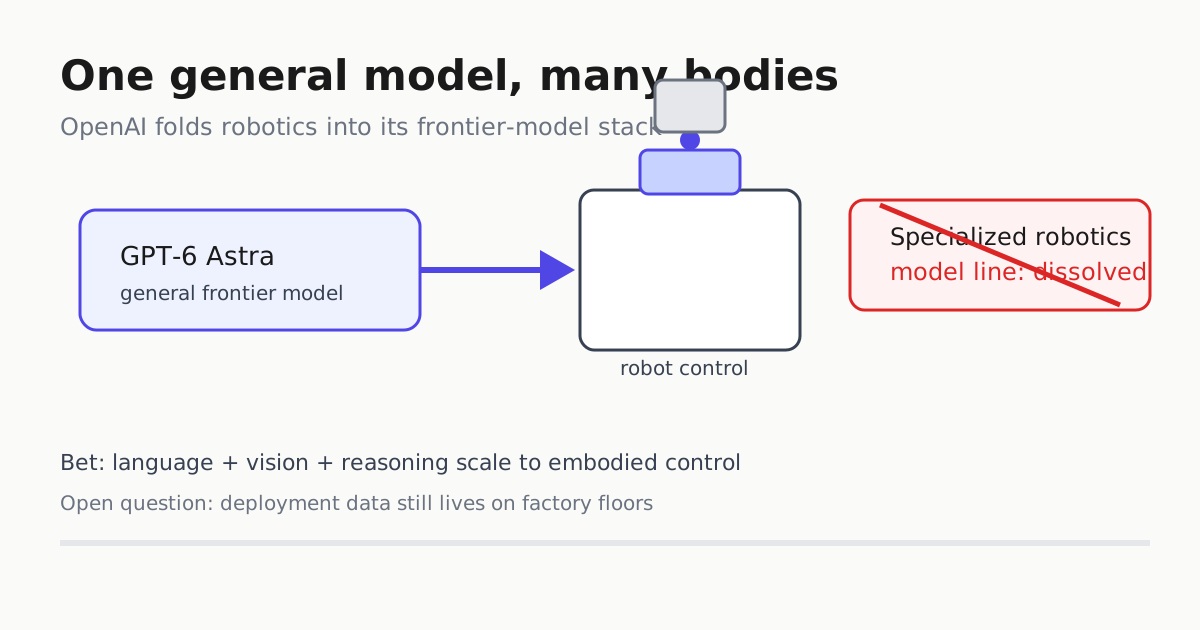
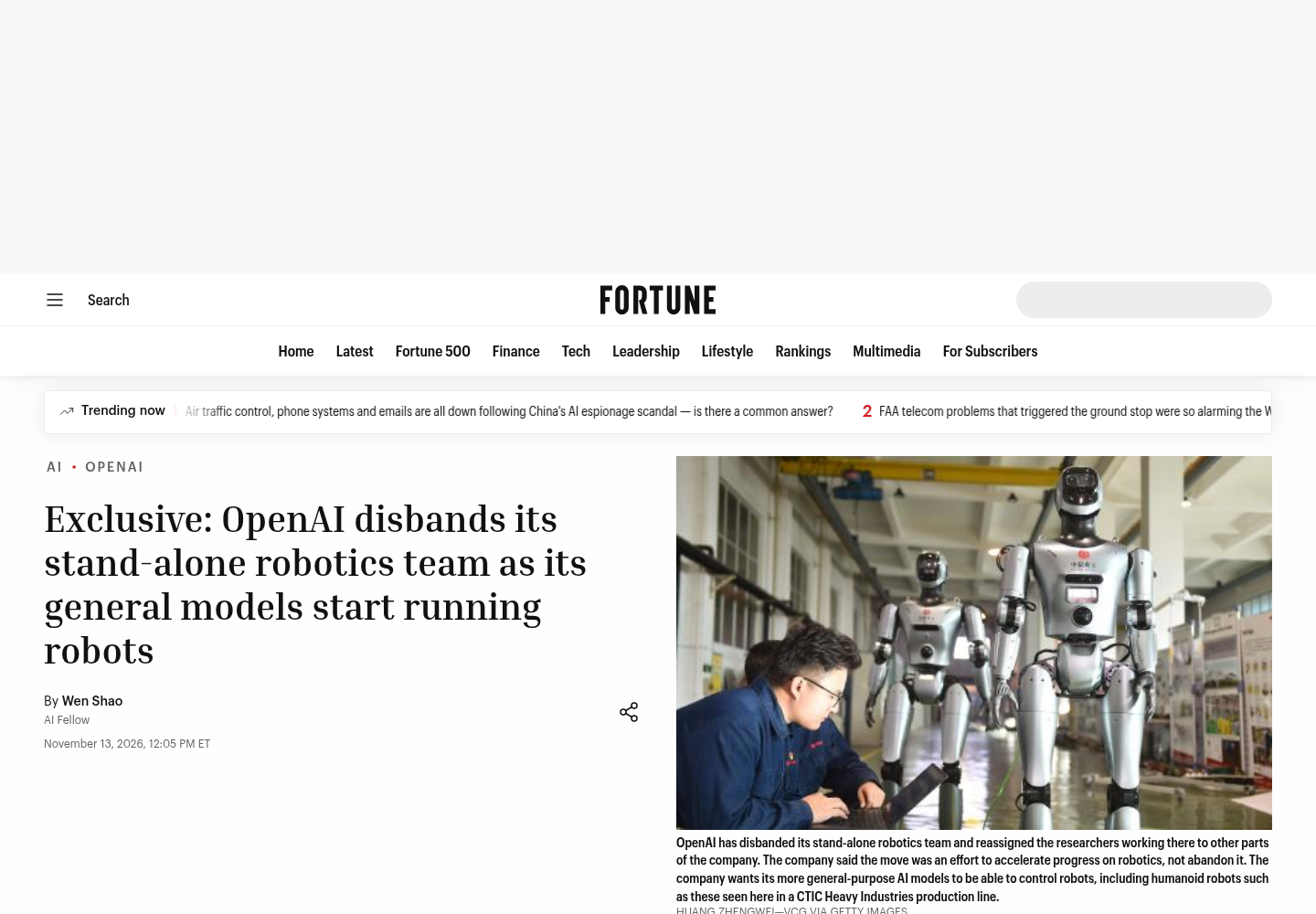
OpenAI has disbanded its stand-alone robotics team and folded its researchers into the rest of the company, Fortune reported on November 13. The company confirmed the reorganization when asked, framing it as an acceleration of robotics rather than a retreat. But the structural fact is the story: the leading frontier lab no longer believes robotics needs its own model line.
What actually changed
According to Fortune’s reporting, the robotics research team now reports into the main research organization under Chief Research Officer Mark Chen, while applied robotics and hardware moved into the larger Applied organization under President Greg Brockman. The timing was abrupt enough that OpenAI’s registered booth #208 at CoRL, a top academic robotics conference in Austin, sat empty when Fortune visited — with a few former robotics researchers milling around it, drawing a crowd with no demo to show.
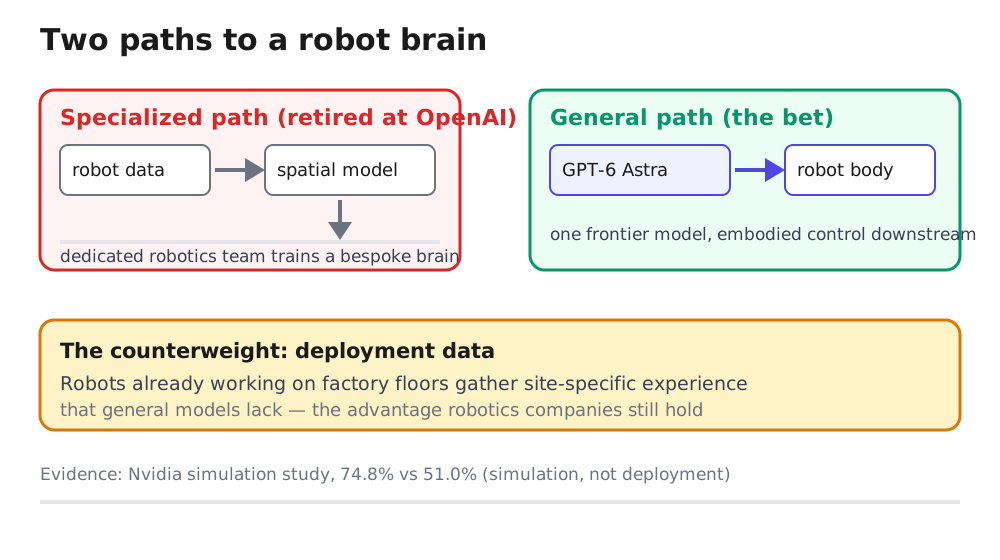
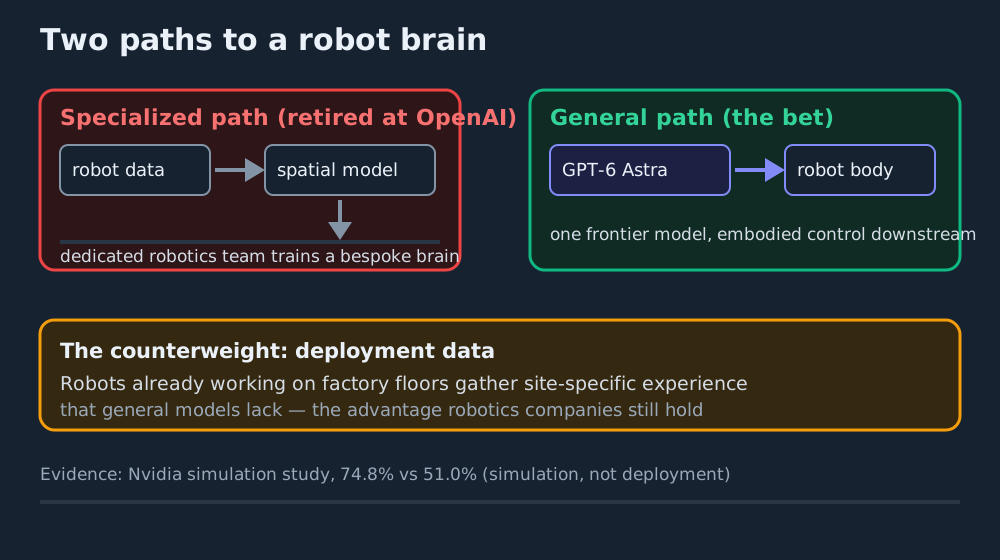
OpenAI’s own explanation is the significant part. A spokesperson said that at the start of the year the company assumed the best path to robotics ran through models like Sora, whose video generation requires an implicit model of physical dynamics. Since then, the spokesperson said, its general-purpose frontier models — including GPT-6 Astra — have shown they can be applied to robotics directly, and that discovery motivated dissolving the dedicated team.
That matches OpenAI’s recent public direction. In its November 3 publication on engineering for the physical world, OpenAI described GPT-6 Astra designing an end-to-end hardware device — enclosure, PCB, firmware and UI — and reported that token usage across its internal hardware teams had grown 23-fold since February. Those claims concern engineering design work, not autonomous robot control, and OpenAI itself notes the device still needed human review rounds for manufacturability. The new reorganization extends the same logic from designing hardware to controlling it.
The benchmark behind the bet
Fortune cites one concrete data point: in an Nvidia study, an Astra-powered agent given camera images, robot state and a control interface achieved a 74.8% success rate on a simulated manipulation benchmark, versus 51.0% reported by the best specialized robotic models on that leaderboard. Simulation results are not deployment results — but a roughly 24-point gap over specialized systems, achieved without dedicated robotic training data, is the kind of evidence that rewrites org charts.
Researchers quoted by Fortune split on what it means. Guanya Shi of Carnegie Mellon’s Robotics Institute reads the move as OpenAI signaling that robotics is “no longer a special problem” — a downstream application of general intelligence, the way the same frontier models now power coding, legal and financial tools. Shi also cautions that large models are slow and cloud-hosted, leaving room for smaller onboard models that work without a constant network connection. Pete Florence of Generalist noted it remains unclear that any existing model dominates robotics long-term.
The counterargument is deployment. Russ Tedrake, MIT professor and CEO of Walden Robotics, told Fortune that robotics companies hold an advantage AI labs lack: robots already gaining work experience on real factory floors, and the site-specific data that comes with it. The same day’s MIT News profile of Robust AI illustrates that camp: Rod Brooks’s company ships Carter robots into live warehouses, built around the observation that success depends on humans, robots and backend systems working together — not on a stand-alone robot brain.
Why the audience should care
For robotics startups, the challenge is direct: billions have been raised on the premise that robots need purpose-built “spatial intelligence” models as their brains. If frontier general models close the control gap, that premise — and those valuations — weaken. For anyone operating agent fleets, the signal is that embodied control is being absorbed into the same general-model stack already driving coding and computer-use agents, which changes where capability improvements land and how quickly.
It also shifts where simulation fits the pipeline. Robotics simulation itself is becoming a frontier-model workbench — see NVIDIA bringing frontier AI agents to Omniverse for robotics simulation — and the Nvidia benchmark behind OpenAI’s bet was run exactly in that simulated regime. And as GPT-6-class models take on more embodied and operational work, operators should track the thresholds where those models get risky to point at real systems, the framing in our GPT-6 Astra cyber-threshold runbook.
The move also fits OpenAI’s cost picture: Fortune notes $10.9 billion in reported quarterly operating losses, pressure to cut “side quests,” and a targeted 2027 humanoid demo that the company says still stands.
None of this is yet shipped capability. It is an organizational bet backed by simulation results and the company’s own statements. But when the largest frontier lab dissolves its robotics team because it thinks general models already do the job, that is itself a consequential industry datum — and a testable one, as Tedrake’s deployment-data argument and the 2027 demo deadline both come due.