Translation Model Evaluation for Lao Accuracy and Thai Retention
Run a translation model evaluation on saved Lao and Thai outputs. Catch wrong-script answers, check delivery dates, and score each language with chrF++.

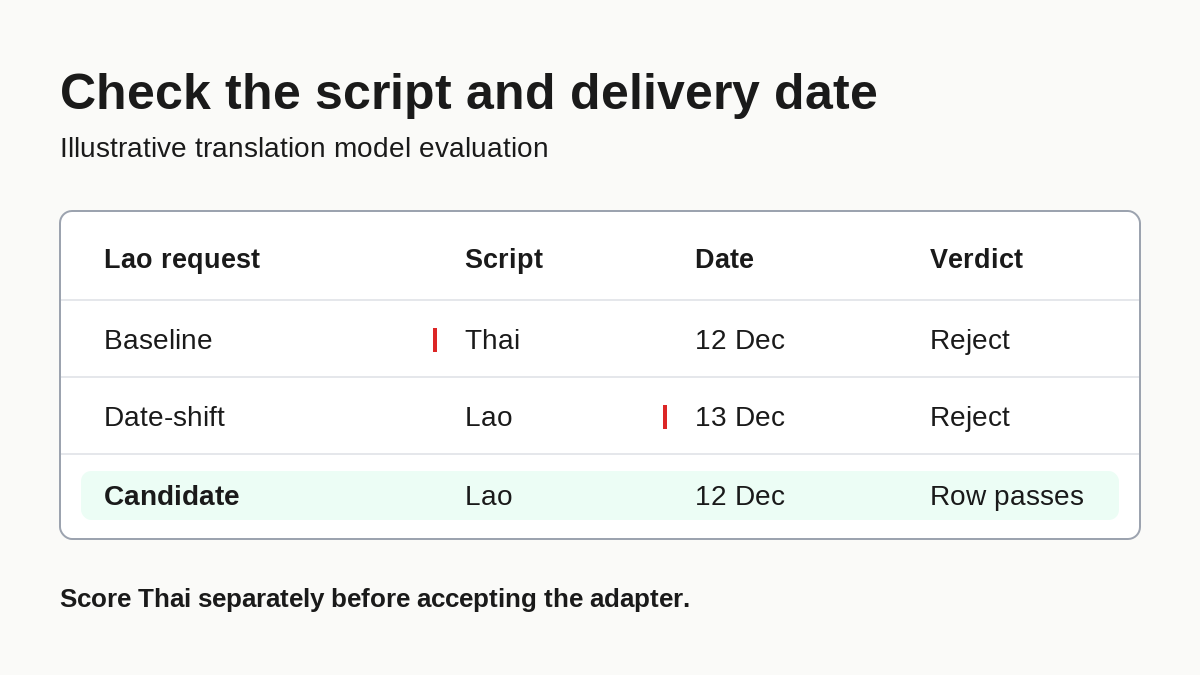
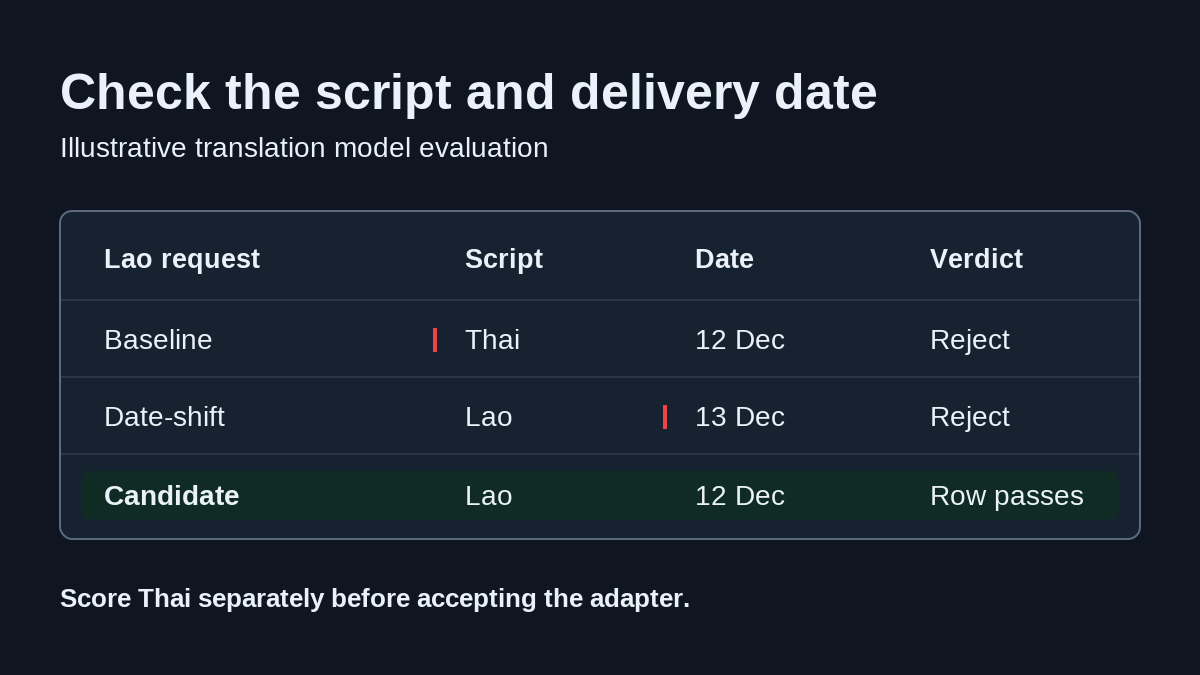
A Lao translation arrives in Thai. The next adapter writes in Lao and moves the delivery from 12 December to 13 December. A third preserves the date and the requested language. Before switching, you still need to see what that adapter does to the Thai messages customers already receive. This translation model evaluation gives an ML engineer a way to make that decision from saved outputs.
You need SacreBLEU, a UTF-8 text editor, aligned English sources and Lao and Thai references, and saved outputs for each system. Start with the two-message fixture below. Its outputs are constructed and its results are illustrative expectations. For a release, arrange for a fluent reviewer in each target language to verify the meaning of consequential messages. At the end, you will have a separate verdict for each language and the IDs of any rows that prevent acceptance.
Build the aligned support-message fixture
- In an empty directory, save each named block as a separate UTF-8 plain-text file. Copy only the lines inside its fence. The filename printed above the block identifies which role the file plays in the evaluation.
- Map line 1 in every file to
task:delivery-01and line 2 totask:delivery-02. Keep the IDs in your review table. The reference and output files passed to SacreBLEU contain only the translations. - Verify that each file has exactly two nonempty lines in the same order. A long line can wrap visually in the editor and still be one record. Use the displayed line numbers to distinguish wrapping from a hard line break.
source.en.txt
Your package will arrive on 12 December.
Your package has already been delivered.
ref.lao.txt
ພັດສະດຸຂອງທ່ານຈະມາຮອດໃນວັນທີ 12 ທັນວາ.
ພັດສະດຸຂອງທ່ານຖືກຈັດສົ່ງແລ້ວ.
ref.thai.txt
พัสดุของคุณจะมาถึงวันที่ 12 ธันวาคม
พัสดุของคุณถูกจัดส่งแล้ว
base.lao.txt
พัสดุของคุณจะมาถึงวันที่ 12 ธันวาคม
ພັດສະດຸຂອງທ່ານຖືກຈັດສົ່ງແລ້ວ.
base.thai.txt
พัสดุของคุณจะมาถึงวันที่ 12 ธันวาคม
พัสดุของคุณถูกจัดส่งแล้ว
date-shift.lao.txt
ພັດສະດຸຂອງທ່ານຈະມາຮອດໃນວັນທີ 13 ທັນວາ.
ພັດສະດຸຂອງທ່ານຖືກຈັດສົ່ງແລ້ວ.
date-shift.thai.txt
พัสดุของคุณจะมาถึงวันที่ 12 ธันวาคม
พัสดุของคุณถูกจัดส่งแล้ว
candidate.lao.txt
ພັດສະດຸຂອງທ່ານຈະມາຮອດໃນວັນທີ 12 ທັນວາ.
ພັດສະດຸຂອງທ່ານຖືກຈັດສົ່ງແລ້ວ.
candidate.thai.txt
พัสดุของคุณจะมาถึงวันที่ 12 ธันวาคม
พัสดุของคุณถูกจัดส่งแล้ว
The language suffix names the requested target. base.lao.txt belongs in the Lao evaluation even though its first line is Thai. Moving that line to the Thai evaluation would erase a wrong-language failure and give Thai an extra prediction for the same source. The English file stays alongside the scoring files for meaning review. SacreBLEU takes the target-language reference and saved output files in this procedure.
The second line supplies a correct answer across all systems, so a good answer and a bad one can contribute to the same corpus score. It also gives you an alignment check. If a prediction about an already delivered package appears beside a scheduled arrival in both languages, look at export order first. Equal line counts can survive a bad sort or a retry that overwrote the wrong record. Verify that line 1 refers to scheduled arrival and line 2 to completed delivery before attributing a low score to an adapter.
For your own data, keep a source record with a stable ID, target language and text before exporting anything for scoring. Join saved responses to the source by ID and requested target, then emit the files in canonical source order. Verify that each system has exactly one response for every expected ID and target pair. If two outputs claim the same pair, resolve the duplicate against the original run records. If an export omitted a response, recover the saved output for that ID. If a model genuinely returned an empty response, record the failure against its ID and block acceptance. Deleting the line can shift subsequent comparisons or hide the case the evaluation needs to catch.
If you extend the benchmark with FLORES-200, use English eng_Latn, Lao lao_Laoo and Thai tha_Thai from the same split. The benchmark README documents the language codes and its split structure. The dataset card describes aligned sentences and an id field that starts at 1. Keep split and ID together in your manifest so the same row number in two splits stays distinguishable. The two examples above are synthetic and can be used directly. FLORES-200 benchmark README · FLORES-200 dataset card
Screen requested script before judging meaning
- Compare line 1 of
base.lao.txtwith line 1 ofref.thai.txt. The fixture uses the same string in both places. Recordtask:delivery-01, requested Lao, Thai script, fail. The date remains 12 December. - Compare line 1 of
date-shift.lao.txtwith line 1 ofref.lao.txt. Record Lao script, pass. Carry the row to meaning review with both strings visible. - Inspect both rows of
candidate.lao.txtandcandidate.thai.txtagainst their requested targets. Expect two Lao-script lines and two Thai-script lines, respectively. Inspectbase.thai.txtanddate-shift.thai.txtas well. The explicit Thai comparison shows whether the problem belongs to one target or affects both.
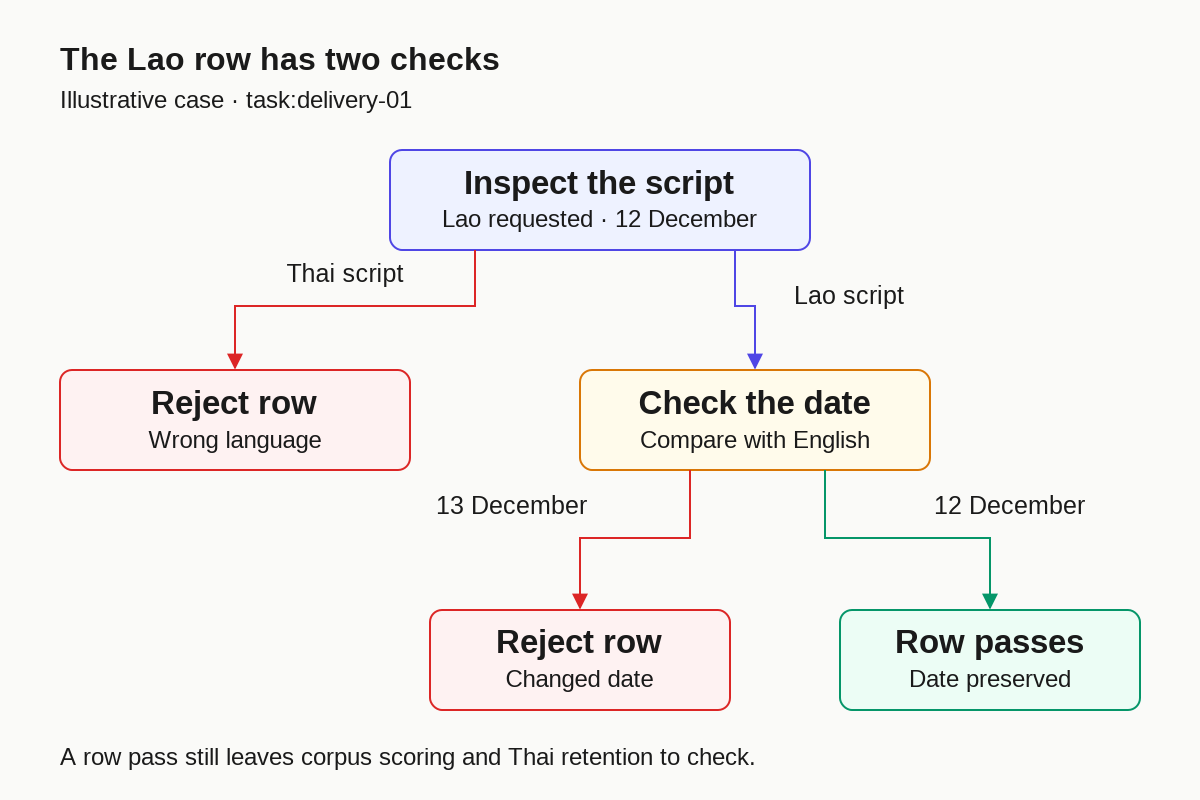
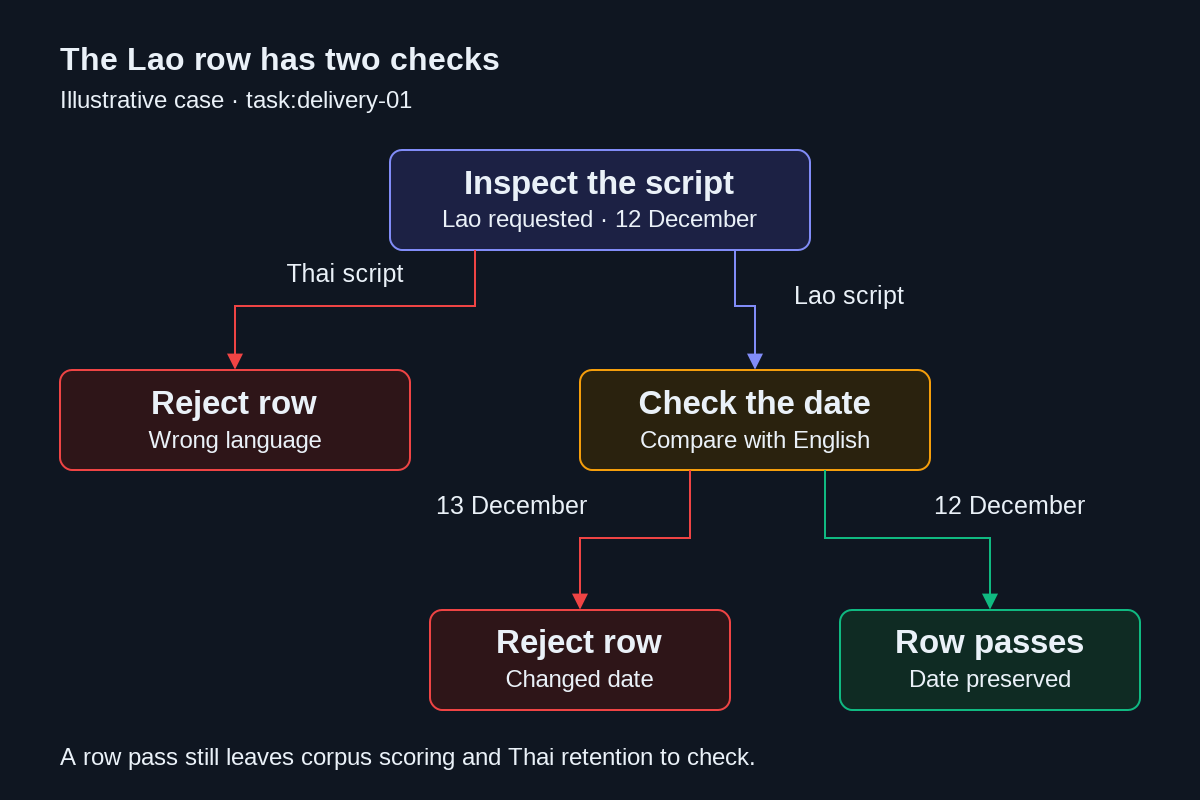
Unicode encodes Thai and Lao in separate blocks. Thai occupies U+0E00 through U+0E7F and Lao occupies U+0E80 through U+0EFF. For the short fixture texts, compare directly with the known references. For a larger export, a useful triage heuristic is to look for letters in the expected block and flag rows with competing-script letters, no target-script letters or too little text to judge. The number 12, a period and whitespace supply no positive evidence of Lao or Thai. Both blocks contain characters beyond letters, so constrain the signal to letters and retain the original text for review. Unicode Standard, Thai and Lao
Mixed text needs a judgment. A Lao sentence with a carrier name in Latin script can be appropriate. A Lao header followed by instructions in Thai can fail even though some of the characters are Lao. Put examples of expected carrier names and tracking references in the reviewer notes. Flag a row when the surrounding sentence may use the wrong language and give the reviewer the full message. A confirmed wrong-language row blocks acceptance in this fixture. An unresolved row keeps the decision pending. Keep the number of expected rows alongside the counts of passes, failures and pending reviews so that missing judgments are visible.
Keep flagged nonempty rows in the corpus. This makes the score describe the full set of original saved outputs. Filtering out failed rows would give each model a potentially different test set, and an adapter that returns the wrong language could end up scored on an easier subset. Use the script verdict and the row ID to direct inspection to the saved answer while each corpus result retains the complete comparison.
Score Lao and Thai independently with chrF++
- Use an environment with SacreBLEU installed. The project documents
pip install sacrebleufor Python 3.9 or later. Open a terminal in the directory containing the nine fixture files. - Run the six commands below. The positional argument is the detokenized reference file and
-iselects the saved translation file.-m chrf --chrf-word-order 2requests chrF with word n-grams through order two, the chrF++ variant. - Save each score and signature with its input filename and target language. Check for
nw:2in every signature before calculating any difference. Compare the candidate with the baseline scored on the same target reference. SacreBLEU command-line documentation · FLORES-200 evaluation recipe
# Illustrative expectation: base Lao scores below date-shift Lao.
sacrebleu ref.lao.txt -i base.lao.txt -m chrf --chrf-word-order 2
sacrebleu ref.lao.txt -i date-shift.lao.txt -m chrf --chrf-word-order 2
# Illustrative expectation: candidate Lao and all three Thai files score 100.
sacrebleu ref.lao.txt -i candidate.lao.txt -m chrf --chrf-word-order 2
sacrebleu ref.thai.txt -i base.thai.txt -m chrf --chrf-word-order 2
sacrebleu ref.thai.txt -i date-shift.thai.txt -m chrf --chrf-word-order 2
sacrebleu ref.thai.txt -i candidate.thai.txt -m chrf --chrf-word-order 2
Expect the candidate Lao score and all three Thai scores to be 100 on the 0–100 scale because their files contain identical lines to the respective references. Expect the two other Lao scores to be below 100, with date-shift above base. The date-shift file changes a single digit while the base file substitutes Thai for the first sentence. Read the exact nonperfect values from your run. The Thai comparisons tie by construction, so both Thai deltas are zero points relative to base.thai.txt. Keep these expected observations with the fixture so someone repeating the exercise can establish whether the comparison ran as intended.
The default output in SacreBLEU 2 and later is JSON. Read score and preserve signature. If you see nw:0, check for a missing --chrf-word-order 2. If the candidate Lao score is below 100, compare the two files line by line. Look for a swapped file, a copied filename label, a hard line break or a changed character. If a file fails to open, check the working directory and filename. If glyphs display as boxes, open the same UTF-8 file in a font that covers both scripts. If the stored text contains replacement characters, recover the original export before relying on the result. SacreBLEU output format and signatures
chrF++ measures character and word n-gram overlap. Normal Thai and Lao spacing indicates larger text boundaries, so leave the input detokenized and use the same metric flags across models. The changed digit in the date-shift example leaves much of the surrounding text intact. A fluent paraphrase may change multiple words while preserving the whole commitment. Read each score as overlap with the chosen target reference, then inspect the underlying translation for preservation of facts. SacreBLEU chrF++ options · Unicode Standard, spacing conventions
Review the delivery date and decide on the fixture
- Place the English line, target reference and saved answer side by side. For
task:delivery-01, check the future arrival commitment and the day and month. Fortask:delivery-02, check that the package has already been delivered and that the answer adds no date or promise. - Record script and meaning independently. The
date-shiftLao answer keeps the target script and changes12to13. The baseline answer to the Lao request keeps12and uses Thai. Record both observations so someone else can reproduce the rejection from the same files. - Require a positive Lao chrF++ delta, a Thai chrF++ delta of at least zero and zero confirmed wrong-script or critical meaning failures in either language. This is the illustrative policy for the two-row fixture. A pending review holds the decision. Apply all conditions to one candidate before accepting it.
| Input | Action | Expected result |
|---|---|---|
task:delivery-01 requested Lao, English arrival on 12 December, baseline output |
Compare line 1 of base.lao.txt with line 1 of ref.thai.txt, then check the date against line 1 of source.en.txt. |
Thai script and 12 December. Mark wrong language and reject the baseline for the Lao rollout. |
task:delivery-01 requested Lao, English arrival on 12 December, date-shift output |
Compare line 1 of date-shift.lao.txt with line 1 of ref.lao.txt and read the date against line 1 of source.en.txt. |
Lao script and 13 December. Mark a critical meaning failure and reject date-shift despite the expected Lao score gain and Thai tie. |
task:delivery-01 requested Lao and Thai, English arrival on 12 December, candidate outputs |
Compare line 1 of each candidate file with its target reference, then verify 12 December against line 1 of source.en.txt. |
Both rows use their requested scripts and preserve 12 December. Mark script and date as passing for each target. |
task:delivery-02 requested Lao and Thai, English package already delivered, candidate outputs |
Review line 2 of both candidate files against line 2 of each reference and verify completed delivery against the English. | Both preserve completed delivery. Accept the candidate on the fixture once the Lao gain and Thai tie are confirmed. |
Choose which facts to check before opening the predictions. Checking the digit alone would miss December changing to November, arrival changing to dispatch, or an added instruction to contact support. For production messages, record the original fact and its rendering in the candidate. Give the reviewer space to accept phrasing changes that retain the event, date and commitment. A changed commitment is critical even when the translation is fluent and similar to the reference.
Use the two failed rows as diagnostic controls. If the date-shift output passes the final decision, inspect whether the reviewer missed the number or whether the decision logic discarded the recorded meaning verdict. If the baseline Lao output never appears in the wrong-language column, check whether the evaluator used the script detected in the response to set its target label. A recorded example with a known error can make that distinction easier to reproduce. LangSmith Backtesting for a Wrong Order Lookup
Apply two score thresholds to reported checkpoints
Together AI’s November 26, 2026 experiment reported the highest Lao score among its student training runs for the adapter trained on human Lao references. Thai fell to 5.3 chrF++ for that run, from 46.7 for the base. The publisher used 1,012 sentences for the final Lao scores and 300 for Thai. Its reported Lao-script rate is the share of outputs whose letters are mostly Lao. Use that measurement as reported when screening the checkpoints, then apply your row-level language and meaning criteria when you have outputs to inspect. Together AI’s experiment and Results table
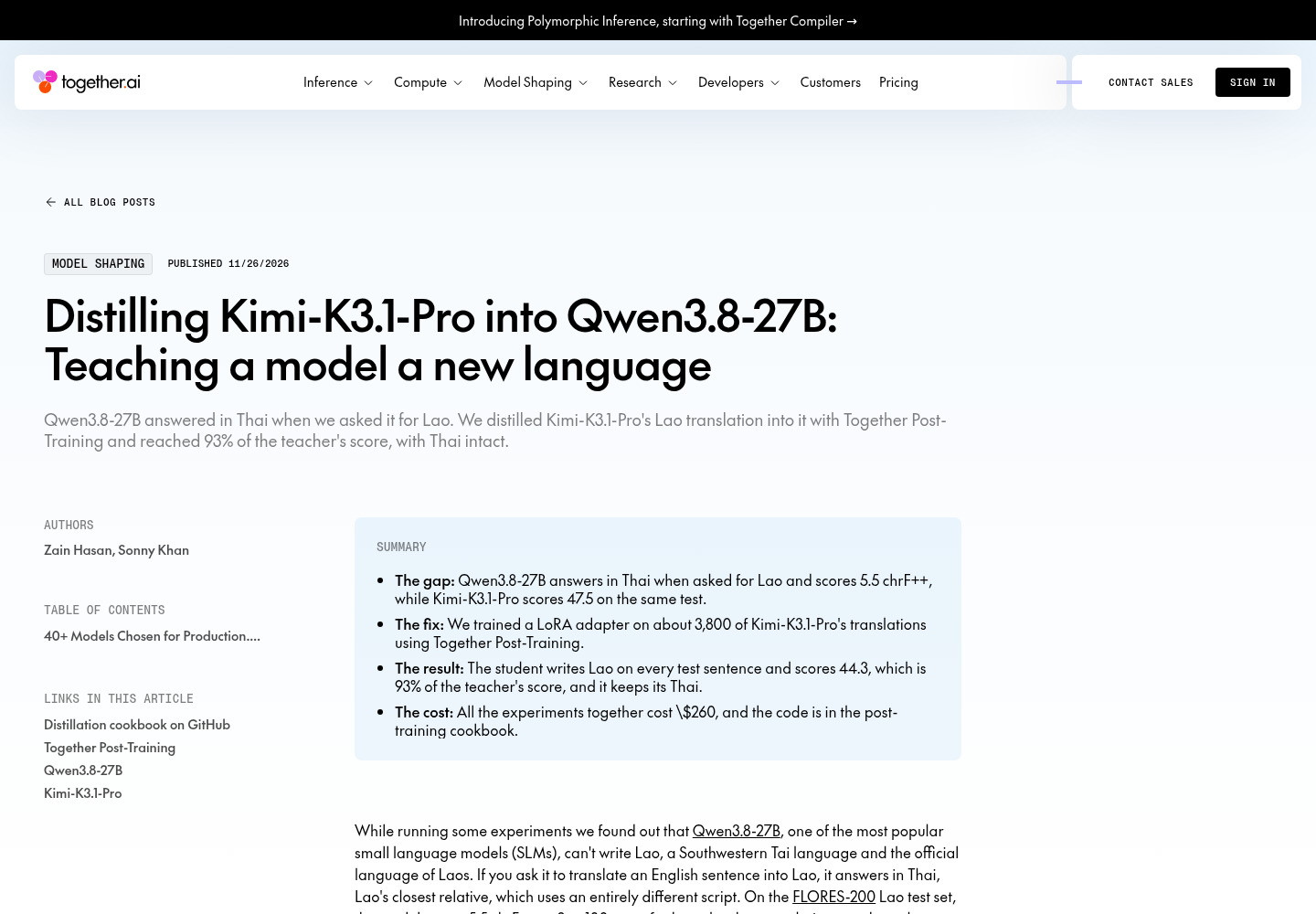
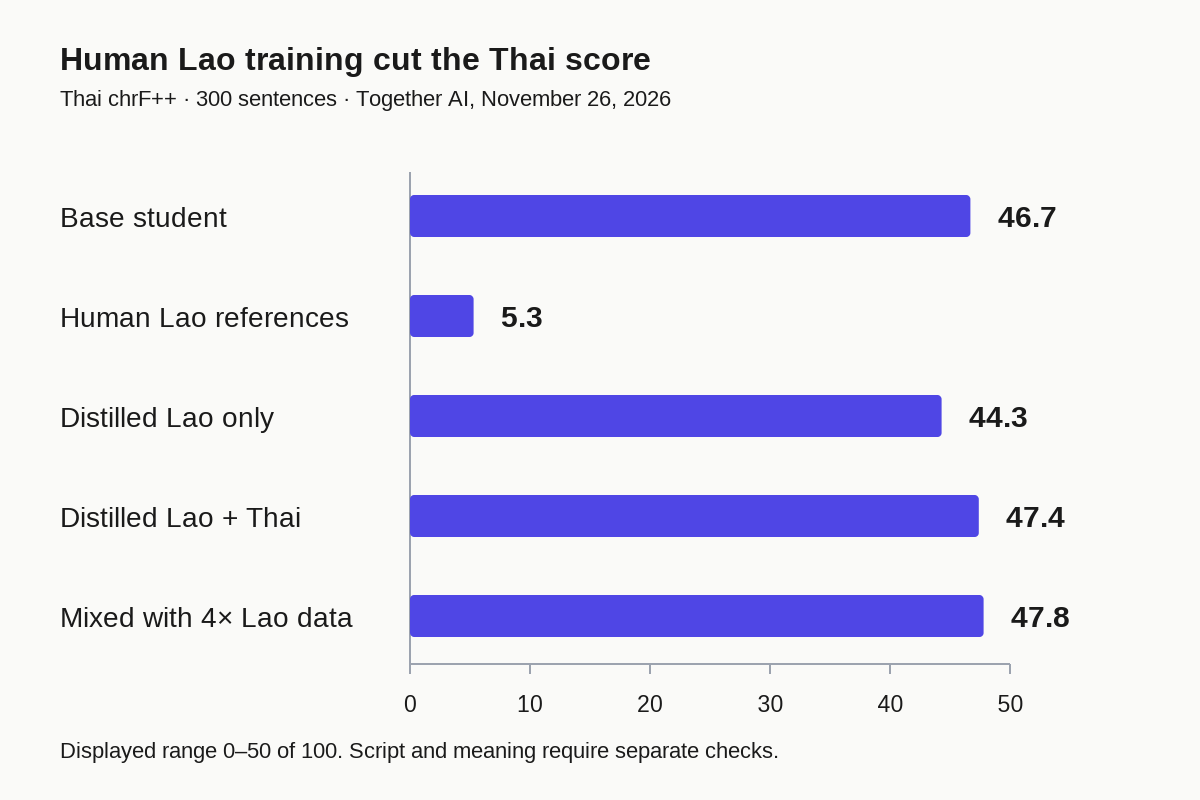
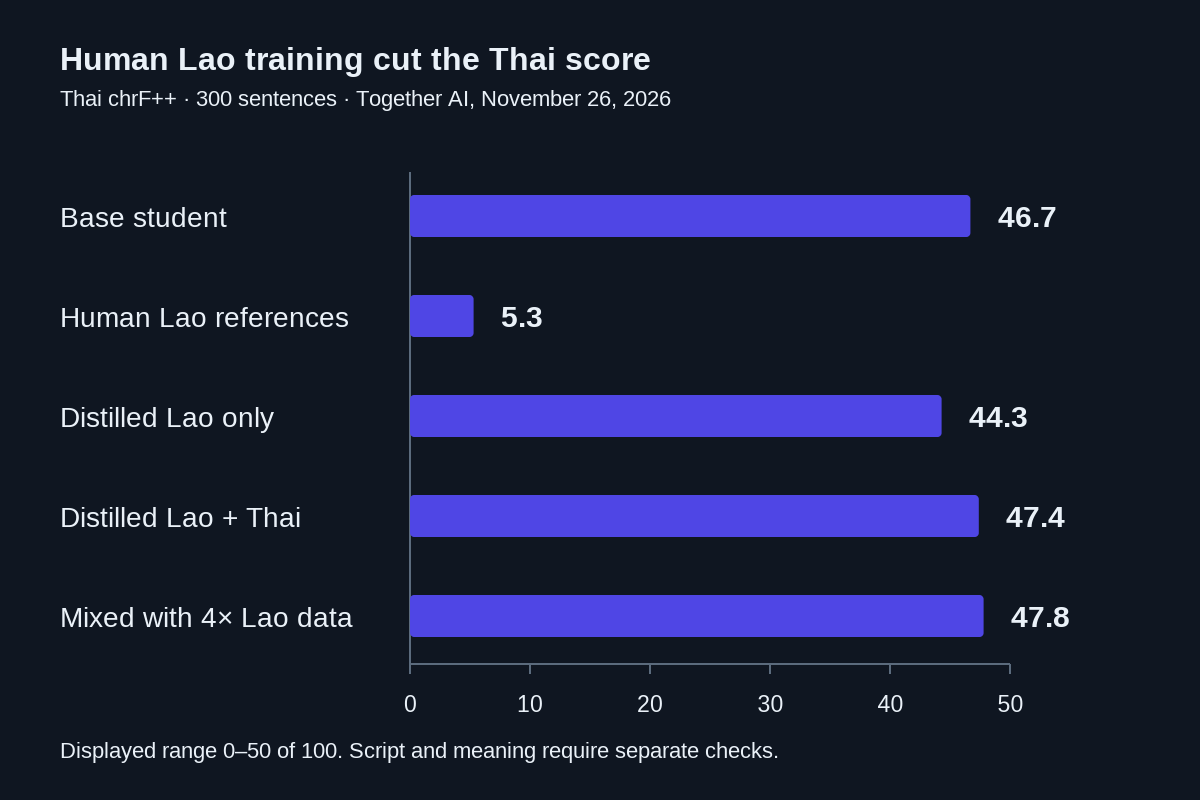
Apply illustrative floors of 44.0 Lao chrF++ and 46.7 Thai chrF++, plus a 100% reported Lao-script rate for this numerical screen. The Lao floor is a chosen benchmark target for the exercise. The Thai floor equals the base result on the same Thai slice. Compare each system with the floors in both columns. A margin of a few tenths is enough to cross a stated floor in this exercise. A statistical conclusion about the size or reliability of the gain would require further evidence.
| Reported system | Lao chrF++ | Lao script | Thai chrF++ | Illustrative numerical decision |
|---|---|---|---|---|
| Base student | 5.5 | 11% | 46.7 | Keep as Thai comparison anchor. Hold Lao. |
| Human Lao references | 44.7 | 100% | 5.3 | Reject because Thai fails. Together also reports 0% Thai script at the end. |
| Distilled Lao only | 41.8 | 100% | 44.3 | Reject because both scores miss the floors. Together reports 17 of 300 Thai answers written in Lao. |
| Distilled Lao + Thai | 41.9 | 100% | 47.4 | Reject because Lao falls below 44.0. |
| Distilled Lao + Thai, 4× Lao data | 44.3 | 100% | 47.8 | Shortlist. Clears the reported numerical screen. |
| Teacher reference point | 47.5 | 100% | 49.9 | Use as a reference for the student comparison. |
The larger mixed run is the sole student adapter on the shortlist under these thresholds. Its Thai score is 1.1 points above the base. The public results table leaves the final Thai-script rate for the mixed runs unstated. The support fixture is separate from the reported test sets. Keep the corresponding script and meaning checks pending. To complete a decision with your own outputs, inspect the Thai rows for language and both sets for changed dates, commitments and delivery status. A confirmed Thai response written in Lao fails the Thai language check even at a Thai score above the floor. Together AI’s checkpoint results
Recover a failed export or a failed candidate
- Missing, duplicated or swapped rows. Return to the saved generation records and export by source ID and requested target. Verify the expected IDs in both model runs, then rerun both language scores on the reconstructed export. Review any rows whose original judgment may have been attached to the wrong answer.
- A candidate fails either language. Keep the current Thai baseline and hold the Lao rollout. If traffic moved during a trial, restore the recorded Thai baseline and return Lao traffic to its previous handling path, such as human review. Verify routing with a known Thai support message and verify that a Lao request reaches its previous handling path.
- A revised candidate is ready. Export its outputs on the same held-out inputs, preserve earlier scores and judgments, and compute the two comparisons again. If a held-out case entered development and helped tune the adapter, replace it with a fresh case that tests the same kind of failure and score the baseline on the updated set too.
Use the same prompt structure, generation settings and export policy for baseline and candidate when isolating an adapter change. If you change the prompt along with the adapter, record both changes and compare the two complete configurations. This makes a second run interpretable if one model adds an explanation or returns a different part of the answer. Save the reference version, source order, file-to-model mapping and metric signature with the review. When the serving system can fall back to a different model, attach the served model identity to the saved answer. Verifying Which Model Actually Answered
For a launch set, choose representative support messages and deliberate edge cases before looking at candidate scores. Include near neighbors such as scheduled arrival and completed delivery, or a permitted action and its negation. Resolve ambiguous English wording before making it an acceptance case. For live Thai traffic, choose an explicit score tolerance against the Thai baseline and set separate limits on unacceptable errors. Record slice counts with the verdict. The two-row fixture verifies that the evaluation can expose a wrong script and a changed date. The held-out release set supplies the evidence for a rollout.
Archive the saved output and its ID so that a report about the wrong date can be traced to the actual response, prompt and adapter. Once you have reproducible row judgments, attach the two language verdicts to the same release record and require both before a routing change. For applying that evidence beyond translation, see the guides on retaining evidence for replay, automating regression decisions and choosing a default model.