
MiniMax Launches M3.1 Flash: Space Bunny's Real Identity, $0.15 Coding Model With Open Weights This Week
MiniMax confirms M3.1 Flash is Space Bunny, the model that topped global leaderboards at 200T+ tokens. $0.15/$0.60 per 1M tokens, 74% DeepSWE, and open weights Oct 23.
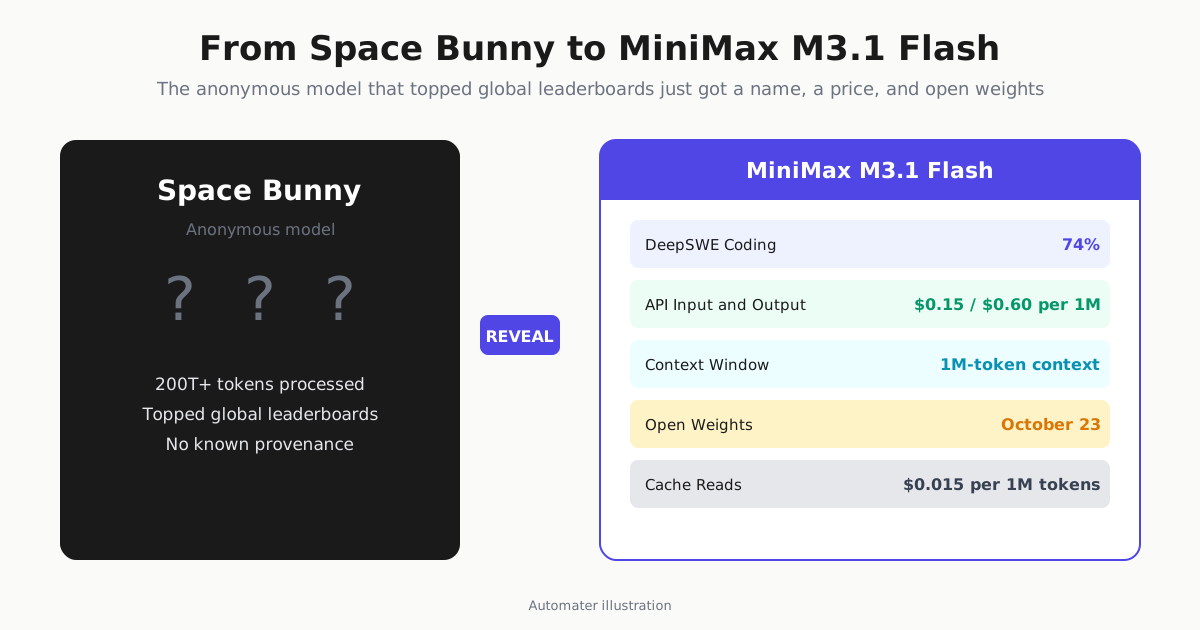
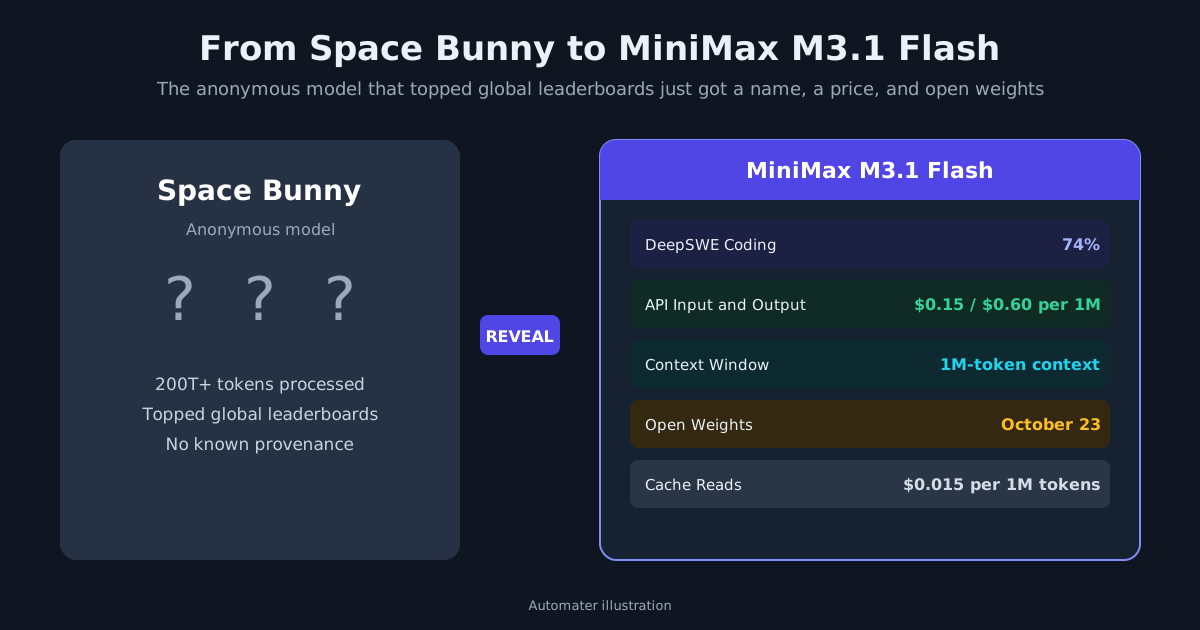
MiniMax officially confirmed today that its new M3.1 Flash model is the system that topped global leaderboards under the anonymous alias “Space Bunny.” The reveal ends one of the more entertaining mysteries in AI coding tooling — and gives agent operators a cheap, officially supported model with open weights arriving October 23.
What Space Bunny Already Proved
Before anyone knew who built it, Space Bunny processed more than 200 trillion tokens, topping global leaderboards while operators routed agent sessions to it. That organic adoption told the story before MiniMax said a word: coding-agent users found the model useful enough to route real work to it, repeatedly, without knowing its provenance or even its real name.
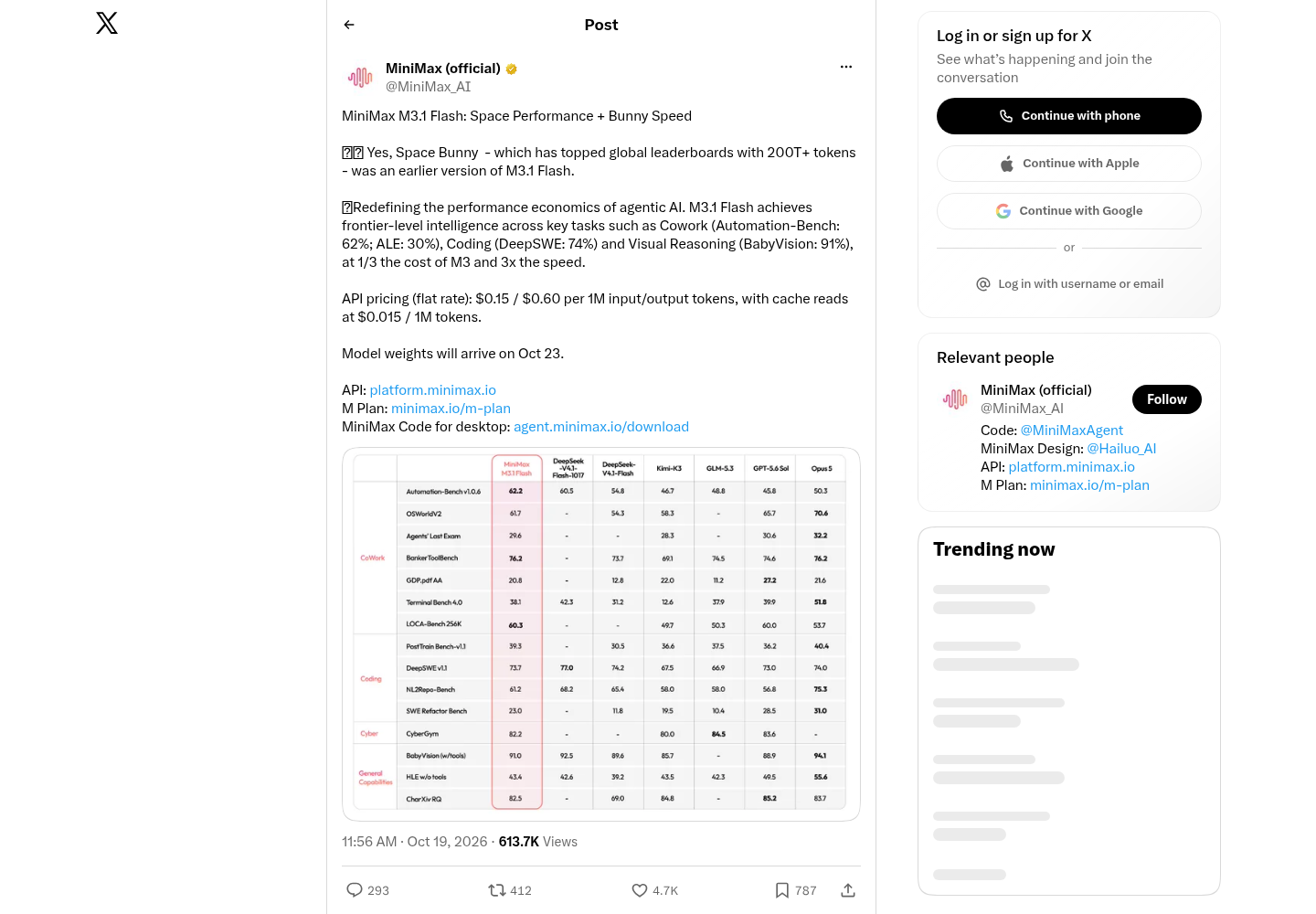
Now the provenance is settled and the numbers are public. MiniMax’s announcement lists 74 percent on DeepSWE, the benchmark that measures a model’s ability to resolve real GitHub issues end-to-end. For cowork and automation tasks, M3.1 Flash scores 62 percent on Automation-Bench and 30 percent on ALE. On BabyVision, a visual reasoning test, it hits 91 percent.
The platform documentation fills in the architecture details: a multimodal model with a 1-million-token context window and tunable thinking depth. That last feature is the one agent operators should pay closest attention to — it means you can dial reasoning effort up or down by task, paying for deep thought only when the job demands it.
Pricing: One-Third the Cost, Three Times the Speed
M3.1 Flash arrives at flat API pricing of $0.15 per million input tokens and $0.60 per million output tokens. Cache reads cost just $0.015 per million tokens. MiniMax positions this at roughly one-third the cost of its larger M3 model with triple the throughput.
At those rates, a coding session that consumes 100,000 input tokens and 50,000 output tokens — a realistic mid-sized refactoring task — costs about 4.5 cents in API fees. A heavier session with a million tokens of context and substantial output runs well under a dollar.
The model is available immediately through MiniMax’s platform API and through the M Plan subscription. MiniMax Code, the company’s desktop coding agent, also supports M3.1 Flash directly.
Weights Arrive Friday
Open weights land on October 23, four days after today’s API launch. MiniMax has an established track record of open releases through its Hugging Face organization, which already hosts the M3 family at up to 440 billion parameters, the H3 video generation models, and Music 3. The weights release means self-hosted deployment on local workstations or private cloud infrastructure, with no per-token API bill beyond your own compute.
This timing matters in a market where open-weight models now represent the majority of gateway traffic. The release follows other recent open-weight coding launches including Reflection Beam’s 501B-parameter model, pushing the cost floor for capable coding models down further and giving fleet operators a routing target with verified provenance — a meaningful upgrade from routing to an anonymous model you hope stays online.
What Operator Teams Should Do Now
Three features make M3.1 Flash immediately actionable for teams running coding agents.
First, tunable thinking depth turns the cost-performance tradeoff into a per-task decision. Route fast inference to boilerplate refactors and linter fixes, then reserve deeper reasoning for architecture changes and cross-file refactors. No more paying for frontier-level reasoning on a one-line import fix.
Second, the 1-million-token context window fits entire medium-sized codebases without chunking or retrieval. Combined with the low cache-read pricing, operators can keep project context resident across turns at near-zero cost.
Third, the October 23 weights release means you can run your own evals on your own hardware before committing production traffic. Benchmark it on your repos, your task mix, and your harness before the first API dollar lands.
The Space Bunny episode carries a broader lesson for the agent ecosystem: users will find and route to models that deliver results, whether or not the model carries a recognized brand. MiniMax has now given those users an official API endpoint, published transparent pricing, and committed to a weights release date. That turns a curiosity into infrastructure.
Sources
- MiniMax (official) on X: "MiniMax M3.1 Flash: Space Performance + Bunny Speed 🚀🐰 Yes, Space Bunny - which has topped global leaderboards with 200T+ tokens - was an earlier version of M3.1 Flash. 💰Redefining the performance economics of agentic AI. M3.1 Flash achieves frontier-level intelligen…
- Models - MiniMax API Docs
- MiniMaxAI (MiniMax)