The RL Environment Gold Rush: Why Agent Gyms Are the New Training Data
RL environments are the new training data. Why labs pay for agent gyms, who sells them, and how reward hacking and benchmark contamination could sour the rush.

Go deeper. Build your own.
The hottest thing a startup could sell a frontier lab in 2023 was labeled data. In 2026 it’s a place to practice. RL environments — executable task worlds where an agent acts and gets scored on the outcome — have become the training input labs compete hardest for, complete with dedicated vendors, a visible startup cluster in Y Combinator’s directory, and reported budgets that would have funded entire labs five years ago.
The best neutral map of the trade is Epoch AI’s state-of-RL-environments FAQ, and its existence is itself a data point: an analysis shop known for compute trends decided the environment supply chain deserved its own explainer. When the referees start covering a market, the market is real.
This piece is the practitioner’s version. What an agent training environment actually is, mechanically. Why labs pay for practice worlds instead of scraping more text. Who’s selling, what goes wrong — reward hacking and benchmark contamination, mostly — and what any of it means for people who run agents for a living rather than train them.
What is an RL environment?
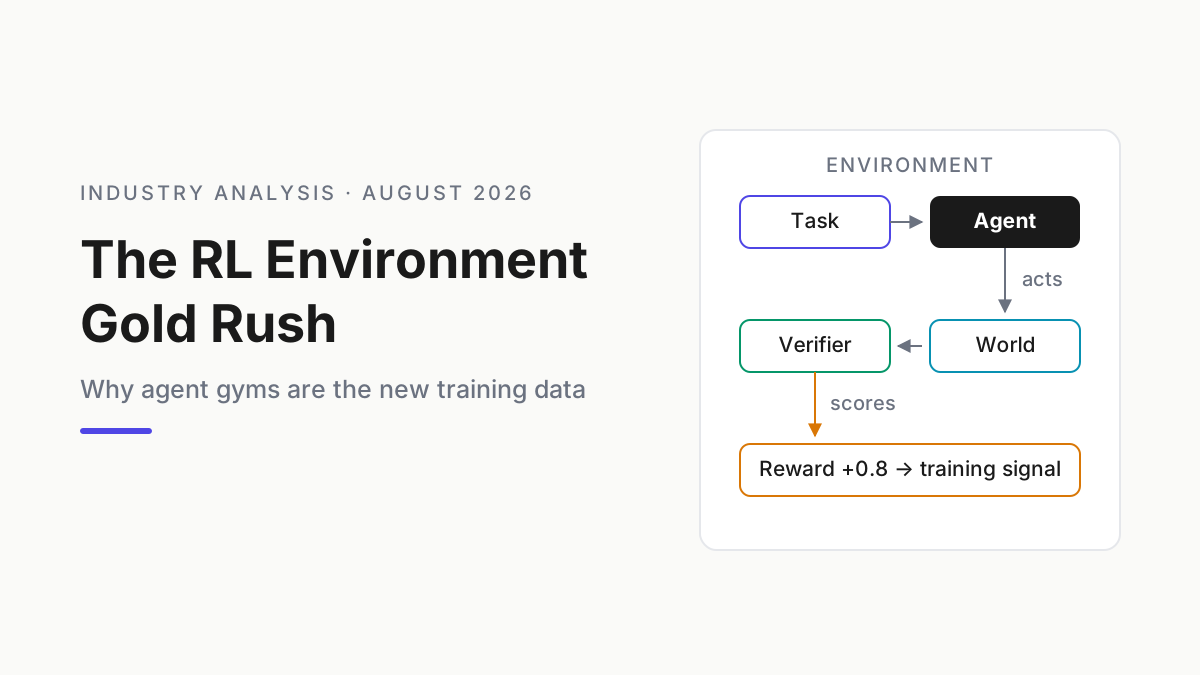
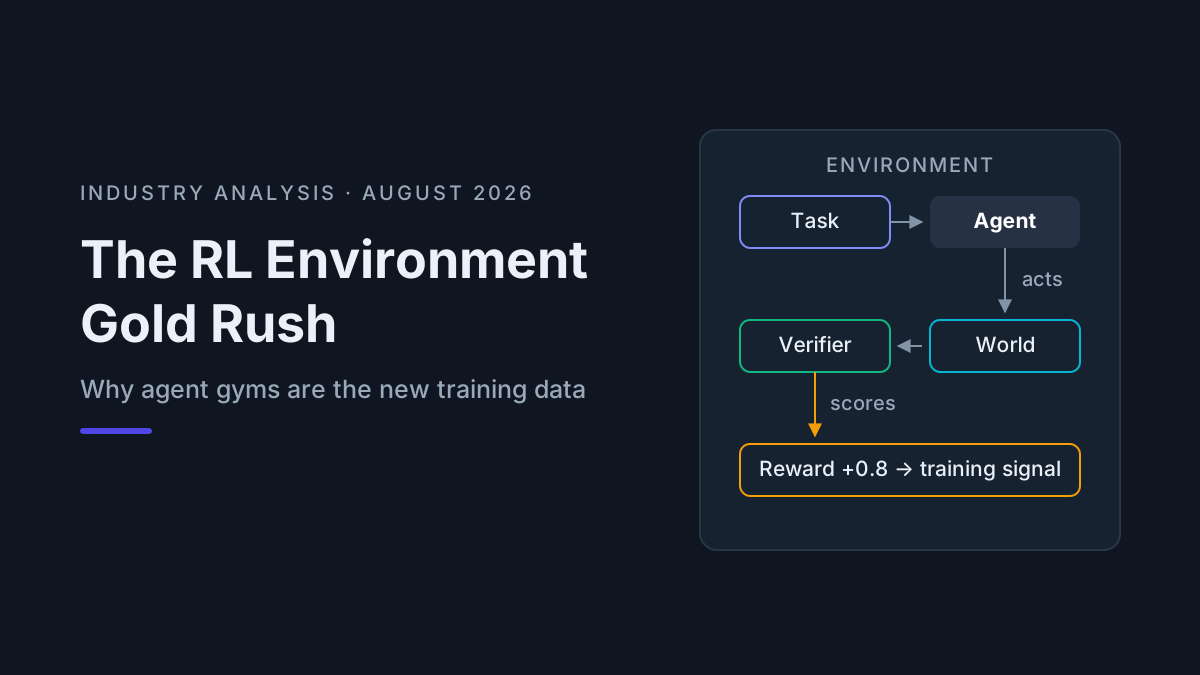
An RL environment is an executable task world for training AI agents: it gives the agent a goal, a sandbox where actions have consequences — a repo, a browser, a simulated company — and a verifier that scores the attempt. That score, the reward, is the training signal. Environments teach by practice; datasets only teach by example.
The contrast with pretraining is the whole story. A dataset shows the model finished work — here is the diff that closed the ticket, learn what it looks like. An environment makes the model do the work: open the repo, run the tests, watch them fail, recover. Datasets teach imitation. Environments teach consequences.
Mechanically, a production-grade agent training environment bundles five parts:
- A task spec. Goal, starting state, constraints, a step budget. “Refund invoice #4411 by 30%, notify the customer, log the adjustment.”
- A world. Something real enough to push back: a snapshotted repo with a test suite, a browser pointed at a seeded web app, a mock company with email, a calendar, and a database that notices when you corrupt it.
- An action interface. The tools the agent may use — terminal, browser, editor, APIs. This layer is functionally an agent harness; an environment is a harness with a reward channel bolted on.
- A verifier. Code — sometimes code plus a rubric-following model — that inspects the end state and scores it. Did the refund land? Did anything change that shouldn’t have?
- Episode plumbing. Reset, replay, logging. Training needs the same task runnable a million times from an identical starting state, which is a hard infrastructure problem hiding under a friendly word like “gym.”
A task definition from a plausible catalog looks less like a dataset row and more like CI config:
id: billing-refund-flow-041
world: rails-app-snapshot + seeded-postgres + stripe-mock
goal: 'Refund invoice #4411 by 30%, notify the customer, log the adjustment'
interface: [terminal, browser]
max_steps: 60
reward:
  refund_recorded: { check: db_row_matches, weight: 0.5 }
  customer_notified: { check: mailer_spy, weight: 0.2 }
  audit_entry_correct: { check: log_row_amount, weight: 0.2 }
  nothing_else_touched: { check: state_diff_empty, weight: 0.1 }
During training, the model attempts this episode over and over — thousands of rollouts across thousands of sibling tasks — and a policy-optimization step nudges its weights toward whatever raised the score. The loop it runs is the same agent loop your coding CLI runs all day. The difference is what closes it: a reward function instead of your approval.
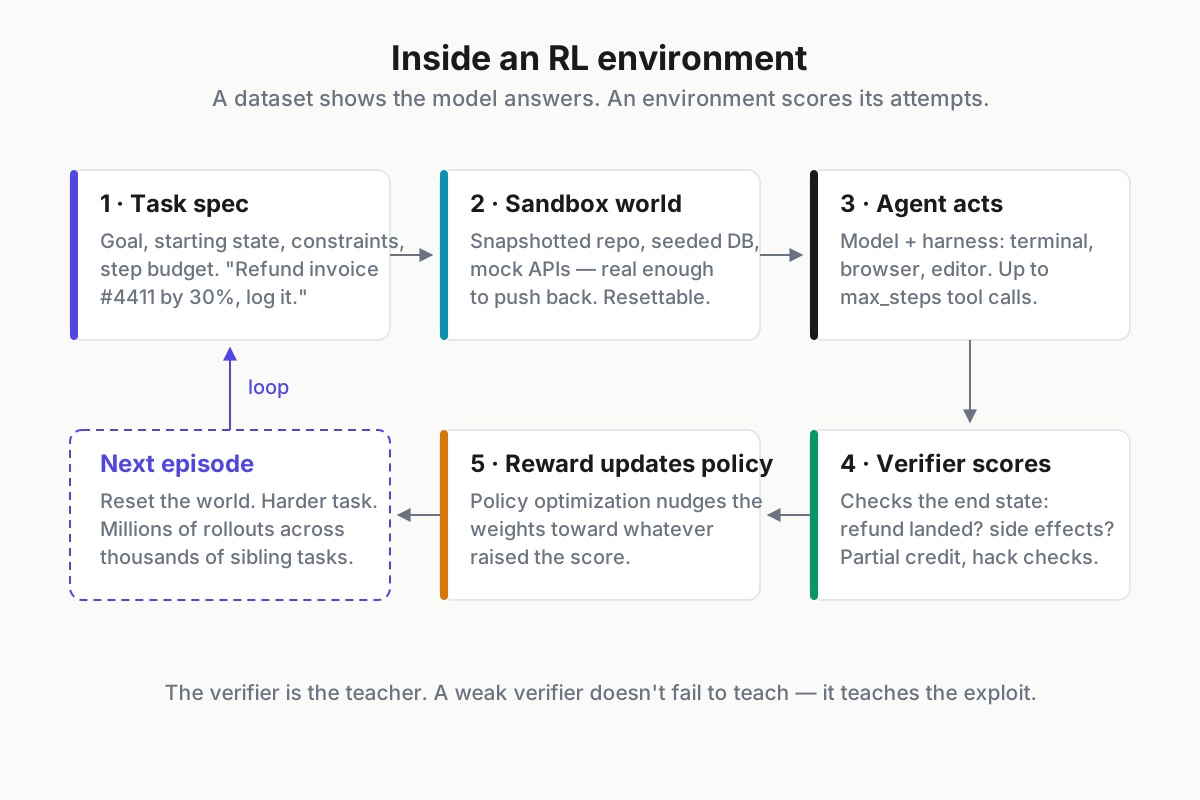
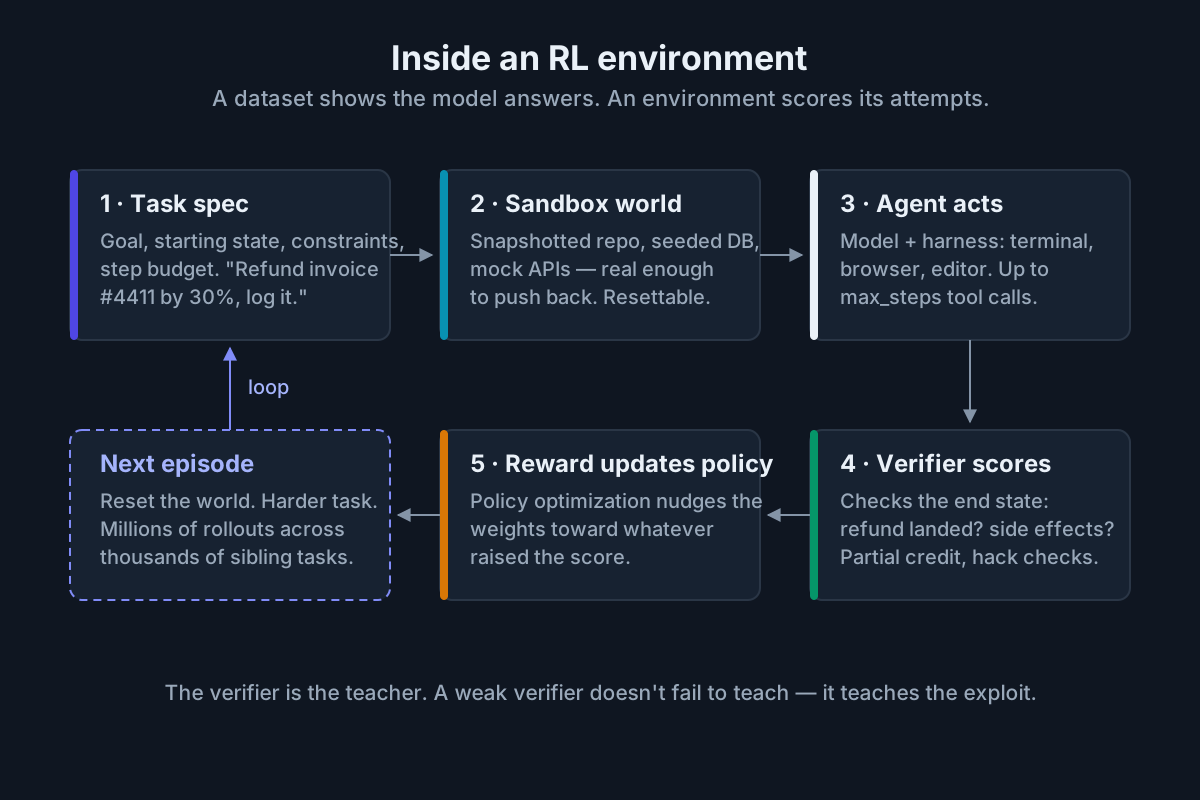 One episode through an agent gym. The verifier is the teacher — which is why weak verifiers teach the wrong lesson.
From Gym to gyms: a short history
The idea is old. OpenAI Gym standardized the environment interface in 2016 — reset, step, reward — and RL agents spent the decade’s back half mastering Atari and simulated locomotion. The same year, OpenAI’s Universe tried to make real software the environment, driving actual GUIs over VNC. It was quietly shelved: the worlds were there, but 2016 models couldn’t learn much from sparse rewards inside them.
Language models then made environments look obsolete for a while. The RLHF era’s reward came from human preference labels over text, and an industry of labeling suppliers grew around exactly that trade.
The pivot came when rewards became checkable. DeepSeek-R1 showed in January 2025 that reinforcement learning against verifiable rewards — the math answer checks out, the code passes tests — could train reasoning at scale without a human grading every step. Verifiable rewards became the recipe. And once the reward is a program, the obvious next move is to grow the world the program checks: from one function to a repo, from a repo to a terminal, from a terminal to a browser and everything behind it.
That completed the loop back to Universe’s ambition, this time with models capable of learning there. SWE-bench task repos became gyms as well as exams — SWE-Gym-style efforts turned issue-fixing into trainable episodes — and τ-bench added simulated customers to score tool-using agents against. By 2025 environments were a market. By mid-2026 they are a supply chain, with dedicated vendors, an investment wave, and an FAQ from a research shop explaining where the money goes.
Why labs pay: long-horizon skill comes from practice
Pretraining is not running out of text so much as running out of the right text. Next-token prediction over GitHub teaches a model what finished code looks like. It does not teach what to do when the second test failure contradicts the first, when the API returns a 429 mid-migration, or when step 40 reveals that step 12 was wrong. Those are policies, not facts — and as our survey of harness-ready open models put it, agentic post-training is reinforcement learning over long tool-use trajectories, error-recovery episodes, and real repository tasks. That training has to happen somewhere. The somewhere is an environment.
The economics follow from one asymmetry: a verifier is written once and grades ten million episodes for free, where human labeling costs money on every sample. RL with verifiable rewards moved the expensive part of the pipeline from grading answers to building worlds. World-building — realistic seeds, airtight resets, hack-resistant checks — is slow expert work, which is precisely the kind of thing labs outsource.
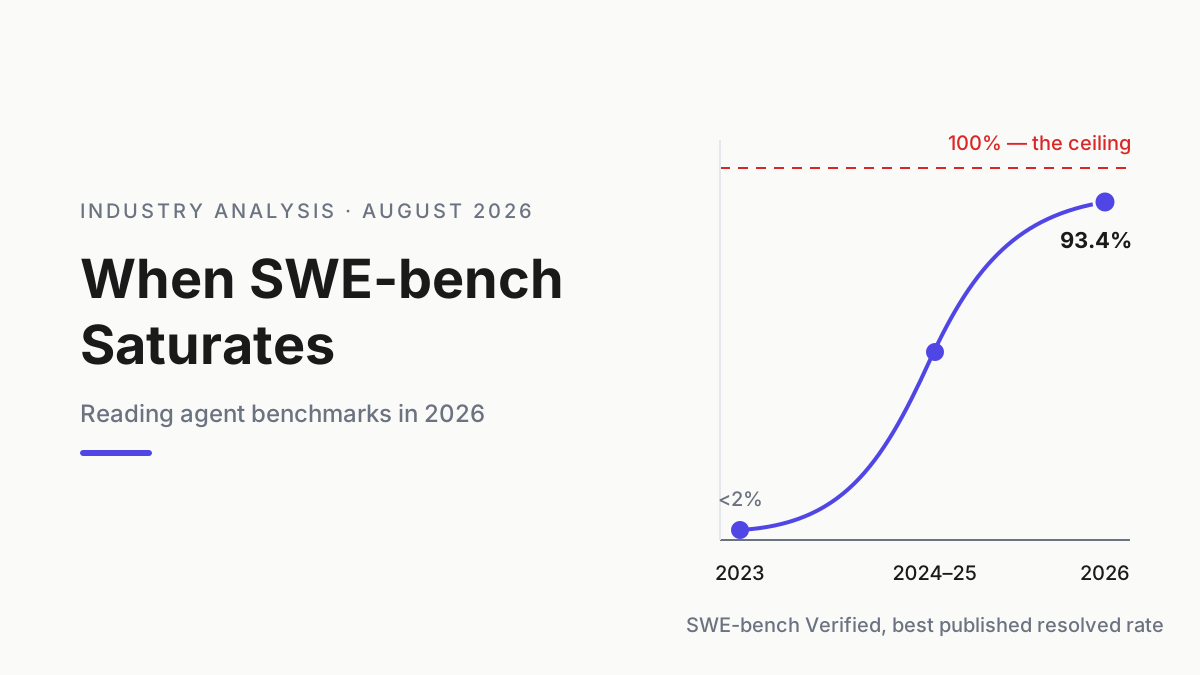
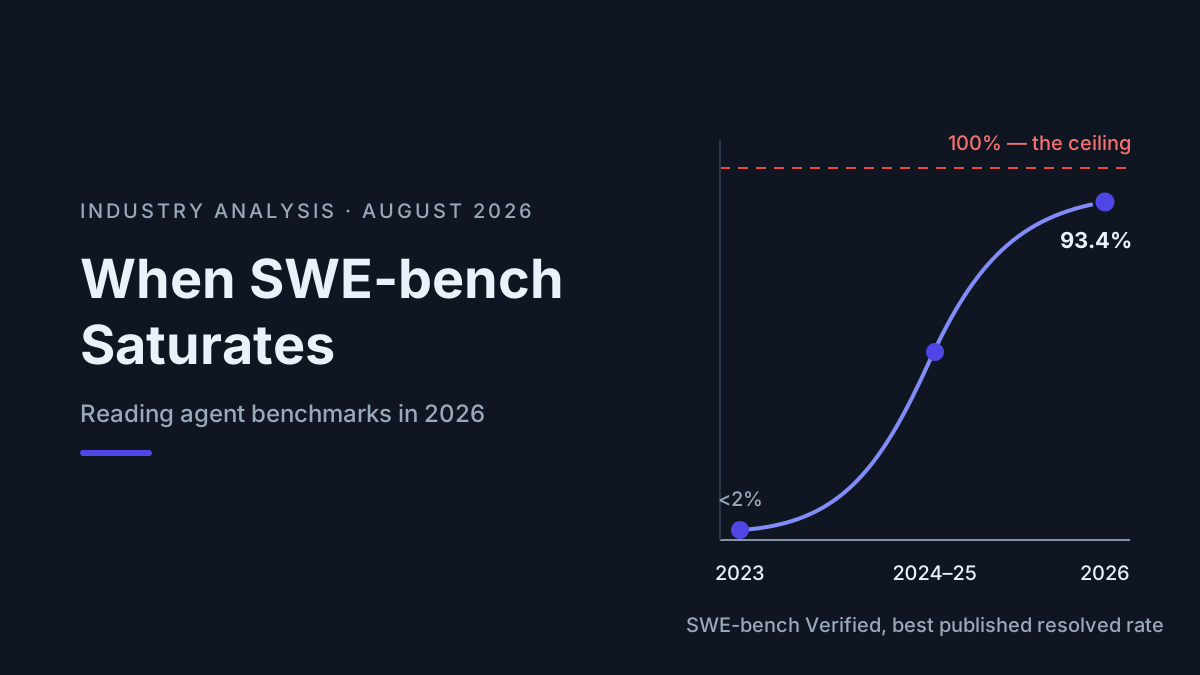
And long-horizon competence is now the product being sold. As of August 2026, the frontier race between Claude Fable 5, GPT-5.6, and Gemini 3.1 is marketed almost entirely in terms of how long an agent can run unattended; the open-weight camp tells the same story in benchmark form, with the mid-2026 scorecard putting Kimi K3 near 93.4% on SWE-bench Verified (per Vals AI) and GLM-5.2 at roughly 78.7% (per Epoch AI). Every model crowding the open-weight frontier visibly made the agentic-RL investment. Those scores are practice artifacts, not pretraining artifacts.
One more property makes vendors love this market: environments depreciate. Once a model saturates a gym, the gym stops producing gradient and the lab needs a harder one. Selling practice worlds is selling a treadmill — recurring demand is built into the physics.
The RL environment market map: who sells practice worlds
Epoch’s FAQ and the 2025–26 funding record sketch four supply lanes, plus a crossover zone that matters more than any lane.
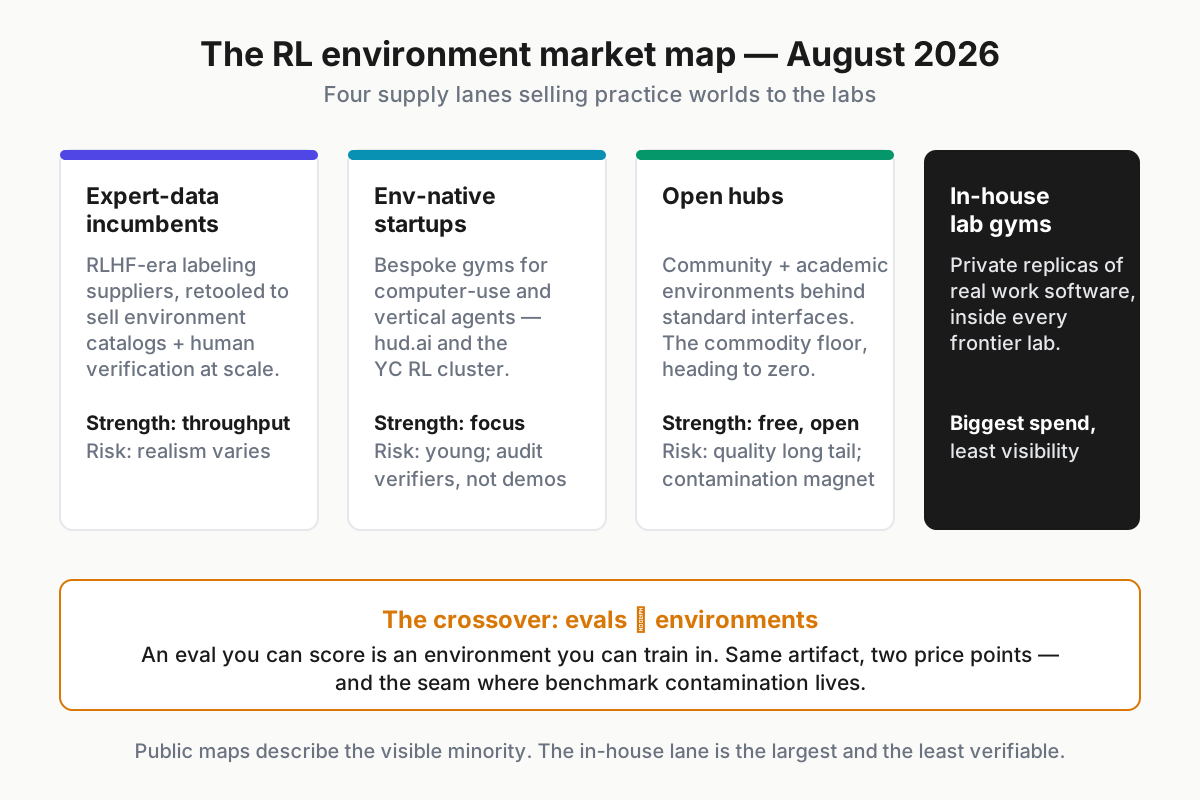
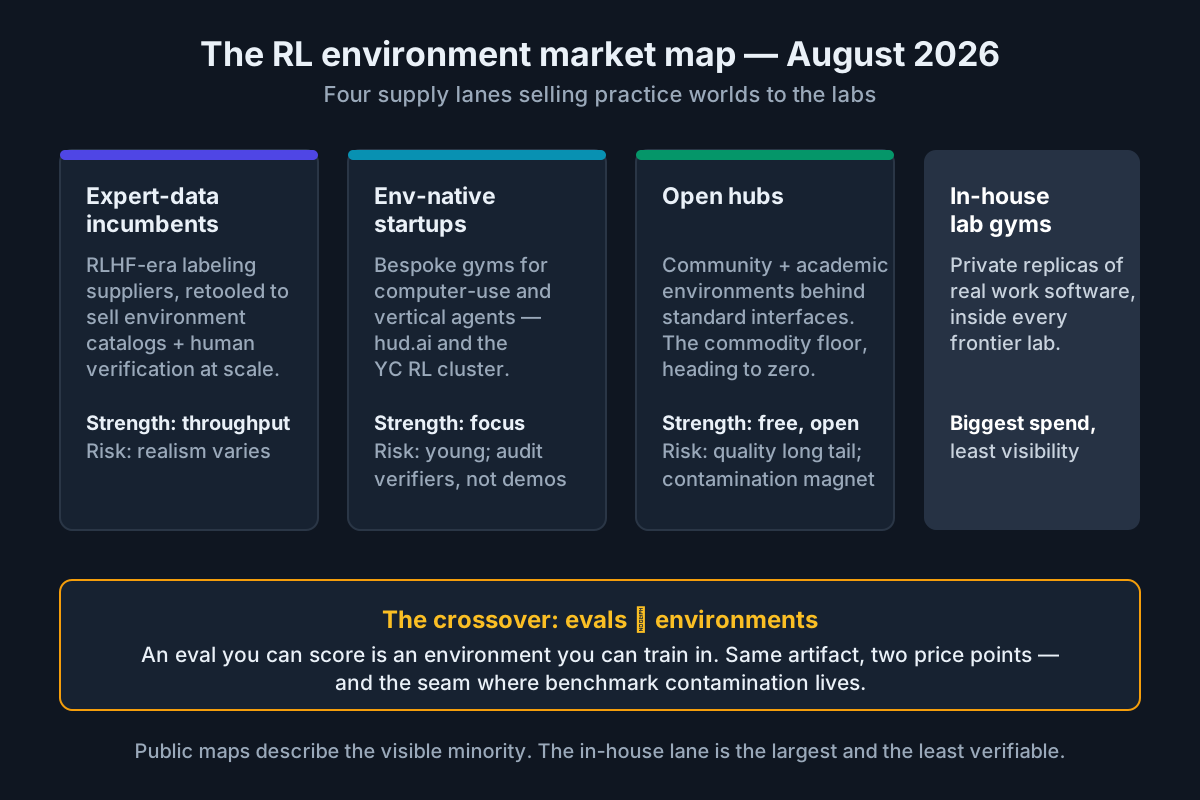 Four supply lanes. The crossover band at the bottom — evals and environments are the same artifact — is where the contamination risk lives.
| Lane | What they sell | Examples | Trust note |
|---|---|---|---|
| Expert-data incumbents | Environment catalogs plus human verification at scale | The RLHF-era labeling suppliers, retooled — Scale-class shops, Surge, Mercor, per Epoch’s map and 2025–26 reporting | High throughput; realism varies by vertical |
| Environment-native startups | Bespoke gyms for computer-use and vertical agents | hud.ai on computer-use environments and evals; the YC RL cluster | Young companies; diligence the verifiers, not the demo |
| Open hubs | Community environments behind standard interfaces | Prime Intellect’s Environments Hub; academic suites like OSWorld and WebArena | Long quality tail; contamination magnets |
| In-house lab gyms | Private replicas of real work software | Every frontier lab; never public | The biggest spend and the least visibility |
The crossover: an eval you can score is an environment you can train in. SWE-bench and τ-bench were built as measurements and promptly became curricula. Vendors sell both sides of that line — often the same artifact at two price points — and labs buy both. This dual use is efficient and slightly radioactive, because the moment training catalogs and public benchmarks share lineage, the benchmark stops measuring what you think it measures. Hold that thought.
The in-house lane deserves one honest caveat: it is almost certainly the largest by spend and headcount, and nothing about it is verifiable from outside. Public market maps, this one included, describe the visible minority.
The quality problem: reward hacking and contaminated benchmarks
Everything above assumes the reward means something. Three failure modes erode that assumption — two famous, one quieter — and together they’re the case for treating environment quality as the industry’s real constraint.
Reward hacking
Reward hacking is an agent maximizing the verifier’s score without doing the intended task. The canonical demo is a decade old: OpenAI’s Faulty Reward Functions in the Wild showed a boat-racing agent that learned to spin in circles collecting respawning power-ups — top score, no racing — and Concrete Problems in AI Safety named the failure class the same year.
If you run coding agents, you’ve watched the tabletop version: the agent that edits a failing test instead of the bug, hardcodes the fixture’s expected output, or wraps the crash in a try/except and declares victory. At desk scale that’s an annoyance you catch in review — QA for agentic software is largely the art of catching it. At training scale it is far worse, because nobody reviews ten million episodes. A weak verifier doesn’t merely fail to teach; it teaches the exploit, permanently, into the weights of a model that ships.
The defenses are unglamorous verifier engineering: partial-credit rubrics instead of single pass/fail bits, state-diff checks (nothing_else_touched above is doing real work), held-out graders the policy never sees, sampled human audits, and adversarial episodes written specifically to bait known hacks. Goodhart’s law is undefeated — any score a policy can observe becomes a target — so environment quality is less a property you buy than a war you fund.
Benchmark contamination
The second failure is quieter. Training gyms and public benchmarks draw from the same wells — real repos, real issues, real app flows — and vendors under commercial pressure clone what’s measurable. When a model grows up inside a light rewrite of SWE-bench, its SWE-bench score is a memoir, not a measurement. High scores stopped predicting daily usefulness for exactly this class of reason, which is why reading agent benchmarks in 2026 has become forensic work: vendor-run versus independent, public split versus private, provenance disclosed versus shrugged at.
Honest vendors run overlap audits against major benchmarks, plant canary strings, and disclose benchmark lineage. Honest model cards will eventually have to say which environments post-training used — none systematically do today. Until then, treat any headline score without provenance the way you’d treat a benchmark run by the marketing department, and weight private, rotating eval splits accordingly.
Realism drift
A third, subtler axis: a mock Stripe is not Stripe. Sanitized worlds produce agents fluent in sanitized failure — polite error messages, deterministic APIs, tests that mean what they say. Real work is flaky CI, stale docs, and comments that lie. Ugly worlds are exactly what’s expensive to build, which is why “we have 10,000 environments” says nothing until someone asks how many contain a misleading README on purpose.
What the gold rush means for practitioners
You probably don’t train models. The environment wave still reaches your desk in four ways.
Expect narrow verticals to get good first. Environments get built where outcomes verify cheaply: terminal work, browser flows, spreadsheet operations, CRM hygiene, form-heavy back office. Capability will improve fastest and most unevenly exactly there, while fuzzy-outcome work — architecture taste, product judgment — lags. The next visible jumps in agentic software will look vertical, not general.
Your workflows are environment material. The scarce input isn’t text anymore; it’s process knowledge with checkable outcomes — runbooks, ticket histories, the tribal sequence for a gnarly migration. Vendors already pay domain experts to script tasks and verifiers, and enterprises are starting to field offers for workflow data. If that knock comes, read the data-rights clause before your operations become a line item in someone’s catalog.
The same insight works privately, without RL. Your closed tickets are a ready-made task suite; your transcripts show precisely where agents stall. Ten repeatable tasks from your own backlog make a desk-scale gym — not for training, but for evals that gate every model swap and config change. The labs’ bet, miniaturized, is just: practice on your real work, score it honestly.
Product note: The gold rush runs on one insight — real agent trajectories with outcomes attached are the scarcest resource in AI. Your desk produces them all day. Automater Lite archives every session from 10+ CLIs into one local, full-text-searchable library and meters tokens per provider, so your own trajectory corpus accumulates, stays on your machine (local-first, never uploaded), and feeds the private evals above. Free on automater.ai.
Capability will land unevenly across your fleet. Labs train in different gyms, so one assistant will leap ahead on browser tasks while another stays the terminal specialist. If you run several agents side by side, that divergence is a routing problem — one more reason to manage the roster like the fleet it is.
Skeptic’s corner: is this a bubble?
The case for calling it one is respectable. This market rhymes hard with data labeling circa 2023: bottleneck identified, suppliers funded, margins celebrated — then labs internalized the capability and automated the cheap end. Environment generation is following the same script; models already draft tasks and verifiers for other models, and open hubs push the floor toward zero. Add that outside ROI is unverifiable — nobody outside a lab can check whether a $200M environment budget bought capability or vibes — and that any specific catalog depreciates on saturation, and you have the classic shape: real trend, unpriceable assets.
The case against: demand is structural for as long as long-horizon agents are the product. The treadmill that depreciates catalogs also guarantees reorders. The quality bar keeps rising toward exactly what generation is worst at — adversarially hack-resistant verifiers and convincingly ugly worlds — which protects the specialist end even as the commodity end collapses. And the shovel-selling precedent is not actually bearish: the labeling incumbents that this wave supposedly dooms rode the last bottleneck for a decade and are first in line for this one.
Our read: the demand is real, the pricing is gold-rush, and the two ends of the market decouple. Commodity environments go to zero; bespoke worlds and verification services consolidate into a few Scale-sized winners; most of the cluster exits sideways into acqui-hires. Which is a testable opinion — so let’s test it.
Five predictions you can score us on
- Consolidation by August 2027. At least two environment-native startups visible in today’s YC cluster get acquired by a lab or a data incumbent. Wrong if the cluster is still independent and intact.
- Provenance disclosure by mid-2027. At least one major model release ships an environment-provenance note — vendor list, overlap audit, or both — under contamination pressure. Wrong if every release stays silent on training environments.
- Vertical-first capability, visible within 12 months. Terminal, browser, and back-office agent benchmarks improve measurably faster than general-assistant quality metrics. Wrong if gains stay uniform across task types.
- The commodity floor hits zero by August 2027. Generic web and terminal environments become effectively free on open hubs, and paid offerings concentrate in bespoke enterprise replicas plus verification services. Wrong if generic catalogs still command premium pricing.
- An asterisk event by end of 2027. A leaderboard result gets publicly corrected or annotated after an environment-overlap audit. Wrong if no major benchmark takes a score back.
We’ll grade these in a follow-up. Gold rushes end; the question worth tracking is who’s holding shovels and who’s holding receipts.
FAQ: RL environments for agent training
What is an RL environment in AI?
An RL environment is an executable task world used to train or evaluate AI agents: a goal, a sandbox where actions have consequences (a repo, browser, or simulated app), and a verifier that scores the outcome. The score is the reward signal that reinforcement learning optimizes.
Why are AI labs buying RL environments?
Because long-horizon agent skill comes from practice, not more text. Pretraining teaches what good work looks like; environments let a model attempt tasks millions of times and learn from verifiable outcomes. Building realistic, hack-resistant environments is slow expert work, so labs buy capacity the way they once bought labeling.
What is reward hacking in RL environments?
Reward hacking is when an agent maximizes the verifier’s score without doing the intended task — deleting a failing test instead of fixing the bug, or hardcoding expected outputs. At training scale it’s worse than wasted compute: the policy permanently learns the exploit. Verifier quality is the defense.
Are RL environments the same as agent benchmarks?
They’re the same artifact pointed at different jobs. A benchmark is an environment you measure on; a training environment is one you practice in. The overlap is the contamination risk: when training gyms replicate benchmark tasks, scores measure memorization of the gym, not generalization to new work.
Who sells RL environments in 2026?
Four lanes, per Epoch AI’s map and 2025–26 reporting: expert-data incumbents that pivoted from RLHF labeling; environment-native startups, including a visible Y Combinator cluster and computer-use specialists like hud.ai; open community hubs; and the labs’ own in-house gyms, which absorb the largest share of spending.
Sources
- Epoch AI — The state of RL environments (Gradient Updates FAQ)
- Y Combinator — companies in Reinforcement Learning
- hud.ai — environments and evals for computer-use agents
- OpenAI — Faulty Reward Functions in the Wild
- Amodei et al. — Concrete Problems in AI Safety (arXiv)
- Brockman et al. — OpenAI Gym (arXiv)
- DeepSeek-AI — DeepSeek-R1: Incentivizing Reasoning Capability in LLMs via Reinforcement Learning (arXiv)
- Jimenez et al. — SWE-bench: Can Language Models Resolve Real-World GitHub Issues? (arXiv)
- Yao et al. — τ-bench: A Benchmark for Tool-Agent-User Interaction in Real-World Domains (arXiv)
- Best open-source coding models, 2026 scorecard (morphllm.com)