Inception Ships Mercury 3: A Diffusion LLM Claiming Frontier-Parity Quality at 1,068 Tokens per Second
Inception's Mercury 3 diffusion LLM claims frontier-parity quality at 1,068 tokens per second and $0.20 per million input tokens. What agent builders should test first.
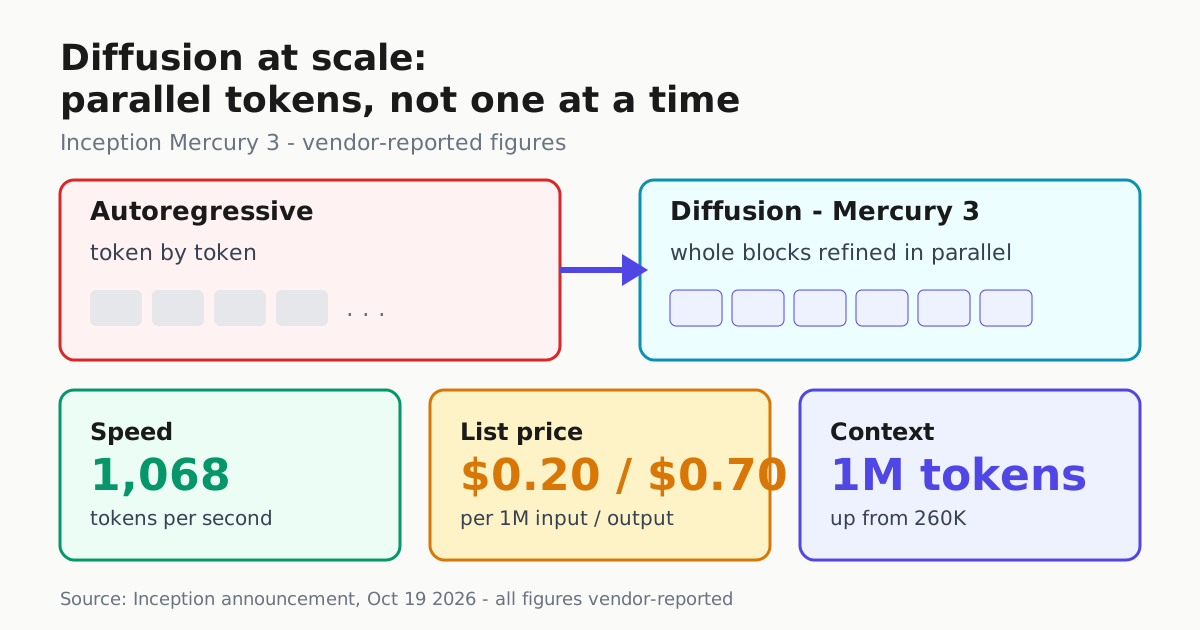
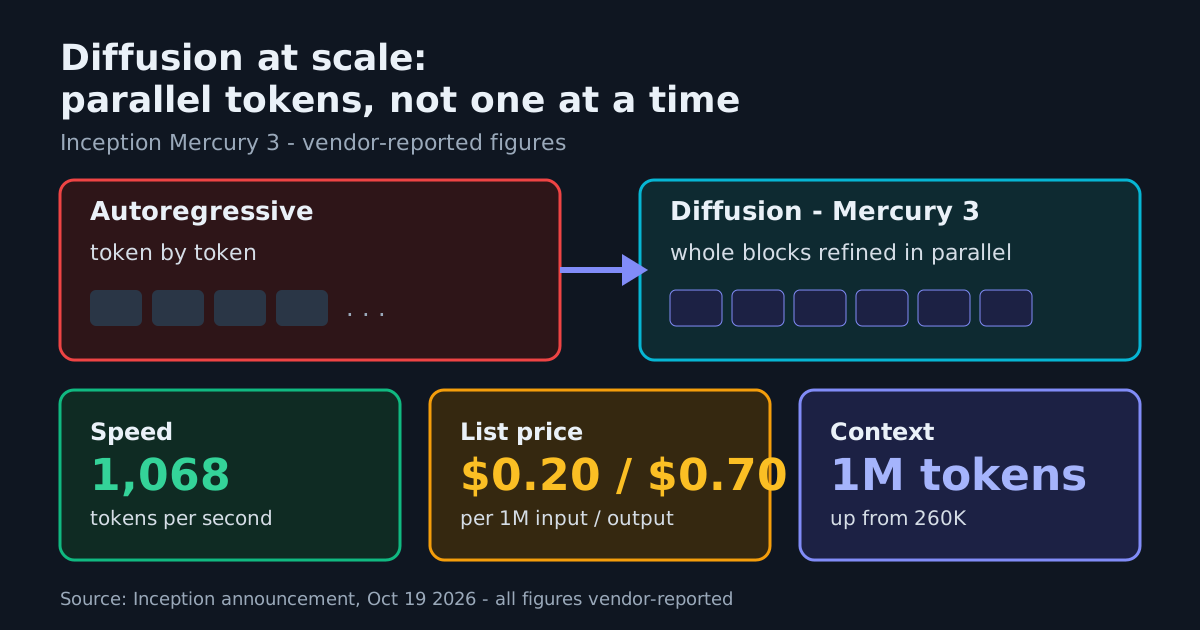
Inception has shipped Mercury 3, a diffusion-based large language model the company describes as the most capable dLLM released to date — and the strongest commercial evidence yet that text diffusion scales as an alternative to autoregressive generation. The pitch to agent builders is simple: frontier-adjacent quality at 1,068 tokens per second, for pocket-change pricing.
The headline numbers
Per Inception’s announcement, Mercury 3 is more than 40x larger than Mercury 1 and claims quality “on par or better” than speed-optimized frontier models GPT-6 Luna and Claude Haiku 5.5 while running 4–8x faster. The at-a-glance sheet:
| Metric | Mercury 3 | Notes |
|---|---|---|
| Speed | 1,068 tokens/sec | Vendor-reported, NVIDIA GPUs |
| Context | 1M tokens | Up from 260K in Mercury 2.5 |
| List price | $0.20 in / $0.70 out per 1M | 50% off at launch |
| Cached input | 90% off input price | Matters for long-horizon agents |
That pricing puts Mercury 3 in the same bracket as budget coding models rather than frontier ones — and the cached-input discount is the line item that matters most for agents that re-read the same large context every step.
Why diffusion changes the agent math
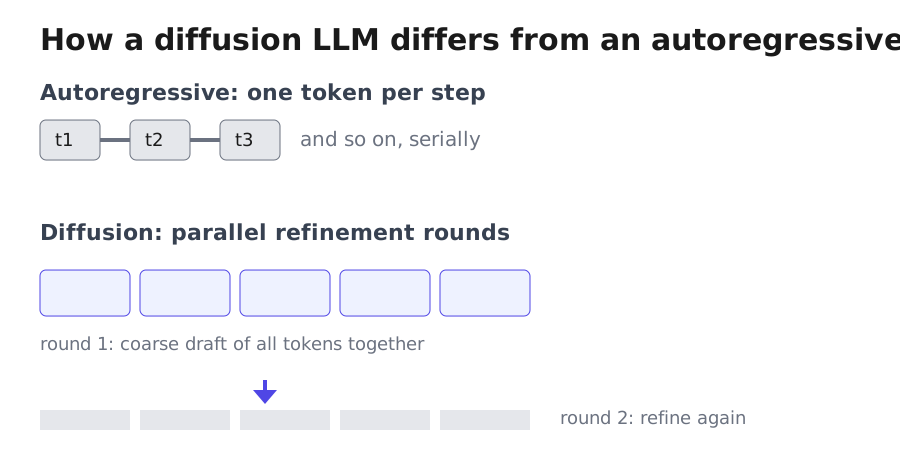
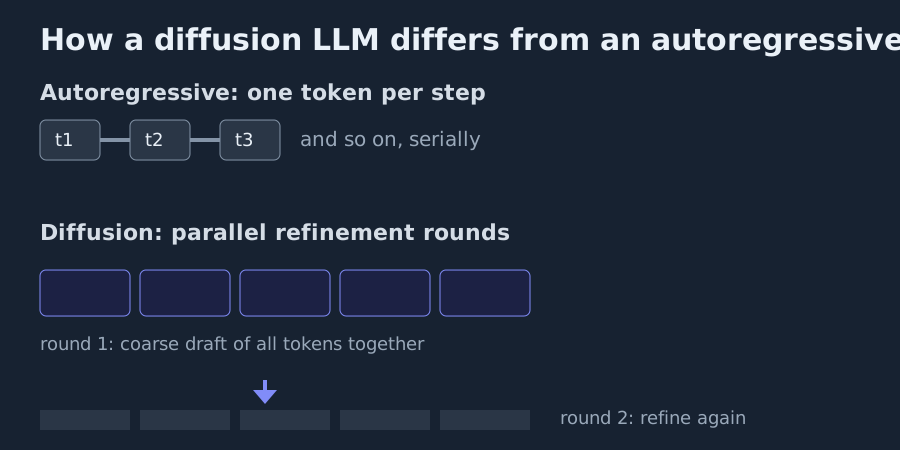
Autoregressive models emit one token at a time; diffusion models refine whole blocks of text in parallel. Inception’s site frames the practical consequences as sub-300ms time to first token, 5–7x throughput and up to 70% lower cost per task. For latency-bound lanes — voice, browser agents, interactive tutoring, real-time search — those are the numbers that decide whether a product feels responsive, not benchmark leaderboard positions.
The most concrete shipped agentic evidence is a partner result: in Inception’s launch post, Shuhao Zhang, cofounder of early-access partner TinyFish AI, reports running Mercury 3 in TinyFish’s own production web-agent harness on 50 live Mind2Web navigation tasks, where it completed 50% — significantly more than GPT-6.1-Sol, using similar token volume and step counts at a fraction of the per-token cost. Other early-access partners report median generation of 0.9s on smart-glasses search (Octen AI), roughly one-second hint turnaround in tutoring (RevisionDojo), and latency-plus-eval wins in regulated support (Lorikeet). All of these are vendor-published partner claims — treat them as directional, not verified.
What you can do today
- Drop it into an existing stack. Mercury 3 is OpenAI API compatible and available on the Inception platform plus OpenRouter, Baseten and Vercel — a base-URL swap, not a rewrite. Inception is also offering 100 million free trial tokens.
- Assign it a latency-bound lane. Voice loops, browser-use steps and interactive feedback are the fits Inception documents. Keep a frontier model on the deep-reasoning lane; this is a fast-worker model, and the swap should follow a fast-worker lane contract — test it like any lane change before the fleet depends on it.
- Budget the cache discount. At 90% off cached input, a 1M-token-context agent that re-sends a stable system prompt and tool definitions every call sees a very different effective bill than the list price suggests.
- Price per completed task, not per token. A cheap model that retries or stalls can cost more per finished job than an expensive one that lands it — the same lesson as cost per completed task versus token price. Run the workload, count completed tasks.
The caveats
Every quality claim here — frontier parity, the TinyFish Mind2Web result, partner testimonials — originates from Inception’s own launch post and its partners; there is no independent benchmark data yet, and “on par or better” is doing a lot of work without published eval tables. The 1,068 tokens/sec figure is vendor-measured on unspecified NVIDIA hardware. Diffusion models also have a different failure texture than autoregressive ones; schema adherence and structured-output behavior should be contract-tested on your own workload before a fleet depends on them. For context on where the credible speed-and-quality contenders now sit, see the open-weight scorecard for 2026.
The strategic signal, though, is real regardless of benchmark truth: Mercury 3 is roughly 40x larger than Mercury 1 with claimed 3x intelligence gain, which if independently confirmed says diffusion inherits the scaling behavior that carried autoregressive models. That makes Mercury 3 less a frontier challenger than a new fast lane with frontier-adjacent claims — and a reason to benchmark it against your current speed tier this week.