
EmbeddingGemma 2: Google DeepMind's Open Multimodal Embedder Runs on a Phone
Google DeepMind's EmbeddingGemma 2 maps text, code, images, audio, and video into one 740M-parameter Apache 2.0 embedding space that runs on a phone. What shipped, what is still promised, and why open weights matter for vector stores.
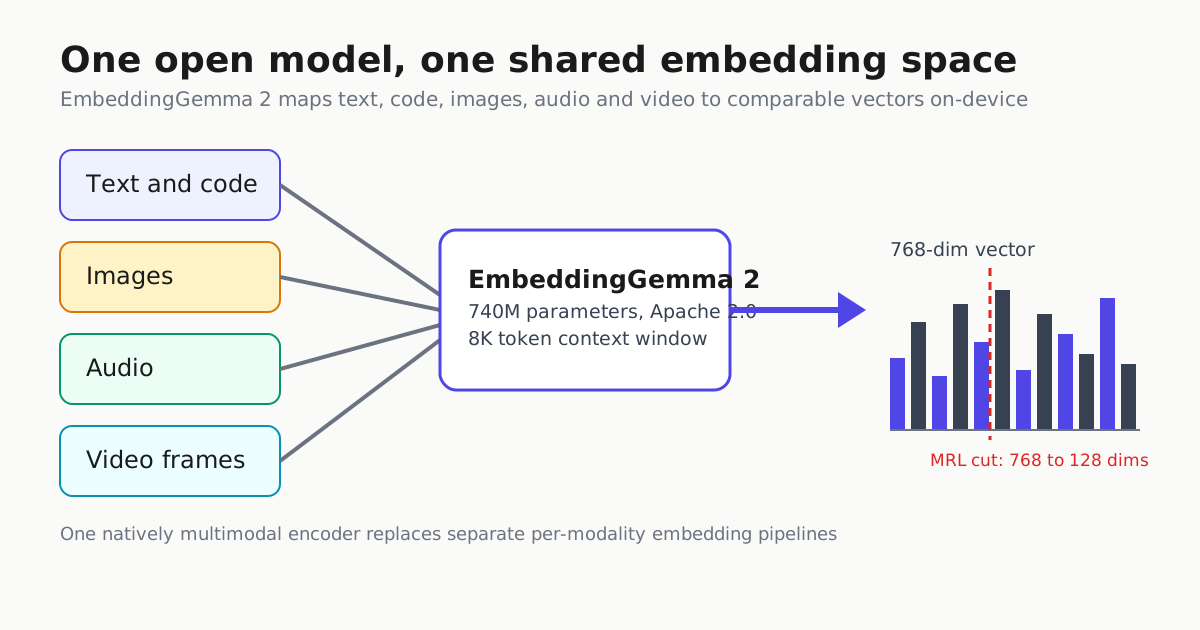
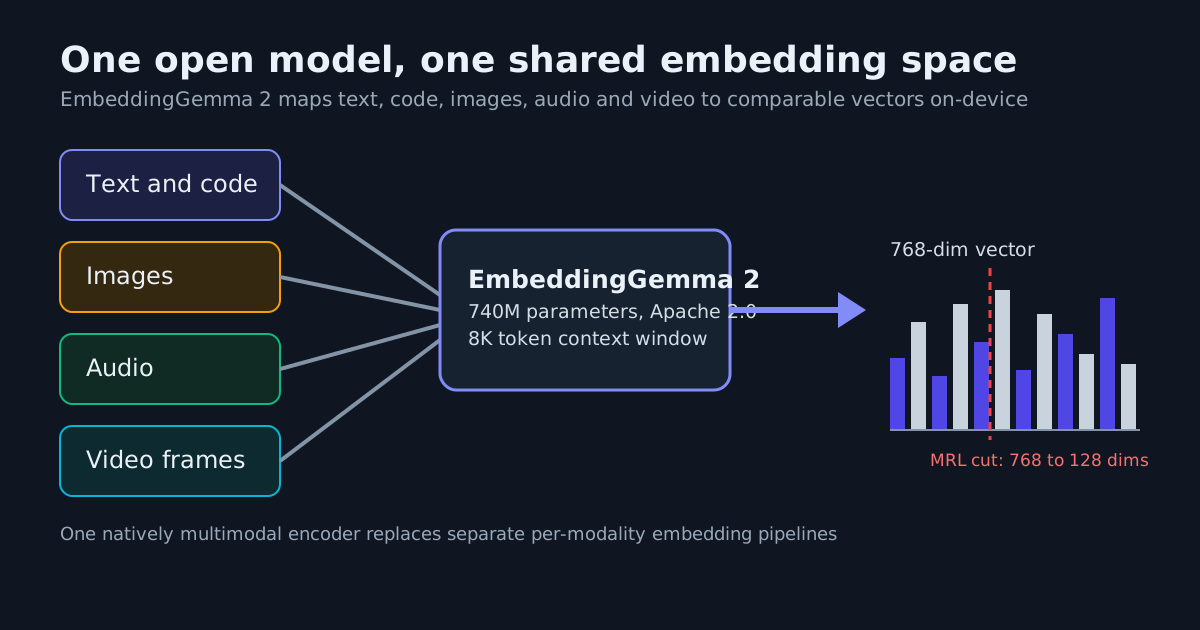
Google DeepMind has released EmbeddingGemma 2, an open-weights embedding model that maps text, code, images, audio, and video into one shared vector space — and it is small enough to run on consumer hardware. Announced October 6 by research engineers Sahil Dua and Henrique Schechter Vera, the model is built on the Gemma 4 architecture, tops out at 740 million parameters, and ships under a commercially permissive Apache 2.0 license. The weights are already downloadable from Hugging Face and Kaggle, while Gemini Enterprise Agent Platform Model Garden availability is listed as “coming soon” — a gap worth noting before you wire the model into a production retrieval stack.
From text-only embedder to one shared space
EmbeddingGemma arrived last year as a lightweight option for high-quality text embeddings, and Google says it has since passed 20 million downloads, powering on-device search tools and privacy-first retrieval-augmented generation (RAG) pipelines. Version 2 extends the idea beyond text: one natively multimodal model that can find a specific video clip from a voice memo, or search hours of recorded audio from a text query, without running a separate encoder per modality. Because it is built from the same technology as Google’s Gemini Embedding models and shares Gemma 4’s text tokenizer and audio encoder, DeepMind says it can run alongside Gemma 4 in a single on-device pipeline with a lower combined memory footprint.
The numbers that matter
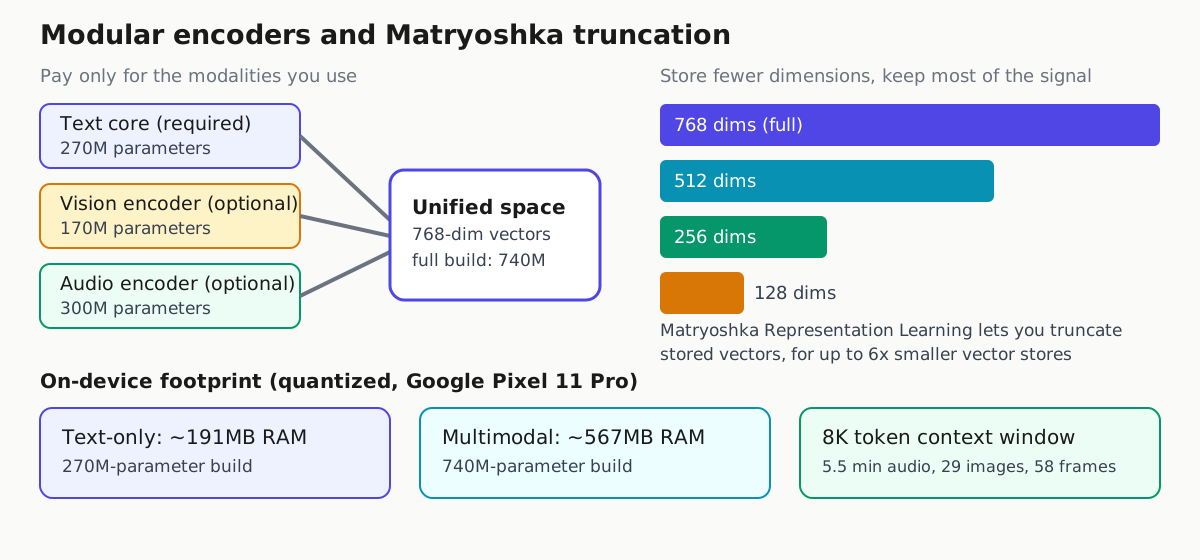
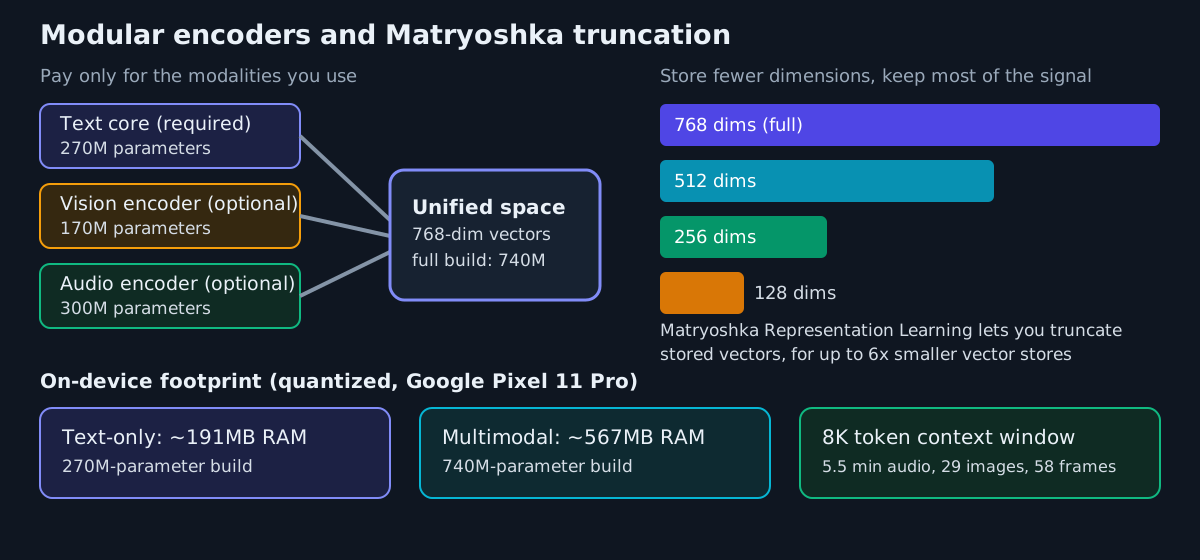
The full build is 740 million parameters, but the architecture is modular: text-only workloads need as little as 270 million, with optional vision (170M) and audio (300M) encoders you can leave out entirely.
| Property | Value |
|---|---|
| Full model size | 740M parameters |
| Text-only configuration | 270M parameters |
| Optional vision encoder | 170M parameters |
| Optional audio encoder | 300M parameters |
| Output dimensions | 768, truncatable to 512 / 256 / 128 |
| Storage savings | Up to 6x via Matryoshka truncation |
| Context window | 8K tokens (4x EmbeddingGemma 1) |
| One-pass capacity | 5.5 minutes audio, 29 images, or 58 video frames |
| Quantized RAM on Pixel 11 Pro | ~191MB text-only; ~567MB multimodal |
| License | Apache 2.0 |
The storage story is the quietly important one. Using Matryoshka Representation Learning (MRL), developers can truncate the 768-dimensional output vector to 512, 256, or 128 dimensions, which DeepMind says yields up to a 6x reduction in vector-database size and memory use. For local-first apps that keep a retrieval index on disk — a pattern we cover in our local-first AI guide — that is often the difference between a vector store that fits on a phone and one that does not.
On quality, DeepMind reports a 9.92-point jump on MTEB Code, from 68.76 to 78.68, positioning the model for local codebase indexing, semantic code search, and coding-agent retrieval. The company claims leading scores among sub-1B multimodal embedders on benchmarks including MTEB Code and MAEB, and says it matches or outperforms some models more than twice its size across text, vision, and audio tasks. These are vendor-reported figures; the model card is where to verify them before betting a production index on the results.
Why the license matters more than usual
For most model categories an open license is a nice-to-have. For embedding models, Simon Willison argues, it approaches a requirement. Embedding applications typically compute thousands or millions of vectors and store them for later comparison. If the vendor of a proprietary embedder retires that model, switching is not free: every stored vector must be recomputed with the replacement, at real cost. OpenAI once offered to cover re-embedding costs during a 2024 model transition, but that is not something to rely on from every provider. Willison’s posture is pragmatic rather than ideological — pay for a hosted model, but keep the option to run the open weights yourself, or move to another vendor, if hosting disappears.
The Hacker News discussion of his comment adds a practical nuance for migrations: embeddings are compared by distance in vector space, not bit-exact equality, so small differences between CPU and GPU runs, or re-encoding a PNG as JPEG, are usually acceptable. What matters is that one model computes both the query and the stored vectors.
Available now versus promised
Downloadable today: model weights on Hugging Face and Kaggle, plus on-device-optimized builds in the LiteRT Community organization on Hugging Face. Not yet: Gemini Enterprise Agent Platform Model Garden availability, which Google marks “coming soon.”
The surrounding toolchain is deliberately broad. Google points to MediaPipe for turnkey embedding, retrieval, and decision tasks, LiteRT for custom integration, and transformers.js or WebGPU for the browser. The model is also built to be served through transformers, sentence-transformers, MLX, vLLM, llama.cpp, SGLang, Ollama, and LMStudio, with Qdrant named for vector storage and Unsloth providing fine-tuning guidance. Reference demos include Instant Media Search and Video Moments Finder in Google AI Edge Gallery, plus the Foresight app that pairs EmbeddingGemma 2 retrieval with Gemma 4 reasoning.
The takeaway
An Apache-2.0 multimodal embedder that fits in under 600MB of RAM changes what a self-hosted retrieval stack can assume. Builders who lean on hosted embedding APIs for agent memory and context engineering now have a credible way to keep the retrieval layer local, offline, and portable. Treat the benchmark claims as unverified until you run your own evals, and treat Model Garden availability as a promise rather than a fact. The weights, at least, are already on the shelf — part of the broader shift toward open-weight models doing real production work on local AI hardware.