
Mistral Releases Timestral: Open Time-Series Foundation Models for Zero-Shot Forecasting on Commodity CPUs
Mistral AI has released Timestral, an open-weight time-series foundation model family from 5M to 209M parameters. Engineered for zero-shot forecasting on commodity CPUs, Timestral reports leading benchmark scores across GIFT-Eval, TIME, and fev-bench under a Modified MIT license.
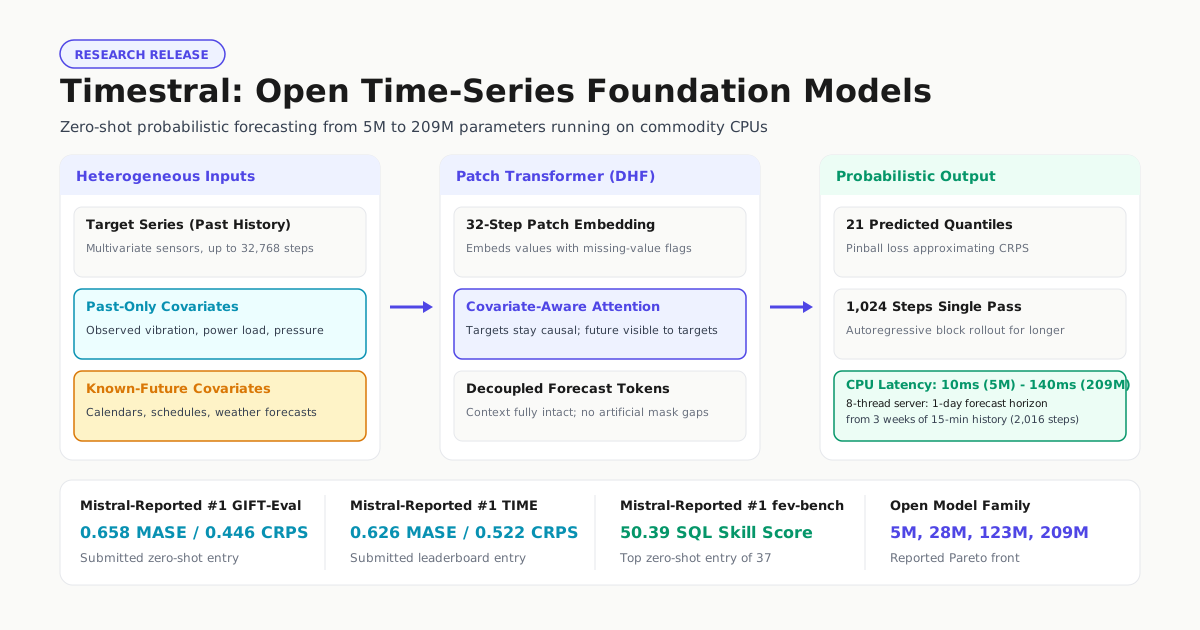
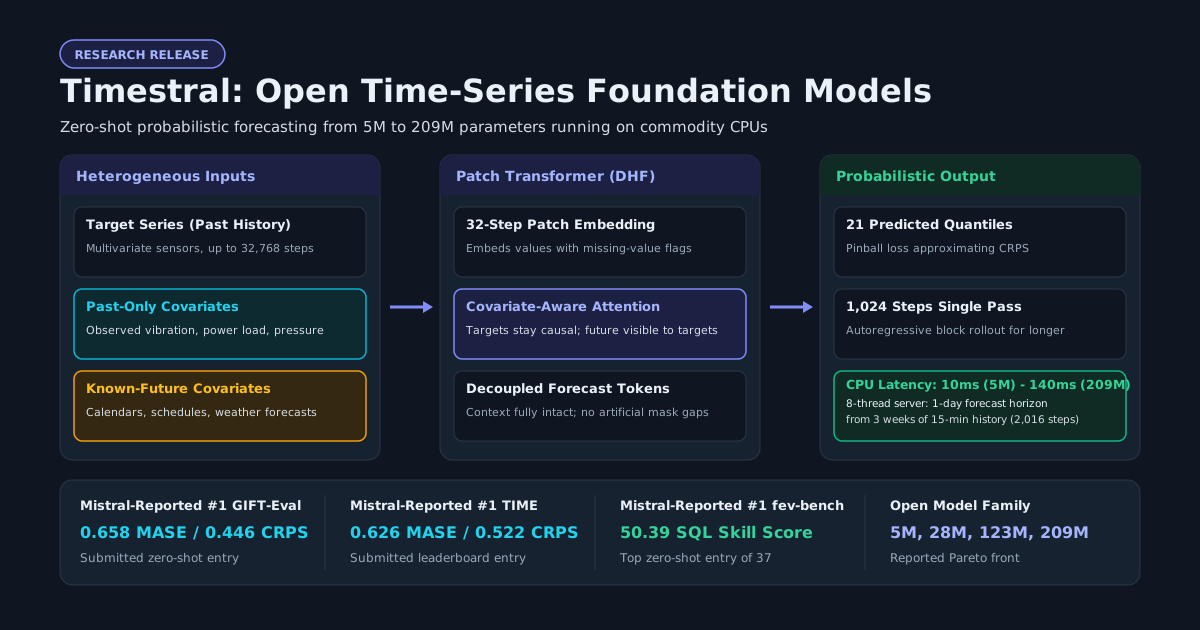
Mistral AI has entered the time-series domain with the release of Timestral, an open-weight family of time-series foundation models (TSFMs) engineered for zero-shot probabilistic forecasting. Announced on October 15, 2026, in a research announcement listed on the official Mistral news blog, Timestral marks a notable expansion beyond large language models like Mistral Large 4. The four configurations have 5M, 28M, 123M, and 209M parameters.
Published under a Modified MIT license with open weights on Hugging Face and code on GitHub, Timestral’s pre-trained approach offers a practical path toward consolidating what might otherwise require fragmented, dataset-specific models. According to the official Mistral research announcement, Mistral reports that its flagship 209M checkpoint ranks first across three primary public forecasting benchmarks: GIFT-Eval, TIME, and fev-bench. Mistral claims this checkpoint outperforms the previous state of the art with only two-thirds of the parameters, surpassing larger architectures including Toto-2.0-2.5B (2.5B parameters). Timestral executes on standard server CPUs without GPU acceleration, enabling lightweight deployments across telemetry and monitoring pipelines.
Rethinking Time-Series Architectures: Decoupled Horizon Forecasting
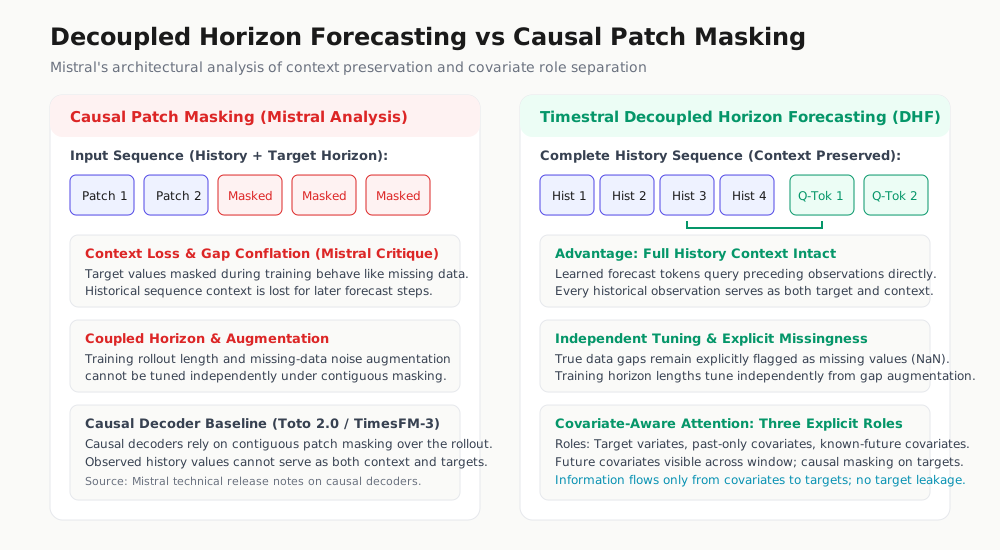
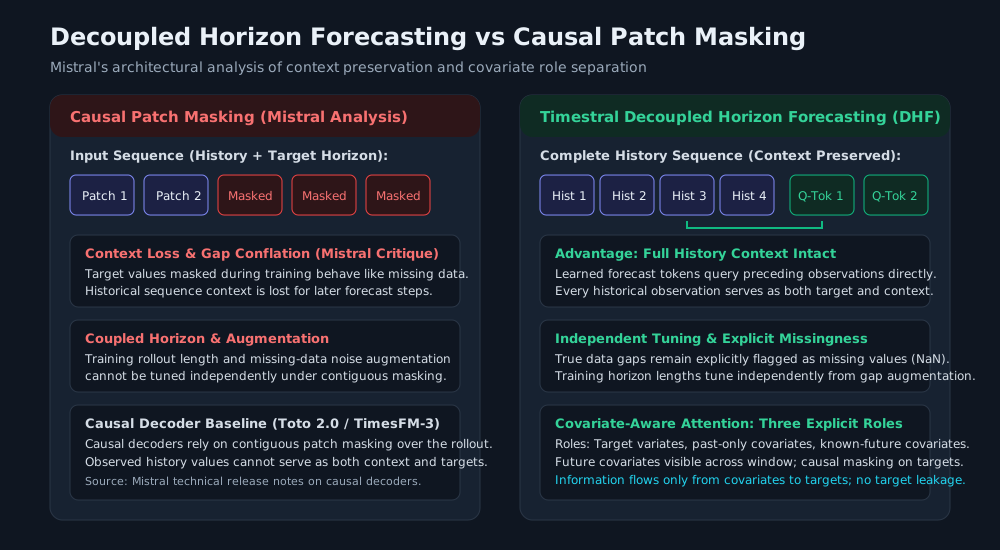
Traditional deep learning approaches such as PatchTST typically train from scratch on individual datasets, limiting cross-domain generalization. While recent time-series foundation models introduced pre-training, Mistral notes that many rely on causal decoders with contiguous patch masking. In Mistral’s technical analysis of frameworks like TimesFM-3 and Toto-2.0, target values slated for prediction are masked out during training, behaving like missing data and depriving subsequent forecasting steps of historical context.
To address this limitation, Timestral introduces Decoupled Horizon Forecasting (DHF). Under DHF, the full observational history remains intact within the sequence while specialized learned forecast tokens query preceding observations. Every historical observation simultaneously functions as both target and context, preserving real data gaps as explicit missing indicators rather than conflating them with prediction masks. According to Mistral, this separates the sequence context from prediction targets, allowing training horizon lengths and missing-data augmentation to be tuned independently.
Timestral’s covariate-aware attention mechanism handles heterogeneous inputs by dividing them into three distinct roles: target variates, past-only covariates (such as machinery vibration), and known-future covariates (such as maintenance schedules, holidays, or weather forecasts). Known-future covariates remain visible across the full window, whereas target series maintain strict causal masking. Attention is restricted so information flows exclusively from covariates to targets, preventing target leakage while conditioning forecasts on external signals whose trajectories are available.
Reported Benchmark Results and Pareto-Front Efficiency
Mistral evaluated Timestral across GIFT-Eval, TIME, and fev-bench, reporting leaderboard submissions to GIFT-Eval and TIME while noting that a comprehensive technical report will follow. According to Mistral, every tier in the family sits on the Pareto front balancing scale against error. Mistral highlights that its 28M parameter variant outperforms Chronos-2 (which Mistral notes is approximately four times larger) on GIFT-Eval and TIME.
| Model | Parameters | GIFT-Eval MASE (↓) | GIFT-Eval CRPS (↓) | TIME MASE (↓) | TIME CRPS (↓) | fev-bench SQL Score (↑) |
|---|---|---|---|---|---|---|
| Timestral-209M | 209M | 0.658 | 0.446 | 0.626 | 0.522 | 50.39 |
| Timestral-123M | 123M | 0.659 | 0.448 | 0.628 | 0.525 | 50.18 |
| Timestral-28M | 28M | 0.678 | 0.461 | 0.638 | 0.534 | 48.42 |
| Timestral-5M | 5M | 0.705 | 0.479 | 0.652 | 0.545 | 46.19 |
| t0-gamma | Unstated | 0.661 | 0.452 | 0.637 | 0.534 | 49.42 |
| TimesFM-3 | Unstated | 0.667 | 0.456 | 0.640 | 0.536 | 48.99 |
| Toto-2.0-2.5B | 2.5B | 0.696 | 0.476 | 0.642 | 0.539 | 44.42 |
| Chronos-2 | Unstated (Mistral: about 4× 28M) | 0.698 | 0.485 | 0.662 | 0.556 | 47.28 |
Across specific metrics, the 123M checkpoint tracks closely behind the 209M model, achieving 0.659 versus 0.658 MASE on GIFT-Eval and 50.18 versus 50.39 SQL skill score on fev-bench. Mistral reports that the 123M model comes within 0.2 percent of the 209M score at three-quarters of its latency. When evaluated on an eight-thread server CPU forecasting 24 hours ahead from three weeks of 15-minute history (2,016 steps), Mistral reports inference takes 10 milliseconds with the 5M model and 140 milliseconds with the 209M model. The 28M model runs roughly five times faster than the 209M checkpoint. These vendor measurements need workload-specific testing.
Implementation and Probabilistic Quantile Outputs
Timestral-209M features a 24-layer patch transformer with an embedding dimension of 768. Its 32-step patches accept up to 32,768 historical steps and forecast up to 1,024 steps per pass, with autoregressive rollout for longer horizons. Instead of predicting a single deterministic point estimate, Timestral outputs 21 quantiles (0.01 to 0.99) trained via pinball loss to discretely approximate continuous ranked probability scores (CRPS). This enables downstream systems to establish dynamic prediction intervals and risk-sensitive alerting thresholds. Developers can run inference directly in PyTorch:
import numpy as np
import torch
from timestral import TimestralForecaster

model = TimestralForecaster.from_pretrained(
    "mistralai/Timestral-209M",
    device="cuda" if torch.cuda.is_available() else "cpu"
)

context = np.random.default_rng(42).standard_normal(1000).cumsum()
forecast = model.forecast(context, prediction_length=96)
median_projection = forecast.median
lower_bound, upper_bound = forecast.quantile(0.1), forecast.quantile(0.9)
Potential Integration into Autonomous Agent Fleets and Enterprise Operations
Mistral proposes integrating numerical telemetry into multi-modal agentic workflows. In an illustrative industrial scenario described by Mistral, Timestral could continuously monitor sensor streams. When an anomaly exceeds preconfigured quantile prediction thresholds, an autonomous coordinator could retrieve historical failure signatures, spawn diagnostic sub-agents to inspect maintenance records, and synthesize recommended remediations for engineering review. Rather than an established turnkey suite, this represents a proposed architectural pattern bridging telemetry with agentic reasoning.
For organizations managing proprietary sensor formats or strict compliance boundaries, Mistral offers domain adaptation through Mistral Forge. Enterprise teams can fine-tune Timestral on internal datasets, incorporate custom categorical covariates, or deploy models across on-premises, VPC, or air-gapped environments.