
MIT Gives AI a 'Crystal Clear' View of the Materials World
MIT paired 3D crystal structures with synthetic narratives so language models can reason about material properties they previously could not see.
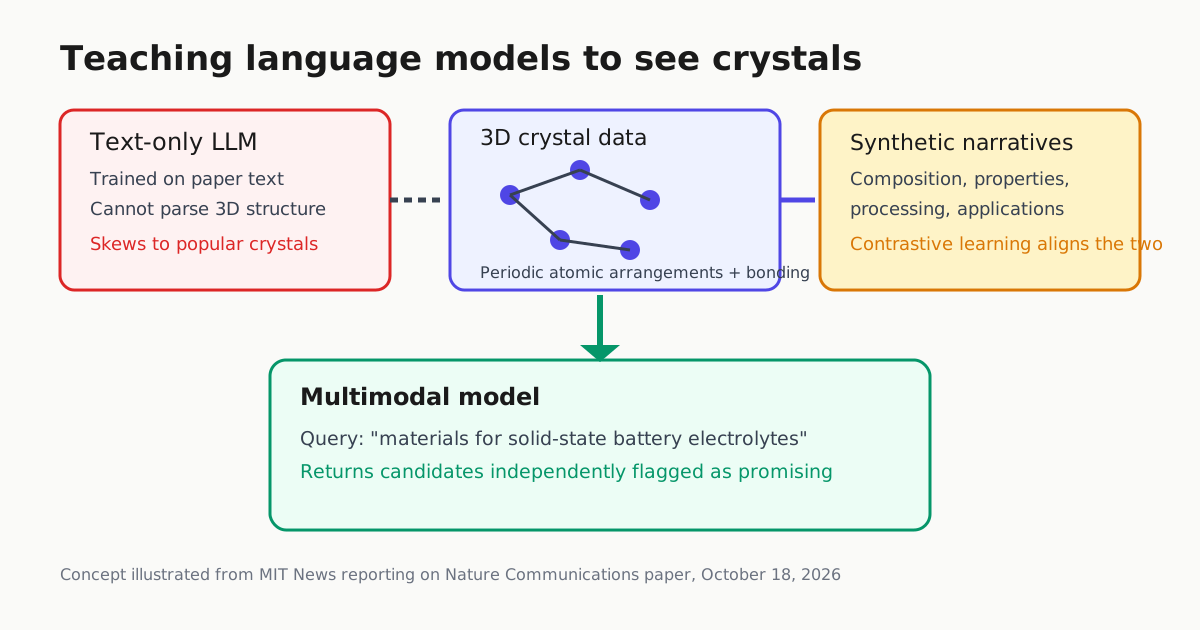
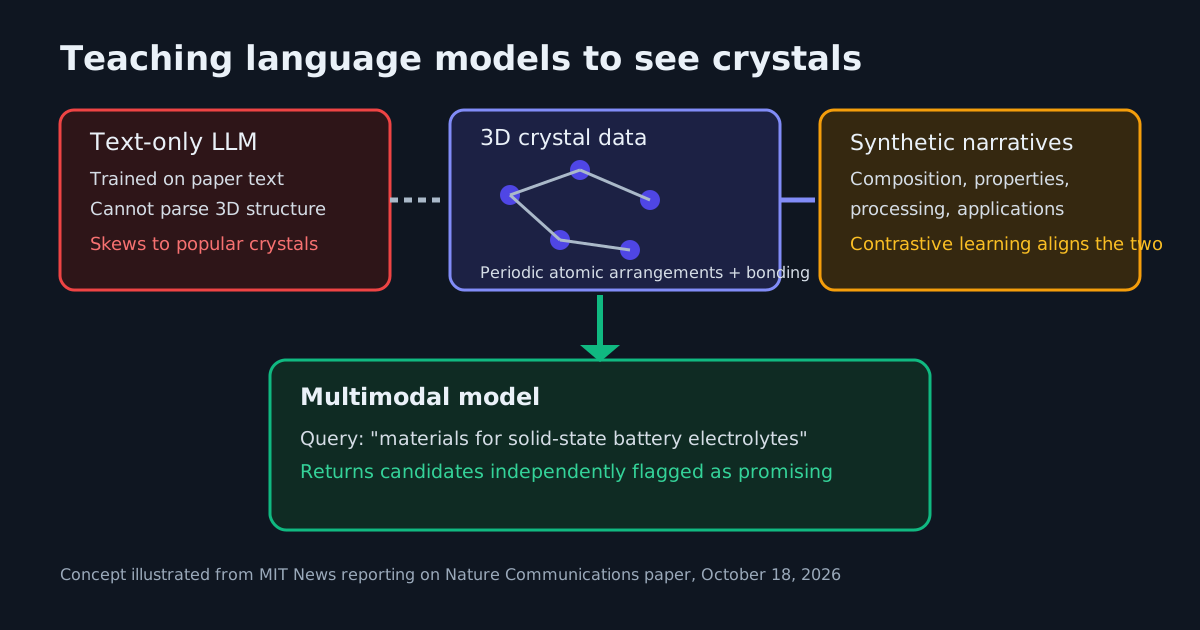
Materials discovery is one of the highest-value applied-AI domains, and one of the most stubborn. On October 18, MIT News reported on new research that attacks a deceptively simple blocker: large language models cannot read crystals. The structures live in specialized 3D periodic formats, not the text streams LLMs are trained on — so the model that drafts your code has, in a literal sense, never seen the atomic arrangement of the battery material it might be asked to help design.
The MIT team — Ju Li, Yang Jeong Park, Mayank Kumaran, Chia-Wei Hsu and Elsa Olivetti — built a multimodal vision-language model that unifies 3D atomic structures with natural language, and published the work in Nature Communications under the title “Scaling multimodal materials representation learning with synthetic narratives.”
The data problem, precisely
Two failures compound each other, per MIT’s account. First, a format mismatch: most solid materials are crystals — more than 90 percent of solids on Earth, by MIT’s figure — whose structures are stored in computational databases as 3D periodic data, invisible to text-trained models that also lack any sense of visual geometry. Second, a coverage bias: the experimental literature overrepresents a few popular crystal classes, so models trained on paper text skew toward those same materials and recycle the field’s existing preferences instead of escaping them.
The fix is a representation fix, not a bigger-model fix. The researchers trained a language model to produce textual descriptions of crystal structures using contrastive learning — comparing similar and dissimilar pairs of structures and descriptions until the model aligns geometry with language, which MIT likens to aligning the visual and language regions of the brain. Crucially, the descriptions are synthesized from experimental papers and first-principles computational databases, and they cover composition, structure, properties, processing considerations and potential applications in one unified narrative — deliberately broader than the published-paper text a text-only model sees.
That synthesis step is what addresses the bias problem: as Li puts it, the team “decided to synthesize narratives rather than rely solely on existing papers,” and found models trained on the narrative dataset “are better at predicting the function.”
What the evidence shows
The reported results are concrete. When the researchers compared two versions of the model — one trained on AI-generated structural descriptions, one on paper text alone — the former learned to align geometric structures with text while the latter did not. Given a natural-language query describing a property, the model identified crystalline materials with that property and outperformed a baseline.
The sharpest example: asked to find materials suited for solid-state lithium-ion battery electrolytes, the model’s top results included materials that had been independently identified as promising candidates. That is a meaningful signal — the model is not generating plausible-sounding crystal names, it is recovering candidates the field arrived at through separate work. The researchers also showed the model learned geometric representations of structures in ways text-only models could not.
Olivetti frames the work as a potential “step change” in algorithmic integration for the field, and Li compares it to AlphaFold’s role in linking protein structure to function — a fair analogy in spirit, though, in this newsroom’s assessment, AlphaFold’s demonstrated predictive accuracy remains far ahead of anything claimed here.
Why it matters beyond the lab
For anyone building AI systems that touch physical domains, the pattern is the interesting part. The bottleneck was never model capacity — it was that the ground truth existed in a modality and format the model could not consume. Rather than waiting for the literature to be rewritten, the team generated the missing bridge: synthetic narratives that describe what databases already knew, at scale, in the format LLMs actually ingest. The same playbook — synthesize training descriptions over structured non-text data, align them with contrastive learning — is portable to other domains where valuable knowledge sits in databases, CAD geometries, sensor time series or simulation outputs rather than prose. It is a close cousin of the context-engineering lesson that keeps resurfacing in agent work: what the model can retrieve and ingest shapes what it can do, a point covered in how AI agents actually work.
It also changes how materials teams should evaluate LLM adoption. A generic chat model asked to propose battery materials is extrapolating from biased paper text; a model with structural grounding can check a candidate’s actual geometry and bonding. And the claim-checking discipline matters here as elsewhere: recovering independently verified candidates is exactly the kind of measurable outcome agent evaluations are built to test, rather than trusting plausible-sounding output. MIT’s story is an announcement of peer-reviewed research, not a shipped product — no public tool, API or release date is claimed — so treat the capability as demonstrated in the paper rather than available today. The work was supported by the U.S. Defense Threat Reduction Agency, DARPA and Korea’s National Research Foundation, and the researchers say they hope other materials scientists will use the approach to accelerate their work.
The story leads MIT’s AI topic coverage and the MIT News homepage as of October 18. “Being able to see a three-dimensional crystal and how its atoms are connected is super foundational,” Li says. “I think this will be useful to anyone who practices materials science.”