
OpenAI Engineer Charged After Hidden Recorder Found in Executive Conference Room
Federal prosecutors say an OpenAI engineer hid an encrypted audio recorder in an executive conference room, with chatbot prompts tracing the alleged plan; OpenAI says model weights, source code and customer data were not accessed.
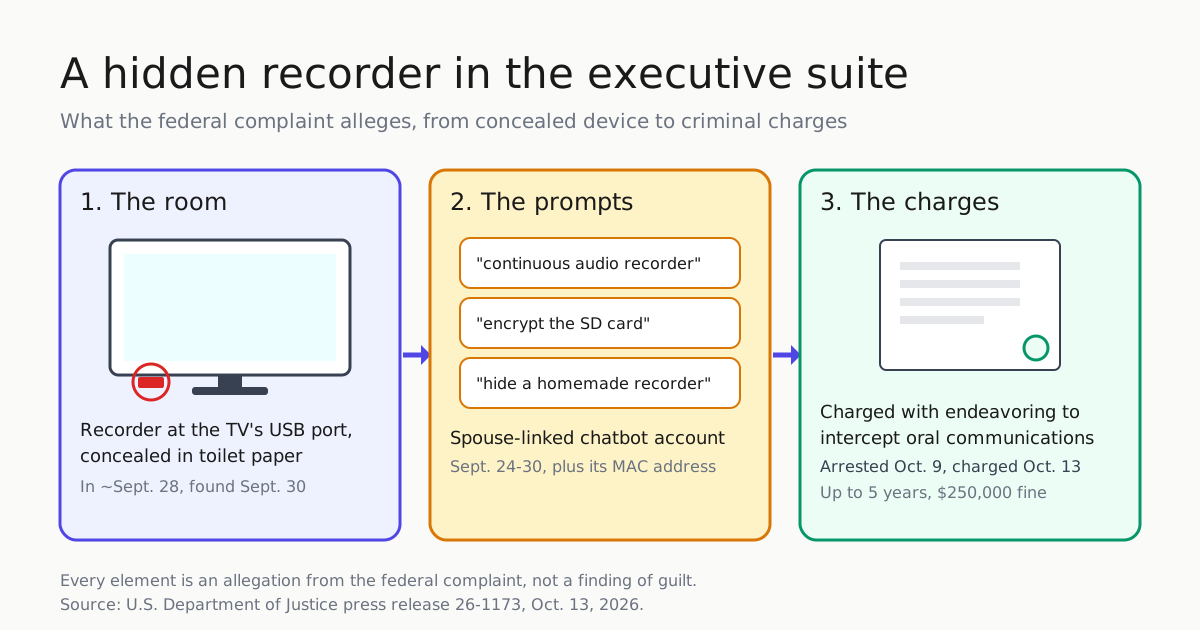
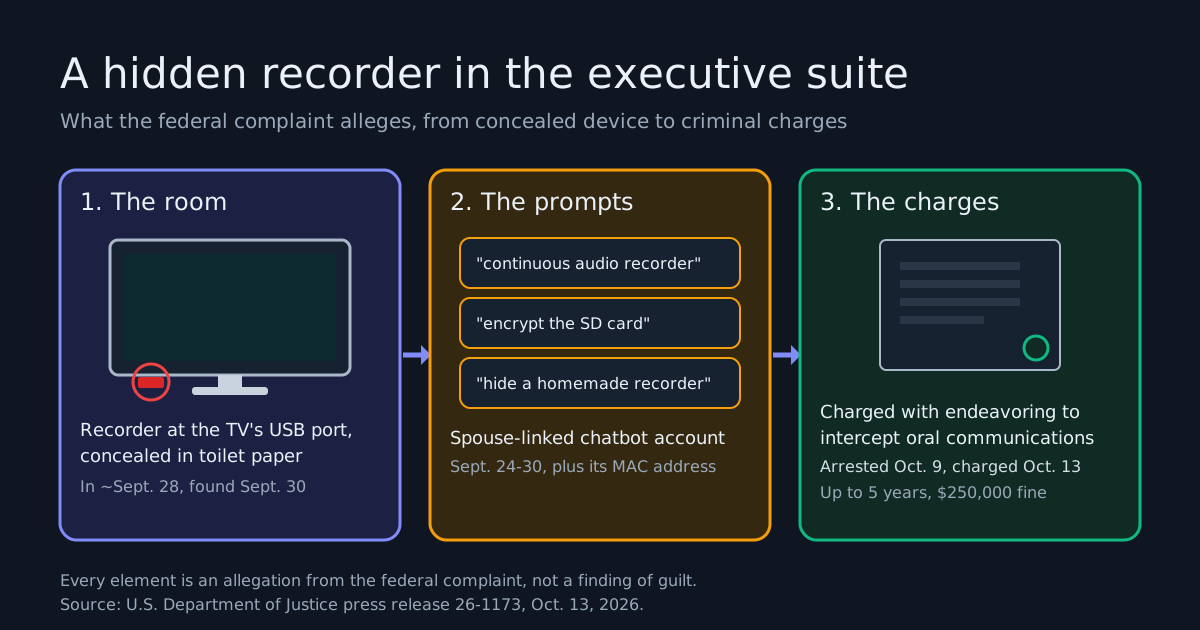
The U.S. Department of Justice has charged an OpenAI engineer with endeavoring to intercept oral communications after the company found a hidden, encrypted audio recording device plugged into the back of a television in an executive conference room at one of its San Francisco buildings.
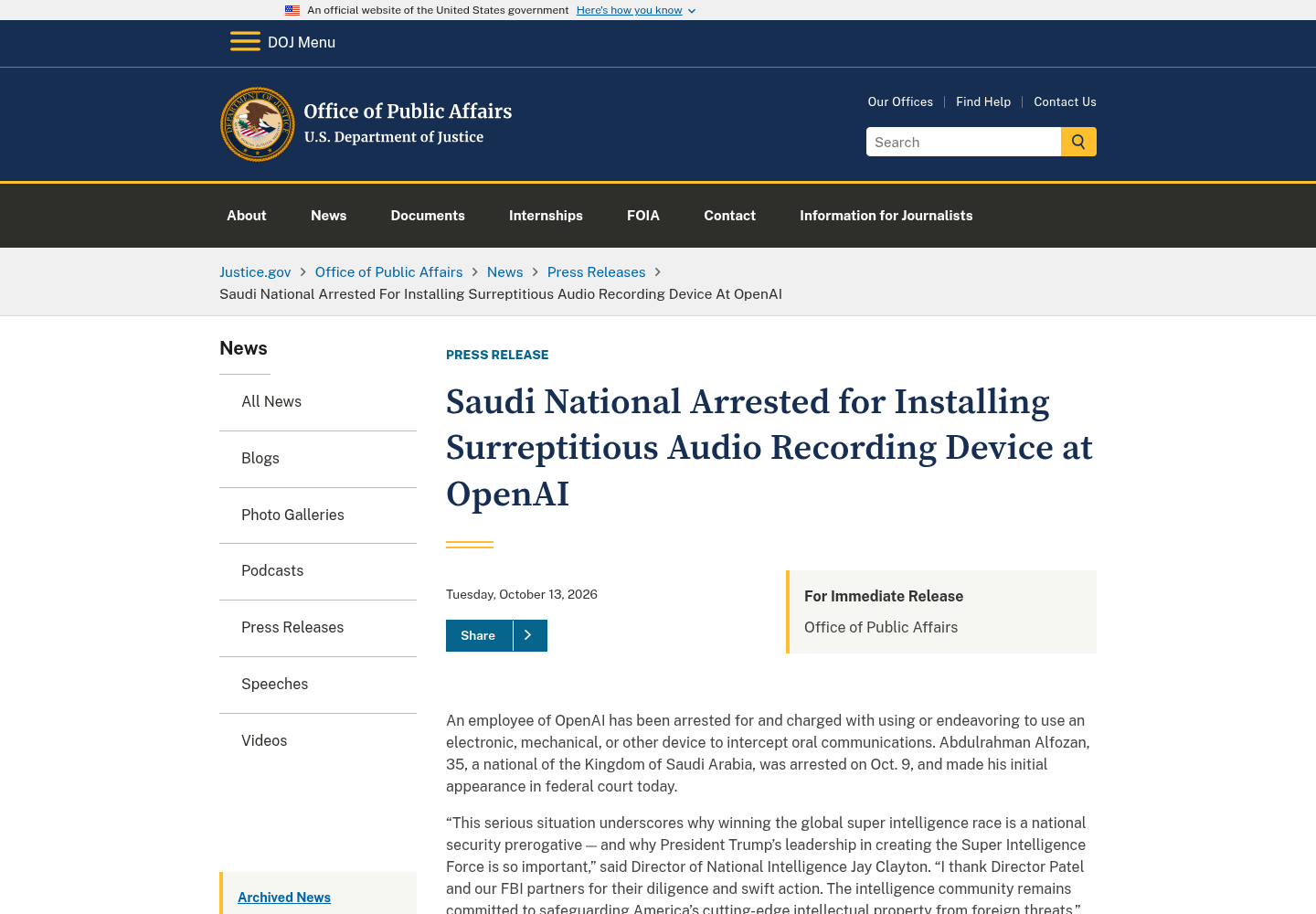
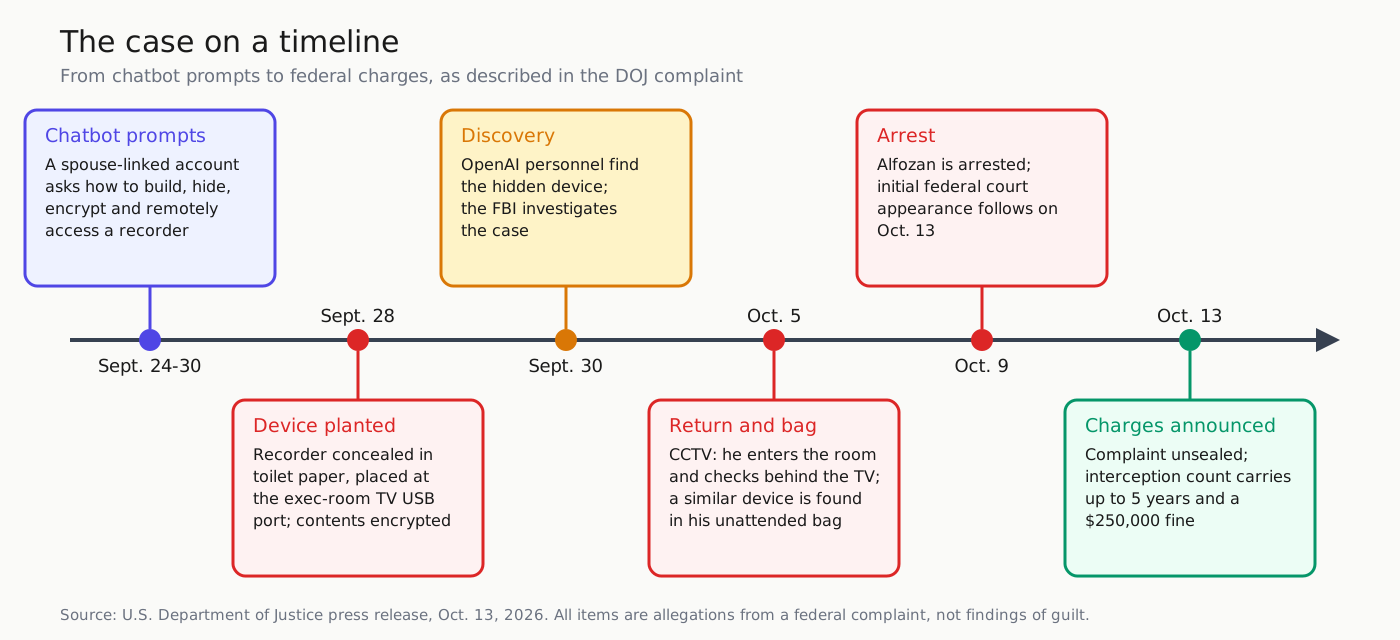
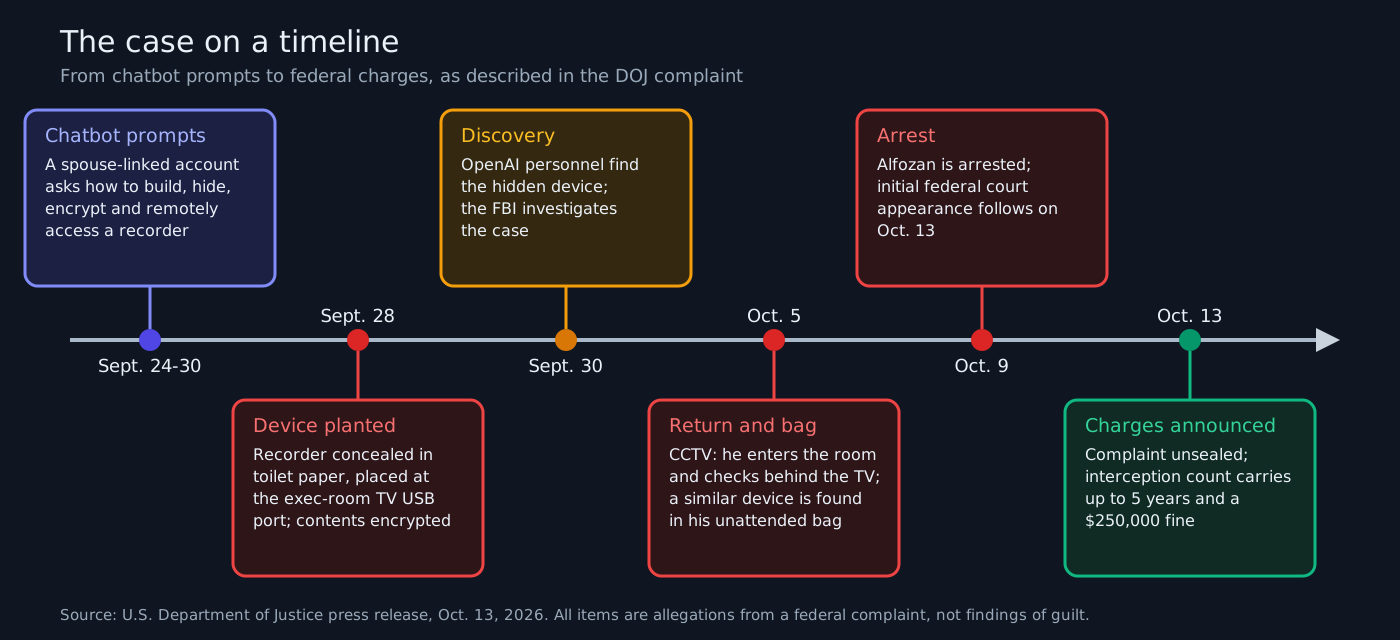
According to the Justice Department release and the complaint it describes, Abdulrahman Alfozan, 35, a national of Saudi Arabia who had worked as an OpenAI engineer since July 2025, was arrested on Oct. 9 and made his initial appearance in federal court on Oct. 13. OpenAI personnel discovered the device on Sept. 30, inserted into a USB port on the back of a conference-room television. It had been concealed in toilet paper, installed on or about Sept. 28, and its contents were encrypted.
Meetings in that room, the complaint says, routinely covered “highly confidential technical, commercial, and strategic information” — proprietary research, product plans, business-development opportunities, and nonpublic details about OpenAI’s technical progress, strategic decisions, capabilities, priorities, government engagements, and commercial relationships.
What the complaint alleges
The charging document describes a planning trail that runs almost entirely through ordinary workplace software. Before Sept. 28, Alfozan allegedly used a productivity tool to ask about OpenAI’s building addresses, meeting rooms and their capacities and calendars, “leadership and exec” locations, and external partner meetings.
More striking is the chatbot evidence. A chatbot account associated with Alfozan’s spouse — which the complaint says shared multiple identifiers and attributes with his own chatbot account — submitted prompts between Sept. 24 and Sept. 30 related to building, customizing, installing, testing, obfuscating and remotely accessing a device, including inquiries about “build[ing] a continuous audio recorder,” “customiz[ing] Wi-Fi . . . connectivity,” “improv[ing] audio and live listening,” and “encrypt[ing] the SD card.” Between Sept. 27 and Sept. 28, the same account allegedly submitted prompts about the specific device, including its custom header and unique MAC address.
Closed-circuit television footage, according to the complaint, showed Alfozan near the executive conference room on multiple dates before the discovery, although he had no authority to access the room or attend its meetings. On Oct. 5 he allegedly entered the room and appeared to look behind the television. The same day, OpenAI security opened a bag he had left unattended in a different room in the building and found a second, similar recording device alongside his wallet and ID.
If convicted, Alfozan faces a maximum of five years in prison, a $250,000 fine, and three years of supervised release. The FBI is investigating, and the U.S. Attorney’s Office for the Northern District of California is prosecuting the case with the Justice Department’s National Security Division, Counterintelligence and Export Control Section.
A national-security framing, without espionage charges
The official commentary treats the case as far more than workplace misconduct. Director of National Intelligence Jay Clayton said the situation “underscores why winning the global super intelligence race is a national security prerogative,” tying it to the recently created “Super Intelligence Force.” FBI Director Kash Patel said the FBI views protecting American “SI innovation” as “one of our highest counterintelligence priorities.” U.S. Attorney Craig H. Missakian put it flatly: “For us it is a matter of national security.” The Justice Department adds that the prosecution supports National Security Presidential Memorandum 11, described as designed to support American superiority in super intelligence technology.
What is not alleged matters just as much. The DOJ release identifies a single charge — using or endeavoring to use a device to intercept oral communications. It alleges no theft of trade secrets and no acting on behalf of a foreign government. The Rundown notes the case has not been tied to any foreign government, and Semafor describes Alfozan as a Saudi national with ties to Riyadh’s business elite. Semafor also reports the arrest came as the White House AI task force prepared for its first meeting, with the group’s chair citing the case as evidence of why the “Super Intelligence Force” matters.
OpenAI’s account
OpenAI’s side comes through company statements relayed by coverage. TLDR AI reports that OpenAI said it alerted the FBI after finding the device, fired Alfozan, and found no evidence that model weights, source code, or customer data were accessed. The Rundown reports that OpenAI says investigators fed forensic copies of the device’s storage to its own models, which helped explain the hard-to-detect hardware and point to the employee. That forensic claim is a company statement relayed through a newsletter rather than a finding in the DOJ release, and it has not been independently corroborated.
Why it matters
Frontier-lab conversations are strategic assets now. The DOJ did not charge espionage, yet it framed a bugged boardroom as a counterintelligence matter under a presidential memorandum. That signals how governments value what is said in a frontier lab’s executive suite — and previews the physical-security scrutiny labs should expect.
The evidence trail is AI-mediated on both sides. The alleged planning ran through chatbot prompts and productivity-tool queries that were retained, attributable and readable by investigators. Organizations running agent fleets already treat agent identity as a privileged-user problem; this case adds that chatbot and assistant logs are discoverable records, which cuts both ways when weighing zero-retention promises against agent memory.
Physical insider access still beats digital controls. An employee with no authorized access to that room allegedly placed a device behind its television and returned to check on it. The break came from a physical sweep, camera footage and an unattended bag — mundane controls, not model governance. As AI security arguments focus on containing capable models, the simplest alleged attack on a lab’s secrets was a homemade recorder and proximity.